Polymarket runs one of its busiest annual sports events at the US Open, and the pricing shows it. Alcaraz's price did something last week that a fixed sportsbook line never does; it nearly doubled in five days without him winning a single extra title. That's the whole trick of trading a live tournament on Polymarket, and it's why this one's worth understanding before you touch it.
The US Open's two singles-winner contracts have pulled over $30 million combined, and every dollar of that got fought for. Seeds went out early. A favorite withdrew hurt before his first match even started. The bracket that looked settled on day one looked nothing like itself by day five. Match contracts mostly resolve clean and boring. Someone wins, the contract pays out, nothing weird happens. The tournament-winner market is the opposite of boring. It repeats every time someone loses, every time someone gets hurt, every time the crowd decides it was wrong about who's actually going to win this thing.
Here's what that actually means for you, and how to trade it without getting run over by your own optimism.
What's Live Right Now
Carlos Alcaraz is the defending champion, and he's currently the favorite to repeat, priced around 48 cents on Polymarket as of this week. That number was 27 cents on the eve of the tournament. Five days and two clean wins later, with four seeds gone from the draw including Djokovic, it was 43. It's kept climbing since.
Treat this table as a snapshot, not gospel. Prices here move by the hour during tournament week, and the only reliable source is Polymarket's own event page at the moment you're actually placing a trade.
Find US Open Polymarket analytics here→
How Individual Match Markets Work
Every single match at the US Open gets its own Polymarket contract, a straightforward binary bet on which player wins. "US Open ATP: Daniil Medvedev vs Frances Tiafoe" resolves Yes or No depending on who takes the match, full stop, no side markets on sets or games attached to it.
These are the most liquid, most beginner-friendly entry points into trading the tournament. You're not predicting a whole two-week bracket, just one match, and pricing tends to track the betting-market consensus fairly closely for anything involving a seeded player. Where it gets interesting is the mismatches. Aryna Sabalenka opened her tournament against Polina Iatcenko, ranked 165th in the world, and traded at 95.5 cents before the match even started. That's not really a trading opportunity so much as a reminder that not every match contract is worth your attention.
Round number matters here too, more than most guides mention. A first-round match between two unseeded players routinely trades on a few thousand dollars of volume total, while a marquee third-round or quarterfinal matchup between two recognizable names can pull in tens of thousands within the first hour of listing. That gap in liquidity means the same five-dollar order that barely moves the price on a big match can shift a sleepy first-rounder noticeably, worth keeping in mind before you seize a position the same way across every match on the card.
If you're the kind of trader who likes stacking a handful of these match contracts into one combined position rather than picking them off one at a time, Prediction Market Parlays Explained covers how that structure works, and where it genuinely differs from a traditional parlay bet at a sportsbook.
How the Tournament Winner Market Works
This is the bigger, messier contract, and it's the one most people mean when they search polymarket us open winners. Rather than betting on one match, you're buying shares in a specific player to win the entire two-week bracket, priced anywhere from 0 to 99 cents depending on how the market currently rates their chances.
It's a multi-outcome market, which changes the math a little. Every player's price is loosely tethered to everyone else's, since the full field has to sum to something close to 100%. When Jannik Sinner withdrew from the tournament with a knee injury before his opening match, his share of that probability didn't vanish, it redistributed across the remaining contenders, and Alexander Zverev picked up the top seed and a meaningful chunk of that repriced probability almost overnight.
The men's field has been genuinely chaotic this year. Djokovic lost his opener in five sets to Mariano Navone. Arthur Fils, seeded tenth and sitting in Alcaraz's own quarter, lost to Stefanos Tsitsipas. Felix Auger-Aliassime, the third seed, went out to Karen Khachanov on a Thursday morning that reportedly reshuffled a good chunk of the tournament-winner book within the hour. Four seeds were gone in the first week, and Alcaraz's price nearly doubled through it.
The women's side has been steadier on the surface, chaotic underneath it. Sabalenka is chasing a third straight US Open title, and she's still the favorite. But she's reached exactly one semifinal across her past seven tournaments coming in, and her side of the draw includes two-time major champion Barbora Krejcikova as a possible third-round opponent. Coco Gauff sits second, with a title already won on this exact court working in her favor.
If tennis is one piece of a broader sports-trading approach rather than the whole plan, Polymarket Sports Markets 2026: Complete Guide covers how the same underlying mechanics apply across other leagues. And if you've traded individual-athlete markets before on a different sport, Polymarket UFC: Complete Trading Guide is worth comparing against, since fight cards and tennis brackets share more in common structurally than either does with a team sport.
How Resolution Actually Works
Resolution on both match-level and tournament-level contracts is governed strictly by official results, sourced from the ATP, WTA, USTA, and ITF depending on the market. Straightforward wins settle cleanly and fast, usually within minutes of the final point.
The genuinely tricky cases are walkovers, retirements mid-match, and disqualifications, and it's worth understanding these before you're staring at one live. A player who retires due to injury mid-match still produces a clear winner under the official record, so those contracts resolve normally. A pre-match withdrawal, the kind Sinner's knee injury caused, resolves the match contract as a loss for the withdrawing player without a ball being struck. Disqualifications are rarer and messier, and Polymarket's own rules for each specific market spell out exactly which sanctioning body's determination governs the outcome, worth actually reading rather than assuming.
Here's a real example worth sitting with. When Sinner withdrew, his individual match contract against whichever opponent he'd been drawn against resolved instantly and cleanly, no ambiguity there. But the tournament-winner market took longer to fully settle into its new pricing, since traders had to work out not just that Sinner was gone, but which specific remaining player benefited most from the vacated slot in the bracket. That lag, the gap between an event happening and the market fully digesting what it means, is where a fast, well-informed trader actually has room to find value. It closed within about twenty minutes this time. It won't always be that fast.
This is also where prediction markets face their sharpest integrity questions, since a live sports result with real money attached creates exactly the kind of incentive structure that draws bad actors. Polymarket Insider Trading Explained: Real Cases, Risks, and Detection covers how that risk has actually played out on the platform historically, and what Polymarket does to catch it.
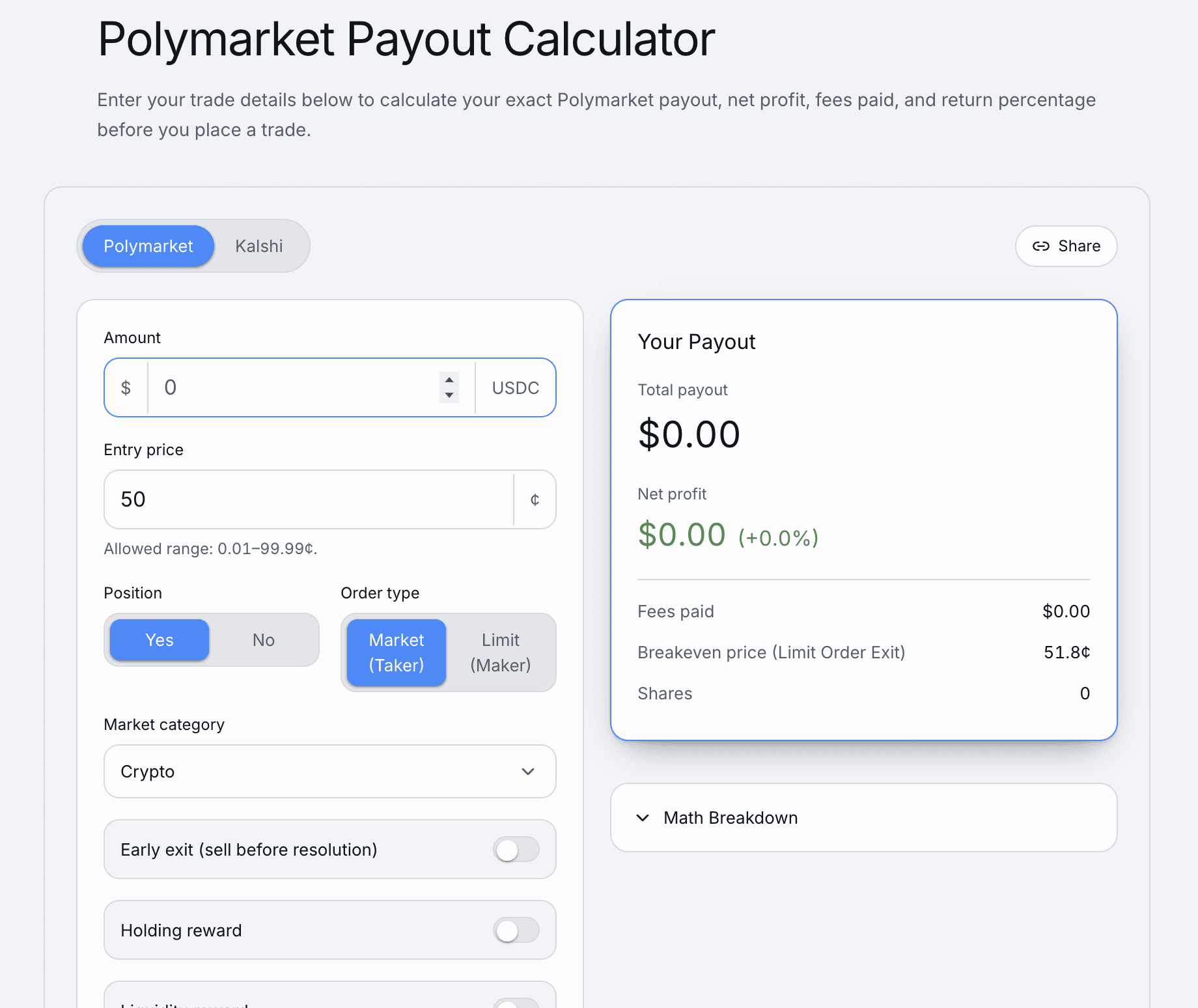
Calculate your Polymarket payout for free →
Reading Momentum During Tournament Week
The single biggest mistake new traders make on a live tournament like this one is treating the tournament-winner market like a set-and-forget position. It isn't. It's a live, continuously repricing instrument that reacts to every set, every retirement, every upset within minutes.
Alcaraz's climb from 27 cents to 48 over the space of a week is the clearest case study available right now. None of that movement came from him actually winning the title, he simply kept winning the matches in front of him while everyone else's bracket fell apart. That's the core skill this format actually rewards: reading who's still standing, not just who was favored on day one.
Liquidity thins out fast the further you get from the two singles-winner markets. A lower-seed early-round match might have a fraction of the volume a marquee matchup pulls, and a modestly sized order in one of those thinner books can move the price against you before it even finishes filling. How to Find Liquid Markets on Polymarket and Why Thin Markets Will Ruin You goes deeper into spotting that problem before it costs you money.
And once you're actually trading the fast-moving stuff, live, during a match that's swinging, the order type you use matters more than usual. Chasing a price with a market order during a volatile stretch routinely fills worse than expected. How to Use Limit Orders on Polymarket Like a Professional Trader covers setting these up properly so a five-cent swing doesn't cost you the whole edge you thought you had.
The Finals This Weekend
Here's the part that actually matters most if you're reading this close to publication: the women's final lands Saturday, September 12, and the men's final follows Sunday, September 13, both on Arthur Ashe Stadium. This is where the tournament-winner contracts finish paying out, one way or the other, and where the last few days of trading tend to compress the most volatility into the shortest window of the entire event.
A polymarket open final contract for either singles bracket effectively becomes a two-player market in its final days, since every other contender has been eliminated by then. That's a fundamentally different trading environment than the wide-open field you're reading odds on right now, tighter spreads, sharper reactions, and considerably less room for a surprise.
If you've traded a single-elimination bracket compress like this before on a different sport, the pattern will feel familiar. World Cup 2026 Live Trading: How to Profit from Knockout Stage Volatility covers the same dynamic in a soccer context, useful background if tennis isn't the only live tournament you're planning to trade this year.
Tools and Account Setup for Trading It Live
If you're setting up specifically to trade finals weekend and haven't funded an account yet, get that sorted well before Saturday rather than during it. How to Set Up Your First Polymarket Wallet Without Losing Your Funds on Fees walks through avoiding the most common first-deposit mistakes, the kind that cost you more in fees than the edge you were trying to capture.
Once you're funded, it's worth knowing what the more experienced traders on this exact bracket are actually doing. Top Polymarket Traders 2026: Leaderboard & Copy Trading covers how to check who's currently well-positioned and why, and if you're more interested in following specific large positions than a full leaderboard, How to Copy Polymarket Whale Trades Without Buying Into the Top is the narrower, more targeted version of that same idea.
Bottom Line
Trading the US Open on Polymarket rewards the same discipline any live sports market does: read the actual bracket, not just the seeding, respect how thin the undercard matches really are, and remember that a tournament-winner price is a snapshot of a field that's still shrinking by the day. Whether that structure appeals more to you than a fixed sportsbook line is worth thinking through on its own, and Prediction Markets vs Sports Betting lays out the mechanical differences plainly. If arbitrage between platforms is more your speed than picking a champion outright, Manual vs. Automated Arbitrage on Polymarket covers that entirely separate approach.
Two finals left. Watch the draw, not just the price.
Frequently Asked Questions
What are the current Polymarket odds for the US Open winner?
As of this week, Carlos Alcaraz leads the men's field at roughly 48 cents, with Alexander Zverev the clear second contender near 24 cents. Aryna Sabalenka leads the women's field around 25 cents, with Coco Gauff next at roughly 18 cents. Polymarket us open odds shift constantly during tournament week, so check the live event page directly before trading.
Can you trade the US Open final on Polymarket?
Yes. The tournament-winner contracts remain open through both finals, women's on Saturday and men's on Sunday, and effectively narrow into a two-player market once the finalists are set. Individual match contracts for the finals themselves are also listed separately.
Is there a separate Polymarket market for the men's and women's US Open?
Yes, polymarket us open men and polymarket us open women run as entirely separate tournament-winner markets, each with its own field of contenders and its own pricing. They don't share liquidity or probability with each other.
When does Polymarket's US Open market resolve?
The tournament-winner markets resolve once the official champion is confirmed by the USTA and ATP or WTA, expected around September 12 for the women's title and September 13 for the men's. Individual match markets resolve immediately after each match concludes.
Does a mid-match retirement affect how a Polymarket contract resolves?
Yes, but only in the sense that the official result still produces a clear winner. A player who retires injured mid-match loses the contract the same way a straight loss would, since the tour's official record shows their opponent advancing regardless of the reason.
How much has traded on the US Open markets so far?
Combined volume across the men's and women's tournament-winner contracts has crossed $30 million, with the men's market alone accounting for roughly $21 million as of early September.