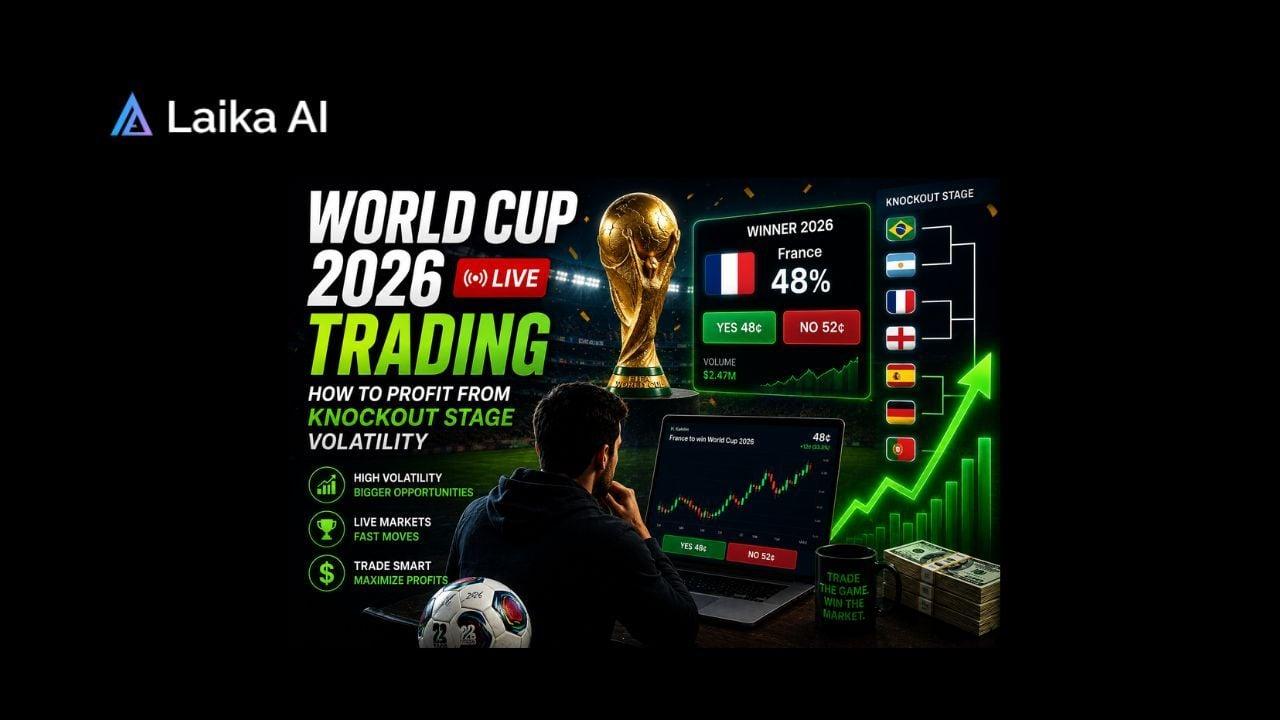
The World Cup knockout stage is the most volatile prediction market environment of the entire calendar year. Every game is eliminated. Every goal reprices the market instantly. Every red card, every missed penalty, every substitution carries information that rational traders can act on faster than the crowd processes it. The world cup 2026 polymarket markets during the knockout rounds are not just bigger versions of group stage markets. They are structurally different trading instruments that reward a completely different set of skills.
In the group stage, you are trading probabilistic outcomes across multiple games with days between each one. In the knockout stage, you are trading binary elimination events where a single moment can move a contract from 70 cents to 15 cents in minutes. The pace is faster, the stakes are higher, the liquidity is deeper, and the mispricing windows are shorter. Traders who apply group stage thinking to knockout games consistently leave money on the table or lose money they should not have lost.
This guide covers how Polymarket prices knockout matches, the live trading tactics that work in this specific environment, and the mistakes that most retail traders make when the pressure and pace of elimination football meet the speed of prediction market repricing. For the foundational framework on trading sports markets across the full platform, the complete guide to trading sports markets on Polymarket covers the structure before you get into knockout-specific tactics.
Why Knockout Stage Markets Are Uniquely Volatile
The group stage creates a forgiving trading environment in one specific way: teams can lose and survive. A team that loses its first group game can still qualify. That cushion means that a single goal in a group game does not necessarily change the fundamental thesis of any position you hold in the tournament winner market. You have time to reassess, adjust, and reposition before the next game.
The knockout stage removes that cushion entirely. Every game is winner-take-all. A goal scored in the 85th minute does not just change the score. It changes the survival probability of two teams simultaneously, and every contract tied to either team across every active market replicates in real time.
This creates three characteristics that define knockout stage trading on Polymarket and make it different from anything else on the platform.
1. Elimination cascades are immediate and total.
When a team is knocked out, every contract tied to that team across the tournament winner market, the conference-equivalent markets, and any remaining game markets resolves to zero simultaneously. The probability that was assigned to that team redistributes across the surviving teams within minutes, and that redistribution follows media narrative rather than statistical quality. The team that advances from an upset receives less redistributed probability than their actual remaining tournament chances justify, because the crowd is still processing the shock of the upset rather than rationally assessing the new bracket.
2. Price movements are non-linear around goals.
A goal scored when a game is 0-0 at the 30-minute mark moves the market differently than the same goal scored when the game is 0-0 at the 80-minute mark. The second goal in a tight game moves the market differently than the first. Extra time approaching changes the probability math in ways that casual traders systematically misprice. These non-linear price dynamics create windows of mispricing that close within minutes but are genuinely exploitable by traders who understand the math.
3. Liquidity is highest at exactly the wrong moments.
The most volume flows into knockout markets in the 48 hours before kickoff and in the immediate aftermath of significant in-game events like goals and red cards. Those are also the moments when prices are most efficient, because the most traders are active simultaneously. The mispricing opportunities are largest in the windows before these liquidity spikes, not during them.
How Polymarket Prices World Cup Knockout Matches
Understanding how prediction market prices behave in knockout games requires understanding both the pre-match pricing model and the in-play repricing mechanics.
Pre-match pricing
Before kickoff, Polymarket's knockout match markets reflect the aggregate of all traders' probability estimates for the 90-minute result, extra time, and penalties as a combined binary outcome. A contract priced at $0.65 for Team A to advance means traders collectively assign a 65% probability to Team A progressing to the next round by any means, including penalty shootout.
This matters for how you evaluate the price. A team that is a strong favorite in open play may be only a moderate favorite to advance if their penalty record is poor. A team with an outstanding goalkeeper and a strong penalty record may be priced higher to advance than their open-play quality alone would suggest. The market is pricing the full path to advancement, not just 90 minutes of football.
Pre-match prices in knockout games also reflect publicly available information that most retail traders have not processed: recent tactical trends, injury news from the previous game, historical head-to-head records in tournament football, and the specific tactical matchup dynamics that create advantages for one style of play over another. Traders who have done this research and disagree with the market price have an opportunity. Traders who simply look at which team is generally considered better have nothing that the market does not already know.
For the framework on how prediction market prices are constructed and what they represent as probability estimates, Polymarket explained: how prediction markets work covers the complete mechanics. For the comparison of how Polymarket and Kalshi price the same knockout markets and where the gaps appear, Kalshi vs Polymarket: which is better for sports covers the cross-platform analysis.
In-play repricing mechanics
When the game kicks off, Polymarket's knockout market prices update continuously as traders respond to in-play events. The pricing is not algorithmic in the way a sportsbook's live betting engine is. It is driven entirely by traders buying and selling contracts on the open order book as events unfold.
This creates a specific repricing pattern around goals. When a goal is scored, the immediate price movement reflects the fastest traders acting on the new information. That first movement is usually an overreaction, because the fastest traders are reacting to the fact of the goal rather than to the full tactical context of when and how it was scored.
In the 60 to 90 seconds after a goal is scored, the price often moves further than the rational probability shift warrants, then partially reverts as calmer analysis enters the market. A goal scored against the run of play in the 75th minute by a team that has been outplayed for 60 minutes moves the market more than it should, because the crowd is pricing the scoreline rather than the underlying game state.
The live Polymarket World Cup 2026 market at polymarket shows the current order book depth and price history for every active knockout contract. Matching that data against live match statistics from fbref.com gives you the information layer required to assess whether any given price movement reflects the underlying game state or a crowd overreaction.
Live Trading Tactics for Knockout Games
Tactic 1: Pre-match position sizing based on the specific tactical matchup
The most reliable edge in knockout stage trading comes not from in-play reactions but from pre-match positioning based on tactical analysis the market has not fully priced. Before any knockout game, assess three specific factors that systematically affect tournament game outcomes differently from regular season or group stage games.
Defensive organization under pressure matters more in knockout games than in open play because teams adopt more conservative tactical structures when elimination is on the line. A team that creates 20 chances in regular football may create eight in a knockout game against organized opposition. Markets that price knockout games based on regular season attacking output are systematically overrating the attacking team.
Set piece quality matters more in knockout games because teams defending narrow leads increasingly rely on defensive compactness that is difficult to break down through open play. Goals from set pieces account for a disproportionate share of knockout stage results compared to group stage results. A team with an elite set piece delivery and aerial threat is worth a small premium above their open play rating that the market often does not fully reflect.
Penalty record matters from the moment the game kicks off. If two teams are closely matched in open play quality and you believe the game is likely to go to penalties, the team with the better historical penalty record and the better goalkeeper in penalty situations should be trading higher than the team without those advantages. Markets often fail to fully weigh penalty-specific factors in pre-match pricing.
Tactic 2: The goal-scored fade
When a goal is scored in a knockout game, the immediate market reaction almost always overshoots the rational probability adjustment. The scoring team's contract price spikes and the conceding team's contract price drops faster than the underlying probability math justifies.
The correct probability adjustment after a goal depends on the time remaining, the number of goals scored, and the underlying game state. A goal in the 30th minute making it 1-0 is significantly less decisive than a goal in the 75th minute making it 1-0. The market treats both similarly in the immediate aftermath because the fastest traders are reacting to the scoreline change rather than the full context.
The fade trade involves selling the scoring team's contract immediately after the goal-spike and buying it back after the partial reversion, or buying the conceding team's contract during the spike in their contract's implied probability of losing and selling after the reversion. This requires fast execution and a good understanding of the rational probability math, but the pattern is consistent enough across knockout games to be worth systematic attention.
Tactic 3: Extra time and penalties pricing
The period when a knockout game approaches 0-0 or a level score with 15 to 20 minutes remaining creates a specific pricing inefficiency. The market begins pricing in extra time and penalties as increasingly likely, but the probability distribution across extra time and penalties is systematically mispriced in most knockout markets because most retail traders do not weight penalty shootout outcomes correctly.
Penalty shootouts are closer to 50-50 than most markets price them when two teams of roughly equal quality meet. The historical base rate of penalty shootout outcomes is much closer to even than the pre-shootout market typically suggests, because the crowd overweights narrative factors like recent penalty-saving form and underweights the fundamental randomness of the shootout format.
A team that is trailing by a goal with 10 minutes remaining in extra time is often underpriced relative to their actual probability of scoring and forcing penalties, because the crowd is anchored on the scoreline rather than the game state. If the trailing team has been creating chances, is fresh from substitutions, and the leading team is visibly fatigued, the true probability of equalization may be significantly higher than the market price implies.
For the complete framework on bankroll management across fast-moving markets, prediction market bankroll management guide covers position sizing for high-volatility binary events specifically.
Common Mistakes in Knockout Stage Trading
Mistake 1: Chasing goals scored
The most common and most costly mistake in knockout stage prediction market trading is entering a position immediately after a goal is scored. At that moment, the contract price reflects the fastest traders' reaction to the new scoreline. The spread has widened. The liquidity at the best prices has been absorbed. And the price is almost certainly further from fair value in the scoring team's favor than it will be five minutes later when the market has processed the full context.
Retail traders who enter a position in the 60 seconds after a goal are consistently buying at the worst available price relative to true probability. The traders who profit from goal-scored repricing are the ones who were already positioned before the goal, not the ones chasing the move after it.
Mistake 2: Ignoring time decay on binary markets
As a knockout game progresses toward its conclusion, the variance of possible outcomes narrows. A team leading 1-0 with 80 minutes played is in a fundamentally different position from a team leading 1-0 with 40 minutes played, even though the scoreline is identical. The probability of the leading team advancing increases non-linearly as time passes, which means that holding a position on the leading team becomes progressively more capital-inefficient as the game approaches its conclusion.
Traders who entered a position on the leading team at halftime at $0.55 and are still holding it at $0.85 with 10 minutes remaining are risking $0.85 to make $0.15 on an outcome that they already assessed as likely. Partial exits that lock in realized profit while maintaining some exposure to the remaining uncertainty are almost always the correct position management decision in this scenario.
Mistake 3: Treating all knockout games as equivalent
A Round of 32 game between two closely matched teams has different volatility characteristics from a semi-final between two tournament heavyweights. Markets in the early knockout rounds are thinner, have wider spreads, and have more retail participation relative to sophisticated traders. Markets in the later knockout rounds are deeper, have tighter spreads, and reflect a higher concentration of informed capital.
Your tactics need to reflect the stage. Early knockout rounds offer more mispricing opportunities but with wider execution costs. Later knockout rounds offer fewer mispricing opportunities but with better execution quality and more reliable price signals from the order book.
For the systematic methodology on finding which knockout markets have genuine price gaps rather than noise, Polymarket arbitrage: how to find price gaps covers the framework.
Frequently Asked Questions
Can you trade World Cup 2026 markets live on Polymarket?
Yes. Polymarket's knockout stage markets update continuously during games as traders buy and sell contracts on the live order book. You can enter and exit positions at any point before the market resolves. There is no sportsbook-style line closing before kickoff. The market remains open and tradeable throughout the game until the final result is confirmed and the market resolves.
How does Polymarket price knockout stage matches?
Knockout match markets on Polymarket are priced by the aggregate of all trader positions on a central order book. There is no house setting the odds. Before the game, prices reflect the collective probability estimate of all active traders across the full path to advancement including extra time and penalties. During the game, prices update as traders react to in-play events including goals, red cards, substitutions, and time remaining.
What is the best strategy for trading World Cup 2026 on Polymarket?
The most consistently profitable approach in knockout stage markets combines pre-match positioning based on tactical analysis the market has not fully priced, with in-play execution that fades immediate goal-scored overreactions rather than chasing them. Position in markets where your analysis gives you a genuine edge before kickoff. Manage those positions actively during the game using time remaining and game state rather than just the scoreline. Exit partially when the probability math inverts the risk-reward of continuing to hold.
Is World Cup trading on Polymarket legal in the US?
Polymarket US launched in December 2025 under CFTC oversight and is available to residents of most US states. Sports markets are accessible on the US platform. Nine states have active restrictions: Arizona, Illinois, Massachusetts, Maryland, Michigan, Montana, New Jersey, Nevada, and Ohio. Users outside those states can access World Cup knockout markets through Polymarket US. Users who want access to the deeper global liquidity on the international platform require USDC on the Polygon blockchain. There is no community specifically on polymarket world cup reddit but the broader Polymarket subreddit and prediction market communities on Reddit cover live tournament trading discussion actively during the knockout stage.
The Bottom Line
Knockout stage trading on world cup 2026 polymarket is the highest-stakes, highest-liquidity, highest-volatility trading environment the platform runs all year. The markets are deep enough to size positions meaningfully. The price movements around goals and eliminations are fast enough to reward preparation and punish reaction. And the elimination cascade dynamics create redistribution opportunities after upsets that the crowd consistently misprices in the immediate aftermath.
The traders who profit consistently from knockout stage polymarket live trading are not the ones with the best football predictions. They are the ones who understand probability math well enough to recognize when the market has overreacted to a goal, underpriced extra time and penalty scenarios, or failed to redistribute probability rationally after an upset elimination.
Prepare your tactical analysis before each game. Build your positions before kickoff. Fade the overreactions rather than chasing them. And manage your exits based on the risk-reward math rather than emotional attachment to the scoreline.
Track how World Cup knockout odds move in real time across every active Polymarket contract with Polymetric by Laika AI. Live market intelligence for traders who want to see the repricing window before the crowd closes it.