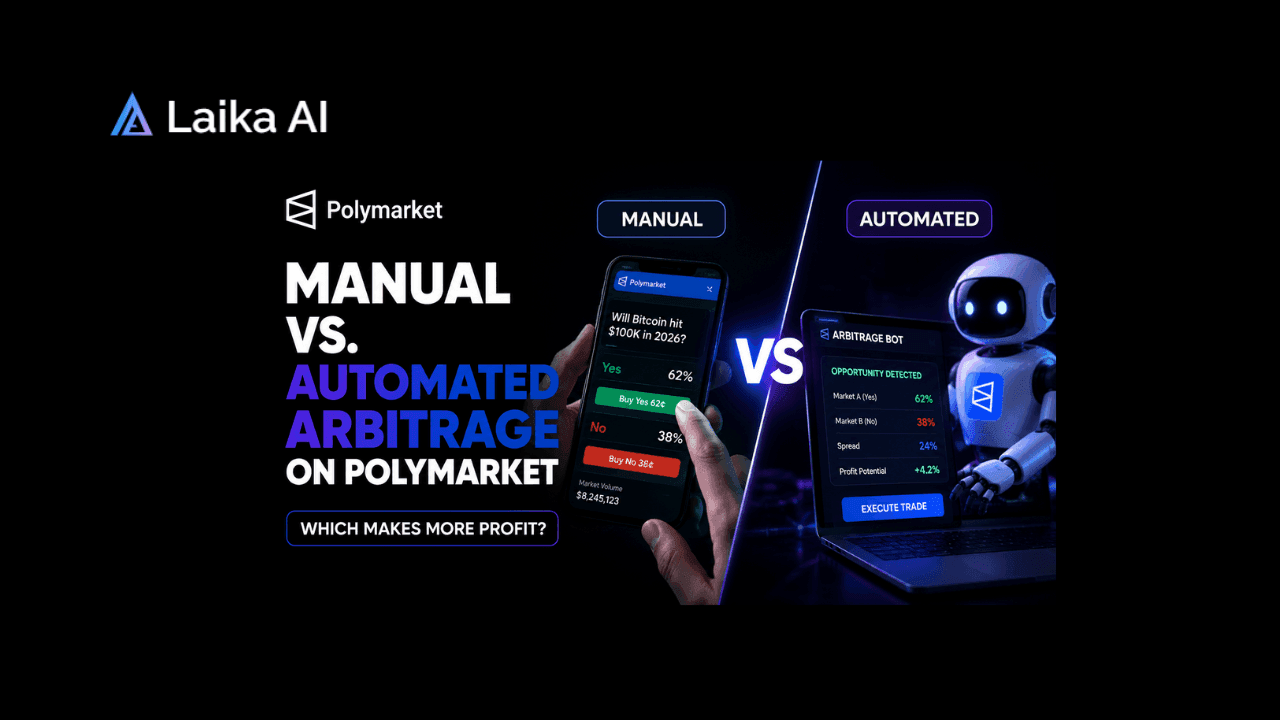
There is a version of Polymarket arbitrage that is genuinely accessible to anyone willing to do the work. And there is a version that requires Python skills, VPS infrastructure, dedicated Polygon RPC nodes, and sub-100 millisecond execution speed.
Most guides blur the line between the two. This one does not.
Understanding which type of arbitrage you are actually attempting before you commit time or capital is the difference between a systematic edge and a recurring loss to execution costs. This article covers both paths honestly, what each requires, which opportunities are still available to manual traders in 2026, and the exact infrastructure automated arbitrage demands.
What Prediction Market Arbitrage Actually Means
Prediction market arbitrage exploits pricing inefficiencies between binary outcome contracts. The core mechanic is simple. If the combined cost of buying both YES and NO on the same event totals less than $1.00, buying both sides locks in a guaranteed profit regardless of what happens. One side always resolves as the winner. The math is mechanical.
A concrete example: a market shows YES at $0.47 and NO at $0.51. The combined cost is $0.98. Buying both sides costs $0.98. One pays $1.00. The guaranteed profit per share pair is $0.02, approximately a 2% return regardless of outcome.
Academic research from IMDEA Networks Institute documented over $40 million in arbitrage profits extracted from Polymarket alone between April 2024 and April 2025, analysing 86 million bets across thousands of markets. Sophisticated traders consistently exploit mispricings that even high-liquidity markets exhibit.
There are three main types of Polymarket arbitrage, each with distinct characteristics and very different execution requirements.
Intra-Market Arbitrage
This is the simplest type. It occurs when YES and NO prices on the same Polymarket contract sum to less than $1.00. In low-liquidity markets, the YES and NO prices do not always reflect true probability, creating gaps. Same-market arbitrage opportunities average returns of 0.5% to 2%, with windows often closing within 200 milliseconds in liquid markets, though thin markets offer longer windows.
Cross-Market Arbitrage
Multiple Polymarket markets sometimes cover the same underlying event. When YES shares in one related market and NO shares in a correlated market create a profitable combined position, that is cross-market arbitrage. The IMDEA research identified over 7,000 markets with measurable combinatorial mispricings.
A classic example: "Trump wins the presidency" and "Republican wins the presidency" are logically related. If Trump wins, Republicans win by definition. When the Trump market trades at 55% and the Republican market trades at 50%, that is a logical inconsistency creating an arbitrage position. These opportunities require more capital and deeper analysis but offer larger spreads.
Cross-Platform Arbitrage
The same event trading at different prices on Polymarket and Kalshi is the largest and most discussed arbitrage category. Because Kalshi is CFTC-regulated and attracts different trader demographics, pricing gaps between the two platforms appear regularly. Buying YES on Polymarket at $0.60 and YES on Kalshi at $0.70 for the same event when their combined NO prices create a gap is a common structure.
Cross-platform arbitrage requires capital deployed on both platforms simultaneously, accounts on both exchanges, and fast execution on both sides. It is also the most competitive category in 2026, with institutional bots targeting 2.5% to 3% minimum spreads to clear fees and gas costs.
The Manual Arbitrage Reality in 2026
Here is the honest picture. Manual identification of intra-market and cross-platform arbitrage opportunities that close in seconds is effectively impossible in 2026 at competitive speed. By the time you calculate spreads across platforms manually, open both markets, check both prices, and attempt to execute both legs, the opportunity is gone. The average arbitrage window on Polymarket is 2.7 seconds. Manual reaction time is measured in seconds, not milliseconds.
That said, manual arbitrage is not completely dead. It is very specifically alive in two situations.
Thin market combinatorial arbitrage. The logically inconsistent markets described above, where related events are priced in ways that violate basic probability rules, often persist for minutes or hours rather than seconds. These require no speed advantage. They require analytical thinking. If you can identify that two politically correlated markets have drifted into a logically inconsistent pricing relationship, you have time to execute both legs manually because the correction takes longer than simple price-gap arbitrage.
Learning and verification. Opening multiple browser tabs and manually comparing prices across platforms is described by tools like ArbBets as the correct starting point for beginners learning how arbitrage works before investing in automated tools. You will not capture most opportunities this way, but you will develop the pattern recognition that makes automated tool interpretation meaningful.
The practical capital requirement for manual edge trading is as low as $500 to $1,000. That covers entry into most market opportunities with returns that are meaningful after fees. Below $500, the absolute dollar returns on 2% arbitrage spreads become negligible relative to time invested.
What Manual Arbitrage Actually Requires
If you are approaching Polymarket arbitrage without automation, here is the realistic toolkit.
Multiple platform accounts. You need funded accounts on Polymarket and Kalshi at minimum. Having capital available on both platforms simultaneously is non-negotiable for cross-platform trades. Capital locked in one platform cannot execute the other leg when the opportunity appears.
A manual scanning process. EventArb.com allows you to enter current prices from Kalshi, Polymarket, Robinhood, and Interactive Brokers to calculate cross-platform arbitrage opportunities. You are doing the scanning manually but the calculation is automated. This is the slowest viable approach for finding opportunities.
Logical relationship mapping. For combinatorial arbitrage, you need a working understanding of which Polymarket markets are logically dependent on others. Building a simple spreadsheet mapping related markets in your specialist categories is the foundation. When prices in logically related markets drift apart, your map tells you before a tool does.
Position sizing discipline. Manual arbitrage requires strict position sizing because failed partial fills, where you execute one leg but not the other, leave you with unintended directional exposure. Never execute one leg of a two-leg arbitrage trade without a reliable plan for executing the second leg immediately. On thin markets, the second leg may not fill at the expected price by the time you reach it.
Automated Arbitrage: What You Actually Need
Automation does not mean complexity by default. It means different complexity from manual trading. The requirements are specific and non-negotiable for the strategy to work at meaningful speed.
The API Foundation
Polymarket provides two primary APIs. The Gamma API handles market discovery and metadata. The CLOB API handles real-time order book data and order execution. Automated arbitrage requires both.
The CLOB API is what allows bots to pull live bid and ask prices, detect gaps, and submit orders programmatically. Polymarket's WebSocket connection provides order book updates with latency under 50 milliseconds, which is the foundation for speed-sensitive strategies.
Kalshi provides its own REST API for cross-platform strategies. A cross-platform arbitrage system monitors both APIs simultaneously, calculates whether any current pricing creates a profitable position after fees, and submits Fill-or-Kill orders, which execute completely at the quoted price or cancel entirely, on both platforms within the window.
The Execution Infrastructure
In 2026, 73% of arbitrage profits are captured by systems executing in under 100 milliseconds. This requires infrastructure beyond a home PC on standard Wi-Fi.
A VPS hosted close to Polymarket's infrastructure, specifically Dublin-based servers for European latency advantage, achieves sub-millisecond connectivity versus the 300 to 500 milliseconds from a standard home connection. This is not a marginal improvement. It is the difference between catching a 2.7-second window and watching it close before your order reaches the exchange.
The hardware specifications that professional automated traders target in 2026 centre around high single-core clock speeds, because the critical path calculations in arbitrage are single-threaded. The Ryzen 9 9950X with single-core speeds up to 5.7 GHz is the most frequently cited hardware target in current Polymarket developer communities.
For strategies running 24/7, VPS hosting also eliminates home power outages, ISP interruptions, and hardware failures as execution risks.
The Code Stack
The reference implementation for Polymarket automated trading is the official Polymarket market maker keeper available on GitHub, which provides the baseline for order book interaction, order submission, and position management. Community projects like polymarket-market-maker-bot and polycop extend this with features including batch order cancellations, gas optimisation, and multi-market simultaneous monitoring.
A functional automated arbitrage system in Python requires the following components:
Price monitoring. A loop that continuously polls both Polymarket and Kalshi APIs for the markets you are targeting, stores the latest bid and ask for YES and NO on each, and calculates the combined cost of both sides across platforms.
Signal generation. When the combined cost drops below your target threshold, typically $0.97 or lower after accounting for fees and gas, the system generates a trade signal.
Order execution. Fill-or-Kill orders submitted simultaneously to both platforms. Threading handles the near-simultaneous execution requirement. The bot must manage the case where one leg fills and the other does not, which creates unwanted directional exposure and must trigger an immediate exit.
Risk controls. Maximum capital per opportunity, daily loss limits, and minimum spread requirements. Polymarket charges approximately 2% on winning positions, which means a profitable arbitrage opportunity needs at least a 2.5% to 3% gross spread to produce net profit after fees and gas.
Dedicated Polygon RPC Nodes
Public Polygon RPC endpoints are shared infrastructure. During high-activity periods, shared nodes produce variable latency that destroys the speed advantage automated arbitrage requires. Professional arbitrage systems use dedicated Polygon RPC nodes from QuickNode, Alchemy, or Infura. These provide consistent sub-10ms transaction submission times that shared public endpoints cannot guarantee.
The Tools Available in 2026
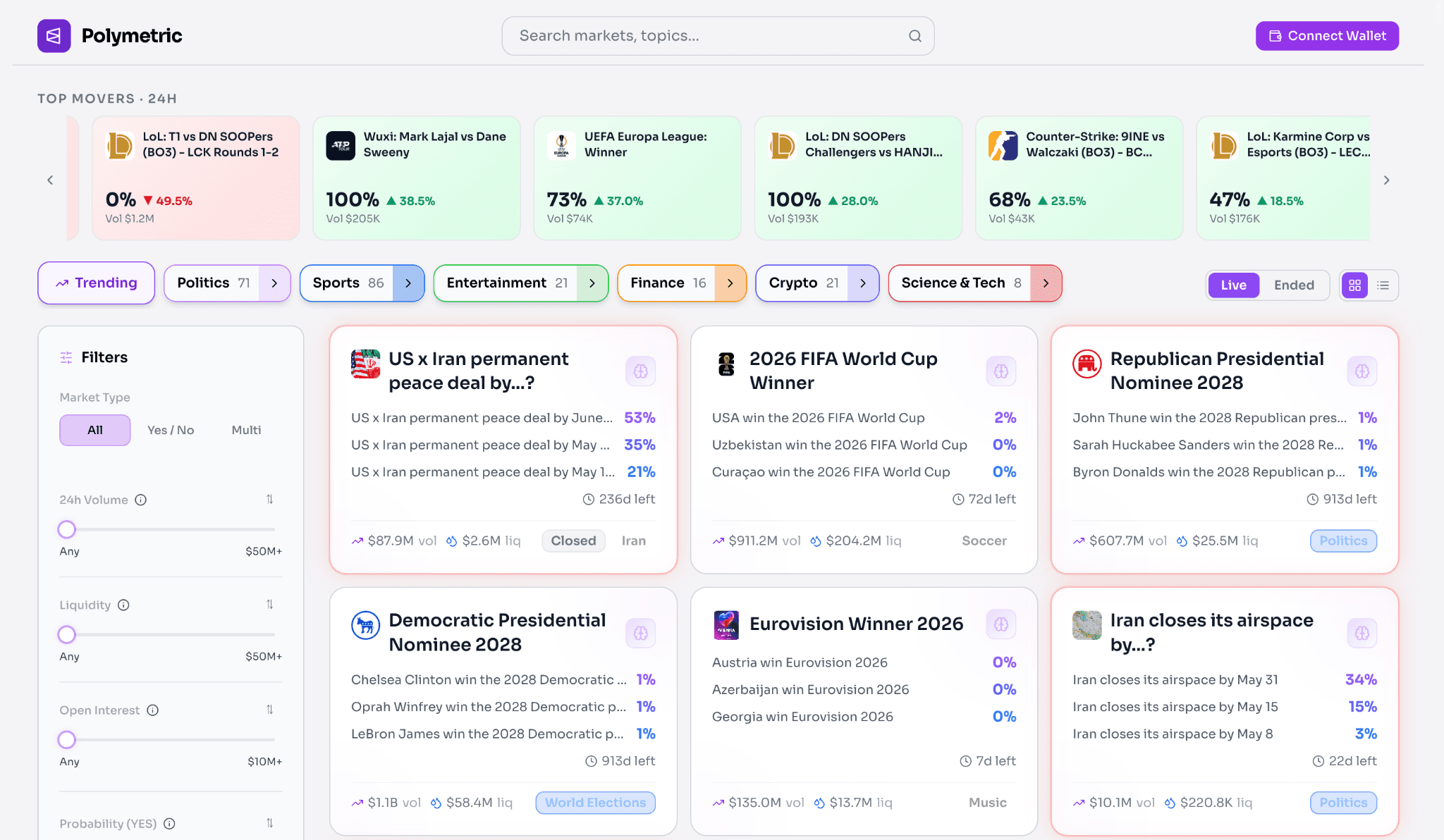
Laika AI at monitors Polymarket on-chain activity and surfaces unusual price movements and smart money entries in real time. For traders pursuing combinatorial and logical relationship arbitrage, Laika's real-time signal layer identifies the markets showing unusual pricing behaviour that warrants investigation before the window closes.
The Fee Structure That Determines Minimum Viable Spreads
Every Polymarket arbitrage calculation needs to account for the full fee stack before a trade is viable.
The Kalshi fee structure is the most significant variable. At up to 3% taker fees on Kalshi trades, any cross-platform opportunity showing less than 3% gross spread is likely a loss after fees. Intra-market opportunities on Polymarket alone face lower fee drag but also narrower gross spreads.
Capital Requirements by Strategy Type
What Most People Get Wrong About Polymarket Arbitrage
The most common misconception is that arbitrage on Polymarket is passive income. It is not. Every type of arbitrage described above has active risks that require ongoing management.
Partial fill risk is the most dangerous. An automated system that executes the Polymarket leg of a two-leg trade and fails to fill the Kalshi leg has just created a directional position it did not intend to take. Managing this requires robust error handling in any automated system and careful manual attention in any manual approach.
Capital lock-up risk matters more than most people calculate. Arbitrage capital is tied up until resolution. In markets resolving in 30 or more days, capital committed to a 2% spread is earning a 2% return over one to two months, not per day. The annualised return on 2% over 60 days is roughly 12%. That is good but not spectacular, and it requires flawless execution to achieve consistently.
Oracle and resolution risk is specific to Polymarket. Polymarket uses the UMA optimistic oracle for dispute resolution. In edge cases where market resolution is disputed, what appeared to be a winning arbitrage position can be frozen or reversed. Automated systems that treat resolution as guaranteed are taking on oracle risk that manual analysis can sometimes identify in advance by reading resolution criteria carefully.
Frequently Asked Questions
Is manual arbitrage still viable on Polymarket in 2026?
For simple intra-market and cross-platform arbitrage where speed determines success, manual execution is essentially unviable in 2026. The average arbitrage window is 2.7 seconds and automated systems executing in under 100 milliseconds capture 73% of profits. Manual traders can still find edge in combinatorial arbitrage, where logically inconsistent market pricing persists for minutes or hours rather than seconds, and where the edge comes from analytical reasoning rather than execution speed.
What is the minimum capital needed to start Polymarket arbitrage?
The practical minimum for manual edge trading and combinatorial arbitrage is $500 to $1,000. This generates meaningful absolute dollar returns on 2% to 3% spreads while leaving enough margin for position sizing across multiple simultaneous markets. Cross-platform automated arbitrage requires at minimum $5,000 to $10,000 deployed across both Polymarket and Kalshi simultaneously, plus infrastructure costs for VPS hosting and dedicated RPC nodes.
What is the minimum spread needed for profitable Polymarket arbitrage after fees?
The gross spread needs to be at least 2.5% to 3% for cross-platform Polymarket and Kalshi arbitrage to be profitable after fees. Kalshi charges up to 3% taker fees. Polymarket charges a 0.10% taker fee plus Polygon gas costs and Uniswap slippage. A trade showing a 2% gross spread on the combined YES and NO prices produces a loss after these costs are applied. Bots are configured to target minimum spreads of 2.5% to 3% to ensure consistent net profitability.
What is Fill-or-Kill order execution and why does it matter for arbitrage?
A Fill-or-Kill order either executes completely at the quoted price or cancels entirely. For arbitrage, this prevents partial fills, where only part of the required position size is filled, from creating unintended directional exposure. If one leg of a two-leg arbitrage trade fills at a partial size, the math of the guaranteed profit breaks down and the trader is left with directional risk they did not intend. Fill-or-Kill orders prevent this by ensuring that either the full position executes at the quoted price or the order does not execute at all.