Let us start with the number that nobody puts in a headline.
Fourteen of the top twenty most profitable wallets on Polymarket's leaderboard are bots. Not traders with an edge. Not researchers with deep domain expertise. Automated systems running 24 hours a day, seven days a week, executing trades in milliseconds while you sleep.
The Polymarket you are trading on in 2026 is not the one that existed two years ago. Weekly volumes have crossed several billion dollars. ICE, the parent company of the New York Stock Exchange, has committed over $1.6 billion to the platform. Professional infrastructure has arrived. And with it, a category of market participant that has no emotions, no sleep schedule, no decision fatigue, and an execution speed measured in fractions of a second.
Understanding what bots actually do on Polymarket, where they dominate, and where they genuinely cannot compete with informed human judgment is not academic. It is the information you need to stop losing to them and start trading in the categories where the competition is actually fair.
The Data Is Worse Than You Think
The 92% figure gets quoted a lot. Ninety-two percent of Polymarket wallets lose money. But the granular breakdown behind that number is more instructive than the headline.
On-chain analysis of over 50,000 Polymarket wallets shows a consistent pattern. The vast majority of retail traders are not just breaking even. They are getting systematically crushed, specifically in the market categories where bots operate with near-complete dominance. Between April 2024 and April 2025, arbitrage traders, primarily automated systems, generated an estimated $40 million in cumulative profits on Polymarket. Bots have demonstrated win rates exceeding 95% to 98% in specific arbitrage setups when properly calibrated.
The comparison between humans and bots running equivalent strategies tells the clearest story. Bots running price lag arbitrage achieve approximately $206,000 in profit with over 85% win rates. Human traders attempting the same strategy capture around $100,000 because they execute more slowly, size positions inconsistently, and exit early due to emotion.
AI agents now represent over 30% of all wallet activity on Polymarket. Of those agent wallets, more than 37% report positive profit and loss. Compare that to human traders, where only 7% to 13% consistently turn a profit. The gap is not subtle. It is structural, measurable, and it is widening every month as autonomous systems get faster, cheaper to deploy, and smarter at market selection. If you trade Polymarket a lot, this just makes life easier, you can actually see what’s moving, who’s active, and where volume is building. Everything in→ one place
What Bots Are Actually Doing
The word bot gets used loosely in prediction market discussions. In reality, there are four distinct types of automated systems operating on Polymarket in 2026, and they behave very differently. Understanding which type you are competing against in any given market changes how you should approach it.
Type 1: Market makers. These are the most common bots on the platform. They continuously post YES and NO orders at slightly different prices, capturing the spread on every fill. They do not have a view on the outcome. They make money on volume, not direction. You can identify them by their massive trade counts, often exceeding 5,000 trades, near-50/50 win rates, and tiny average profit per trade. Paradoxically, these bots are good for human traders. They are the reason you can buy and sell positions in most markets without facing enormous slippage.
Type 2: Arbitrage bots. These bots scan for pricing relationships that have gotten out of sync. When the YES price on one correlated market and the NO price on a related market sum to less than $1.00, buying both sides guarantees profit at resolution. Simple arbitrage opportunities that once lasted 12 seconds on average in 2024 now close in an average of 2.7 seconds. Seventy-three percent of arbitrage profits are captured by bots executing in under 100 milliseconds. If you have read any guide telling you that Polymarket arbitrage is easy money, that guide was written before early 2025.
Type 3: Price lag exploiters. These are the headline bots. The most widely cited example is a bot that converted $313 into $414,000 in a single month by trading 15-minute BTC, ETH, and SOL up/down markets with a 98% win rate. The strategy is not prediction. It is exploiting the small window where Polymarket's contract price lags behind confirmed spot momentum on Binance and Coinbase. The bot identifies a strong directional move on Binance, checks whether the corresponding Polymarket 15-minute contract has repriced yet, and buys the directionally correct outcome before the lag closes. Execution happens in under 100 milliseconds through dedicated Polygon RPC nodes. Polymarket removed the 500-millisecond taker delay in February 2026 without announcement, which killed many slower bots overnight but created new opportunities for faster ones.
Type 4: AI probability models. These are the newest and most sophisticated category. Systems like Polystrat, launched on the Olas protocol in early 2026, use natural language processing to autonomously select markets across sports, politics, and economics. Polystrat executed over 4,200 trades in its first month with single-trade returns as high as 376%. Its agents achieve win rates between 59% and 64% in technology-specific markets. Over 37% of Polystrat agents report positive P&L, roughly two to three times the success rate of human traders on the same platform.
Where Bots Cannot Beat You
Here is the part that rarely gets told honestly. Bots are not dominant everywhere on Polymarket. They are dominant in specific categories with specific structural characteristics. Outside those categories, the advantage shifts back toward humans, sometimes dramatically.
Bots dominate where speed determines the outcome. Ultra-short-duration markets, specifically 5-minute and 15-minute crypto direction contracts, are a near-complete bot domain. The latency required to exploit these markets profitably is under 100 milliseconds. No human reaction time can compete. If you are trading these markets manually, you are handing money to automated systems.
Bots struggle where genuine domain knowledge is required. A political scientist who has spent years studying electoral systems in specific countries holds a genuine informational edge that no current AI model can replicate when it comes to reading the specific nuances of how a parliament behaves under coalition pressure, or how a particular election administration handles contested results. An economist who reads Fed minutes in the context of 15 years of FOMC behaviour holds an analytical edge that a model trained on historical price patterns cannot match. These are the categories where human expertise still produces consistent profits against automated systems.
The Emotion Tax That Kills Human Performance
Even in the categories where humans have a genuine informational edge, most of them give it back through predictable emotional errors.
Traders who hold positions for less than 24 hours underperform the market by an average of 18% compared to those with 7-plus day hold times. Most losses are not from bad predictions. They are from premature exits triggered by fear. You buy YES at $0.42 with a well-reasoned view that the true probability is 62%. The next day a poll drops and the price moves to $0.35. You panic sell. Three days later the price was at $0.58. You were right. Your emotion made you wrong.
Bots do not have this problem. They execute the strategy they were programmed to execute without deviation, without second-guessing, and without the real-time financial anxiety that causes human traders to exit winning positions early and hold losing positions too long.
The most honest framing of the bot versus human debate is this: in the categories where humans still have genuine edge, the primary reason they fail to capture it is not that their analysis is wrong. It is that their execution disciplines break down under the psychological pressure of watching position values move in real time. Bots solve the discipline problem by removing the human from the execution loop entirely.
The practical solution for human traders who understand this is not to become a developer and build a bot. It is to use tools that solve the discipline and monitoring problems without requiring full automation. Knowing when a market is moving, what the signal behind the movement is, and whether that signal validates or invalidates your original thesis before you react emotionally is the core problem.
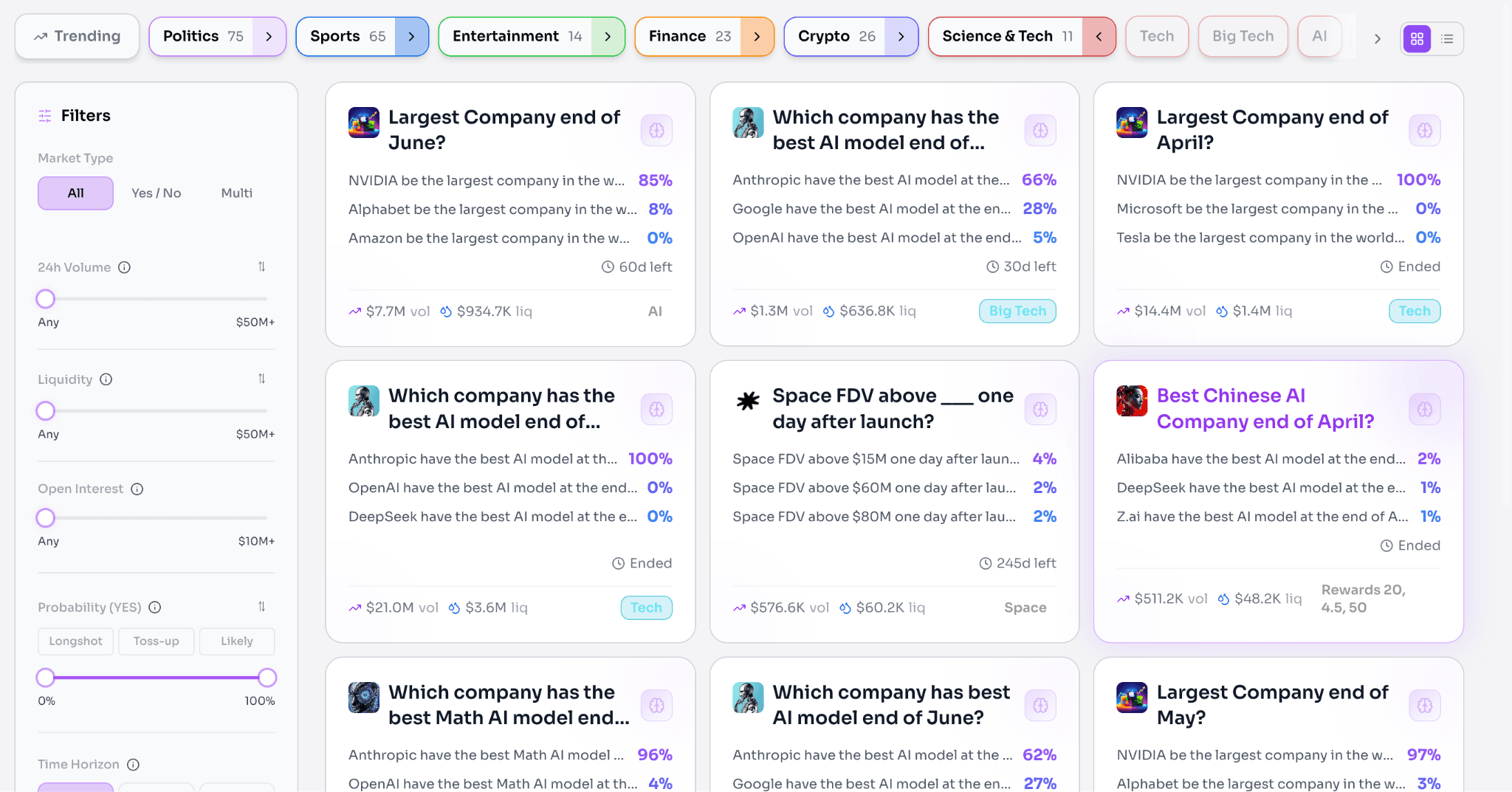
This is exactly what Laika AI addresses. Rather than watching your positions manually and reacting to every price tick, Laika monitors Polymarket's on-chain signals and market movements continuously, surfacing the specific information you need to make a rational decision rather than an emotional one. When a market you hold is moving and you need to know whether it is a real signal or noise, Laika surfaces the on-chain context before you react impulsively. When a new market opens in your specialist category with a potential mispricing before bots have focused attention there, Laika flags it.
The Strategies That Still Work for Humans in 2026
Given everything above, here is the honest practical framework.
Abandon ultra-short-duration crypto markets. The 5-minute and 15-minute direction markets are a bot domain. If you trade them manually, you are providing liquidity to automated systems that will take it from you faster than you can react.
Specialise in one long-duration category with genuine domain knowledge. The traders in the 7.6% who consistently profit are not generalists. They are specialists. Pick one category where your real-world knowledge gives you a probability estimation edge that no model currently trained on historical price data can replicate.
Focus on resolution criteria analysis. Read the Rules section before you look at the price on every single market you consider. The bot-resistant edge available from understanding resolution nuances better than the crowd is one of the most durable and underused advantages on the platform.
Use the new market window. Within the first 12 to 24 hours of a market opening in a low-attention category, automated systems are underrepresented. This is your window to apply domain expertise in a market that has not yet attracted the sophisticated participants who will close the gap later.
Remove emotion from execution. Pre-commit your exit criteria before you enter. Write down the conditions under which you will sell, before the position is live and emotions are engaged. Traders who hold positions for 7-plus days with pre-committed exit criteria consistently outperform those who manage positions reactively.
Laika AI is the tool that makes these strategies executable at the speed the 2026 environment requires, without requiring you to become a developer. It surfaces new market opportunities in your categories, monitors your open positions for the signals that matter, and gives you the real-time on-chain context that separates rational decisions from emotional ones.
Frequently Asked Questions
Are most top Polymarket traders actually bots?
Yes, based on available data. Fourteen of the top twenty most profitable wallets on Polymarket's leaderboard exhibit patterns strongly consistent with automation. AI agents now represent over 30% of all wallet activity on the platform. Identifying bots involves looking for execution speeds measured in seconds rather than minutes, round-the-clock trading with no sleep patterns, mathematically precise position sizing, and trade timing regularity that no human maintains for days or weeks at a time.
Which Polymarket market categories are dominated by bots?
Ultra-short-duration crypto direction markets, specifically 5-minute and 15-minute BTC, ETH, and SOL contracts, are near-complete bot domains. Simple arbitrage opportunities, where YES plus NO prices sum below $1.00, are captured in an average of 2.7 seconds, down from 12.3 seconds in 2024, with 73% of arbitrage profits going to bots executing in under 100 milliseconds. High-volume, high-frequency market categories where execution speed determines the outcome are structurally inaccessible to manual human traders.
Where do human traders still have an edge over bots on Polymarket?
Humans retain genuine competitive advantage in four areas: long-duration fundamental markets requiring real domain expertise, resolution criteria analysis where institutional and legal nuances are not easily modelled, new markets in low-attention categories within the first 24 hours before automated systems have focused there, and complex analytical markets where the informational edge requires genuine subject-matter expertise rather than execution speed.
Why do human traders with correct predictions still lose money?
The emotion tax. Traders who hold positions for under 24 hours underperform those with 7-plus day hold times by an average of 18%. Most losses come from premature exits triggered by seeing adverse price movements rather than from fundamentally incorrect analysis. A trader who buys at $0.42 with a correct thesis of 62% true probability but sells at $0.38 after a temporary price drop has correct analysis and a losing trade. Bots do not make this error because they have no capacity for fear-based decision-making.
Can a regular person compete on Polymarket against bots in 2026?
Yes, but only in specific categories and with realistic expectations. The categories where humans genuinely compete, long-duration political and economic markets, resolution criteria analysis, new low-attention market opportunities, are not speed games. They are knowledge and discipline games. The human traders who consistently profit in 2026 are those who have accepted the bot-dominated categories as inaccessible, built genuine expertise in one or two remaining areas, and removed emotion from their execution through pre-commitment and real-time monitoring tools.
Disclaimer: This article is for educational purposes only and does not constitute financial or investment advice. Prediction market trading involves real financial risk including total loss of capital. Always conduct your own research before placing any trade.