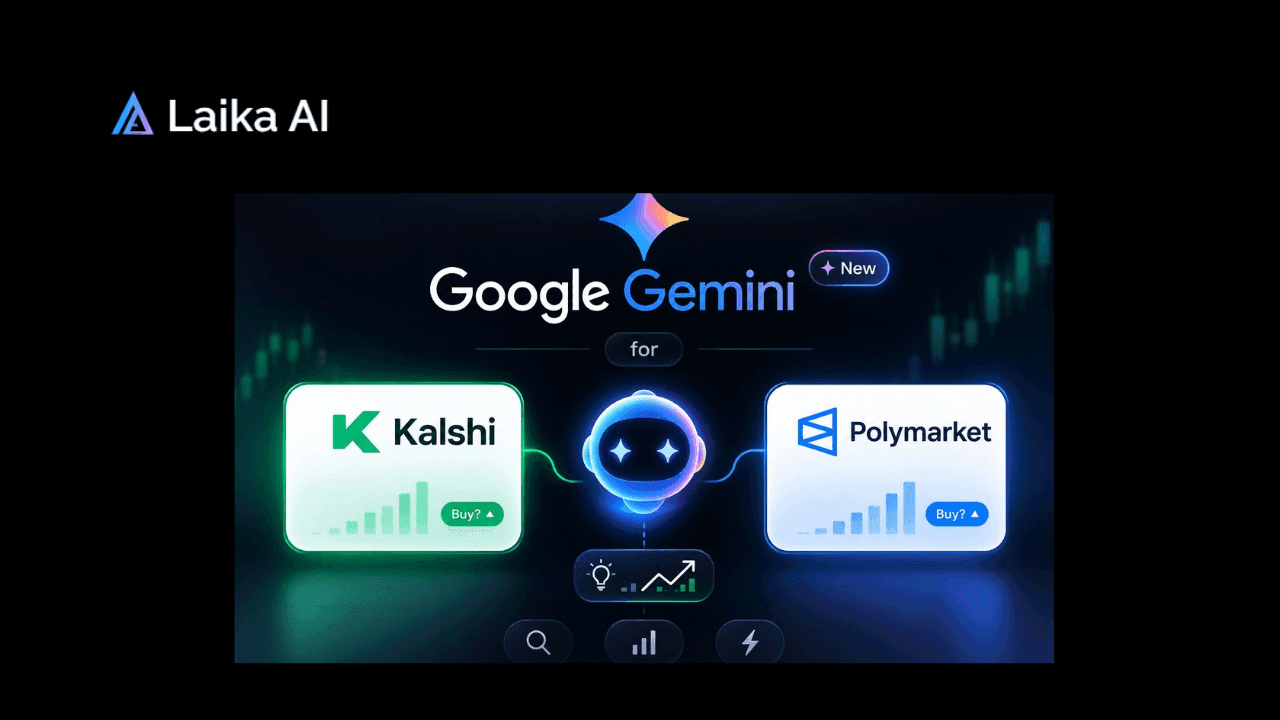
Type "will the US enter a recession" into Google right now and you won't just get news articles anymore. You'll get an actual probability, pulled live from Kalshi and Polymarket, sitting right in the search results. That's google gemini polymarket integration in a nutshell, and it happened quietly enough that plenty of regular Google users still have no idea it's there. A parallel google gemini polymarket and Kalshi pairing shows up in Google Finance too, not just the plain search box.
Before anything else this article is about Google's Gemini, the AI model baked into Search and Finance. It has nothing to do with Gemini, the crypto exchange the Winklevoss twins run, which also happens to sell its own prediction market contracts and unfortunately shares the exact same name. Different company, different product, same word, and it trips people up constantly. If you landed here looking for that other Gemini's trading product, our review of it is over here instead, not to be confused with the Google Gemini feature covered in this guide.
With that out of the way: here's what Google actually shipped, where you'll run into it, and what it can and can't replace.
What Google Gemini Actually Added to Search and Finance
Google announced this on November 6, 2025, folding prediction market data into a bigger overhaul of Google Finance. The company's own blog framed it plainly: Google Finance was getting more AI-powered, more interactive, and now it would let people "ask questions about future market events and harness the wisdom of crowds." That last phrase is doing a lot of work, since it's essentially Google admitting that a crowd of traders putting real money on the line can sometimes beat a headline or a pundit's guess. This whole google finance prediction markets rollout was framed less as a betting feature and more as a data upgrade, sitting right next to stock quotes and earnings summaries.
Ask something like "what will GDP growth be for 2025" and Google surfaces live odds pulled straight from Kalshi and Polymarket, plus a chart showing how that probability has moved over time. No login required, no need to visit either platform directly. It rolled out first to Google Labs users in the US, with India named early on as the next stop for international expansion. Worth noting the timing too. October 2025 had just seen Kalshi and Polymarket post record combined volume north of $7 billion. Google wasn't randomly picking two obscure startups to feature. It was tapping into a category that had already grown too large to ignore.
Where You'll Actually See the Odds
Two places, mainly. Google Search itself, when you type a natural-language question about an economic or political event, and Google Finance, inside the newly rebuilt dashboard that now sits alongside stock quotes and earnings summaries. Neither location requires you to know Kalshi or Polymarket exist beforehand. That's sort of the point of putting google finance prediction markets front and center rather than burying the feature behind a settings toggle.
The data shown is a blend, not a single platform's number. Google pulls probabilities from both Kalshi and Polymarket and displays them together, with historical trend lines so you can see whether a given outcome has been gaining or losing ground. This is a genuinely different animal from a dedicated Kalshi ai tool built specifically for one platform's markets; Google is aggregating across two competing exchanges at once, which no single-platform tool really does. If you're new to what these platforms actually are underneath the Google wrapper, How Does Kalshi Work? A Complete Beginner's Guide covers the mechanics behind one half of that data, and it's worth reading if "prediction market" is still a fuzzy concept to you.
It's also worth saying plainly what this isn't. It's not a trading interface. You can't buy a contract from inside Google Search. You see the number, you see the trend, and if you want to actually act on it, you're heading over to Kalshi or Polymarket directly to do that.
Not the Other Gemini: A Real Disambiguation
This deserves its own section because the confusion is genuinely common, not a hypothetical edge case. Google Gemini is an AI model family, the same one powering Google Search's AI Overviews and a chunk of the new Google Finance experience. It is not a company that trades on prediction markets.
Separately, and totally unrelated in ownership, there's a crypto exchange called Gemini, founded by Cameron and Tyler Winklevoss, which launched its own competing prediction markets product through an affiliate called Gemini Titan. That product got its own CFTC approval, its own trading interface, its own everything. It shares zero infrastructure with Google's AI. Gemini Predictions Review 2026, our full writeup of that other, unrelated Gemini's prediction market business, is the one to read if that's what you were actually searching for when you landed here.
Why does Google even call its AI "Gemini" when there's already a well-known finance company using the name? Honestly, trademark law allows plenty of overlap across unrelated industries, and Google picked the name years before the Winklevoss twins' prediction markets push existed in its current form. It's an accident of timing more than anything deliberate, but it's a genuinely confusing one if you're searching casually. Neither company markets itself as a generic prediction market ai brand, which is part of why the overlap catches people off guard rather than being an obvious rebrand collision.
Where Google Gemini's AI Actually Comes In
Here's the part that's easy to miss. The prediction market odds themselves aren't generated by Google Gemini at all. They're just numbers pulled from Kalshi and Polymarket, the same way a stock ticker pulls a live share price. Google Gemini's actual role sits one layer over, in something Google calls Deep Search.
Deep Search is a Google Gemini-powered feature inside the new Google Finance that generates longer, cited answers to financial questions, weaving together data points, including prediction market probabilities, into something closer to an analyst's summary than a raw number. That's the real google gemini Kalshi and Polymarket connection point in this whole story: not a betting odds calculator, but a research assistant that happens to have prediction market data as one of its inputs. Google's own announcement post on the Finance redesign lays out how Deep Search fits into the bigger picture, worth reading directly if you want the primary source rather than secondhand summaries stacked three articles deep.
How Google Gemini, Grok, and Laika AI’s Chatbot Comparison for Prediction Markets Trading
Grok got there first, but the bigger story is where AI is being embedded. xAI has integrated Grok directly into Kalshi's trading interface, allowing users to ask questions and analyze markets at the exact moment they're making a trading decision.
Google has taken a different path, surfacing prediction market odds and contextual insights through Search and Google Finance, keeping AI adjacent to the trading experience rather than inside it.
Laika AI pushes the concept even further by embedding an interactive AI copilot within its own web app, with copy trading on the roadmap. Put side by side, these approaches reveal that while all three combine AI with prediction markets, they're solving fundamentally different problems and creating very different user experiences.
→ Try Laika Chatbot at https://laikalabs.ai/app/chatbot
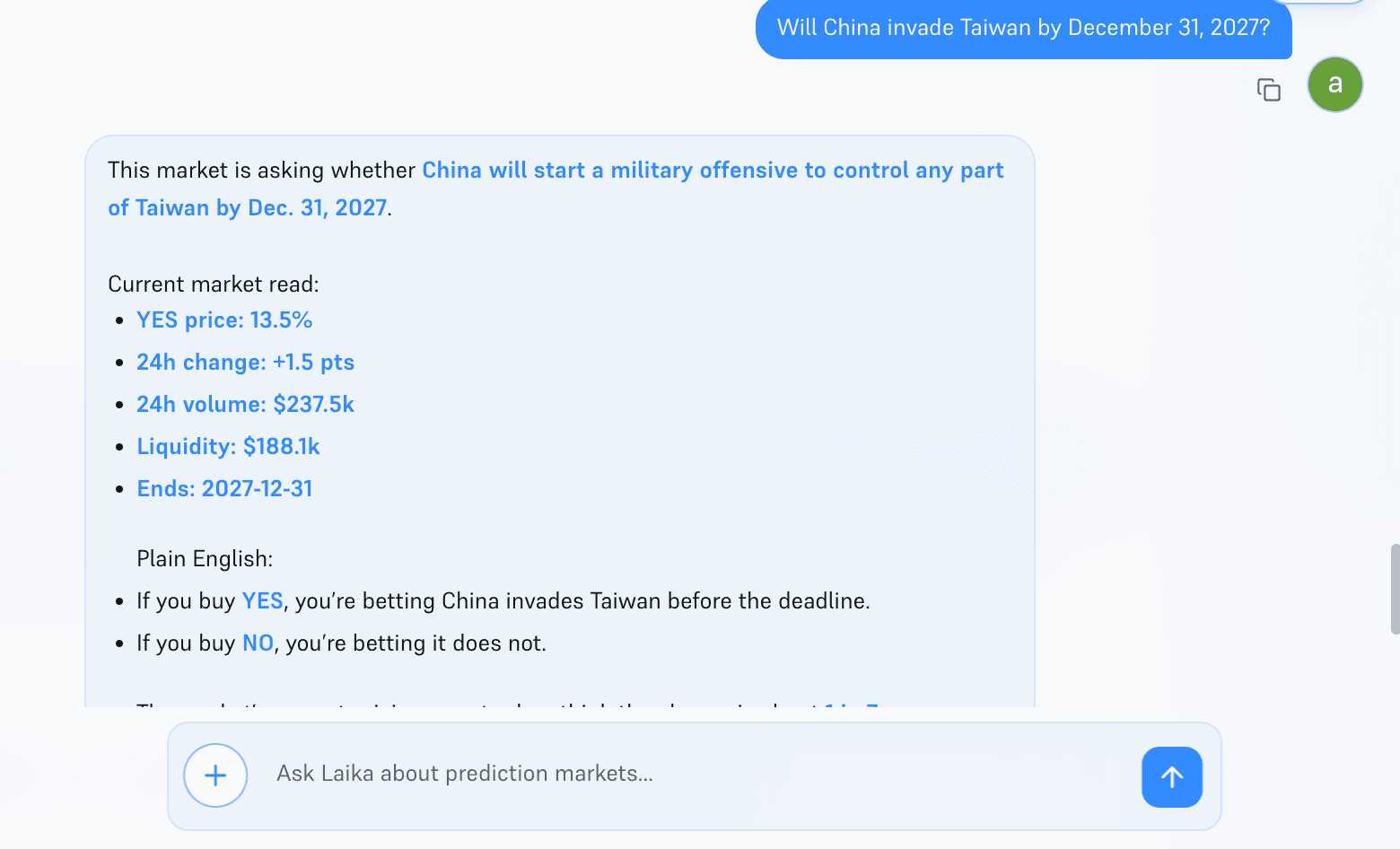
A few concrete prompts worth trying if you're still figuring out how to use Laika AI for trading research specifically
- "Summarize the resolution criteria for this Kalshi or Polymarket contract in plain language, and flag anything ambiguous."
- "List the three most recent news events that could move the probability on this market, with dates."
- "Compare the current implied probability on this contract to what public polling or expert estimates suggest, and explain any gap."
- "Check this contract's price history over the last 48 hours and tell me whether the move looks like a genuine reaction to news or a thin-liquidity spike."
- "Pull the equivalent contract on the other platform, if one exists, and tell me whether the two prices imply an arbitrage gap worth investigating."
Can You Actually Chat With Google Gemini About a Specific Trade?
No, at least not the way Grok lets you on Kalshi. Google's version doesn't offer a conversational interface tied to a single contract. You can ask Deep Search open-ended financial questions and it might reference prediction market data in its answer, but there's no dedicated "ask about this trade" box sitting next to a Kalshi or Polymarket order form the way there is on Kalshi's own site.
That gap matters if you were expecting a copilot. What you're actually getting is closer to a smarter search result: odds plus context, generated once per query, not an ongoing back-and-forth about whether a specific position still makes sense an hour later. For traders who do want that kind of AI back-and-forth about a specific decision, working through Claude manually is a reasonable substitute, and How to Automate Polymarket Trading Using a Claude Bot covers a more technical version of that same idea if you're willing to build something yourself.
International Availability
US-first, as of this writing, rolling out through Google Labs before expanding more broadly. Google named India specifically as an early expansion target, which lines up with how the company tends to test finance features in a couple of markets before going fully global.
Availability outside the US, especially in places where Polymarket or Kalshi themselves face access restrictions, is genuinely worth checking before assuming the odds you see reflect a market you could actually trade on locally. Google surfacing a number doesn't mean the underlying platform is legally available where you're sitting. Polymarket Guide 2026: How does it Work, Legality, and Strategies covers the platform-specific access questions that Google's search feature doesn't answer on its own.
How to Actually Use This Well
Treat the Google odds as a fast reference point, not a research tool on its own. If you're skimming headlines and want a quick sense of where the market stands on a recession question or an election outcome, it's genuinely convenient, faster than opening either platform's app just to check a number.
If you're actually planning to trade based on that number, go deeper. Pull up the market directly on Kalshi or Polymarket, check the liquidity, read the resolution criteria carefully, and don't assume the version Google shows you is perfectly synced to the live price down to the second. Aggregated data has a way of lagging the source it's pulled from, even by a little. For a fuller comparison of how Kalshi and Polymarket differ once you're past the search results and into actual trading decisions, Kalshi vs Polymarket: Which Prediction Market Is Right for You? is the natural next stop.
The Bottom Line
Google folded live Kalshi and Polymarket odds into Search and Finance back in November 2025, and Google Gemini's real contribution is Deep Search, the AI layer generating cited financial summaries around that data, not a standalone prediction market chatbot. It's a discovery feature first, a research aid second, and not a trading tool at all.
Remember the name collision too. Google's Gemini and the Winklevoss twins' Gemini exchange are entirely separate companies that happen to share a name, and mixing them up is an easy mistake to make if you're skimming search results quickly. A quick google gemini polymarket search should land you here, on the AI-and-search version, not the exchange's competing product. Get the basics of prediction markets themselves sorted first if any of this still feels foreign; What Are Prediction Markets and How Do They Work? is the right starting point before layering any AI feature, Google's or otherwise, on top.
FAQ
Does Google use Gemini AI to power its Kalshi and Polymarket odds feature?
Partially. The odds themselves are raw data pulled from Kalshi and Polymarket, not generated by Google Gemini. Google Gemini's actual role is powering Deep Search, the AI layer inside the new Google Finance that produces longer, cited financial answers, sometimes referencing that prediction market data as one input among several.
Is Google's Gemini integration the same as the Gemini exchange's prediction markets?
No, and this is worth stating clearly since the confusion is common. Google Gemini is Google's AI model, unrelated in ownership to Gemini, the crypto exchange founded by the Winklevoss twins, which separately launched its own prediction markets product. The two share a name and nothing else.
Can I chat with Google Gemini directly about a specific Kalshi or Polymarket trade?
No. Unlike Grok's integration on Kalshi, Google Gemini's feature doesn't offer a conversational interface tied to individual contracts. You'll see odds and AI-generated context through Search and Finance, but there's no dedicated chat function for discussing a specific trade the way Grok allows on Kalshi's own platform.
Where do I see Kalshi and Polymarket odds inside Google?
Two places: Google Search results when you ask a natural-language question about a future event, and the redesigned Google Finance dashboard. Both display live probabilities from Kalshi and Polymarket along with historical charts showing how those odds have shifted, as part of the broader google finance prediction markets rollout that began in November 2025.
Is Google's prediction market integration available outside the US?
Not fully yet. The rollout started in the US through Google Labs, with India named as an early expansion market. Broader international availability wasn't confirmed as of this writing, so checking current access in your specific country is worth doing before assuming the feature works the same way everywhere.
How does Google's Gemini integration compare to Grok's on Kalshi?
Google's version is broader but shallower: it covers both Kalshi and Polymarket in one feature, but it's limited to search results and Finance dashboards, with no chat function. Grok's version functions more like a dedicated kalshi ai assistant, built directly into Kalshi's trading interface with an interactive query function available before placing an order.