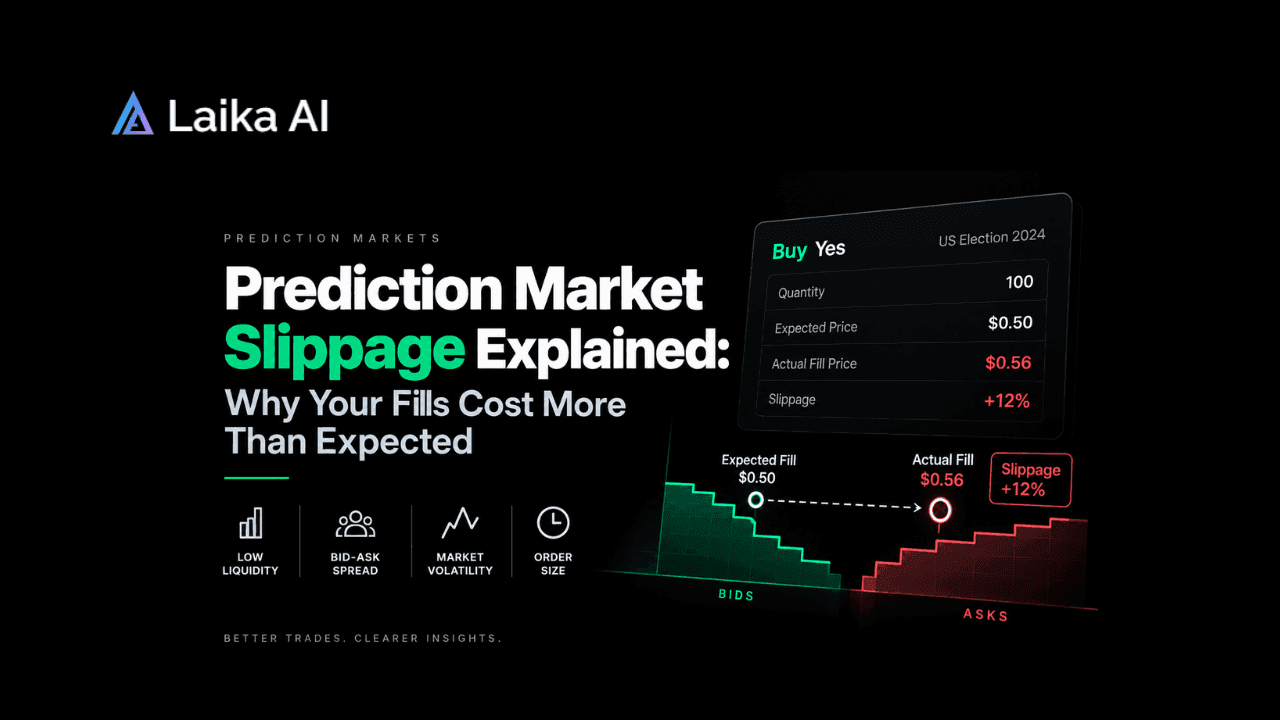
You see 65 cents on the screen. You click buy. The confirmation shows 66.3. That three-figure gap between the quote and the fill is Kalshi slippage, and it isn't a bug, a glitch, or Kalshi quietly taking a cut. It's just what happens when a big order meets a thin order book, and it happens on Polymarket too, and it happened on the New York Stock Exchange decades before either platform existed.
Here's the actual mechanic, in one sentence: you're never trading against a fixed price, you're trading against whatever resting orders happen to be sitting in the book at that exact moment. Everything else in this article is really just working through the implications of that one fact.
Kalshi Slippage Meaning: What's Actually Happening When You Click Buy
Start with the plumbing. Kalshi runs on a central limit order book, the same basic matching structure that powers the NYSE and Nasdaq, just scoped to a single contract instead of one giant shared pool. Every resting limit order for "will X happen" sits stacked by price, best bid on one side, best ask on the other, and a market order (Kalshi calls these quick orders) doesn't get one price. It gets whatever the book has, working outward from the top until your full size is filled.
Say the best ask is 65 cents with 100 contracts sitting there. You want 500. Your order eats through that first level, then the next, then the next; 100 fill at 65, maybe 150 at 66, the rest at 67, and your actual average lands at 66.3 cents even though 65 was the number on your screen a second earlier. That process has a name. Traders call it walking the book, and it's the single most common cause of kalshi slippage meaning exactly what it sounds like: the gap between the price you saw and the price you got.
Depth is the whole variable here. A contract with a one-cent spread and a long queue on both sides barely moves when you trade it, crossing costs next to nothing. A thin contract on some niche market at 3 a.m. can have an 8 or 15-cent spread with almost nothing resting behind it, and that's where a single mid-sized order can visibly move the tape.
Why Polymarket Slippage Works the Same Way, Just On-Chain
Polymarket runs the identical core structure, a central limit order book matching bids and asks by price and time, and don't let the crypto framing fool you into thinking it's some novel mechanism. It isn't. Polymarket's own documentation is explicit that the exchange is hybrid, off-chain matching for speed, on-chain settlement on Polygon for finality, but the order-matching logic underneath is the same walk-the-book process Kalshi runs.
A genuine quirk worth knowing, and it trips people up constantly coming from a traditional platform: Polymarket technically treats every order as a limit order under the hood. What you'd casually call a "market order" is really a Fill-Or-Kill or Fill-And-Kill limit order set to execute immediately at whatever the book allows. Functionally, that's the same experience as a market order anywhere else, same slippage risk, same walking-the-book mechanic, just a different label sitting on top of it.
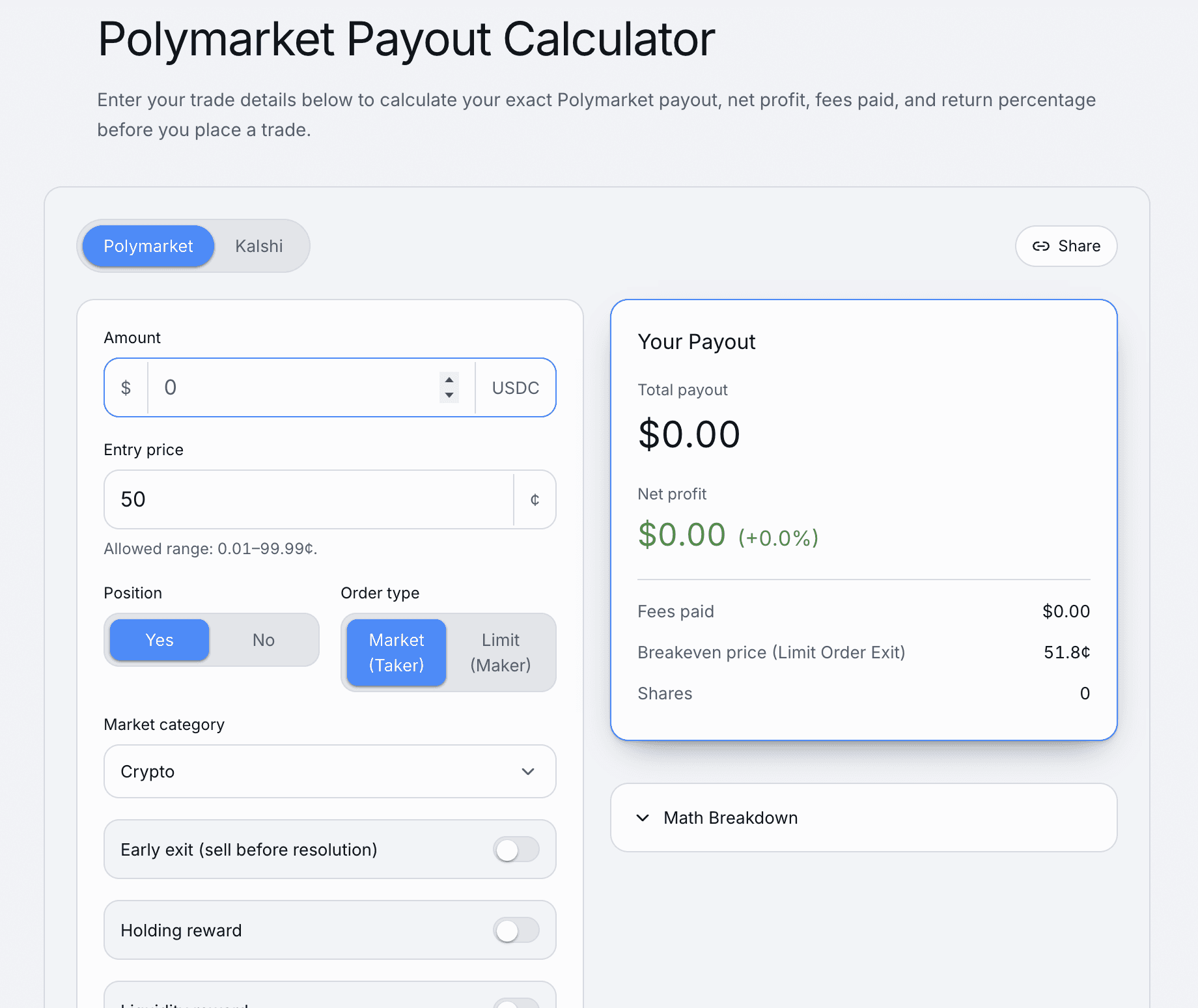
Polymarket slippage shows up hardest on thin, newly listed markets or ones with genuinely low interest, and there's a technical wrinkle worth flagging: tick size varies by market. Most contracts move in one-cent increments, but certain high-volume categories like World Cup markets have been decimalized down to a quarter-cent tick, which changes how granular the book actually is and, by extension, how much a given order size can move the price.Calculate your Polymarket payout for free →
Kalshi Liquidity: Why Some Markets Are Just Thinner Than Others
Liquidity isn't evenly distributed across a platform, not even close. A marquee market, a presidential approval rating, a Fed rate decision, pulls real volume and stays tight. A random Tuesday-afternoon weather contract for a mid-size city might have three people watching it, ever.
Kalshi liquidity concentrates hardest around a small number of high-profile, high-volume markets, and thins out fast the further you move from them. That's not a criticism of the platform, it's just the natural shape of interest across hundreds of simultaneous, isolated markets rather than one shared pool the way a stock exchange works. Every contract on Kalshi is its own separate order book. There's no spillover liquidity from a popular market propping up an obscure one sitting right next to it.
Polymarket runs a Maker Rebates Program that pays daily rebates to traders who post resting liquidity rather than take it, specifically to counteract this exact thinness problem on less-popular markets. Kalshi runs its own version of the same idea, rewarding traders willing to sit on the book rather than cross it. Both exist for the same reason: thin books are bad for everyone trading them, and both platforms have a direct financial incentive to fix that.
Thin books create a side effect worth knowing about too. When the same event is priced differently across Kalshi and Polymarket, or when a single platform's spread briefly gaps wide enough, that mispricing is exactly what manual and automated arbitrage strategies on Polymarket are built to catch. It's a different skill from simply avoiding slippage, closer to profiting from someone else's slippage than avoiding your own, but the two topics share the same root cause.
How to Actually Avoid It
None of this requires anything exotic. The fix is standard order-book discipline, the same discipline that's applied to stocks and crypto for decades, just pointed at YES/NO contracts instead.
- Use limit orders, not market orders, whenever you're not in a genuine rush. A limit order names your exact price and simply won't fill worse than that, full stop. It might not fill at all if the market moves away from you, but it can never walk the book against you the way a market order can. How to Use Limit Orders on Polymarket Like a Professional Trader covers the mechanics of actually setting these up so you're not improvising the settings under pressure.
- Check depth before you size a trade, not after. A five-contract position and a five-hundred-contract position are entirely different risks on the same thin book, and the order book itself will tell you that before you click anything, if you actually look at it first.
- Avoid trading obscure, low-volume markets at size. If a contract barely has anyone watching it, that's precisely the contract where a market order gets punished hardest. How to Find Liquid Markets on Polymarket and Why Thin Markets Will Ruin You goes deeper into spotting a thin market before you're already in one.
- Factor fees into the real cost of taking liquidity, not just the price gap. Kalshi and Polymarket charge different rates depending on whether you're adding or removing liquidity, and how those two fee schedules actually compare against each other matters more than most traders assume before picking a platform based on price alone.
- Split large orders instead of sending one big one. Working a large position in smaller pieces over time, rather than one order that has to walk the entire book at once, is standard practice for exactly this reason on every exchange that runs a central limit order book, not just these two.
If any of the order-book language above felt unfamiliar rather than obvious, it's worth backing up to how Kalshi's exchange actually operates as a whole, before circling back to slippage specifically. And for traders building automated systems rather than clicking buttons manually, setting up a proper FIX 4.4 connection for algorithmic trading matters even more than it does for a manual trader, since a bot blindly firing market orders into thin books all day is one of the fastest ways to quietly bleed an edge that a well-built system should be protecting instead.
Bottom Line
Slippage isn't a prediction-market-specific mystery. It's the ordinary cost of taking liquidity from a book that doesn't have infinite depth waiting at your exact price, the same mechanic that's been true on every order-book exchange for a century. Kalshi and Polymarket both make the book visible before you trade. Use that. A limit order and a quick glance at depth solves most of what actually costs people money here.
Frequently Asked Questions
What does slippage mean on Kalshi?
Kalshi slippage meaning refers to the gap between the price you see quoted and the actual average price your order fills at, caused by a market order consuming multiple price levels in a thin order book rather than filling entirely at the top-of-book price.
What is slippage on Polymarket?
Polymarket slippage works the same way as on Kalshi, a market-style order (technically a Fill-Or-Kill or Fill-And-Kill limit order under the platform's system) walks through available resting orders on the central limit order book, filling at progressively worse prices as it consumes each level.
Why does Kalshi have low liquidity on some markets?
Kalshi liquidity concentrates around high-profile, high-volume contracts and thins out significantly on niche or low-interest markets, since every contract runs its own isolated order book with no shared liquidity pool connecting it to other markets on the platform.
How do I avoid slippage on Kalshi?
Using limit orders instead of market orders is the single most effective fix, since a limit order names an exact price and can't fill worse than that. Checking order book depth before sizing a trade and avoiding large positions in thin, low-volume markets are the other two habits that matter most.
What is order book depth on Polymarket?
Order book depth refers to the total quantity of resting buy and sell orders available at each price level on a given market. Greater depth means a larger order can fill closer to the quoted price, while shallow depth means the same order walks through several price levels and fills at a worse average price.