Somewhere around late March, every year, the same thing happens. A trader who did fine on Kalshi and Polymarket all year sits down to file and realizes nobody actually kept the receipts. Not because they were careless. Because both platforms hand you a lot less paperwork than a stock brokerage does, and most people don't find that out until it's already a problem.
Here's the uncomfortable part. A Kalshi 1099 covers less of your activity than you'd assume, and Polymarket, as of this writing, sends you no tax form at all. Waiting until April to reconstruct a full year of trades across two platforms with two completely different reporting philosophies is a genuinely bad plan. This piece is the opposite of that plan: a running list of what to log as you go, so tax season is a formatting exercise instead of an archaeology project.
What Kalshi's 1099 Forms Actually Cover, and What They Don't
Kalshi does issue tax forms. Just not the one most people expect.
The form traders actually want, something covering the gains and losses from event contract trading itself, doesn't exist. Kalshi has confirmed this directly and hasn't announced plans to change it. What you'll actually get, if you clear the relevant thresholds, looks more like this:
None of those four forms tells the IRS, or you, what you actually made or lost trading contracts. That gap is the entire reason this checklist exists. Forms get delivered electronically by January 31 of the following year, through a third-party provider called Zenwork, and you'll find them under Settings, then Tax Documents, inside your account.
There's also a bigger, still-unresolved question sitting underneath all of this. As of mid-2026, the IRS hasn't issued a Revenue Ruling, a Notice, or even a Private Letter Ruling that says plainly how event contract income should be classified. Capital gains treatment, gambling income, ordinary income, a Section 1256 contract - all of them have been floated as the right framework by different tax professionals, and none has been officially confirmed. That uncertainty is exactly why your own clean records matter more here than they would with, say, a stock brokerage account where the classification question was settled decades ago.
One small, genuinely useful detail worth knowing before your first export: Kalshi's trade history downloads store values in cents, not dollars. Miss that once, and every number in your spreadsheet is off by a factor of a hundred. Kalshi's own P&L tool runs FIFO accounting by default too, and explicitly says so isn't tax advice, just a summary. If you want the full breakdown of how that trading income actually gets classified and reported once you've got the records in hand, Kalshi Taxes Explained: Reporting Prediction Market Profits covers that side in depth; this piece is strictly about capturing the data before you get there.
What About Polymarket?
Nothing. That's really the whole section.
Polymarket issues no U.S. tax form of any kind for event contract activity. Not a 1099-MISC, not a 1099-B, nothing. Your entire audit trail lives on-chain, on Polygon, and if you're not exporting and organizing that yourself as you go, you're relying on a blockchain explorer to reconstruct a year of trading months after the fact. 10 Ways the US IRS Can Find Your Polymarket Tax Gains walks through exactly how visible that on-chain activity actually is to the IRS regardless of whether a form ever gets issued, worth reading if you've assumed no form means no record.
Because Polymarket runs through crypto rails end to end, the tax questions layered on top of trading itself, deposits, conversions, and gas fees get genuinely tangled with crypto tax rules in a way Kalshi's dollar-denominated system doesn't. Prediction Market Taxes vs Crypto Taxes: Key Differences breaks down where those two frameworks actually diverge, and it's more than most traders assume going in.
The Core Fields to Log Per Trade
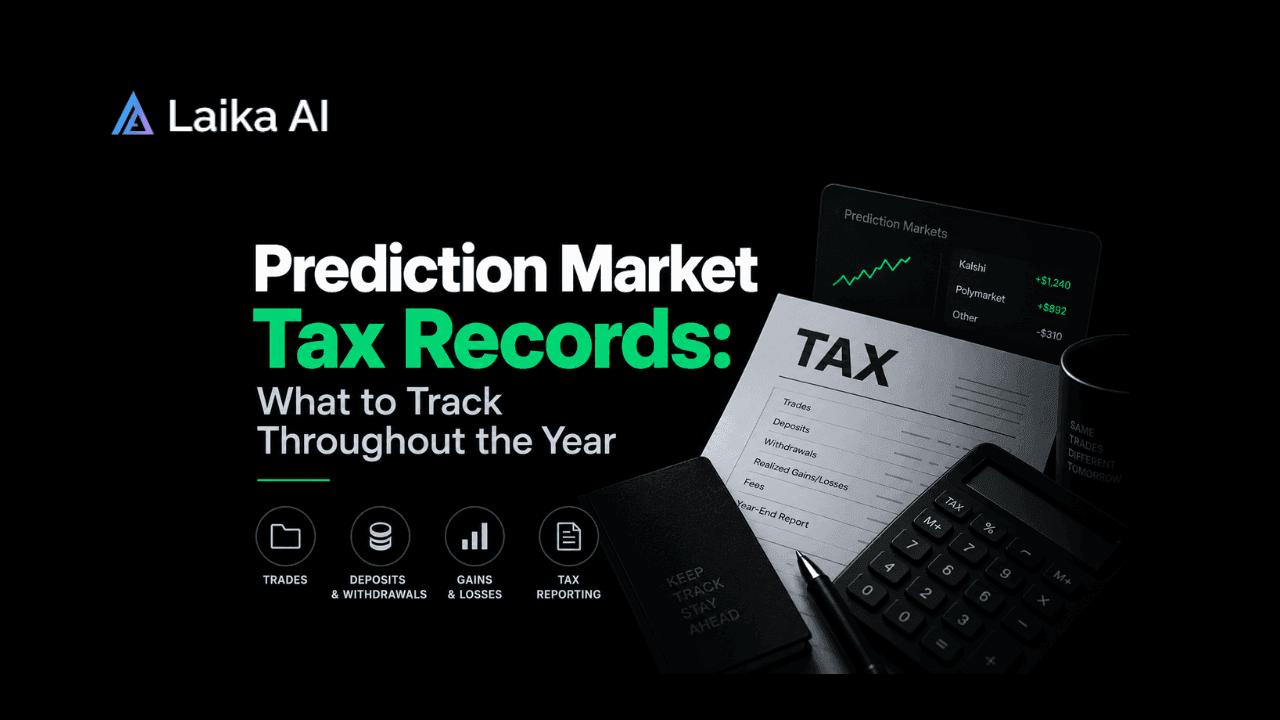
This is the actual checklist. Seven fields, logged consistently, and April stops being a scramble.
- Trade date: when you entered, not when the market resolved
- Market name or ticker: exactly as it appears on the platform, copy-paste rather than retype
- Entry price: what you paid per contract or share
- Exit price or resolution value: what you received, whether from selling early or the contract settling
- Fees paid: trading fees, withdrawal fees, network gas on Polymarket specifically
- Resolution outcome: Yes, No, or still open at the time you're logging it
- Cost basis: your entry price plus any fees baked into getting the position on
Skip any one of these and you're back to reconstructing it from memory in April, which is exactly the situation this whole exercise exists to avoid. And cost basis specifically is the field people skip most, mostly because it feels redundant with entry price until the fees actually add up across two hundred small trades.
Cross-Platform Tracking: Reconciling Kalshi and Polymarket
Trading both platforms doubles the record-keeping problem, and it doesn't double it evenly. Kalshi hands you dollar-denominated trades and a partial paper trail. Polymarket hands you crypto-denominated trades and no paper trail at all. Reconciling the two into one coherent picture of your year means normalizing everything into the same currency, same date format, same field structure, before either platform's export does it for you. Neither will.
The traders who get this wrong tend to make the same two mistakes, over and over. Common Tax Mistakes Kalshi Traders Make and Common Tax Mistakes Polymarket Traders Make cover the platform-specific versions of that pattern, worth reading separately since the failure points genuinely differ between a regulated dollar exchange and an on-chain one.
Withdrawal timing matters here too, more than people expect. A withdrawal isn't a taxable event on its own, but it's a useful checkpoint for reconciling your running log against what actually hit your bank or wallet. How to Withdraw From Kalshi: Complete Guide to Every Method is worth a glance if you're not already treating each withdrawal as a natural point to double-check your records against reality.
Simple Tools for This
You don't need software built specifically for prediction markets to solve this. A spreadsheet with the seven fields above as columns, updated the same day you trade rather than batched up weekly, handles the vast majority of traders just fine. Add a column for platform, Kalshi or Polymarket, and you've got your cross-platform reconciliation built in from the start rather than bolted on later.
For anyone trading at real volume, dozens of positions a month rather than a handful, exporting raw trade history directly from each platform and importing it into that same spreadsheet structure beats manual entry every time. Kalshi's export sits under the same Tax Documents tab as its 1099s. Polymarket's version means pulling wallet activity off Polygon directly, which is considerably more hands-on, and exactly why the on-chain record matters so much on that side of the ledger.
None of this requires anything fancy. A trader logging fifteen positions a month doesn't need a subscription tool built for hedge funds; they need a spreadsheet they actually open every week instead of once a year. The traders who fall behind almost never fall behind because the system was too complicated. They fell behind because they stopped updating it in March and told themselves they'd catch up later. Later, in this context, is always April.
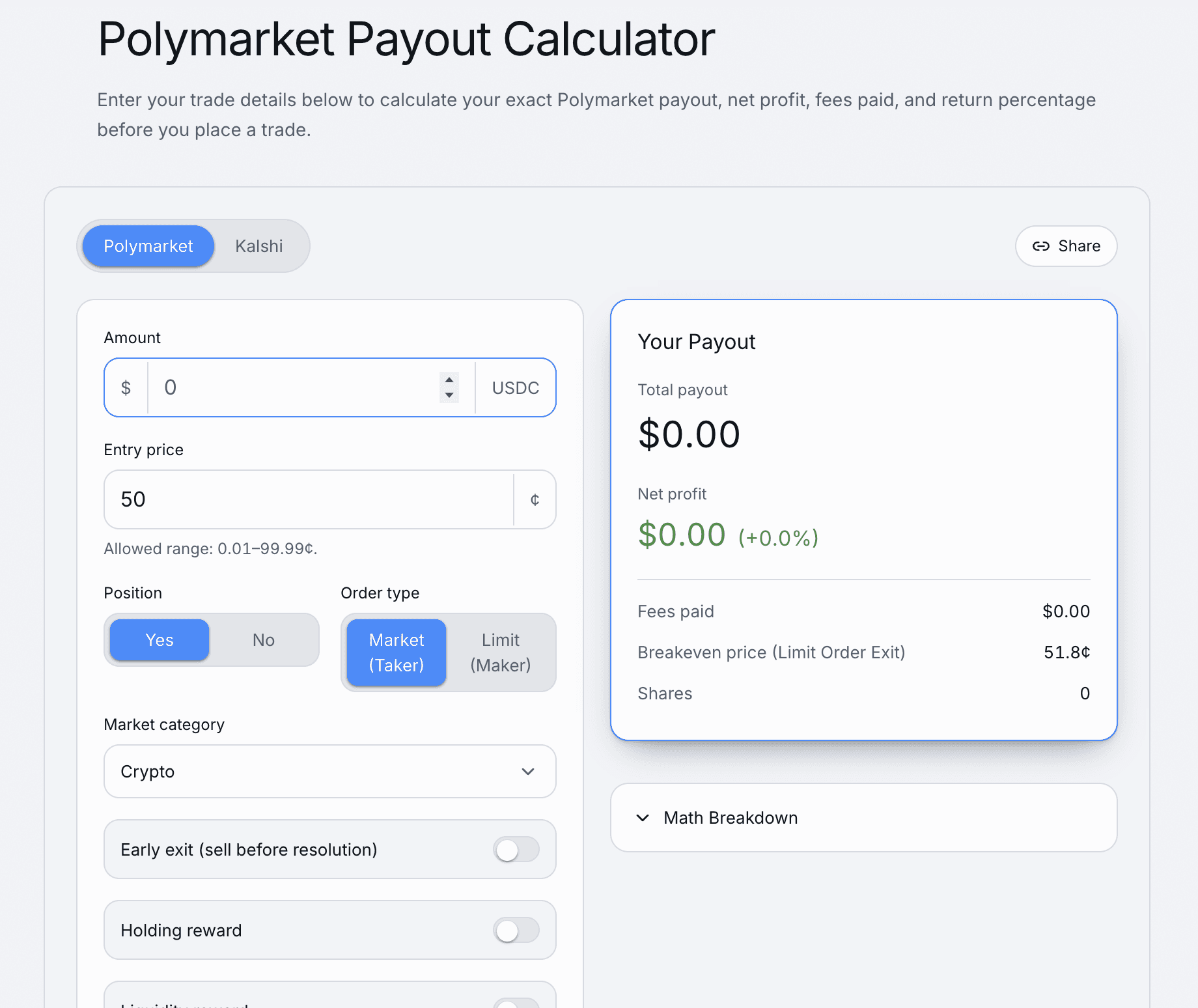
Set a recurring reminder if you have to. Sunday night, fifteen minutes, update the log. It's not exciting advice, and it's not supposed to be.Calculate your Polymarket payout for free →
Bottom Line
Neither Kalshi nor Polymarket is going to hand you a clean summary of what you owe. Kalshi gets partway there and stops well short of trading profit itself. Polymarket doesn't start. The seven fields above, logged consistently as you trade rather than reconstructed from memory in April, are what actually closes that gap. For the deeper question of how this income gets classified and reported once you've got clean records in hand, Prediction Market Tax Guide: How the IRS Treats Your Polymarket and Kalshi Winnings in 2026 picks up exactly where this piece leaves off.
Keep the log boring. Boring is the whole point.
Frequently Asked Questions
Does Kalshi send a 1099 form?
Yes, but not one covering event contract trading profit or loss. Kalshi issues a 1099-INT for interest on cash balances of $10 or more, a 1099-MISC for referral bonuses and credits, and limited 1099-B or 1099-DA forms tied specifically to crypto transfer transactions, not to your actual trading results.
What tax form does Kalshi provide?
Kalshi delivers whichever forms you qualify for electronically by January 31 of the following year, accessible under Settings, then Tax Documents, inside your account. None of them functions as a comprehensive trading summary, so you'll need your own exported trade history for that.
Does Kalshi send a 1099-B?
Only a limited one, and only for proceeds tied to crypto transfer transactions on the platform. It does not cover event contract trading activity, so most active traders won't see their full year of contract gains and losses reflected on it.
Does Kalshi send a 1099-MISC?
Yes, but specifically for referral bonuses, credits, and promotional rewards once you cross the reporting threshold, not for net trading profit. That threshold sits at $600 for 2025 activity and rises to $2,000 for 2026 payments.
What are people saying about Kalshi 1099s on Reddit?
The recurring theme across trader discussion is confusion over the gap between what Kalshi issues and what traders assume they'll receive, with many discovering only at tax time that trading profit itself isn't covered by any form Kalshi sends, which is exactly the throughout-the-year tracking problem this article is built to prevent.