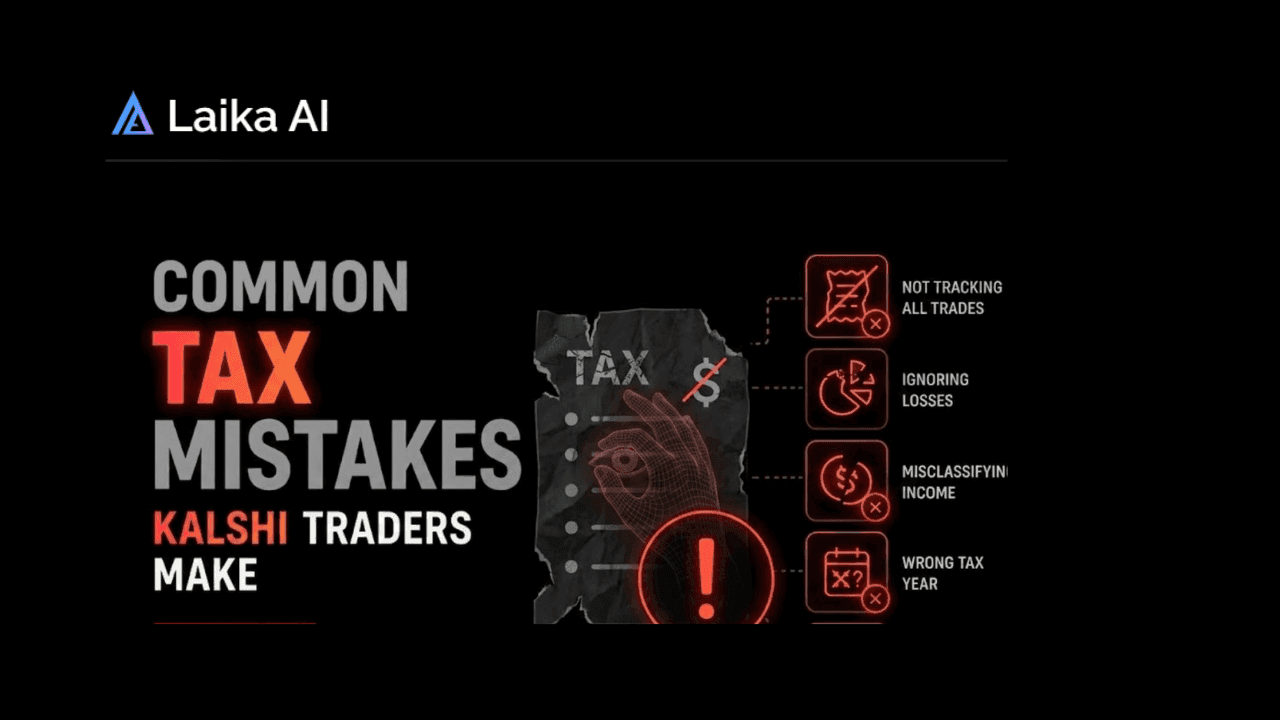
Kalshi tax mistakes tend to stem from a specific misunderstanding: because Kalshi is a CFTC-regulated Designated Contract Market, traders often assume this regulatory status automatically settles how their gains get taxed, and treat the resulting paperwork with more confidence than the underlying law actually supports. Kalshi's regulatory position genuinely does distinguish it from an offshore, crypto-native platform like Polymarket, but that distinction shapes the argument for favorable tax treatment, it does not guarantee it. The IRS has issued no guidance specific to event contracts, and the gap between what traders assume their 1099 forms mean and what those forms actually establish is where most of the costly errors happen.
This guide covers the specific mistakes that show up most often in Kalshi tax reporting, how to correct them if you've already made one, and a practical checklist for getting it right going forward. For the full breakdown of how Kalshi's regulatory status shapes the underlying tax question, Kalshi taxes explained: reporting prediction market profits covers the Section 1256 analysis in detail.
Why Kalshi's Regulatory Status Creates a Different, But Not Simpler, Tax Situation
Kalshi's CFTC designation is real and meaningful. It is also the source of most of the confusion in this category, because traders tend to treat "CFTC-regulated" and "gets favorable tax treatment" as the same statement when they are not. Being a CFTC-regulated exchange is a prerequisite for the argument that Kalshi's event contracts qualify under Section 1256 of the Internal Revenue Code, the provision that splits gains 60 percent long-term and 40 percent short-term regardless of holding period. It is not, on its own, proof that the argument succeeds.
The CFTC itself has described event contracts in terms that overlap with how the tax code defines swaps, and Section 1256(b)(2)(B), a provision added by Dodd-Frank, specifically excludes certain swaps from Section 1256 treatment. This creates a genuine tension: Kalshi's regulatory status supports the 1256 argument, while the specific structure of its contracts may undercut it. Reasonable tax professionals currently land on different sides of this question, and neither position has been confirmed by a Revenue Ruling, Private Letter Ruling, or Tax Court decision. Every mistake in this guide traces back, in one way or another, to treating this unsettled question as though it were already resolved.
See Real-Time Odds and Discover Your Next Trading Opportunity.
The Most Common Kalshi Tax Mistakes
Mistake 1: Assuming Section 1256 treatment applies automatically
This is the most consequential mistake in the category, and it happens because the tax benefit is genuinely large and genuinely well-publicized in Kalshi trading communities. A trader in the 32 percent bracket with $10,000 in net gains owes roughly $3,200 under ordinary income treatment versus roughly $2,180 under Section 1256's 60/40 split, a difference that scales meaningfully at higher income levels. That gap is real, which is exactly why so many traders default to claiming it without confirming whether their specific facts support it.
Section 1256 treatment is not something you get by default simply because you traded on a CFTC-regulated exchange. It is a position you take, one that requires the analytical work to support it and the willingness to defend it if examined. Claiming it because the exchange is CFTC-regulated, without engaging with the swap exclusion question at all, is the single most common way traders overstate a defensible tax position without realizing they've done so.
Mistake 2: Misreading what the 1099-B actually establishes
Kalshi's tax documentation practices are, in practice, described inconsistently even among tax professionals who specialize in this area. Some sources indicate Kalshi issues a 1099-B covering event contract activity once you cross a reporting threshold. Others describe Kalshi's 1099-B coverage as limited to specific transaction types, with the bulk of event contract activity left for the trader to self-report using exported trade history and P&L statements. What is consistent across sources is that Kalshi's own help center confirms issuance of a 1099-INT for interest earned on cash balances, and that the platform explicitly disclaims its own P&L display as tax advice.
The mistake traders make here is assuming that receiving any 1099 form from Kalshi means the character of their gains, meaning whether they qualify for Section 1256 treatment, has been determined or endorsed by the platform. It has not. A 1099 form reports amounts. It does not adjudicate the underlying legal question of how those amounts should be characterized on your return. Traders who see a form arrive and assume the classification question has been handled for them are skipping a step that still requires their own or their preparer's independent analysis.
Mistake 3: Treating the 60/40 split as optional line-item flexibility rather than an all-or-nothing framework choice
Some traders attempt a hybrid approach: applying Section 1256's favorable 60/40 split to their winning positions while reporting losing positions under a different, more favorable-in-that-instance framework. This is not how the election works. If you take the position that your Kalshi contracts qualify as Section 1256 contracts, that treatment applies to your net result for the year, reported on Form 6781, not selectively to whichever individual trades benefit most from it. Cherry-picking treatment by trade is both incorrect and one of the more obvious red flags in an examination, since Form 6781 is specifically structured around an aggregated net figure, not trade-by-trade characterization choices.
Mistake 4: Ignoring the mark-to-market requirement on open positions at year-end
Under Section 1256, open positions are generally treated as if sold at fair market value on the last business day of the tax year, whether or not you actually closed them. Traders who only report gains and losses from positions they actually settled or sold during the calendar year, while ignoring open positions still held on December 31, are missing a required component of the framework if they're claiming 1256 treatment. This mistake compounds the following year, since a position marked to market at year-end effectively establishes a new cost basis going into the next tax year, and traders who skipped the mark-to-market step often end up double-counting or under-counting gains in the subsequent year without realizing why their numbers don't reconcile.
Mistake 5: Assuming state tax treatment mirrors federal treatment
A federal Section 1256 election does not automatically carry through to your state return. Several states do not recognize the 60/40 capital gains split at all and instead tax the full net gain at ordinary income rates regardless of how you characterized it federally. A trader who claims the favorable federal treatment while assuming their state return follows the same logic can end up with a real, unexpected state tax bill that wasn't factored into their planning. This mismatch is state-specific and needs to be confirmed directly rather than assumed either way.
For the equivalent set of platform-specific errors on the crypto-native side of prediction market trading, common tax mistakes Polymarket traders make covers how Polymarket's lack of any comparable regulatory status changes the analysis entirely, and why the Section 1256 argument that's at least plausible for Kalshi is considerably harder to support for Polymarket specifically. For how blockchain-based platforms create additional traceability that traders sometimes underestimate, 10 ways the IRS can find your Polymarket tax gains covers the enforcement mechanics relevant to anyone trading across both platforms.
How to Correct Kalshi Tax Reporting Errors
If you've already filed a return that reflects one of the mistakes above, the correction path depends on the specific error and how far back it goes.
For a straightforward basis or classification error in a single prior year, the standard mechanism is an amended return using Form 1040-X, which allows you to correct the affected line items, recalculate the resulting liability, and pay any additional tax owed along with interest. If the error involved incorrectly claiming Section 1256 treatment without adequate support, amending to a more conservative ordinary income position, and being prepared to explain the correction if questioned, is generally the more defensible path forward than leaving an unsupported position in place.
For errors involving mark-to-market omissions on open positions, the correction may need to touch more than one tax year, since an unmarked position at the end of one year affects the basis calculation entering the next. This is a scenario where working with a tax professional familiar with Section 1256 reporting specifically, rather than a general preparer, meaningfully reduces the risk of the correction itself introducing new errors.
For any correction involving a material dollar amount or multiple years, consult a tax professional before filing anything. The specific facts, how the original error occurred, how many years it spans, and how large the resulting adjustment is, determine whether a standard amended return is sufficient or whether a more structured approach makes sense. This is not a decision to make unilaterally based on a general guide, including this one.
For how this correction process compares across different prediction market tax scenarios more broadly, prediction market taxes vs sports betting taxes covers where the underlying mechanics and risk profile diverge.
A Simple Checklist for Kalshi Tax Compliance
Before your next filing deadline, work through the following.
1. Confirm what documentation Kalshi has actually issued to your specific account by checking the Tax Info page directly rather than assuming based on generic guides, since coverage described across sources is inconsistent and may depend on your specific account activity and thresholds.
2. Reconcile your own trade history against whatever 1099 you did receive, checking specifically for partial fills that may have been aggregated in a way that obscures your true weighted cost basis.
3. Decide on a classification framework, Section 1256 or ordinary income, with input from a tax professional who understands the swap exclusion argument specifically, rather than defaulting to whichever framework produces the lower number without engaging with the underlying support for that position.
4. If claiming Section 1256, confirm the mark-to-market treatment has been applied to any positions still open on December 31, and carry that adjusted basis forward correctly into the following tax year.
5. Apply your chosen framework consistently across all positions for the year, rather than selectively applying favorable treatment trade by trade.
6. Check your state's specific treatment of Section 1256 income before assuming your state return will mirror your federal position, since several states do not recognize the 60/40 split.
7. Keep your own transaction-level export, downloaded periodically rather than reconstructed at filing time, and compare it against whatever Kalshi documentation you receive before you file, resolving any discrepancy before submitting your return rather than after.
Frequently Asked Questions
Does Kalshi qualify for Section 1256 tax treatment?
This is genuinely unsettled. Kalshi's CFTC-regulated status is the necessary prerequisite for the Section 1256 argument, but the IRS classifies event contracts in terms that overlap with the tax code's definition of swaps, which are specifically excluded from Section 1256 under a Dodd-Frank provision. No Revenue Ruling, Private Letter Ruling, or Tax Court decision has resolved this question for Kalshi's specific contract structure. Claiming Section 1256 treatment is a defensible position some tax professionals support, not an automatic entitlement that follows from Kalshi's regulatory status alone.
What 1099 does Kalshi send at year-end?
Kalshi's own help center confirms issuance of a 1099-INT for interest earned on cash balances. Whether Kalshi issues a comprehensive 1099-B covering event contract trading is described inconsistently across sources, and the most reliable approach is checking the Tax Info page in your own account directly rather than assuming based on any general guide. Kalshi's platform documentation is available at kalshi.com for the most current information on what forms apply to your account.
How do I correctly report Kalshi losses?
The reporting mechanism depends on which classification framework applies to your situation. Under Section 1256 treatment, net losses are reported on Form 6781 and can be carried back three years to offset prior Section 1256 gains specifically. Under ordinary income treatment, losses generally offset other ordinary income without the $3,000 annual cap that applies to standard capital losses. The IRS's own Form 8949 instructions at irs.gov provide the underlying framework for how capital losses more broadly integrate with your return, relevant background if your chosen framework routes through that form.
What is the most common Kalshi tax mistake?
Assuming Section 1256 treatment applies automatically because Kalshi is CFTC-regulated, without engaging with the specific statutory exclusion argument that complicates the analysis. This mistake is common precisely because the tax benefit is real and well-known in trading communities, which makes it tempting to claim the position without confirming it's actually supportable for your specific facts.
Can I switch between Section 1256 and ordinary income treatment from year to year?
This is a nuanced area that should be discussed directly with a tax professional rather than decided unilaterally, since consistency in tax positions matters and switching frameworks between years without a clear change in the underlying facts or law can itself raise questions in an examination. If you've taken a position in a prior year, changing it in a subsequent year needs a documented basis for why, not just a preference for whichever treatment produces a better result in a given year.
Where can I discuss Kalshi tax questions with other traders?
Kalshi tax discussions on Reddit and various trading communities can be useful for understanding what documentation other traders have received and how common tax software handles Kalshi's export format, but the classification questions at the center of most Kalshi tax mistakes carry real financial consequences and deserve review by a licensed tax professional rather than crowd-sourced consensus, particularly given how much disagreement exists even among credentialed preparers on the core Section 1256 question.
The Bottom Line
Kalshi's CFTC-regulated status creates a genuinely different, but not necessarily simpler, tax situation than an offshore or crypto-native platform. The regulatory status supports a real argument for favorable Section 1256 treatment, but it does not settle the question, and most of the costly mistakes traders make in this category come from treating an unsettled legal position as though it were already decided.
Confirm what documentation Kalshi has actually issued to your account rather than assuming, reconcile that documentation against your own transaction records rather than trusting a summary view, apply whatever classification framework you choose consistently rather than selectively, and get a qualified tax professional's input before claiming a position with the size of financial consequence that Section 1256 treatment carries.
This article is educational and does not constitute tax, legal, or financial advice. Consult a qualified tax professional before filing based on any framework described here.
Track your Kalshi positions and realized gains as they accumulate throughout the year with Polymetric by Laika AI, so your tax reporting starts from organized, reconciled data instead of a year-end scramble through exported trade history.