Here's a number worth sitting with before anything else in this piece: by most independent estimates, somewhere around 90% of Polymarket wallets lose money over time, and that figure applies to wallets rather than traders, which is a meaningfully different and more damning statistic. The uncomfortable part isn't that prediction markets are somehow rigged or fundamentally unbeatable, it's that the traders who actually turn a profit aren't noticeably better at forecasting outcomes than everyone else trading alongside them. What separates them instead is a much less glamorous skill: not letting one bad week quietly erase three good months of work.
Consistent profit on Polymarket turns out to have far less to do with forecasting skill than most new traders assume, and far more to do with the kind of risk-management discipline poker players and options traders have been refining for decades. That discipline matters even more on a platform like this one, where nobody hands you built-in guardrails, since most of the rules that would normally protect a trader from themselves simply don't exist here.
Why Most Traders Never Get to "Consistent"
Ask a losing Polymarket trader what went wrong and they'll usually tell you a story about a bad call, a market that resolved against them on a technicality, a news event they didn't see coming. Ask someone who's been profitable for a year and you'll get a much more boring answer: sizing.
The math here is genuinely stark. Picture two traders who are both right 60% of the time, which is a real, solid edge in a prediction market. Trader A bets 30% of their account on every position, while Trader B bets 5%. Run three losses in a row, a completely normal occurrence at a 60% win rate rather than some black-swan fluke, and Trader A has lost roughly two-thirds of their account while Trader B has lost about 14%. Both traders had identical skill, identical edge, and identical bad luck, yet they ended up in wildly different places, because only one of them let variance do what variance always eventually does.
That's the part nobody tells beginners. You don't need a better crystal ball. You need to survive long enough for the crystal ball you already have to pay off.
Read More: How to Think Like the 3% of Polymarket Traders Who Are Actually Profitable
The Kelly Criterion, Without the Math Headache
There's an actual formula for this, and you don't need to love math to use it. The Kelly Criterion, developed at Bell Labs in the 1950s for a completely different problem, tells you the mathematically optimal fraction of your bankroll to risk on a bet where you have an edge.
Applied to a Polymarket contract, it looks like this:
f = (your estimated probability − market price) ÷ (1 − market price)
Say a market's trading at 50 cents and you genuinely believe the true probability is 60%. Plug it in and Kelly tells you to bet 20% of your bankroll. That number probably feels aggressive, and here's the thing: it is. Nobody actually trades full Kelly.
That last row matters more than it looks. Full Kelly assumes your probability estimate is correct. Nobody's estimate is perfectly correct, and traders are reliably overconfident about how sharp their own edge really is. Betting a fraction of Kelly is less a hedge against bad luck and more a hedge against being wrong about your own accuracy, which happens more than anyone likes to admit.
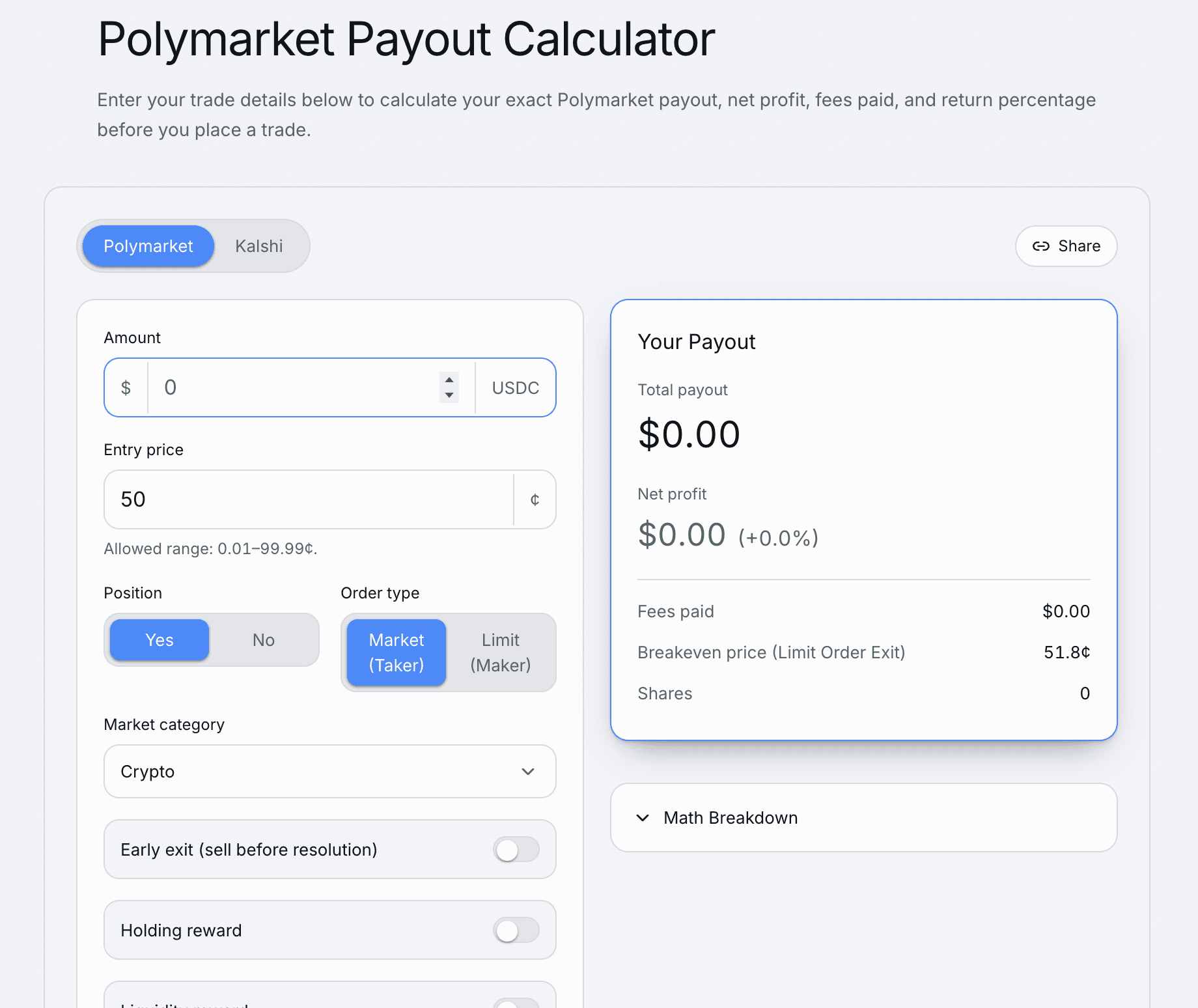
Calculate your Polymarket payout for free →
The Position Limits Worth Actually Writing Down
Kelly tells you how to size one bet. It doesn't tell you what happens when five of your bets are secretly the same bet wearing different outfits.
This is the part that quietly wrecks more accounts than any single bad call. A trader with heavy exposure across several Trump-administration markets, a Fed-decision market, and a related economic-indicator market might feel diversified because the tickers look different. They're not diversified. They're running one large, leveraged position on a single underlying story, just spread across four line items instead of one.
A workable framework most experienced traders converge on:
- Single market: no more than 10 to 15% of total capital
- Correlated cluster: no more than 25 to 30% of total capital across markets that would all move together on the same news
- Broad theme: no more than 40% in any one category, politics, crypto, macro, whatever your specialty happens to be
These aren't laws of physics. A trader with real conviction on a specific market might reasonably bend the single-market cap. But bending the correlated-cluster cap is the specific mistake that turns a good trader into a cautionary tale, because it's the one that doesn't feel like extra risk until the news breaks and every position moves the same direction at once.
Pick One Thing You Actually Understand
The single most repeated piece of advice across every serious Polymarket strategy guide, and it's advice most people nod along to and then ignore, is to specialize. Not "trade politics and sports and crypto and whatever's trending," one lane, chosen because you already know it better than the crowd does.
That might be a sport you've followed obsessively for a decade. A regulatory process you happen to work adjacent to professionally. A country's politics you can read in the original language while everyone else is relying on translated headlines. The specific domain matters less than the fact that it's genuinely yours, some edge in information or interpretation that the average trader pricing that market doesn't have.
The discipline that goes with this is almost embarrassingly simple and almost nobody actually does it: write your own probability estimate down before you look at the market's pricing. If your honest number is 80% and the market's sitting at 62 cents, you've found real daylight. If your number and the market's number land in the same place, close the tab. No trade is a legitimate outcome of research, not a failure to find one.
Fees, Spreads, and the Slow Bleed Nobody Notices
None of the sizing discipline in the world helps if the platform's own mechanics are quietly eating your edge before you notice. Trading fees on Polymarket look small in isolation, a fraction of a percent here, a wider spread on a thin market there, and that's exactly why they're dangerous. Nobody blows up their account on a single fee. People bleed out slowly over a month of active trading across a dozen positions, and by the time they add it up, the fees and spreads have quietly consumed a meaningful chunk of what looked like a winning month on paper.
The fix isn't complicated: trade less often, in more liquid markets, and treat every entry and exit as a real cost rather than a free action. If you find yourself opening a new position because the last hour felt slow rather than because you found genuine value, that's the fee drag finding you, not the other way around.
The Losing Streak Is Not a Signal, It's Just Math
Here's where psychology gets genuinely interesting, and where most sizing discipline quietly falls apart in practice even among traders who understand it perfectly on paper.
A losing streak feels like information. It isn't, not usually. If you're trading with a real 60% edge, a run of three or four losses in a row isn't rare, it's an expected, regular feature of that edge playing out over time. The trader who reads a losing streak as "the market's rigged" or "my edge is gone" and responds by doubling their size to "win it back" is the same trader who was profitable on paper a week earlier and broke by the end of the month.
There's a specific, well-documented pattern behind this called the disposition effect: traders hold losing positions far longer than winning ones, because selling a loser means admitting it, and that admission feels worse than an equivalent gain feels good. On Polymarket specifically, that shows up as traders sitting in a position that's clearly gone wrong, waiting for a resolution that would let them avoid ever actually clicking sell.
A few practical guardrails that show up again and again in how disciplined traders actually operate:
- A hard stop after three consecutive losses. Not forever, just long enough to check whether you're trading your plan or your frustration.
- A daily or weekly loss cap, decided in advance, before any money is actually on the line and emotions are still calm.
- Sizing down, not up, during a rough stretch. The instinct is always to bet bigger to recover faster. The math says the opposite: smaller size during a drawdown protects the capital your edge needs to eventually come back.
- A short pause before re-entering after a loss. Even five minutes away from the screen is usually enough to tell the difference between a genuine new opportunity and a revenge trade wearing a disguise.
None of this is exciting advice and it's not supposed to be. The traders quietly compounding a real edge month over month are, almost without exception, the ones who've made their trading boring on purpose.
What "Consistent" Actually Looks Like Month to Month
Worth resetting expectations here too, because "consistent monthly profit" gets read by a lot of new traders as "profit every single month, no exceptions," and that's not really how any edge-based strategy actually behaves. A real edge, sized correctly, produces a positive result over a long enough stretch, a quarter, a year, not necessarily every single thirty-day window along the way. Some months will be flat. A few will be down, even with perfect discipline, because that's what variance does to a real edge that hasn't had time to fully express itself yet.
The trader chasing a smooth, always-green monthly chart is usually the trader taking on far more risk than their actual edge justifies to manufacture that smoothness artificially. The trader who's actually building something durable is the one whose worst month is survivable and whose best month doesn't get spent the moment it lands.
FAQs
How much of my bankroll should I bet on a single Polymarket position?
Most experienced traders keep individual positions in the 2 to 5% range of total capital, with a hard ceiling around 10 to 15% even for high-conviction trades. That range comes from fractional Kelly sizing, deliberately betting less than the mathematically "optimal" amount to protect against the reality that nobody's probability estimates are perfectly accurate.
Is the Kelly Criterion actually useful for Polymarket, or just theory?
It's genuinely practical, not just theory, once you use a fraction of what it recommends. Full Kelly is too aggressive for real trading given how often traders overestimate their own edge, but quarter Kelly has become something close to a professional standard because it captures most of the long-run growth benefit while dramatically reducing the size of drawdowns.
Why do most Polymarket traders lose money even when their picks are often right?
Being right on individual calls and being profitable over time aren't the same skill. Traders who lose money despite a real edge typically fail at position sizing, correlation risk (multiple "different" bets that are actually the same underlying bet), or emotional discipline during losing streaks, not at prediction itself.
What's a realistic bankroll to start with for consistent trading?
There's no hard minimum, and small accounts can work, but position sizing only becomes meaningful once individual trades are large enough to matter after fees. Most guides suggest a few hundred to a few thousand dollars as the range where disciplined sizing actually produces results worth tracking, though starting smaller to build the habit before adding real capital is a completely reasonable approach too.