Most people who lose money on Polymarket never notice the execution tax they pay on every single trade.
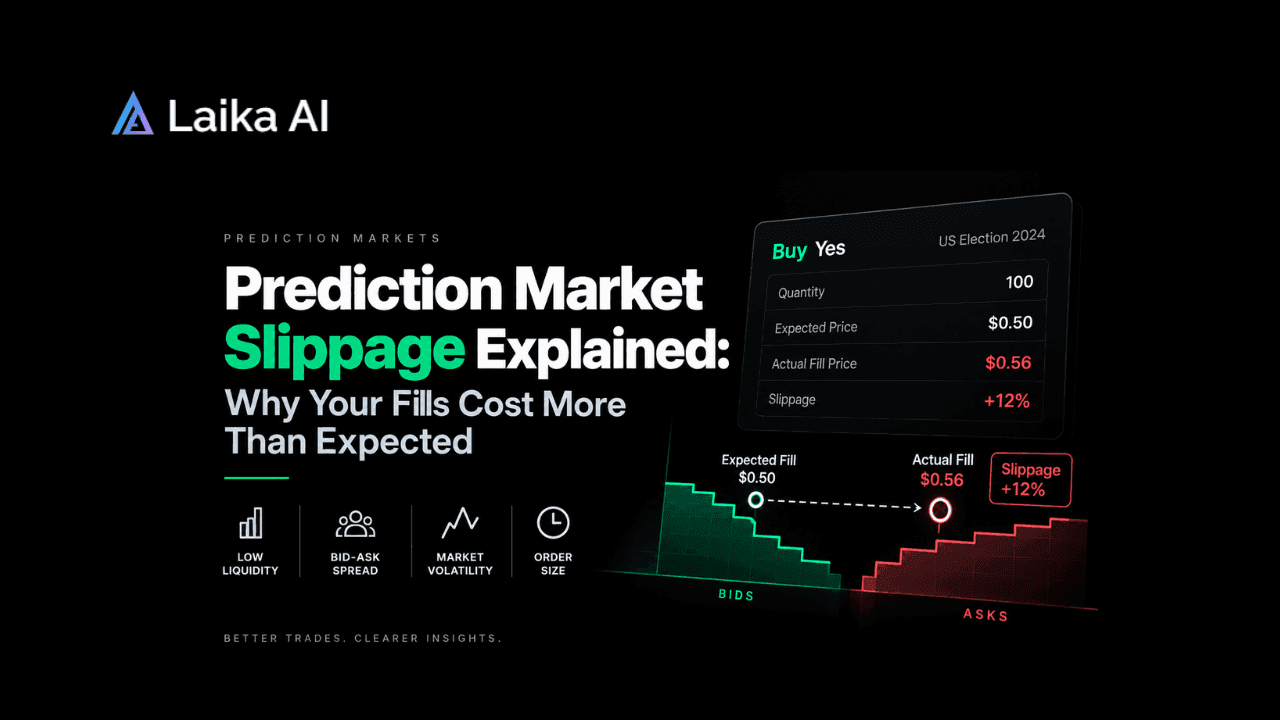
You see a market priced at 62 cents YES. You click buy. Polymarket fills your order. You own shares at what you assume is 62 cents. Except you don't. You paid 64.3 cents. The market order consumed available liquidity at 62, then 63, then 64, giving you a weighted average entry that immediately puts you underwater by 2.3 cents before the market has moved at all.
That 2.3 cent difference is slippage. On a $5,000 position, that is $115 gone before you even begin. Do that across 50 trades and you have given away $5,750 to the market structure itself, separate from fees, separate from whether your predictions were right or wrong.
Professional traders on Polymarket do not pay this tax. They use limit orders. They set the price they are willing to pay, wait for the market to come to them, and in the process earn maker rebates that reduce their effective fee from 2% to 1.5% or lower.
The difference between clicking market buy and placing a patient limit order is often the difference between profitable and unprofitable trading over any meaningful sample size. This article is about how to use limit orders correctly so you stop funding other people's edge with your execution costs.
What Limit Orders Actually Do on Polymarket
When you place a market order, you are saying: fill me now at whatever price is currently available. Polymarket looks at the order book, finds the best available prices, and executes your trade immediately by taking liquidity from existing limit orders already sitting in the book.
When you place a limit order, you are saying: I will buy at this specific price or better, and I am willing to wait. Your order goes into the order book as an offer. When someone else submits a market order or a limit order at your price, your order fills.
The mechanical difference is obvious. The financial difference is not.
Market order buyer: Pays 64 cents on a market showing 62-64 spread, takes liquidity, pays 2% fee on any profit.
Limit order buyer: Places order at 62 cents, waits, gets filled when someone sells into the bid side at 62, provides liquidity, pays 2% fee minus 0.2% to 0.5% maker rebate.
The limit order buyer saved 2 cents on entry (3.1% better) and earned a 0.2% to 0.5% rebate on any profit. Combined advantage: roughly 3.5% to 4% per round-trip trade. Across 100 trades on $100,000 total volume, that is $3,500 to $4,000 in saved costs.
This is not a theoretical edge. This is a mechanical advantage built into Polymarket's fee structure that most traders ignore because market orders feel faster and easier.
When Limit Orders Work and When They Fail
Limit orders are not universally better than market orders. They trade immediacy for price. Sometimes you need immediacy. Most of the time, you don't.
When limit orders work perfectly
Long-duration markets with weeks or months until resolution. A presidential election market resolution in November does not care whether you entered your position at 2:47 PM or 4:13 PM on a Tuesday in March. Set a limit order at your target price and wait. You will get filled within hours or days, and you will pay a better price than anyone who market-bought during that same window.
Liquid markets with tight spreads and active two-sided flow. When a market shows consistent volume with a 1 to 2 cent spread and regular trades on both sides, limit orders placed inside the spread fill quickly. You are offering a slightly better price than the current best bid or ask, making it attractive for the next market order to hit your limit rather than the worse price sitting further out.
Positions you are building over multiple days. If your strategy is to accumulate $20,000 in a market over the next week, placing patient limit orders at your target price lets you average in without moving the market against yourself. Each limit fill happens at your price, not at whatever the market has moved to after your previous order.
When limit orders fail and cost you money
Breaking news events where the window closes in minutes. If a major poll drops showing a candidate surging and you believe the market has not priced it in yet, a limit order placed at yesterday's price will sit unfilled while the market prices 10 cents higher in the next four minutes. You wanted execution. You needed immediacy. The limit order was the wrong tool.
Thin markets with wide spreads and low volume. In a market showing a 6 cent spread with $8,000 total depth, a limit order placed inside the spread might sit for days without filling because there is insufficient two-sided flow to clear the book. You have capital locked in an unfilled order while the market potentially moves against you.
Positions you need to exit urgently due to new information. If you are holding YES and new data invalidates your thesis, you want out now. A limit order trying to capture a better exit price than the current bid might never fill if the market continues moving against you. Sometimes paying the spread to exit immediately is the correct decision.
The timing question you need to answer every time
Before placing any limit order, ask: is my edge in this trade time-sensitive information that decays in minutes, or is it analysis that remains valid for hours or days?
If your edge decays fast, use market orders. If your edge is structural or patient, use limit orders. Most traders get this backwards. They market-buy long-duration positions where they have days to get filled, and they limit-order breaking news trades where the edge expires in six minutes.
How to Price Your Limit Orders
Placing a limit order at a price that never fills wastes time and capital. Placing it too close to the market order price captures no advantage. The pricing decision matters.
The spread-splitting approach
Look at the current order book. Note the best bid and best ask.
Example:
- Best bid (highest buy order): 61 cents
- Best ask (lowest sell order): 63 cents
- Spread: 2 cents
If you want to buy, place your limit order at 62 cents. You are offering one cent better than the current best bid, making your order the new best bid. When the next seller submits a market order, they hit your limit before anyone else's.
If you want to sell, place your limit order at 62 cents. You are offering one cent better than the current best ask. The next buyer hits your limit before anyone else's.
This approach captures half the spread. You paid 62 instead of 63 if buying, or received 62 instead of 61 if selling. One cent saved per share. On a $5,000 position, that is $50 to $80 in pure savings depending on share count, before considering the maker rebate.
The patient undercut approach
If you are not in a hurry and the market has decent volume, place your limit order two to three cents inside the spread rather than one.
Same example:
- Best bid: 61 cents
- Best ask: 63 cents
Place your buy limit at 60 cents, two cents below the current best bid. You will not be the best bid. You will sit further down in the order book. But if the market dips even slightly, or if a large seller comes in and works through the 61 cent bids, your 60 cent limit fills and you capture the full spread plus an extra cent.
This only works in markets with real volatility and regular two-sided flow. In a stagnant market, your 60 cent limit might sit unfilled for a week while the price never moves below 61.
The reference price approach
Ignore the current order book entirely. Decide what price makes the trade profitable based on your analysis.
If you believe fair value on a YES contract is 68 cents and the market is currently showing 63-65, place your limit buy at 62 cents. If it fills, you got an even better entry than you needed. If it does not fill and the market moves to 68 without you, you avoided paying 65 for something worth 68, which is a marginal trade you didn't need to make.
This approach treats limit orders as conditional trade expressions: I only want this position if I can get it at a price that gives me a meaningful edge. If the market never offers that price, I skip the trade entirely.
The wrong way: placing limits at the ask
The most common beginner mistake is placing a buy limit order at the current ask price, or a sell limit at the current bid.
If the ask is 63 cents and you place a buy limit at 63 cents, you have created a market order with extra steps. Your order fills immediately at 63 cents, the same price you would have paid with a market order, except now you waited for the order to process and gained nothing.
Limit orders exist to get you better prices than market orders. Placing them at market prices defeats the entire purpose.
The Maker Rebate and Why It Matters
Polymarket V2 introduced a maker rebate program that pays liquidity providers 0.2% to 0.5% of their gross profit, depending on trading volume tier.
When you place a limit order that sits in the order book and gets filled by someone else's market order, you are the maker. You provided liquidity. Polymarket gives you a rebate.
When you place a market order that immediately matches an existing limit order, you are the taker. You took liquidity. You pay the full 2% fee with no rebate.
The math on a single trade
Market order execution:
- Buy at 64 cents via market order
- Sell at 72 cents later when thesis plays out
- Gross profit: 8 cents per share
- Fee: 8 cents × 2% = 0.16 cents per share
- Net profit: 7.84 cents per share
Limit order execution:
- Buy at 62 cents via limit order (maker)
- Sell at 72 cents via limit order (maker)
- Gross profit: 10 cents per share
- Fee: 10 cents × 2% = 0.20 cents
- Maker rebate: 10 cents × 0.3% (average tier) = 0.03 cents
- Net fee: 0.17 cents
- Net profit: 9.83 cents per share
Difference: 1.99 cents per share, or 25% higher net profit, from execution discipline alone.
On a $5,000 position that translates to roughly $150 to $200 in additional profit purely from order type selection, assuming you paid 62 instead of 64 and earned the rebate on both entry and exit.
The compounding effect
Most traders on Polymarket place 20 to 100 trades per year. If switching from market orders to limit orders saves 2 cents per share on average, and you trade $50,000 total volume annually, you just saved $1,000 in execution costs.
If your annual P&L is $3,000 before considering execution optimization, you just increased it to $4,000. That is 33% performance improvement from order type discipline, not from better predictions.
The traders who make serious money on Polymarket are not necessarily smarter about politics or sports. They are more disciplined about execution. Limit orders are the most accessible execution discipline available.
Partial Fills and Order Management
Limit orders do not always fill completely in one transaction. Sometimes you get partial fills. Understanding how to manage this is the difference between professional and amateur limit order usage.
What a partial fill looks like
You place a limit buy order for $10,000 at 61 cents. That is 16,393 shares at your limit price. The order sits in the book.
Twenty minutes later, someone sells 6,000 shares via market order into the bid side. Your limit order is the best bid at 61 cents, so their market sell fills 6,000 of your 16,393 share limit order.
You now own 6,000 shares at 61 cents. You still have an open limit order for the remaining 10,393 shares at 61 cents.\
How to handle partial fills
Option 1: Leave it and wait. If your thesis has not changed and you still want the full position at 61 cents, leave the remaining limit order open. It will fill eventually if the market continues trading at or below 61 cents.
Option 2: Cancel and reprice. If the market has moved and 61 cents is no longer realistic, cancel the unfilled portion of your limit order and place a new limit at the current realistic price. Leaving stale limits sitting in the book ties up capital in orders that will never fill.
Option 3: Fill the rest via market order. If new information has made the position urgent and you need the full exposure now, cancel the remaining limit and market buy the rest. You got part of your position at the patient price. Taking the rest at the market is fine if circumstances change.
The mistake: forgetting about open limits
The most common error with limit orders is placing them and forgetting they exist. You place a limit, it does not fill immediately, you move on to other things, and three days later you realize you have an open order sitting at a price that is no longer relevant.
Unfilled limit orders are not free. They lock up capital that could be deployed elsewhere. They create execution risk if they suddenly fill at a moment when you were not expecting it.
If you are going to use limit orders seriously, you need a system for tracking open orders and canceling the ones that are no longer valid.
Advanced Limit Order Techniques
Once you understand basic limit order execution, three advanced techniques separate casual traders from professionals.
Technique 1: Layering multiple limits
Instead of placing one large limit order at a single price, place multiple smaller limit orders at incrementally better prices.
Example: You want to buy $10,000 worth of YES shares. Current bid is 60 cents, current ask is 62 cents.
Single limit approach: Place one $10,000 buy limit at 61 cents.
Layered approach:
- $2,000 buy limit at 60.5 cents
- $2,000 buy limit at 60 cents
- $2,000 buy limit at 59.5 cents
- $2,000 buy limit at 59 cents
- $2,000 buy limit at 58.5 cents
If the market dips slightly, your 60.5 and 60 cent limits fill, giving you $4,000 of your position at an average of 60.25 cents. If it dips further, the rest fills at even better prices.
If it never dips and stays at 61-62, you might get zero fill or only partial fill. That is fine. You avoided buying at 62 via market order and preserved capital for better opportunities.
Layering limits is particularly effective in volatile markets where prices swing 3 to 5 cents multiple times per day. You catch the dips without having to watch the market constantly.
Technique 2: Post-only limits
Some platforms and interfaces offer a "post-only" limit order option. This guarantees your order will only execute as a maker, never as a taker.
If you place a post-only limit buy at 62 cents and the current ask is also 62 cents, instead of immediately matching and executing as a taker, your order gets canceled or repriced to 61.9 cents to ensure it goes into the book as a maker order.
This is valuable when you are optimizing for maker rebates and do not want to accidentally take liquidity if your limit price happens to match the current best ask or bid exactly.
Polymarket's native interface does not currently offer post-only as a built-in option, but some third-party trading tools that connect to Polymarket's API do.
Technique 3: Iceberg orders
An iceberg order is a large limit order that only shows a small portion of its size publicly in the order book. The rest is hidden.
If you want to buy $50,000 at 60 cents but don't want the entire market to see a massive buy order sitting there, you can place an iceberg order that shows $5,000 publicly. As the visible $5,000 fills, another $5,000 automatically appears, until the full $50,000 is filled.
This prevents other traders from front-running your order or adjusting their limit prices unfavorably in response to seeing your size.
Polymarket's standard interface does not natively support iceberg orders, but algorithmic trading tools built on top of Polymarket's API can execute them.
Reading the Order Book to Improve Limit Order Timing
Placing effective limit orders requires understanding what the order book is telling you about supply and demand.
What to look for in a healthy order book
Depth on both sides. A good market for limit orders shows meaningful size on both the bid and ask sides. If you see $80,000 in buy orders and $75,000 in sell orders within a 3 cent range, that is a liquid two-sided book. Your limit orders placed inside that range will likely fill within hours.
Consistent refreshment. Watch the order book for two to three minutes. If orders are constantly being added, filled, and replaced, that is active market-making and real flow. Your limits will fill.
Tight spread. A 1 to 2 cent spread indicates healthy competition between buyers and sellers. Limit orders placed inside a tight spread fill quickly because there is minimal gap to cross.
Red flags that suggest your limit will not fill
One-sided book. If the bid side shows $120,000 and the ask side shows $6,000, the market is heavily skewed. Placing a buy limit at a reasonable price will likely sit unfilled because there is overwhelming buy-side pressure and insufficient sellers.
Stale orders. If the same exact orders have been sitting at the same prices for six hours without any fills or changes, that is a dead market. Your limit order will sit alongside theirs, unfilled.
Wide spread. A 6+ cent spread indicates low liquidity and infrequent trading. Limit orders placed inside the spread might fill eventually, but "eventually" could mean days.
Frequently Asked Questions
Do limit orders cost less than market orders on Polymarket?
Yes in two ways. First, limit orders typically get you better execution prices by avoiding slippage. Second, limit orders that sit in the order book and get filled by someone else's market order qualify for Polymarket's maker rebate of 0.2% to 0.5%, reducing your effective fee from 2% to 1.5% to 1.8%. Combined, limit orders save 3% to 4% per round-trip trade compared to market orders.
How long do limit orders take to fill on Polymarket?
It depends entirely on market liquidity and how aggressive your limit price is. A limit order placed one cent inside the current spread in a liquid market might fill within minutes. A limit order placed several cents away from the current price in a thin market might sit for days or never fill at all. There is no guaranteed fill time.
What is the difference between a limit order and a stop loss on Polymarket?
A limit order specifies the price you want to buy or sell at. A stop loss is a conditional order that triggers a market sell if the price drops to a certain level. Polymarket V2 introduced native stop loss functionality. Limit orders are for getting better entry and exit prices. Stop losses are for automatic risk management.
How do I know what price to set for my limit order?
Look at the current bid-ask spread. If the spread is 61-63 cents and you want to buy, placing a limit at 62 cents (middle of the spread) is a good starting point. If you are patient, place it at 61 cents or even 60.5 cents. The more patient you are willing to be, the better the price you can target.
Does Laika AI help with limit order execution?
Laika AI monitors order book depth and liquidity conditions across the markets you are tracking and surfaces when conditions are favorable for limit order fills. Instead of manually watching order books to figure out when to place limits and at what price, Laika provides real-time alerts when markets you are interested in reach limit-friendly liquidity states, and tracks your open limits so you know which ones have been sitting unfilled for too long and should be canceled or repriced.
Disclaimer: This article is for educational purposes only and does not constitute financial or investment advice. Prediction market trading involves real financial risk including total loss of capital. Always conduct your own research before placing any trade.