Kalshi is not a sportsbook, a casino, or a stock exchange. It is a federally regulated event contracts exchange where you trade binary yes/no contracts on real-world outcomes. Understanding how Kalshi works starts with that distinction, because every practical feature of the platform, from how prices are set to how fees are calculated to how your money is protected, flows from its regulatory structure rather than from a house-sets-the-odds model.
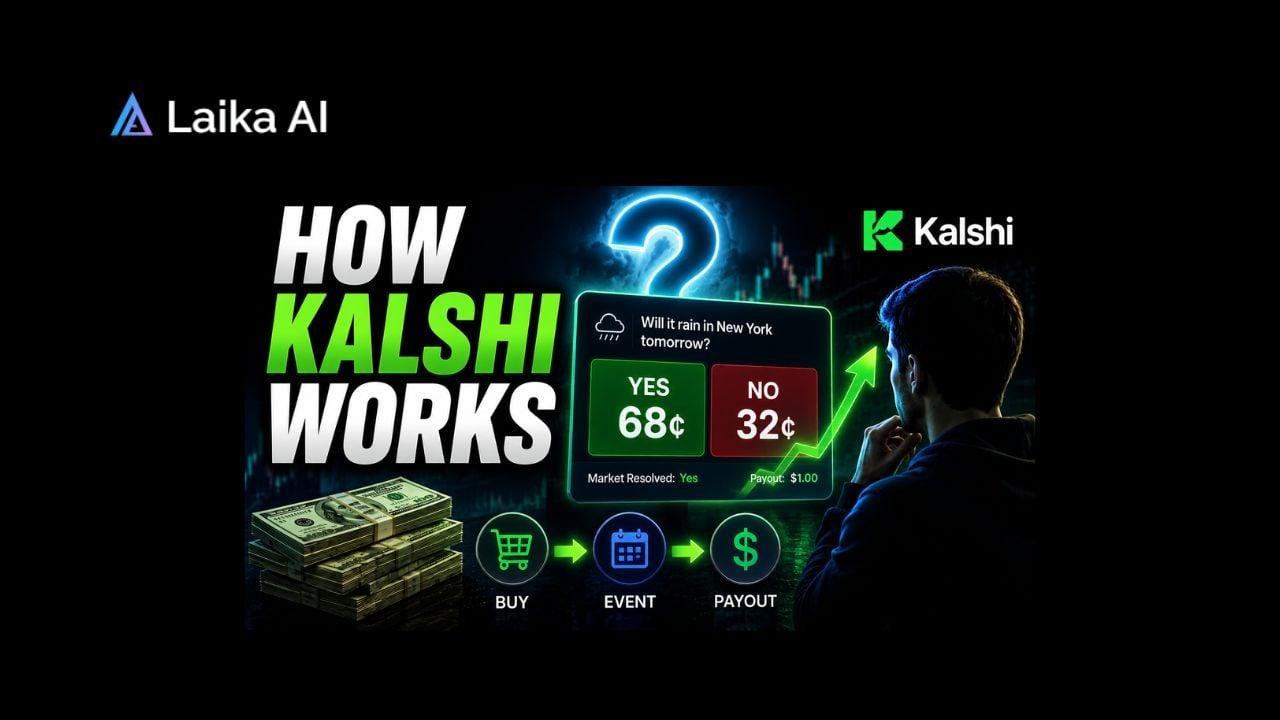
The short version: you buy a contract on whether something will happen. If you are right, the contract pays $1.00. If you are wrong, it pays $0. The price you pay to enter reflects the market's implied probability of that outcome. You can sell your position at any time before resolution if the price moves in your favor.
This guide covers every mechanical question a beginner needs answered before placing a first trade.
What Kalshi Actually Is
Kalshi is a CFTC Designated Contract Market, the same federal regulatory classification as the Chicago Mercantile Exchange. It has held that status since 2020, making it the longest-standing federally regulated prediction market in the United States. The CFTC classifies Kalshi's event contracts as derivatives under the Commodity Exchange Act, not as gambling products, which is why Kalshi can legally operate in states where traditional sportsbooks cannot.
That regulatory structure creates three practical differences from a sportsbook that matter before you trade anything.
You are not betting against the house. On DraftKings or FanDuel, the sportsbook takes the other side of your bet and profits from the built-in margin in every line. On Kalshi, you are trading against other participants on a central order book. Kalshi earns a transaction fee regardless of who wins. There is no structural incentive to take positions against you.
Winning accounts are not limited or banned. Sportsbooks routinely restrict accounts that win consistently because profitable bettors cost the book money directly. Kalshi earns fees whether you win or lose, so there is no reason to restrict profitable traders. Position size limits exist but apply equally to every participant.
You can exit before resolution. A sportsbook bet is locked until the event ends. A Kalshi contract can be sold at any time before resolution at the current market price. If you buy a contract at $0.40 and the market moves to $0.65 in your favor, you can sell and realize the profit without waiting for the outcome.
For the full background on Kalshi's history, regulatory journey, and founding, Kalshi explained: billionaire founder and prediction markets covers the complete context. For the specific question of whether Kalshi constitutes sports betting under US law, is Kalshi sports betting? Legality and how it works covers the legal framework in detail.

How Kalshi Contracts Are Priced and Resolved
Every Kalshi market asks a specific yes or no question about a real-world outcome. Will the Federal Reserve cut rates at the July meeting? Will the high temperature in Chicago exceed 90 degrees on August 3? Will the US unemployment rate fall below 4.0% by year-end?
The pricing mechanic
Contracts are priced between $0.01 and $0.99. The price represents the market's implied probability of the YES outcome occurring. A contract at $0.72 means traders collectively assign a 72% probability to that outcome. The math is direct: price equals implied probability, expressed as a dollar amount rather than a percentage.
If you buy YES at $0.72 and the outcome occurs, you receive $1.00 per contract. Your profit is $0.28 per contract. If the outcome does not occur, your contract pays $0 and you lose the $0.72 you paid.
If you buy NO at the inverse price of approximately $0.28, you receive $1.00 if the outcome does not occur. YES and NO prices always sum to approximately $1.00, reflecting the constraint that exactly one side must win on any binary contract.
How prices are set
Kalshi does not set prices. The order book sets prices through the interaction of buy and sell orders from all active participants. When more traders want to buy YES, the price rises. When more want to sell or buy NO, the price falls. The current price at any moment is the market's best estimate of the probability, aggregated across all capital-backed positions.
This is why Kalshi prices can be more accurate than a sportsbook line on the same event. A sportsbook line reflects one company's opinion, adjusted for their risk position and profit margin. A Kalshi price reflects the aggregate of thousands of traders with real money at stake, updated continuously.
What triggers resolution
Every Kalshi contract specifies an official resolution source and a resolution condition. For a Federal Reserve rate decision market, the resolution source is the Fed's official announcement of the target federal funds rate. For a temperature market, the source is typically the National Weather Service observation at a named station. The contract resolves automatically once the resolution condition is confirmed by the specified source.
Resolution typically happens within a few hours of the outcome being publicly confirmed. Winning shares convert to $1.00 each in your cash balance automatically. You do not need to claim a payout or submit any request.
Kalshi Fees Explained
Understanding Kalshi fees requires separating three distinct cost types: trading fees, deposit fees, and withdrawal fees.
Trading fees
Kalshi charges a fee on each trade based on the contract price and the size of your position. The fee structure uses a percentage of expected profit rather than a flat percentage of your stake.
The taker fee coefficient on Kalshi is 7%, applied to the implied expected profit of the trade. On a contract priced at $0.60 where your maximum profit per share is $0.40, the fee is approximately 7% of $0.40, which equals $0.028 per share. On 100 shares, the fee is $2.80.
The fee is highest on contracts near $0.50, where expected profit per dollar staked is highest. It is lower on contracts near $0.01 or $0.99, where the outcome is near-certain and the potential profit per dollar staked is correspondingly small.
In plain terms, the answer to how much does Kalshi take is approximately 1 to 2% of your total position size on standard contracts, though the exact amount depends on the contract price. That compares favorably to sportsbook vig of 4.5 to 8% on equivalent markets.
Traders who provide liquidity through limit orders that sit on the book and get filled by other traders pay lower fees than traders who cross the spread with market orders. Kalshi introduced tiered maker rebates in early 2026 that partially offset taker fees for high-volume traders who consistently provide liquidity.
Deposit fees
Kalshi charges a 2% fee on debit card deposits. ACH bank transfers, wire transfers, and PayPal deposits do not carry the same deposit fee. If you are depositing regularly and want to minimize costs, ACH is the preferred funding method.
Withdrawal fees
Kalshi charges a flat $2 withdrawal fee per withdrawal regardless of the amount. On large withdrawals this fee is negligible. On small withdrawals it can represent a meaningful percentage of the amount transferred. Batch your withdrawals if you withdraw frequently to keep this cost proportional.
The idle balance offset
Kalshi pays 3 to 4% APY on uninvested cash balances in your account. Capital sitting in your Kalshi account between trades earns interest at a rate that partially offsets the fee costs for traders who maintain a cash reserve. This is a genuine advantage over Polymarket, which pays nothing on idle balances.
For a full side-by-side fee comparison including worked examples across different contract prices and position sizes, prediction market fees in 2026: Kalshi vs Polymarket covers every calculation in detail.
Placing a Trade and Getting Your Money Out
Funding your account
Kalshi accepts deposits via ACH bank transfer, debit card, wire transfer, PayPal, Venmo, and Cash App. No cryptocurrency or crypto wallet is required. Debit card deposits arrive instantly. ACH transfers take one to two business days. The minimum deposit is $1.
Account creation requires standard identity verification: name, address, date of birth, and government-issued ID. The process takes approximately five minutes. Kalshi is currently available in over 40 US states. The nine restricted states as of mid-2026 are Arizona, Illinois, Massachusetts, Maryland, Michigan, Montana, New Jersey, Nevada, and Ohio.
Understanding Kalshi odds
Kalshi odds are displayed in four formats that you can switch between in your account settings: price, which is the default dollar amount between $0.01 and $0.99; percentage, which shows the implied probability directly; American odds, which converts to the plus/minus format familiar from sportsbooks; and decimal odds, used by international bettors.
All four formats represent the same underlying probability. A $0.65 price equals 65% probability equals approximately -186 in American odds equals 1.54 in decimal odds. The choice of display format does not affect the contract mechanics, fees, or payout. Choose whichever format you find most intuitive.
Placing an order
From the market page, select YES or NO on your chosen outcome, enter the number of contracts and the price you want, and submit the order.
A market order executes immediately at the best available price on the order book. It is the simplest way to enter a position but crosses the spread, meaning you pay slightly more than the midpoint price on a buy and receive slightly less on a sell.
A limit order specifies the exact price you want and waits on the book until another trader matches it. Limit orders avoid paying the spread but may not fill immediately or at all if the market moves away from your specified price before your order is matched.
For beginners: use limit orders on thinner markets where the spread between the best bid and ask is wide. Use market orders on liquid markets where the spread is narrow and immediate execution is more important than price precision.
How to withdraw from Kalshi
To withdraw, navigate to your account balance section and select withdraw. Enter the amount and choose your withdrawal method. Withdrawals go to the same funding source used for the original deposit.
ACH withdrawals typically arrive within one to three business days. Debit card withdrawals typically arrive within 30 minutes. Wire transfers take one to two business days.
The $2 flat fee applies per withdrawal regardless of method. Your Kalshi cash balance must reflect cleared funds before withdrawal is available. Funds from recently resolved markets may take a short processing period before appearing as withdrawable cash.
Frequently Asked Questions
How does Kalshi actually work?
Kalshi is a CFTC-regulated exchange where you trade binary yes/no contracts on real-world outcomes. Each contract is priced between $0.01 and $0.99, reflecting the market's implied probability. A winning contract pays $1.00 per share. A losing contract pays $0. You trade against other participants on a central order book, not against the house. You can sell your position at any time before resolution at the current market price.
How much does Kalshi take in fees?
Kalshi's taker fee coefficient is 7% of the expected profit per trade. On a standard contract at $0.60 where maximum profit per share is $0.40, the fee is approximately $0.028 per share. In practice this works out to roughly 1 to 2% of total position size on most contracts. Kalshi also charges a 2% fee on debit card deposits and a flat $2 withdrawal fee. Idle cash in your Kalshi balance earns 3 to 4% APY, which partially offsets fee costs.
How long does a Kalshi withdrawal take?
Debit card withdrawals typically arrive within 30 minutes. ACH bank transfers take one to three business days. Wire transfers take one to two business days. A flat $2 fee applies per withdrawal regardless of amount or method. Funds must be cleared in your Kalshi balance before they are available to withdraw.
What happens if a Kalshi market ties or resolves ambiguously?
Kalshi's contract rules specify exactly how each market resolves, including edge cases. Most binary contracts cannot technically tie because they ask yes/no questions with a defined resolution source. If an event is canceled, postponed, or otherwise cannot be resolved according to the original contract criteria, Kalshi's rules may specify cancellation of the market with full refund of positions, or resolution based on the most recent confirmed data. The exact handling depends on the specific market rules, which are listed on every market page. Read them before trading any market where an edge case is plausible.
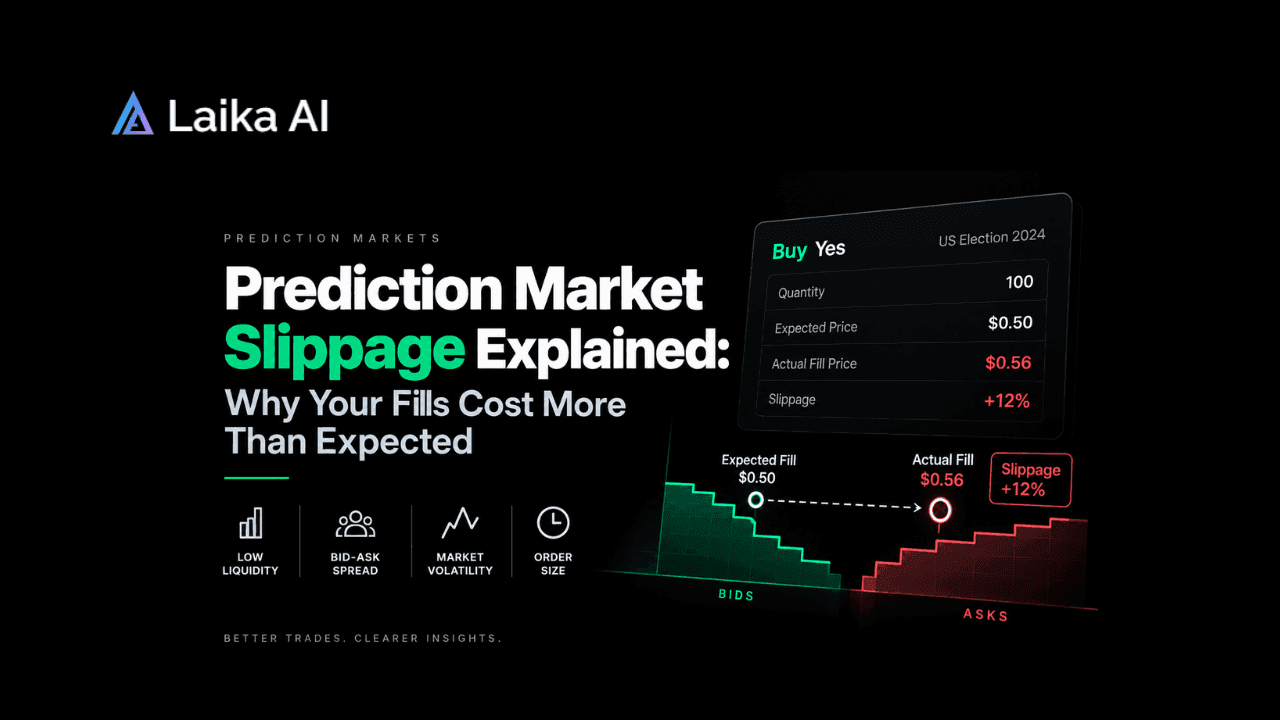
What is slippage on Kalshi, and how does it affect my trade?
Slippage is the difference between the price you expect and the price you actually receive when your order executes. It occurs when the order book does not have enough volume at your target price to fill your full order. If you want to buy 500 shares at $0.60 but only 100 shares are available at $0.60, the next 400 shares may fill at $0.61, $0.62, or higher depending on available liquidity. Your average fill price ends up worse than the displayed price. Slippage is more common on thin markets with low volume. Avoid it by using limit orders at your target price rather than market orders, and by checking order book depth before entering larger positions.
The Bottom Line
Kalshi works as a federally regulated exchange where you trade event contracts on real-world outcomes. The price is the probability. Winning contracts pay $1.00. Fees are based on expected profit rather than stake size, typically 1 to 2% of position value in practice. You can exit any position before resolution. Withdrawals process within minutes to a few business days depending on your method.
The key features that make Kalshi different from a sportsbook, no house edge in the price, no account limiting for winners, and the exit mechanic before resolution, are all products of its exchange structure rather than policy choices that could change. They are built into how the market mechanism works.
For strategies that go beyond the basics and apply specifically to weather markets on Kalshi, Kalshi weather betting strategy covers the beginner-to-intermediate framework. For a broader set of approaches across every Kalshi market category, Kalshi prediction market: 7 strategies that work in 2026 covers the full tactical picture.
Track how Kalshi market prices move in real time across every active contract with Polymetric by Laika AI. Live market intelligence for traders who want to see price movements before the crowd does.