Kalshi weather betting works differently from anything you have probably seen on a sportsbook. You are not picking a team or predicting a score. You are trading a binary contract on a specific, measurable weather outcome: will the high temperature in Chicago exceed 90 degrees on Nov 14, or will total rainfall in Miami exceed one inch this week? If you are right, your contract pays $1. If you are wrong, it pays $0. The price you pay to enter is the market's implied probability of that outcome occurring.
That structure makes Kalshi weather markets genuinely tradeable in a way that traditional weather bets are not, because the price is always visible, the resolution source is always specified, and you can sell your position before the market resolves if the market moves in your favor. For a full comparison of how Kalshi weather markets sit against Polymarket's equivalent offering, Kalshi vs Polymarket weather markets covers the head-to-head in detail.
This guide covers how Kalshi weather contracts are priced and structured, a simple strategy for placing your first trade, and the most common mistakes beginners make before they understand how the markets actually work.
How Kalshi Weather Markets Are Priced and Structured
Every Kalshi weather market is a binary event contract. The contract asks a yes or no question about a specific measurable weather condition at a specific location on a specific date or within a specific window.
The pricing mechanic
Contracts are priced between $0.01 and $0.99. The price represents the market's implied probability of the YES outcome occurring. A contract priced at $0.65 means traders collectively assign a 65% probability to that outcome. If you buy YES at $0.65 and the outcome occurs, you receive $1.00 per contract, a profit of $0.35. If the outcome does not occur, you receive $0 and lose your $0.65 stake.
You can also buy NO contracts at the inverse price. If YES is at $0.65, NO is at approximately $0.35. Buying NO pays $1.00 if the outcome does not occur. YES and NO prices always sum to approximately $1.00, reflecting the constraint that exactly one side must win.
The resolution source
Every Kalshi weather contract specifies the official data source that determines resolution. For most US temperature and precipitation markets, that source is the National Weather Service observation at a named station. The exact station matters, not just the city. The NWS station at O'Hare Airport and a private weather station five miles away can record different readings on the same day. Always check which station the contract resolves on before comparing it to any forecast you are using to evaluate the trade.
Resolution typically occurs within a few hours of the observation being recorded. Kalshi's settlement materials indicate that markets usually resolve once the official data is confirmed, and your cash balance updates automatically.
The contract types available
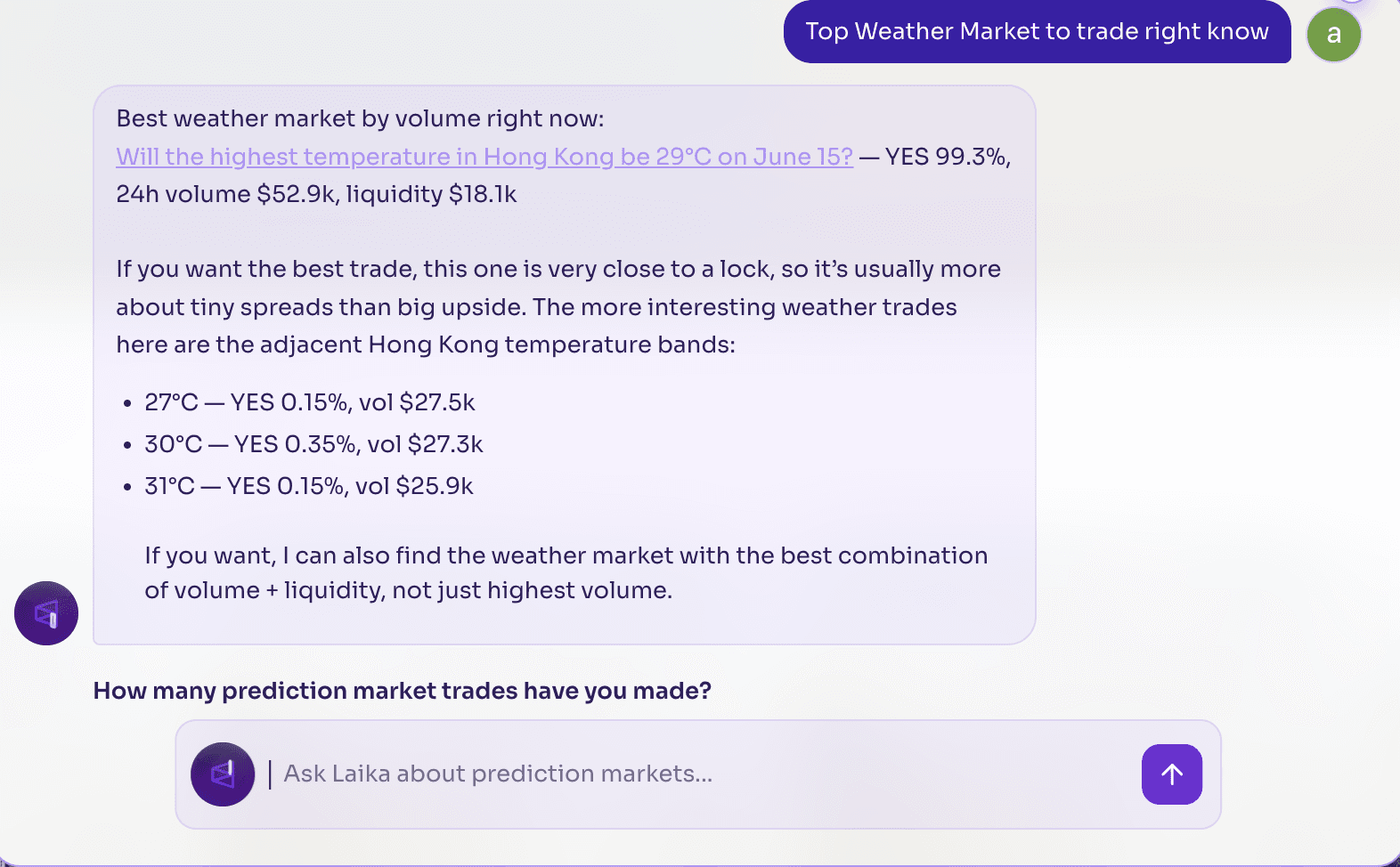
Temperature range markets ask whether the high or low temperature at a specific location will fall within or exceed a specific range. Precipitation markets ask whether total rainfall or snowfall will exceed a threshold over a defined period. Named storm markets during hurricane season cover formation, intensity, and landfall questions. Each type has its own data dependency and its own timing characteristics.
For a full explanation of how Kalshi sits within the broader prediction market landscape, Kalshi explained: billionaire founder and prediction markets covers the platform's regulatory structure and history.
A Simple Strategy for Beginners
The core of any kalshi weather betting strategy is comparing the current contract price to what the official forecast suggests the probability actually is, then trading the gap when you find one.
Step 1: Find the forecast for the resolution station
Before evaluating any contract price, identify the exact NWS station named in the contract resolution criteria. Go to weather.gov and pull the forecast for that specific station or the nearest forecast point. Do not use a weather app on your phone. Do not use a city-level forecast that may be averaging across multiple stations. Use the NWS forecast for the specific location the contract resolves on.
Step 2: Estimate the probability from the forecast
Convert the forecast into a rough probability for the specific contract outcome. If the NWS is forecasting a high of 88 degrees with high confidence and the contract asks whether the high will exceed 85 degrees, your probability estimate is high, perhaps 80 to 90 percent. If the forecast is 84 degrees with significant uncertainty due to a passing storm system, your estimate is lower and more spread across possible outcomes.
The NWS forecast discussion document, available on weather.gov for every forecast zone, describes the meteorologist's confidence level and the key uncertainties in plain language. Reading it takes two minutes and tells you more than the headline forecast number alone.
Step 3: Compare your estimate to the contract price
If the contract is priced at $0.55 and your probability estimate based on the NWS forecast is 70%, you have identified a potential 15-point gap. That gap represents a possible edge. If your estimate is 58%, the gap is small enough to be within normal forecast uncertainty and is not worth acting on.
A gap of 8 percentage points or more on a clear, high-confidence forecast is the threshold most systematic weather traders use as a minimum before entering a position. Below that, the uncertainty in your own estimate likely overlaps with the uncertainty in the market price.
Step 4: Size the position conservatively
For your first trades, keep individual positions small relative to your total Kalshi balance. A reasonable starting point is 2 to 5 percent of your available capital per trade. Weather markets can move quickly after model updates, and a forecast that looks clear at noon can look less certain by 6 PM after the next GFS model run. Small positions let you learn how the markets behave without overexposing yourself to a single outcome.
Step 5: Monitor the position and decide whether to hold or sell
After entering a position, the NWS will issue updated forecasts at regular intervals. If the forecast shifts meaningfully toward your position, the contract price will likely move with it and you may be able to sell at a profit before resolution. If the forecast shifts away from your position, you can cut the loss by selling rather than waiting to see if the market moves back.
The exit option is one of the most valuable features of kalshi betting on weather contracts relative to traditional fixed-odds weather bets. Use it. Do not treat every position as something you must hold to resolution.
For a broader set of strategies that apply across Kalshi's market categories beyond weather, Kalshi prediction market: 7 strategies that work in 2026 covers the full tactical framework. For the equivalent manual strategy framework on Polymarket's weather markets, the complete guide to trading weather markets on Polymarket covers the structure in detail.
Common Mistakes and How to Avoid Them
Using the wrong data source
The most expensive beginner mistake in Kalshi weather betting is comparing the contract price to a forecast from a different source than the one the contract resolves on. A city-level forecast from a consumer weather app may differ from the NWS station observation by 2 to 4 degrees on any given day due to local terrain effects, urban heat islands, and data processing differences. If the contract resolves on the NWS O'Hare station reading and you are evaluating it against the forecast for downtown Chicago, you are not comparing equivalent things.
Always identify the exact resolution station first. Then find the NWS forecast specifically for that station. Everything else is secondary.
Treating the point forecast as certain
A forecast of 86 degrees does not mean the temperature will be exactly 86 degrees. It means 86 is the most likely outcome given current atmospheric conditions. There is a meaningful probability of the temperature being 81 or 91 depending on how a front moves or how cloud cover develops. Beginners often see a forecast and immediately enter a position as if the forecast is guaranteed, without accounting for the uncertainty range around the point estimate.
Before entering any temperature contract, ask how confident the NWS is in the forecast. A seven-day forecast has significantly more uncertainty than a 24-hour forecast. A forecast during a stable, high-pressure weather pattern has less uncertainty than one during an active weather system. That uncertainty should be reflected in your position size.
Entering too many markets at once
Kalshi weather markets across multiple cities and multiple dates can look like diversification. In practice, temperature patterns are correlated across geographic regions. If a heat dome settles over the Midwest, temperature contracts in Chicago, St. Louis, and Kansas City may all move in the same direction simultaneously. Entering all three does not reduce your risk the way entering three unrelated market categories would.
In your first month of kalshi weather market trading, restrict yourself to one or two markets at a time. Understand how those specific markets behave before expanding to a broader set.
Ignoring the spread on thin markets
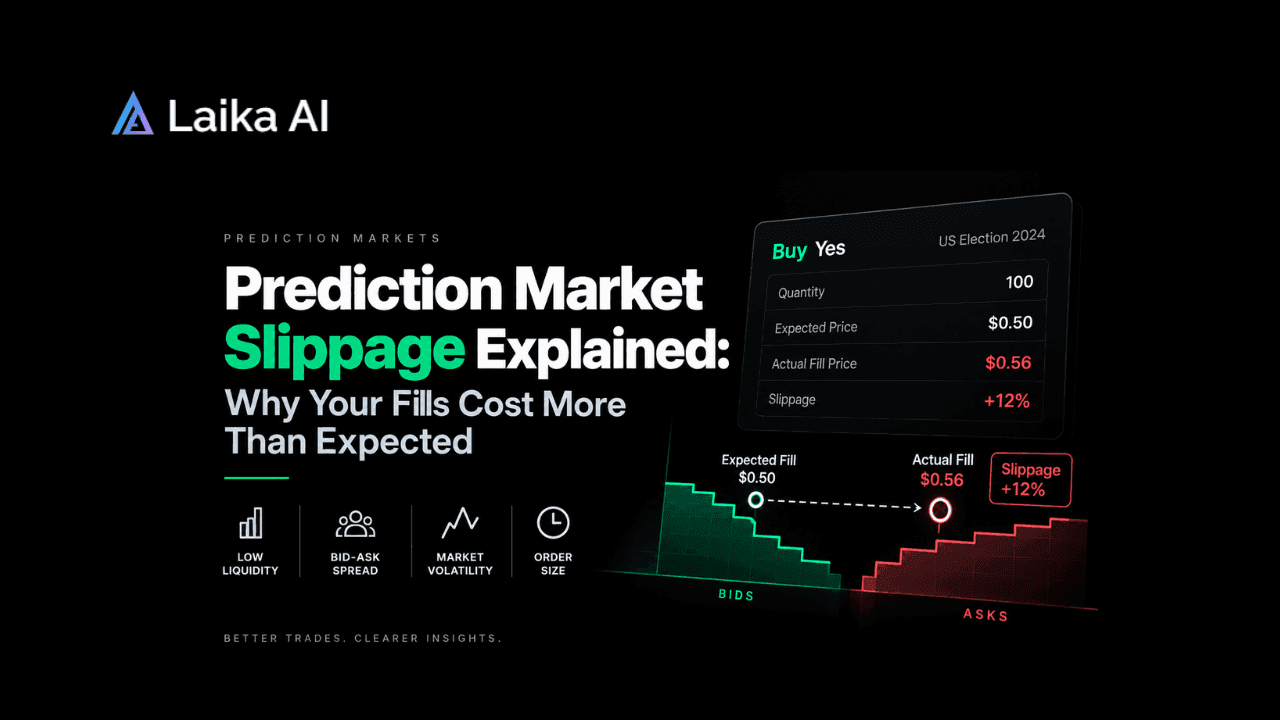
Not every Kalshi weather contract has deep liquidity. On thinner markets, the spread between the best bid and the best ask can be 5 to 10 cents. If you enter a position by crossing a 7-cent spread, you are immediately down 7 cents per share before the market has moved at all. On a contract where your estimated edge is 10 percentage points, a 7-cent spread consumes 70 percent of your potential gain before you have done anything.
Check the order book depth before placing any trade. If the spread is wide, use a limit order at the price you want rather than a market order that crosses the full spread immediately.
Not knowing your exit path before you enter
Every position you enter on Kalshi should have a defined exit plan before you commit capital. That plan should answer two questions: at what price will you sell if the market moves in your favor, and at what price will you cut the loss if the market moves against you. Entering a position without that plan leads to holding too long on losing trades and exiting too early on winning ones.
For a complete framework on managing capital across multiple prediction market positions including sizing, exit rules, and loss limits, the prediction market bankroll management guide covers the methodology in detail.
Frequently Asked Questions
How does Kalshi weather betting work?
Kalshi weather betting involves trading binary event contracts on specific measurable weather outcomes. You buy YES or NO contracts on questions like whether a city's high temperature will exceed a threshold on a specific date. Contracts are priced between $0.01 and $0.99, representing the market's implied probability. A YES contract pays $1.00 if the outcome occurs and $0 if it does not. You can sell your position at any time before resolution at the current market price.
Is Kalshi weather betting legal in the US?
Yes. Kalshi is a CFTC Designated Contract Market and has held that regulatory status since 2020. Its weather event contracts are classified as derivatives under federal law, not as gambling products. Kalshi is currently available in over 40 US states. It is restricted in nine states including Arizona, Illinois, Massachusetts, Maryland, Michigan, Montana, New Jersey, Nevada, and Ohio. Check Kalshi's current availability page before signing up if you are unsure about your state.
What is the Kalshi betting market for weather?
The Kalshi weather market category includes temperature range contracts, precipitation threshold contracts, and named storm contracts across major US cities. Each contract specifies a measurable weather condition, a location, a resolution date, and an official data source, typically the National Weather Service. Contracts resolve automatically once the official observation is recorded, and payouts go directly to your Kalshi cash balance. Visit Kalshi for the current live market menu.
Can you find good Kalshi weather betting strategies on Reddit?
Reddit communities including the prediction markets subreddit and crypto-adjacent communities have documented weather trading approaches on both Kalshi and Polymarket. The most commonly discussed strategy across those communities is the forecast-versus-price comparison approach covered in this article: identifying gaps between NWS model output and current contract prices. Community discussions are useful for understanding how other traders approach position sizing and resolution risk, but treat any specific trade recommendation with appropriate skepticism, as individual circumstances and risk tolerances vary significantly.
What is the safest way to start betting on weather with Kalshi?
Start with short-duration temperature contracts on major US cities where NWS forecast data is most reliable and the resolution source is clearly documented. Keep individual positions at 2 to 5 percent of your available Kalshi balance. Use limit orders rather than market orders to avoid crossing wide spreads on thinner markets. Enter positions only when the gap between your NWS-based probability estimate and the contract price is 8 percentage points or more. And always identify your exit plan before committing capital to any position.
The Bottom Line
Kalshi weather betting rewards traders who do two things consistently: use the right data source and compare it honestly to the current contract price. The edge in these markets is not in predicting weather better than professional meteorologists. It is faster than the broader market at incorporating NWS forecast updates into a probability estimate and trading the gap before the market catches up.
Start small, stay disciplined about which data source you compare prices against, and treat the exit option as a feature rather than an afterthought. Most of the mistakes beginners make in Kalshi weather markets come from entering positions without a clear plan for how and when to get out.
For the full comparison of how Kalshi and Polymarket weather markets differ in liquidity, fees, and resolution mechanics, Kalshi vs Polymarket weather markets covers every dimension worth knowing before you decide which platform to use.
Track how weather contract prices move in real time across every active market with Polymetric by Laika AI. Live market intelligence so you see forecast-driven price gaps before the crowd does.