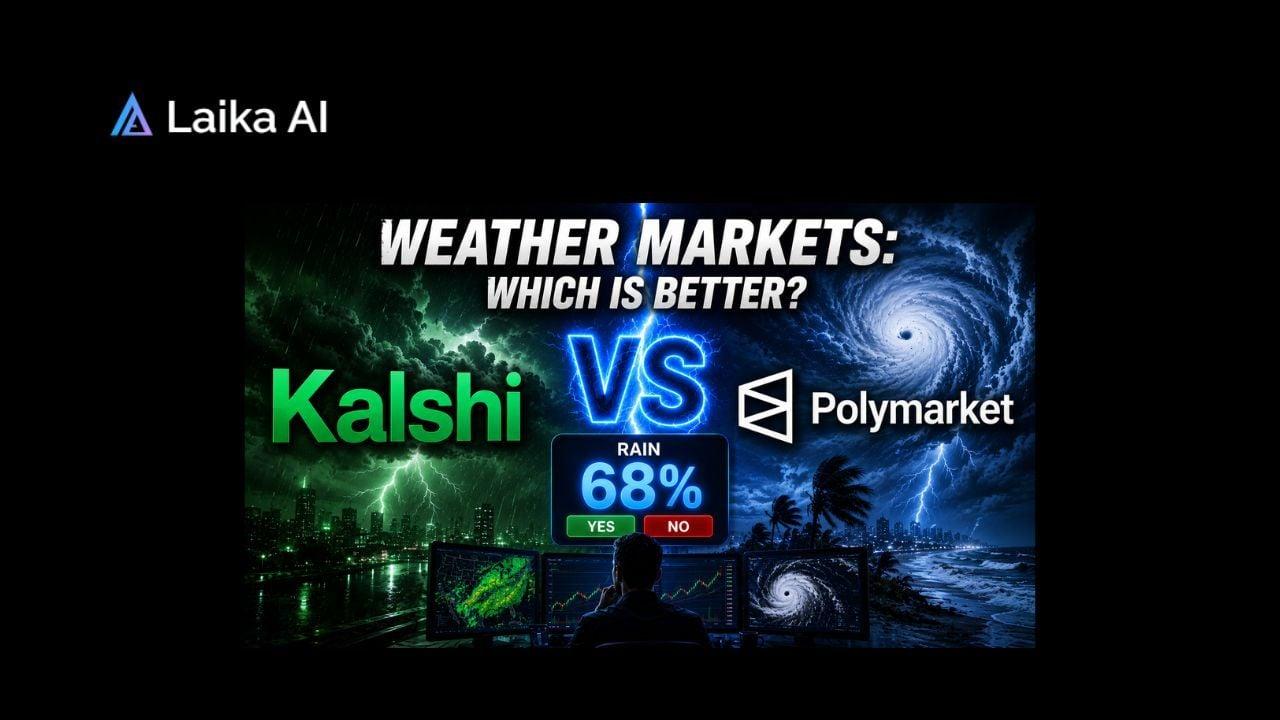
Kalshi weather betting has quietly become one of the most distinctive product categories in the prediction market industry. Both Kalshi and Polymarket now run meaningful weather market categories, and the differences between them are not obvious from a surface-level comparison. The resolution sources differ. The fee structures differ. The liquidity profiles differ. And the regulatory frameworks that govern each platform create meaningfully different experiences depending on where you are located and how you trade.
This article compares Kalshi and Polymarket weather markets across every dimension that matters for an active trader: coverage, liquidity, fees, resolution sources, and the specific trader profiles each platform serves best. For the full manual trading strategy framework across both platforms, the complete guide to trading weather markets on Polymarket covers the complete picture.
Weather Market Coverage: What Each Platform Offers
The first thing to establish is what each platform actually runs, because the category descriptions from both platforms are broader than the specific markets available at any given time.
Kalshi weather market coverage
Kalshi runs weather event contracts structured as binary yes/no questions on specific measurable conditions. The core categories are temperature extremes, precipitation events, and named storm activity. Temperature markets typically ask whether the high or low temperature at a specific city will exceed or fall below a specific threshold on a specific date. Precipitation markets ask whether total rainfall or snowfall will exceed a specific amount over a defined period. Named storm markets cover hurricane formation, landfall, and intensity.
City coverage on Kalshi concentrates on major US population centers where NWS observation data is most reliable and where the retail trading audience has the most direct interest. New York, Chicago, Los Angeles, Miami, Houston, and Atlanta consistently have the most active weather contracts. Kalshi also runs national aggregate markets covering whether a heat dome or winter storm warning will be issued across a defined region.
The Kalshi weather category is accessible at kalshi.com. The full current market menu changes seasonally, with hurricane markets dominant from June through November and temperature and precipitation markets active year-round.
Polymarket weather coverage
Polymarket weather markets run on the global platform and reflect a broader international audience. Temperature, precipitation, and named storm contracts are available, with coverage extending to European cities including London, Paris, and Berlin alongside US markets. The international audience creates a different liquidity profile from Kalshi: Polymarket weather markets on European conditions tend to have more informed participants than Kalshi, where the user base is primarily US-based.
Polymarket also runs weather markets that do not exist on Kalshi, including longer-duration climate and seasonal outlook markets that extend beyond the two-week window where numerical weather models have meaningful skill. These longer-duration markets are fundamentally different trading instruments because they rely on seasonal climate patterns rather than deterministic forecast models.
The full Polymarket weather market hub is accessible at polymarket.com for direct comparison against Kalshi's current offerings.
The coverage verdict
For US-focused weather traders, Kalshi has comparable or better coverage on domestic temperature and precipitation events with stronger regulatory clarity. For international weather markets and longer-duration climate contracts, Polymarket's global platform has broader coverage. For hurricane season specifically, both platforms run overlapping markets and the cross-platform comparison is worth checking before entering any position.
Liquidity, Fees, and Resolution Sources
This is the section where the practical differences between polymarket weather betting and kalshi weather betting become most significant for active traders.
Liquidity comparison
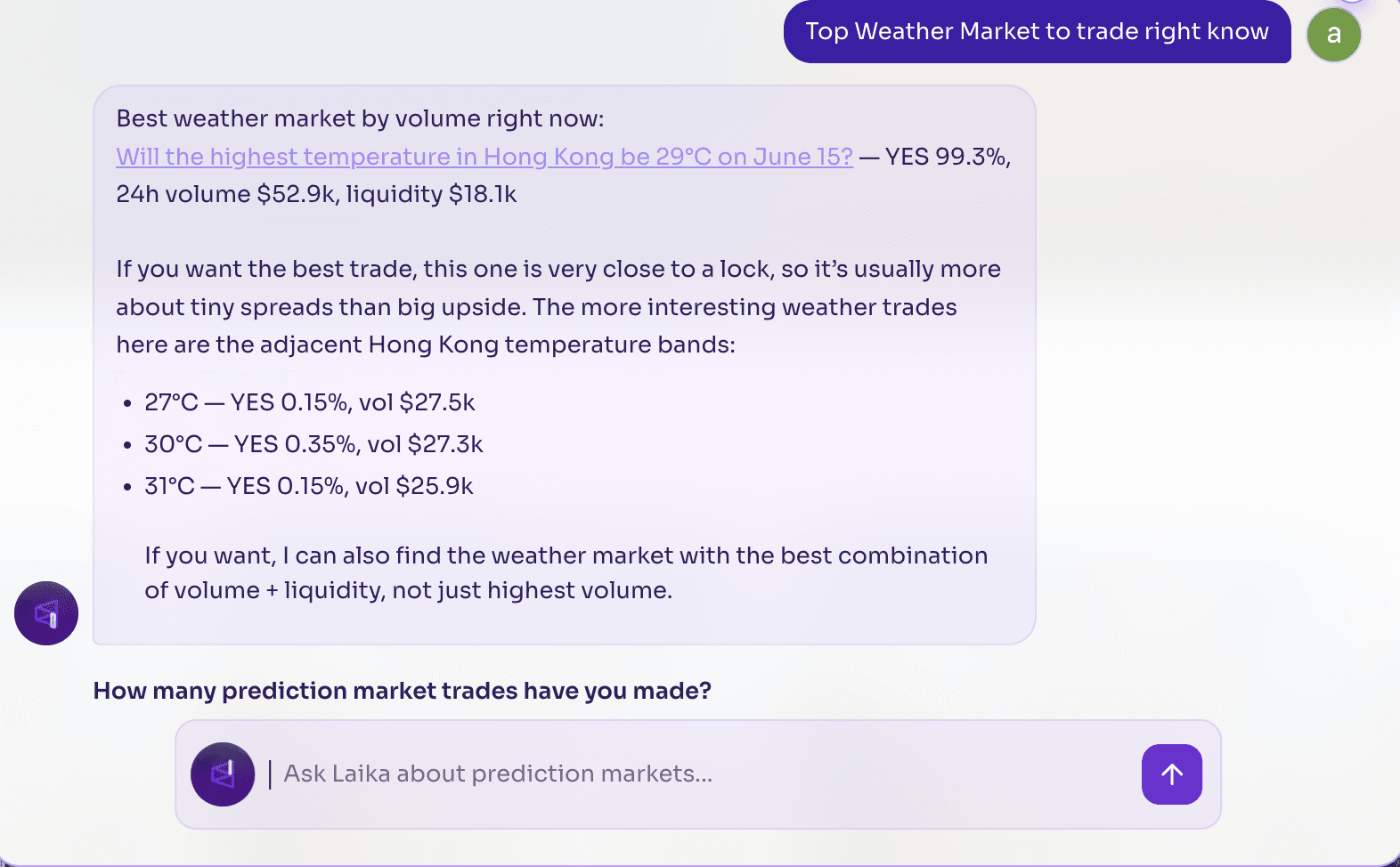
Kalshi's weather markets benefit from the platform's US retail audience and its Robinhood integration, which routes millions of existing Robinhood users into Kalshi weather contracts without requiring a separate account. This distribution advantage creates higher retail volume on domestic US weather events than Polymarket's equivalent contracts typically see.
Polymarket's weather markets have higher volume on major events and on markets that attract international interest, particularly during major named storm events and seasonal temperature anomaly markets. For a standard city temperature contract on a Tuesday in March, Kalshi's volume is typically comparable to or higher than Polymarket's.
The practical implication for position sizing: on major named storm markets during the active hurricane season, both platforms run deep enough to size meaningfully. On routine daily temperature markets in off-peak months, neither platform has enough volume to deploy large positions without moving the price against the entry. Check the order book depth on both platforms before committing to any position above $500 on a single weather contract.
Fee comparison
The fee difference between the two platforms is material across active weather trading volume.
On a standard weather contract at 55 cents where maximum profit per share is 45 cents, Kalshi's taker fee is approximately 2% of 45 cents, which is under 1 cent per share. Across a high-frequency weather bot running dozens of trades per day, that fee compounds into a meaningful number. Across a casual trader making five weather trades per month, the dollar difference is negligible.
The counterargument for Kalshi's fee structure is the idle balance interest. A trader who keeps $5,000 in a Kalshi account between weather market trades earns $150 to $200 annually in APY. Polymarket pays zero on idle funds. For traders who maintain significant capital on the platform between positions, this partially closes the fee gap.
For the full fee breakdown with contract-level worked examples across both platforms, prediction market fees in 2026: Kalshi vs Polymarket covers every calculation in detail.
Resolution sources: the most important practical difference
Resolution source is the single most important variable to understand before trading weather markets on either platform, and it is the dimension most comparison articles skip.
Kalshi weather markets resolve based on official NWS (National Weather Service) observations at specific stations. The resolution station is named in each contract's rules. This means a Chicago temperature contract resolves on the reading from Chicago O'Hare International Airport's NWS station, not from a private weather network, not from a nearby suburban station, and not from a model forecast.
Polymarket weather market resolution sources vary by contract. Most US temperature and precipitation markets also use NWS observation data, but some contracts reference NOAA's Climate Data Online system, which can produce slightly different readings than real-time NWS station reports due to data quality control processing. The specific resolution source is listed in each contract's rules and must be read before entering any position.
Why this matters in practice: a temperature market where the NWS station reads 32.1 degrees Fahrenheit resolves differently from the same market where a nearby private station reads 31.8 degrees. If your weather bot is pulling data from a model that does not map precisely to the resolution station, your probability estimates will be calibrated to a slightly different outcome than the one that determines your payout. This discrepancy is small on most trades but can be significant on contracts where the resolution condition falls close to a threshold.
The resolution risk associated with these differences is covered in the context of the broader regulatory landscape in Kalshi and Polymarket: the prediction market boom, risks, and regulation.
Is Kalshi or Polymarket Better for Weather Trading?
The answer depends on the specific trader profile. There is no universal verdict.
For US casual traders who want simple bank deposits
Kalshi is the better starting point. No crypto wallet required. Standard US bank transfers, debit cards, PayPal, and Venmo accepted. The Robinhood integration means millions of existing users can access Kalshi weather contracts without creating a separate account. For a trader who wants to place five to ten weather trades per month on domestic US temperature or precipitation events without managing crypto infrastructure, Kalshi removes all the friction.
For systematic traders and bot operators
Polymarket have a structural advantage on fees. Zero taker fees on most weather contracts versus Kalshi's 2% of expected profit adds up across high-frequency automated trading. A bot placing 50 trades per day at average position sizes of $200 pays significantly less in total fees on Polymarket than on Kalshi over a month of operation. The Polygon gas costs are negligible at $0.01 to $0.10 per transaction. For the technical infrastructure considerations in building weather bots, how Polymarket weather trading bots work covers the full implementation detail.
For international weather markets
Polymarket's global platform wins clearly. European city temperature markets, international precipitation events, and longer-duration seasonal outlook markets do not exist on Kalshi at comparable depth. A trader based in Europe or trading European weather outcomes has essentially one option: Polymarket.
For hurricane season trading specifically
Both platforms are worth monitoring simultaneously. Named storm markets on Kalshi and Polymarket on the same hurricane can diverge by 5 to 8 percentage points during rapidly developing storm situations, because Kalshi's US retail audience and Polymarket's global audience process the same NHC (National Hurricane Center) forecast updates differently. That gap is a documented cross-platform arbitrage opportunity during the active hurricane season.
The kalshi weather strategy for each profile:
For casual traders: enter Kalshi weather markets in the 24 to 48 hours before a resolution event when the NWS forecast has high confidence, fees are a small percentage of the expected edge, and resolution is imminent enough to minimize holding risk.
For systematic traders: use Polymarket for high-frequency weather bot trading to minimize fee drag, monitor Kalshi prices simultaneously for cross-platform divergences, and maintain accounts on both platforms during hurricane season to capture the 5 to 8 cent gaps that develop during rapidly intensifying storm events.
Cross-Platform Arbitrage: When Both Platforms Price the Same Event Differently
The most concrete opportunity created by running both platforms simultaneously is the cross-platform weather arbitrage trade.
The same named storm, the same temperature event, or the same precipitation outcome can be priced meaningfully differently on Kalshi and Polymarket because the two platforms have different user bases with different information sources and different reaction speeds.
Kalshi's US retail audience, many arriving through Robinhood, tends to anchor on NWS official forecasts and mainstream weather app updates. Polymarket's global audience includes traders from Europe and North America who actively follow ECMWF model output and private meteorological data. When these two data sources diverge on an evolving weather situation, the platforms can diverge by 5 to 8 cents on the same outcome simultaneously.
The arbitrage trade is mechanical: buy the underpriced contract on the platform where the market has not yet incorporated the new information, sell or short the overpriced contract on the platform where it has. The risk is that the two contracts have slightly different resolution criteria or resolution dates, which must be verified before treating them as equivalent instruments.
On liquid named storm markets during an active hurricane season, this cross-platform divergence is the most reliably documented weather market opportunity available. On routine daily temperature contracts, the divergence is smaller and less frequent because both platforms' audiences are processing the same NWS data.
For the complete platform comparison across all market categories beyond weather, Kalshi vs Polymarket: which prediction market is right for you covers the full head-to-head framework.
Frequently Asked Questions
Does Kalshi or Polymarket have more weather markets?
Kalshi has more weather markets focused on US cities, temperature, precipitation, and named storms, with strong retail volume driven by its Robinhood integration. Polymarket has broader coverage overall, including international city markets and longer-duration seasonal climate contracts not available on Kalshi. For US-focused daily weather trading, the depth is comparable. For international weather or seasonal outlook markets, Polymarket's global platform is the only realistic option.
Which platform has better liquidity for weather trading?
For major US named storm events during hurricane season, both platforms run enough volume for mid-size positions. For routine daily temperature markets in off-peak months, neither platform runs deep enough to size large positions without price impact. Kalshi benefits from retail volume driven by Robinhood integration on domestic US events. Polymarket has a higher volume of events with international interest. Check order book depth on both platforms before sizing any individual weather position above $500.
Are Kalshi weather markets regulated differently from Polymarket's?
Yes, materially. Kalshi is a CFTC Designated Contract Market and has held that status since 2020. Its weather contracts are classified as derivatives under federal law. Polymarket's global platform operates under a different regulatory structure and is not accessible to US residents without using the Polymarket US platform launched in December 2025. The regulatory difference affects account funding, withdrawal mechanics, and the legal framework protecting traders in dispute situations.
Can the same weather event be traded on both platforms?
Yes, and this creates the most concrete opportunity in weather market trading. Major named storms, seasonal temperature anomaly events, and significant precipitation events frequently have parallel contracts on both platforms. Resolution criteria and resolution dates may differ slightly between the two, so verification is required before treating them as equivalent instruments for arbitrage purposes. When the criteria are identical or nearly identical, a 5 to 8 cent price gap between platforms on the same event during rapidly developing conditions is a documented trading signal.
Which platform is better for weather market arbitrage?
Arbitrage between Kalshi and Polymarket requires active accounts on both platforms. The opportunity is most reliable during hurricane season on major named storm contracts where the two platforms' audiences process forecast model updates at different speeds. Polymarket's global audience tends to incorporate ECMWF model updates faster. Kalshi's US retail audience anchors more heavily on NWS official guidance. When these two update on different timescales during a fast-moving storm situation, the platforms diverge and create a tradeable gap. Monitoring both simultaneously during active tropical weather events is the most systematic approach to capturing this edge.
The Bottom Line
Kalshi weather betting and polymarket weather betting are not competing for exactly the same trader. They have different strengths, different fee structures, different liquidity profiles, and different user bases that price the same events differently.
For US casual traders who want simple fiat deposits and domestic US weather coverage, Kalshi is the lower-friction platform. For systematic traders and bot operators who want zero platform fees and international coverage, Polymarket is the better venue. For anyone active during hurricane season, both platforms are worth monitoring simultaneously for the cross-platform arbitrage gaps that develop during rapidly intensifying storm events.
The resolution source differences between the two platforms are the most underappreciated practical risk in weather market trading. Read the resolution criteria for every contract on both platforms before entering any position where the outcome falls close to the resolution threshold.
For everything running across polymarket weather markets including manual trading strategies, bot implementation, and market type breakdowns, the complete guide to trading weather markets on Polymarket is the complete resource.
Track how weather market odds shift in real time across every active Polymarket contract with Polymetric by Laika AI. Live market intelligence so you see every model update before the crowd does.