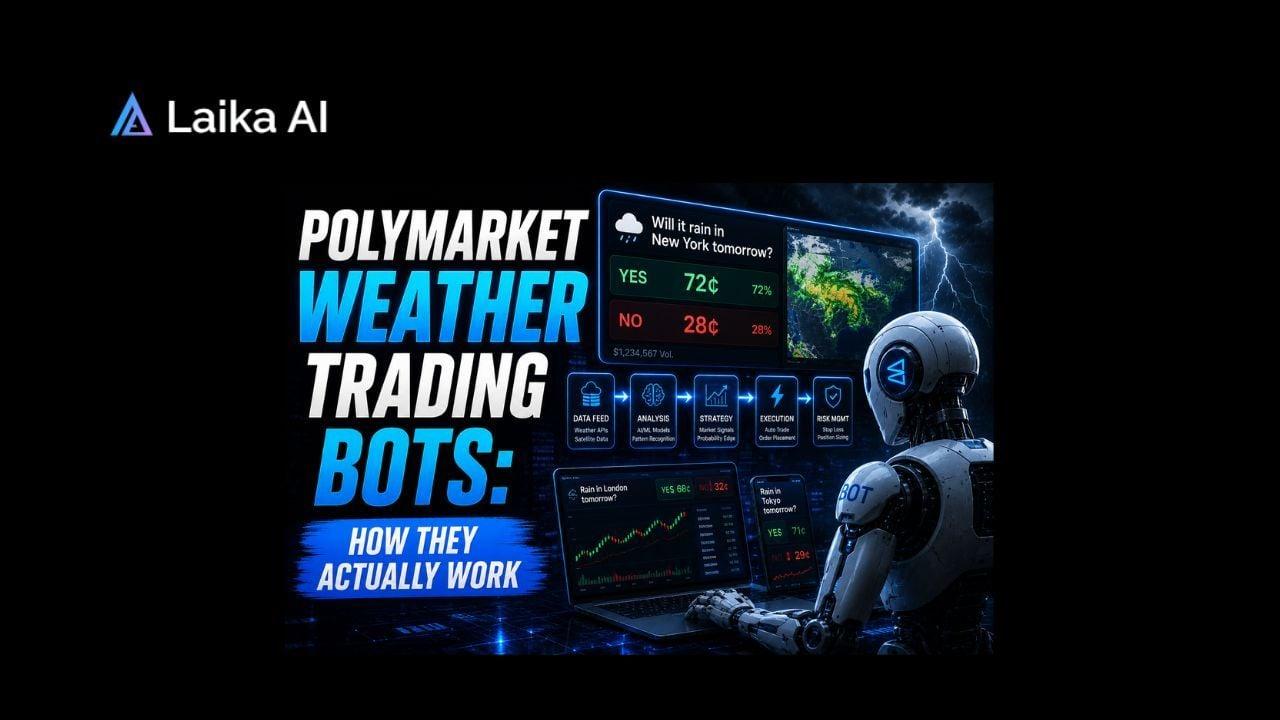
A polymarket weather bot is not a magic money machine. It is a script that checks weather forecast data against Polymarket's current contract prices, identifies gaps between what the forecast model says and what the market is pricing, and places trades automatically when those gaps exceed a defined threshold. That is the entire concept. The sophistication lives in the data sources, the execution logic, and the risk controls around the core idea, not in anything exotic.
Polymarket weather markets have been running since 2023 and currently cover temperature extremes, precipitation totals, snowfall events, and named storm activity across major US and European cities. These polymarket weather markets attract a specific type of trader: one who understands that meteorological forecast models update on a known schedule and that the market is slow to incorporate those updates. The bot exploits that lag.
This article explains how the bots work, what data they use, what the realistic results look like based on documented trader activity, and what the risks are before you run one.
What a Polymarket Weather Bot Actually Does
The core idea behind a weather trading bot is simpler than most people expect.
National weather services and private meteorological agencies run numerical weather prediction models multiple times per day. The most widely used public models, NOAA's GFS and the European Centre for Medium-Range Weather Forecasts ECMWF model, update on a six-hour cycle: 00z, 06z, 12z, and 18z UTC. Each update incorporates new observational data from weather balloons, satellites, ocean buoys, and surface stations, and produces revised probability distributions for temperature, precipitation, and storm activity at specific locations over specific timeframes.
Polymarket's weather market prices, set by human traders, do not update on a six-hour schedule. They update when traders notice the model has changed and decide to act. On thin markets and at off-peak hours, that lag can stretch to several hours. On markets where the resolution event is still days away, the lag is even longer because casual traders are not watching minute-to-minute.
How does a polymarket weather bot work in practice: the bot pulls the latest model output from a weather API, computes the model-implied probability of the resolution condition being met, compares that to the current Polymarket contract price, and places a buy or sell order when the gap exceeds a defined threshold, typically 3 to 8 percentage points after accounting for fees.
The bot does this automatically, across multiple markets, on every model update cycle. A human trader checking prices once a day misses most of the update windows. The bot misses none of them.
For the full context on how to trade weather markets manually before building automation around the process, the complete guide to trading weather markets on Polymarket covers every market type, resolution mechanism, and manual strategy in detail.
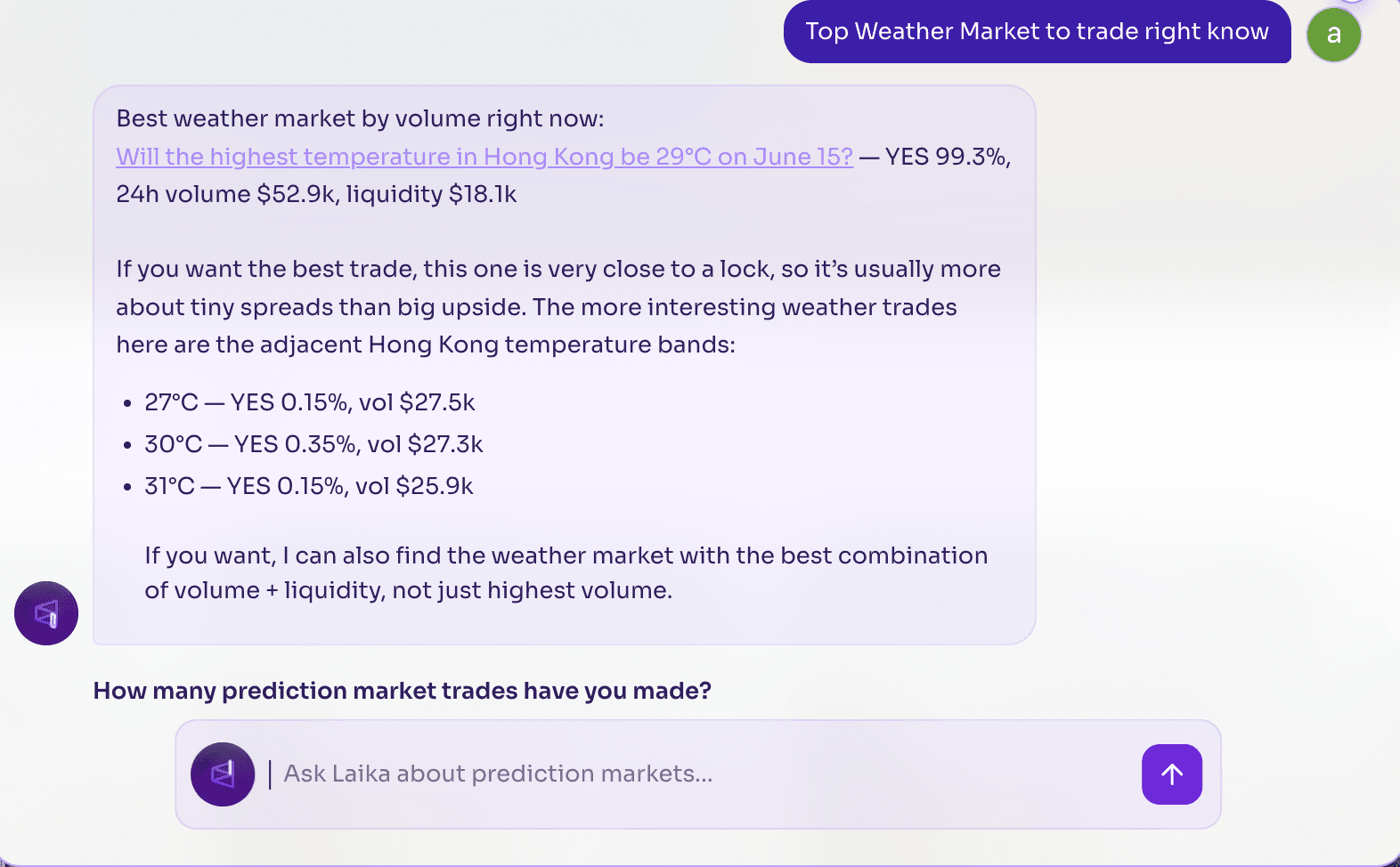
The Data Sources: What Bots Actually Use
The quality of a weather trading bot is almost entirely determined by the quality of its forecast data. The execution logic is straightforward. The data layer is where serious bots differ from amateur ones.
NOAA GFS (Global Forecast System)
The GFS is the primary US government weather model, run by the National Oceanic and Atmospheric Administration. It updates four times per day on the six-hour cycle and produces forecasts out to 16 days at 0.25 degree spatial resolution. GFS data is freely available through NOAA's API and is the most commonly used data source in open-source weather bot implementations. The limitation of GFS is that its skill degrades rapidly beyond seven days and it has known biases in specific geographic regions and weather patterns.
ECMWF (European Centre for Medium-Range Weather Forecasts)
The ECMWF model is widely considered the most accurate medium-range forecast model in the world, particularly for the three to ten day window. Full ECMWF output requires a paid subscription. The ECMWF's ensemble model, which runs 51 slightly different versions of the forecast to produce probability distributions rather than single deterministic forecasts, is particularly valuable for weather trading because it directly outputs probabilities rather than requiring statistical post-processing.
Open-Meteo
Open-Meteo is a free weather API that aggregates GFS, ECMWF, and several other forecast models into a single API endpoint. It is the fastest path to a functional weather bot data feed and is the data source used in most open-source bot repositories currently on GitHub. The free tier covers the data needs of most retail-level weather bots. Visit open-meteo.com for the full API documentation and model coverage.
What good bots do with the data
A basic bot takes the model's point forecast for a specific location and converts it to a binary probability using historical weather data as a calibration layer. A more sophisticated bot uses the ECMWF ensemble directly, which already outputs probability distributions. The most sophisticated bots run multiple models simultaneously, weight them by recent verification skill, and produce a blended probability estimate that outperforms any single model in specific market conditions.
The six-hour model update window is the key timing constraint. A bot that updates its probability estimates and checks market prices every six hours will catch most of the meaningful model changes. A bot that checks more frequently, say every 30 minutes, captures intra-cycle updates from experimental model runs and observational data assimilation, but requires more infrastructure and generates more API calls.
What Realistic Results Look Like
The GitHub repos and developer blog posts around weather trading bots tend to fall into two categories: ones that report remarkable early results on thin markets before the edge was competed away, and ones that document the more modest and more sustainable edges available on liquid markets with good data.
The honest picture from documented trader activity on Polymarket weather markets is as follows.
On markets with under $10,000 in volume, bots with good forecast data can find consistent edges of 5 to 12 percentage points on individual trades. The problem is position sizing. Thin markets cannot absorb large positions without moving the price against the entry. A bot that finds a 10-point edge but can only deploy $200 before moving the market makes $20 on the trade. Scaling a thin-market edge is the primary constraint on weather bot profitability.
On markets with $50,000 or more in volume, edges compress toward 2 to 5 percentage points because more sophisticated traders and other bots are already competing. These markets are liquid enough to size meaningfully, but the edge per trade is smaller. The economics work at scale if the bot is running across many markets simultaneously.
The traders who have documented real profits from weather bots share three characteristics. They use professional-grade forecast data rather than free GFS alone. They run across many markets simultaneously rather than concentrating on one or two. And they treat the bot as a systematic process with defined risk parameters rather than running it unsupervised with unlimited position sizing.
For the fuller comparison of what automated approaches actually produce versus manual trading across Polymarket categories, Polymarket bots vs human traders: the uncomfortable truth about who wins covers the documented evidence in detail.
The Risks: What Bot Guides Usually Skip
Most guides to building weather trading bots spend 90% of their content on the technical implementation and 10% on risk. That ratio should be reversed for anyone considering running a bot with real capital.
Execution risk
Polymarket's order book can be thin on weather markets, particularly outside of peak hours. A bot placing a market order on a contract with $5,000 in volume can move the price against itself by 2 to 4 percentage points on the fill. If your edge is 5 points and your execution slippage is 3 points, you are making 2 points on the trade before fees. At Polygon gas costs of $0.01 to $0.10 per transaction, gas is not the issue. Slippage on thin order books is.
The mitigation is to use limit orders rather than market orders, which means the bot may not fill at all on fast-moving markets. Deciding between fill certainty and price certainty is the core execution trade-off in weather bot design.
Model failure risk
Forecast models fail. Rapidly developing weather systems, convective events, and unusual synoptic patterns regularly produce outcomes that all models miss simultaneously. A bot that is heavily positioned based on model consensus can lose across multiple markets simultaneously when an unexpected weather event occurs. Position limits per market and per total weather exposure are essential risk controls.
Resolution ambiguity risk
Polymarket weather market resolution criteria are specific but not always perfectly aligned with the data source your bot uses to estimate probability. A market that resolves based on the official NWS observation at a specific station may produce a different result than the GFS forecast for the nearest grid point. Understanding the resolution source for each market and ensuring your probability estimates are calibrated to that specific source is non-negotiable before running a bot.
Competition risk
The edge in weather bot trading is not static. As more bots enter the market and as Polymarket's weather market volumes grow, the gaps between model-implied probability and market price compress. An edge that was 10 points in 2023 may be 3 points in 2026. A bot built on a documented strategy from two years ago may be trading into a market that has already eliminated that specific edge.
Bot reliability risk
An unmonitored bot can place losing trades across multiple markets simultaneously if an API connection fails, a data feed returns stale data, or a software bug produces incorrect probability estimates. Running a weather bot requires active monitoring infrastructure, error handling that halts trading on data anomalies, and position exposure limits that cap the maximum loss from a runaway execution error.
For the systematic methodology on identifying which weather markets have genuine pricing gaps before committing both capital, how to find mispriced markets on Polymarket covers the framework. For the full list of open-source bot repositories worth reviewing before building your own, top 10 free GitHub repos for Polymarket trading covers the most maintained and documented options currently available.
Kalshi Weather Trading Bots: The Same Concept, Different Platform
Kalshi runs weather event contracts on the same underlying weather outcomes as Polymarket, with different resolution criteria and a different fee structure. A kalshi weather trading bot works identically at the data layer: pull forecast model output, compute implied probability, compare to contract price, trade the gap.
The practical differences for bot builders are regulatory and structural. Kalshi is a CFTC-regulated platform that accepts US bank deposits, which simplifies the capital management layer compared to Polymarket's USDC on Polygon requirement. Kalshi's fee structure charges up to 2% of expected profit per trade, which reduces the net edge on any given trade relative to Polymarket's zero-fee model on most weather contracts.
For bots that are running on both platforms simultaneously and comparing prices between them, the cross-platform arbitrage gap on equivalent weather contracts is occasionally large enough to exploit. When Polymarket's GFS-literate crowd has priced a temperature market differently from Kalshi's US retail audience, the difference can exceed 5 cents on the same outcome, which is a documented arbitrage signal.
Frequently Asked Questions
What is a Polymarket weather trading bot?
A Polymarket weather bot is an automated script that pulls real-time weather forecast data, computes the model-implied probability of a specific weather outcome, compares that probability to the current Polymarket contract price, and places trades automatically when the gap exceeds a defined threshold. It removes the human monitoring requirement from the model-update arbitrage strategy that underpins weather market trading.
How do weather trading bots find mispriced markets?
Weather bots find mispriced markets by comparing forecast model output to the current contract price at each model update cycle. When the GFS or ECMWF model updates every six hours, the bot checks whether Polymarket's current price reflects the new model data. If the market has not yet adjusted to the new forecast, the gap between model-implied probability and market price represents a potential edge. The bot places a trade sized to the confidence in the gap and the available order book depth.
Do I need to know how to code to use a weather trading bot?
Basic coding knowledge is required to run an existing open-source weather bot. You need to install dependencies, configure API keys for your weather data source and Polymarket account, and set position sizing and threshold parameters. Building a bot from scratch requires Python or JavaScript competency and familiarity with REST APIs. The open-source repos on GitHub lower the entry barrier significantly, but running any bot without understanding the code creates unquantified execution risk.
Are weather trading bots allowed on Polymarket?
Polymarket does not prohibit automated trading. The platform's terms of service do not restrict bots as of the current published version. However, Polymarket does prohibit wash trading, market manipulation, and exploiting platform bugs. A weather bot that trades on legitimate forecast data against the public order book is operating within platform rules. A bot that places and cancels large orders to manipulate prices before entering is not. The distinction is whether the bot is expressing a genuine probability view or manipulating market mechanics.
What data sources do Polymarket weather bots rely on?
The most commonly used data sources are NOAA's GFS model for free US forecast data, the ECMWF model for higher-accuracy medium-range forecasting, and Open-Meteo as a free API aggregating multiple models into a single endpoint. More sophisticated bots supplement these with the ECMWF ensemble for direct probability outputs, private weather data providers for higher resolution local forecasts, and historical NWS observation data to calibrate the model output to the specific resolution source each Polymarket contract uses.
The Bottom Line
A polymarket weather bot is a systematic approach to one specific market inefficiency: the lag between when forecast models update and when Polymarket prices reflect those updates. The edge is real, documented, and accessible to anyone with basic coding skills and access to free weather APIs.
The ceiling on that edge is determined by market liquidity, competition from other bots, and the quality of your forecast data relative to the crowd. The risks, execution slippage, model failure, resolution ambiguity, and bot reliability, are all manageable with proper infrastructure but are not to be underestimated.
The traders who run weather bots profitably in 2026 treat them as systematic processes with defined risk parameters, not as passive income generators. They monitor for data anomalies, update their model weighting as new verification data accumulates, and adjust position sizing as market liquidity evolves.
For everything running across Polymarket weather markets including manual trading strategies, market types, and resolution mechanics, Polymarket trading strategies and the complete guide to trading weather markets on Polymarket cover the complete picture.
Track how weather market odds move in real time across every active contract with Polymetric by Laika AI. Live market intelligence for traders who want to be positioned before the model update, not after it.