Prediction markets are no longer a niche crypto experiment. They have become one of the fastest-growing tools for forecasting elections, sports outcomes, interest rate decisions, and even cultural events. Among all platforms, Kalshi and Polymarket stand out as the two dominant players shaping the industry.
But if you are trying to decide Kalshi vs polymarket, the real question is not which one is more popular. The real question is which platform fits your risk tolerance, trading style, and legal situation.
Kalshi is a CFTC-regulated prediction market available across 42+ US states, offering USD-based trading and traditional banking access, as explained in our detailed Kalshi prediction market guide. It processed over $43.1 billion in 2025 volume and recently raised $1 billion at a $22 billion valuation.
Polymarket, historically the largest crypto-native prediction market, processed $33.4 billion globally in 2025, making it one of the most influential platforms in the Polymarket prediction markets ecosystem. It also completed a $112 million acquisition of QCEX (CFTC-licensed exchange) in July 2025, enabling regulated US re-entry, and has since secured a $2 billion strategic investment commitment from Intercontinental Exchange (ICE), completed in March 2026.
So, Kalshi is best for regulated US traders who want legal clarity and bank deposits, while Polymarket is better for crypto-native traders seeking lower fees and faster market creation.
This guide breaks down everything you need to know about Kalshi vs polymarket, including fees, legality, market coverage, liquidity, insider trading enforcement, conflict market policy, and user experience.
Quick Summary: Kalshi vs Polymarket (2026)
If you want a short answer
Kalshi is the best choice for US traders who want legal clarity, bank deposits, and predictable access.
Polymarket is the best choice for traders who want ultra-low fees, faster market creation, and global crypto-driven markets.
Here is the big picture
Kalshi operates legally across 42+ US states with fiat banking and traditional onboarding.
Polymarket is federally legal after CFTC approval in November 2025. The US waitlist was removed in May 2026 and the iOS app is now open to eligible-state users.
Follow along for a detailed breakdown of Which Prediction Market Is Right for You in 2026.
Stop Guessing. Follow Polymarket's Biggest Winners.
The best Polymarket traders are not hiding their wallets. They are public on-chain.
Track their positions, copy their strategies, and get alerts when they make moves.
Comparison Methodology: How We Evaluated Kalshi vs Polymarket
To evaluate Kalshi or polymarket, we used a structured framework focused on what matters most to real prediction market traders. We assessed both platforms across five core factors: legal status and regulatory compliance, trading fees and total cost, market coverage and category depth, user experience for beginners and advanced traders, and liquidity quality including spreads and slippage. We also considered platform growth indicators such as 2025 trading volume, institutional adoption, and regulatory history. Each factor was weighted based on its impact on trader safety and profitability, with legality and fees receiving the highest priority. This approach ensures the comparison reflects both short-term usability and long-term risk exposure.
Expanded Comparison Table
Is Polymarket Legal? Understanding the Complex Regulatory Landscape
If you are asking if Polymarket is legal, the answer depends on what type of Polymarket access you are using.
Short Answer (July 2026)
Polymarket is federally legal in the United States following CFTC approval in November 2025. The invite-only waitlist was removed in May 2026 and the iOS app is now open to eligible-state users. State-level legal battles continue, with Nevada blocked by court order and Minnesota banning the platform from August 1, 2026.
Kalshi vs Polymarket: Legal Status Comparison
Kalshi holds its CFTC Designated Contract Market designation since 2020, giving it the longest continuous regulatory track record in this industry, though it now faces state-level challenges across roughly 19 states as of mid-2026. Polymarket's path to US regulation ran through a different route: a 2022 CFTC settlement of $1.4 million over its earlier unregistered offering, followed by a $112 million acquisition of QCEX in July 2025 that carried an Amended Order of Designation dated November 25, 2025, formally establishing Polymarket's US entity as a CFTC-regulated exchange.
State-by-state variation is real and worth checking directly for your specific location, since access differs meaningfully depending on where you live, similar to how Kalshi's own state-specific availability pages break down individual state status.
Verdict on Legality
If legal clarity is your priority, Kalshi is the safer option. Kalshi offers immediate access across 40+ states, while Polymarket's US iOS app is now open without a waitlist, though Android and web are still pending and several states are contested for both platforms.
Fees & Cost Structure: The Real Kalshi Formula
Fees are where the Kalshi vs Polymarket comparison becomes extreme. For active traders, cost differences can easily determine whether your strategy is profitable.
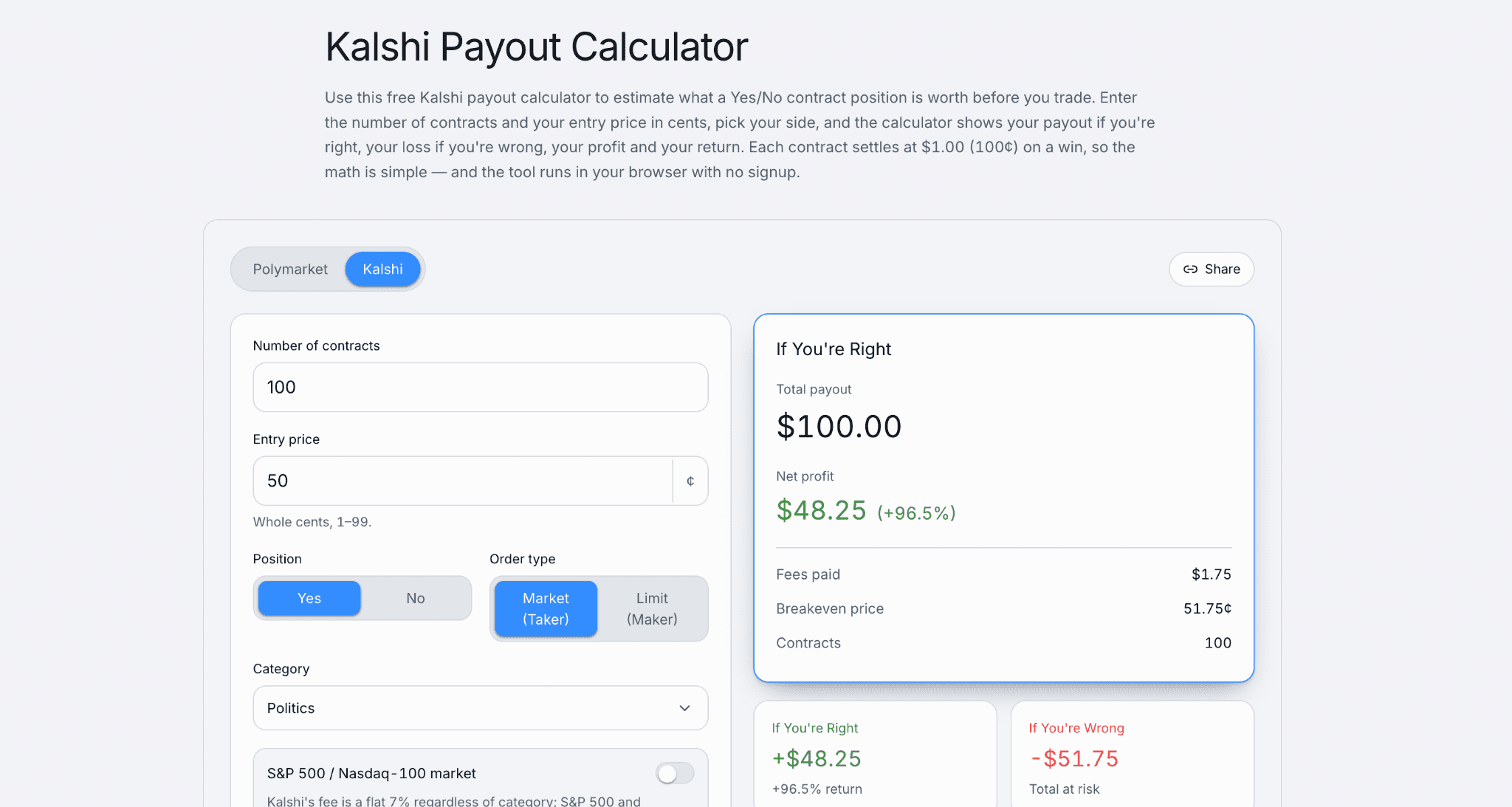
Kalshi's actual fee formula is not a flat percentage tier. It follows a parabolic curve: 0.07 × contracts × price × (1 − price), capped at 1.75 cents per contract for takers, with makers paying roughly a quarter of that. The fee peaks around 50-cent contracts, where outcome uncertainty is highest, and falls sharply near the extremes.
Polymarket's global platform has historically charged zero trading fees. A small taker-only fee was introduced in March 2026 on select US categories, while geopolitics and world event markets remain free on both the global and US platforms.
For the full worked-example breakdown, including deposit and withdrawal costs across both platforms, see our dedicated Kalshi vs Polymarket fees comparison guide.
Fee Verdict
If you care about cost efficiency, Polymarket remains dramatically cheaper on a per-trade basis, particularly for contracts priced near 50 cents where Kalshi's fee formula peaks.
Read More: How to Set Up Your First Polymarket Wallet Without Losing Your Funds on Fees?
Available Markets & Coverage: Breadth vs Speed
If fees are the biggest difference in cost, market coverage is the biggest difference in product design.
Kalshi is regulated, which means market creation is slower but standardized. Polymarket is flexible, which means markets appear fast, but can be more speculative.
Kalshi Market Categories
Kalshi focuses on CFTC-approved event contracts across regulated categories.
Politics & Elections
1. Presidential elections (primary, general)
2. Congressional races (House, Senate)
3. Policy outcomes (government shutdowns, legislation passage)
4. Approval ratings and political events
Sports
1. NFL (game outcomes, season totals, player props, Super Bowl)
2. NBA (playoffs, MVP awards, championship futures)
3. MLB, NHL, college football, college basketball
4. Golf, tennis, international sports
Economics & Finance
1. Federal Reserve decisions (interest rate changes)
2. Economic indicators (CPI, PCE, jobs reports, GDP)
3. Stock market levels (S&P 500 milestones)
4. Cryptocurrency prices (Bitcoin reaching specific thresholds)
Weather & Climate
1. Named storm predictions
2. Temperature ranges by region
3. Climate milestones
Read More: Kalshi vs Polymarket Weather Markets: Which Is Better?
Culture & Entertainment
1. Award show outcomes (Oscars, Grammys, Emmys)
2. Box office performance
3. Major cultural events
Total Markets: 200+ active markets typically, with significant expansion during election cycles or major sporting events.
Market Creation Speed: Slow. Each market requires CFTC review and approval, taking weeks to months. Kalshi cannot rapidly create markets responding to breaking news without regulatory clearance.
Polymarket Market Categories
Polymarket emphasizes rapid market creation and global event coverage. If you decide to trade on Polymarket, your edge depends heavily on execution speed, order timing, and market selection. These are the categories for which you can trade on Polymarket.
Politics & Elections
1. Same core coverage as Kalshi
2. International elections (UK, France, Latin America, Asia)
3. Geopolitical events (conflicts, treaties, diplomatic outcomes)
4. More granular sub-markets (polling averages, debate performance metrics)
Sports
1. Traditional sportsbook-style markets (spreads, totals)
2. Live in-game betting
3. International sports (Premier League, Champions League, cricket)
4. Esports (League of Legends, Dota 2, CS:GO)
Read More: Polymarket vs Kalshi for Sports: Which Platform Is Better for Traders?
Crypto & Technology
1. Cryptocurrency price predictions
2. Protocol launches and upgrades
3. Tech company earnings and product releases
4. AI development milestones
Read More: Polymarket vs Kalshi: Which Is Better for Crypto Markets?
Pop Culture & Entertainment
1. Celebrity news and gossip
2. Social media metrics (follower counts, viral moments)
3. Streaming platform releases
4. Internet culture and memes
Science & Current Events
1. Scientific breakthroughs and discoveries
2. Climate events and environmental milestones
3. Global health developments
4. "Will X happen by Y date?" micro-markets
Total Markets: 1,000+ active markets globally, with dozens created daily responding to breaking news.
Market Creation Speed: Fast. Decentralized structure allows community-proposed markets launching within hours of news breaking, pending UMA oracle resolution framework approval.
Market Verdict
Kalshi is more regulated and structured. Polymarket is broader, faster, and more global.
If you want depth in US events, Kalshi wins. If you want variety and speed, Polymarket dominates.
Insider Trading and Market Integrity
This is one area where the two platforms genuinely diverge, and it deserves direct, factual treatment rather than speculation about either company's intentions.
In February 2026, Kalshi publicly disclosed two enforcement cases from its surveillance program.
1. The MrBeast editor case. Kalshi's surveillance team flagged Artem Kaptur, an editor employed by MrBeast's production company, after his trading showed "near-perfect success" on low-probability markets tied to MrBeast's YouTube content. Kalshi's investigation found he "likely had access to material non-public information connected to his trading." He was fined more than $20,000, five times his initial trade size, and suspended from the platform for two years. Kalshi reported the case to the CFTC and said it would donate the fine to a nonprofit focused on derivatives market education.
2. The California gubernatorial candidate case. Kalshi's team separately identified a candidate, Kyle Langford, who appeared in an online video trading on his own candidacy. Kalshi fined him and issued a five-year suspension, citing its rule barring candidates from betting on their own races.
Kalshi disclosed that it has opened more than 200 investigations into possible rule violations since launch, with over a dozen developing into active enforcement cases. The CFTC issued a public advisory referencing Kalshi's action, with the agency's chairman describing exchanges like Kalshi as the "first line of defense" against insider trading.
The contrast with Polymarket is structural rather than a matter of one platform being more or less diligent. Polymarket's international platform operates outside CFTC jurisdiction entirely, so there is no equivalent regulatory enforcement mechanism, even though every trade is publicly auditable on-chain. Anyone can review wallet-level trading history on Polymarket's global platform, but there is no regulator with authority to fine or suspend a trader the way Kalshi can under its CFTC-filed rulebook.
Conflict and War Markets
This is a live and genuinely contested area of policy, and it is worth covering factually rather than taking a side.
CFTC Regulation 40.11 prohibits registered entities, including Kalshi and Polymarket's US entity, from listing contracts that involve, relate to, or reference war, terrorism, or assassination. Polymarket's international platform is not bound by this regulation and has listed such contracts.
This difference became highly visible on February 28, 2026, when US and Israeli forces killed Iranian Supreme Leader Ali Khamenei. Both platforms had active markets tied to his removal from power.
Polymarket's international "Khamenei out as Supreme Leader" market resolved YES and paid out in full, with reported trading volume above $500 million across related contracts. No CFTC death restriction applies to the offshore platform.
Kalshi's equivalent market, which had drawn roughly $50 to $55 million in volume, did not resolve the same way. Kalshi's rulebook contained a clause stating that if a leader "leaves solely because they have died," the market would settle at the last traded price before confirmation of death rather than paying out on the death itself, consistent with its CFTC-filed rules against contracts tied directly to death. Kalshi CEO Tarek Mansour stated the company does not list markets "directly tied to death" and does not want traders profiting from an assassination. Following trader backlash over the wording of the rule, Kalshi announced it would refund trading fees and reimburse net losses for affected traders, at a stated cost of roughly $2.2 million.
The episode prompted a group of senators, led by Senator Adam Schiff, to publicly call on the CFTC to ban prediction contracts tied to death or assassination outright, citing both ethical concerns and the risk of insider trading by government officials with advance knowledge of military action. A subsequent class-action lawsuit, Risch v. KalshiEX LLC, was filed in California federal court over Kalshi's handling of the resolution. Separate legislation, the DEATH BETS Act, was introduced to formally bar CFTC-regulated exchanges from listing contracts tied to an individual's death, terrorism, war, or assassination.
The practical takeaway: the same real-world event can resolve differently depending on which platform and which regulatory framework you are trading under, and this is precisely the kind of edge case worth understanding before placing a position on any geopolitical contract.
Interest on Balance and Position Limits
Tax Reporting
User Experience & Platform Design
User experience is where beginner friendliness matters most. Many people ask about kalshi or polymarket, but the real question is whether you want a traditional finance feel or a crypto-native feel.
Kalshi User Experience
Account Creation
1. Email registration
2. Identity verification (KYC): Government ID, SSN, address confirmation
3. Bank account linking: ACH connection for deposits/withdrawals
4. Eligibility check: State residence verification
5. Approval: Typically 1 to 24 hours
Deposit Methods
1. ACH bank transfer (free, 1 to 3 business days)
2. Wire transfer (free incoming)
3. Debit card (via third-party, ~2% fee)
4. Apple Pay / Google Pay
5. Cryptocurrency (via Moonpay or similar, 1 to 3% fees)
Interface & Design
- Desktop: Clean, minimalist design resembling brokerage platform (think Robinhood/Schwab aesthetic).
- Mobile app: iOS and Android native apps with full functionality.
- Navigation: Market categories clearly organized, filters for sorting by volume, liquidity, and expiration.
- Order Entry: Traditional order ticket (limit orders, market orders, stop-loss).
- Charts: Basic price history, volume indicators.
Polymarket User Experience
Account Creation (Global Platform)
1. Connect crypto wallet: MetaMask, Coinbase Wallet, WalletConnect
2. Optional email: For notifications and updates (not KYC)
3. Load USDC: Purchase on exchange (Coinbase, Binance) or via on-ramp
4. Start trading: Immediate access, no identity verification for basic use
Account Creation (US Platform)
1. Download iOS app (waitlist removed May 2026)
2. Complete KYC via QCEX intermediary
3. Link bank account or approved crypto wallet
4. Begin trading
Deposit Methods (Global)
1. USDC on Polygon network (primary)
2. Direct crypto purchases via Moonpay, Wyre
3. Transfer from Ethereum mainnet (bridge fees apply)
Interface & Design
- Desktop: Web3-native design with market cards, grid layout.
- Mobile: Responsive web app (no dedicated native app yet for US, though the iOS app is now live and open).
- Navigation: Tag-based filtering, trending markets prominence.
- Order Entry: Simple buy/sell panel, slider for quantity.
- Charts: Price history, volume, related markets.
- Portfolio: Wallet-based (all positions tied to connected address).
UX Verdict
Kalshi is easier for beginners. Polymarket is faster for experienced crypto users.
Liquidity, Market Depth & Trading Experience
Liquidity is where real traders make their decision. If spreads are wide or slippage is high, even the best market selection does not matter.
Kalshi Liquidity Profile
Institutional Backing
Sequoia Capital, Paradigm, Charles Schwab, Coatue, Andreessen Horowitz, and Morgan Stanley have all backed Kalshi, most recently at a $22 billion valuation in a $1 billion Series F round led by Coatue in May 2026, roughly double its $11 billion valuation from just five months earlier.
Robinhood integration: "Prediction Markets Hub" funneling billions in volume from 100M+ users.
Market makers provide continuous liquidity.
Typical Market Metrics
Top political markets: $5 to $20M open interest, 0.5 to 1 cent bid-ask spreads.
Major sports events: $2 to $10M open interest, 1 to 2 cent spreads.
Smaller markets: $50K to $500K open interest, 2 to 5 cent spreads.
Order Book Depth: Generally sufficient for trades up to $10,000 without significant slippage on high-volume markets. Larger institutional trades ($50K+) may experience 1 to 2% slippage.
Kalshi's structured markets and regulated order books create different opportunities than crypto-native platforms. If you plan to trade actively, read our Kalshi trading strategies guide to understand how spreads, position sizing, and macro catalysts impact profitability.
Polymarket Liquidity Profile
Global Liquidity (Non-US Platform)
Processed $33.4 billion total volume in 2025.
$3.7 billion on the 2024 US Presidential Election alone.
Deep international user base, now backed by Intercontinental Exchange (ICE), which completed a $2 billion total strategic investment commitment in March 2026, valuing Polymarket at approximately $9 billion post-money.
Typical Market Metrics (Global)
Top political/crypto markets: $10 to $50M open interest, 0.2 to 0.5 cent spreads.
Popular sports events: $3 to $15M open interest, 0.5 to 1 cent spreads.
Niche markets: $10K to $200K open interest, 3 to 10 cent spreads.
Order Book Depth: Excellent on high-profile markets (elections, major crypto events), enabling $50K to $100K+ trades with minimal slippage. Lower liquidity on niche markets creates wider spreads.
US Platform Liquidity (Current Status)
Still developing. With the iOS waitlist removed in May 2026, US-specific liquidity data is beginning to emerge but remains lighter than the global platform while the US user base scales.
Liquidity Verdict
Polymarket have stronger global liquidity. Kalshi has stronger regulated US liquidity.
Final Verdict: Kalshi or Polymarket?
There is no universal winner. The best platform depends on what kind of trader you are.
Choose Kalshi If You
1. Prioritize legal certainty and want immediate, unrestricted US access
2. Prefer traditional finance (bank transfers, familiar brokerage-style interface)
3. Trade primarily US-focused events (sports, domestic politics, economic indicators)
4. Want interest paid on your idle balance and full tax form reporting
Choose Polymarket If You
1. Want dramatically lower fees on a per-trade basis, particularly around 50-cent contracts where Kalshi's fee formula peaks
2. Trade crypto, international politics, or niche events Kalshi does not offer
3. Are comfortable with cryptocurrency wallets (MetaMask) and blockchain transactions
4. Value rapid market creation responding to breaking news within hours
Frequently Asked Questions (FAQ)
Is Polymarket legal in the US?
Yes, Polymarket is federally legal following CFTC approval in November 2025. The waitlist was removed in May 2026 and the iOS app is now open to eligible US users. Android and web access are still pending. State-level legal challenges continue in Nevada, Massachusetts, and other jurisdictions. Do not use VPNs to access the global platform. Accounts will be terminated and funds frozen.
Which is better for beginners: Kalshi or Polymarket?
Kalshi is significantly better for beginners due to familiar banking integration (ACH transfers), simple account setup, native mobile apps, and customer support infrastructure. Polymarket requires cryptocurrency knowledge (wallets, USDC, gas fees), creating a steep learning curve for non-crypto users.
Which platform among Kalshi & Polymarket is safer?
Kalshi offers superior regulatory protections (CFTC oversight, FDIC insurance up to $250K, legal recourse, and a documented insider-trading enforcement program). Polymarket provides technological decentralization reducing platform hack risk but lacks regulatory insurance and the same enforcement mechanism on its international platform. Choose based on whether you trust regulatory oversight (Kalshi) or smart contract security (Polymarket) more.
Can I arbitrage between Kalshi and Polymarket?
Theoretically yes, but practical challenges include contract differences, transfer timing, and fee erosion. We break down real examples, execution math, and live monitoring methods in our Kalshi vs Polymarket arbitrage guide.
Which has better sports markets, Kalshi or Polymarket?
Kalshi offers deeper liquidity and more comprehensive coverage of major US sports (NFL, NBA, MLB, college football). Polymarket provides international sports coverage (Premier League, cricket) and sportsbook-style spreads and totals. For the NFL and NBA, Kalshi dominates. For global sports, Polymarket leads.
Is Kalshi or Polymarket better?
It depends entirely on what you value most. Kalshi is better for US-based traders who want regulatory certainty, bank-based funding, interest on idle balances, and standard tax forms. Polymarket is better for traders who want the lowest possible fees, the broadest global and crypto-native market coverage, and the fastest market creation on breaking news.
Which is bigger, Kalshi or Polymarket?
By trading volume, the two have been closely matched through 2026, with Kalshi processing $43.1 billion in 2025 and Polymarket processing $33.4 billion globally the same year. By valuation, Kalshi has pulled ahead, reaching $22 billion in its May 2026 Series F round and reportedly seeking $40 billion shortly after, compared to Polymarket's roughly $9 billion post-ICE valuation and reported ambitions toward $15 to $20 billion.
What's the difference between Kalshi and Polymarket?
Kalshi is a CFTC-regulated US exchange operating in fiat currency with full KYC, FDIC-insured balances, standard tax reporting, and a formal insider-trading enforcement program. Polymarket's global platform is a crypto-native, largely unregulated prediction market settled in USDC, offering zero historical trading fees and the fastest market creation in the industry, while its newer US entity operates under its own CFTC designation with more limited market coverage so far.