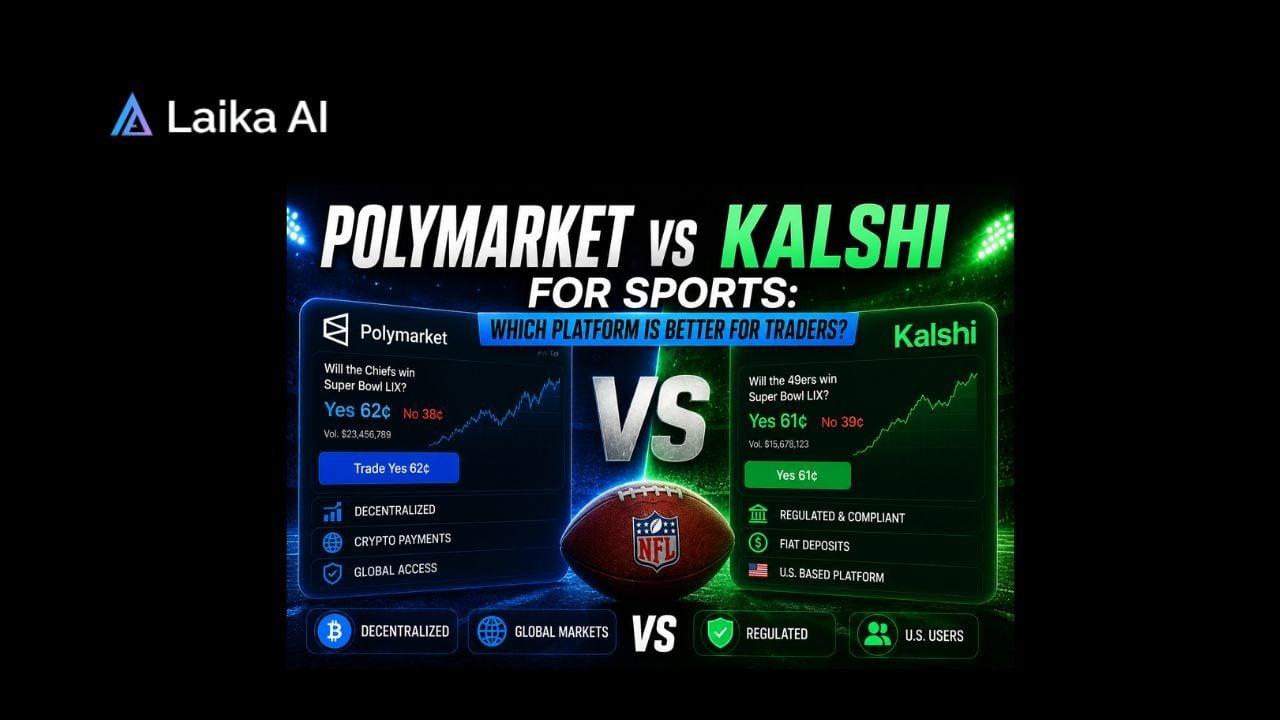
Kalshi sports trading now accounts for an estimated 91.1% of the platform's total January 2026 volume. Polymarket re-entered the US in December 2025 and immediately targeted sports as its primary growth category. Both platforms are all-in on sports in 2026. The question is not which platform takes sports seriously. The question is which one is better for you specifically, and that answer changes depending on which sport you trade, where you live, and how you fund your account. Within the broader polymarket sports markets guide ecosystem, understanding the difference between these two platforms is the most practically useful comparison a sports trader can make right now.
The Quick Version: Who Wins Where
For readers who want the verdict before the analysis.
For the full platform comparison across every category beyond sports, kalshi vs polymarket full platform comparison covers the complete picture.
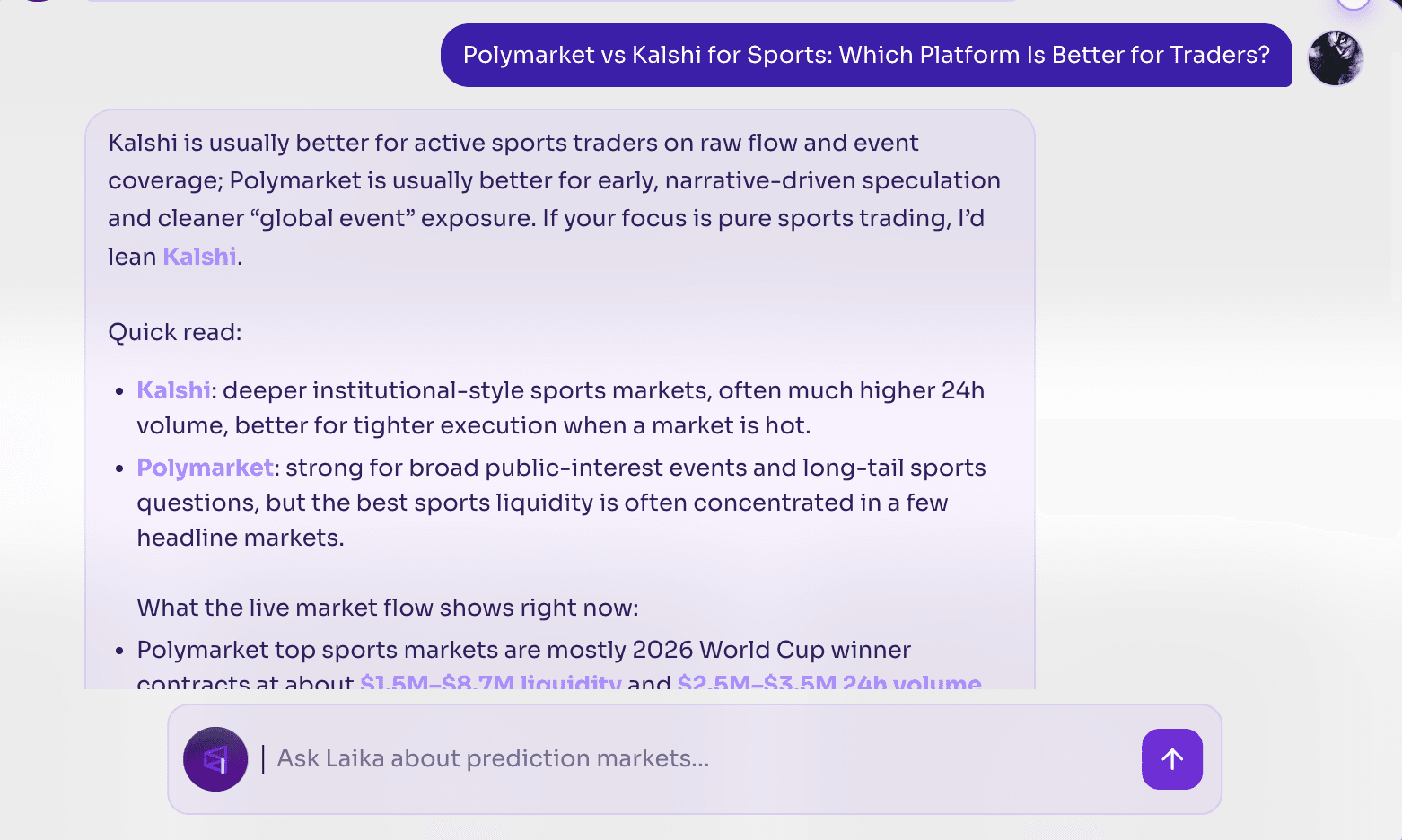
Sports Coverage: What Each Platform Actually Offers
Most readers do not know the exact difference in sport coverage between the two platforms. The gap matters more than most comparison articles acknowledge.
Since the 2025 sports expansion, Kalshi sports coverage spans event contracts across 17 different sports including NFL, NBA, MLB, NHL, college football and basketball, and major soccer leagues. The catalogue includes game moneylines, spreads, totals, championship futures, player awards, and live in-game contracts. College sports coverage, specifically Power 4 football and major conference basketball, is a category where Kalshi has a clear structural advantage over Polymarket's current US offering. For a US trader whose primary interest is the full domestic sports calendar including college games, Kalshi covers the menu.
Polymarket covers 14 sports on its international platform with meaningfully broader depth on international categories. Champions League, EPL, La Liga, Serie A, cricket, golf majors, and tennis Grand Slams all carry genuine liquidity on the global platform. In a direct UEFA Champions League fixture comparison, Polymarket proved more liquid than Kalshi on equivalent contracts. The global audience that prices European football is simply larger and more knowledgeable on that platform than on a primarily US-facing exchange.
The practical summary: if you primarily trade NFL, NBA, MLB, and NHL game-by-game markets, kalshi sports betting covers everything you need with better US liquidity and simpler onboarding. If you trade World Cup, Champions League, golf majors, or tennis, Polymarket's international platform has meaningfully better depth and a sport-literate global audience that prices those markets more accurately than any US-centric platform can.
For the full mechanics of how sports contracts work on Kalshi specifically, kalshi sports betting explained covers the platform in detail. For how Polymarket structures its sports market categories, polymarket sports betting guide covers the equivalent.
Fees: What You Actually Pay Per Trade
Both platforms use midpoint-weighted fee models, but the rates differ enough to matter across active trading volume.
Kalshi fees
Kalshi's taker coefficient is 7%, which is 40% more expensive than Polymarket's 5% taker rate. The fee is highest near 50-cent contracts. A 50-cent YES contract on Kalshi costs approximately 1.75 cents per share in taker fees. Kalshi also charges a 2% fee on debit card deposits and a flat $2 withdrawal fee. For high-volume traders who provide liquidity via limit orders, Kalshi introduced tiered maker rebates in Q1 2026 that partially offset taker costs. The 3 to 4% APY on idle balances is a genuine partial offset for traders who keep significant capital on the platform between trades.
Polymarket fees
Polymarket uses a category-based fee structure with maximum taker fees ranging from $0.75 per 100 shares on sports to $1.80 on crypto. Geopolitical markets are completely fee-free. Maker orders receive rebates of 20 to 25%. Polymarket currently charges zero trading fees on its US platform for sports contracts. On the international platform, gas fees on Polygon average $0.01 to $0.05 per transaction.
The real-world comparison
On a standard NFL moneyline contract at 60 cents: Kalshi charges approximately 1.68 cents per share in taker fees. Polymarket US charges zero for sports. Polymarket International charges under $0.05 in gas per transaction. A trader running $10,000 in monthly notional volume will pay approximately $150 to $200 more in fees on Kalshi than on Polymarket across equivalent contracts.
The counterargument is Kalshi's idle balance interest. Traders who keep $10,000 on Kalshi between trades earn $300 to $400 annually in APY. Polymarket pays nothing on uninvested funds. For less active traders who hold capital on the platform for extended periods, this partially closes the fee gap.
For the complete fee breakdown with contract-level examples across both platforms, kalshi vs polymarket fees full breakdown covers every calculation. For assessing market depth before entering any position, how to find liquid markets on Polymarket covers the practical methodology.
Liquidity: Sport-by-Sport Verdict
NFL
Kalshi wins on US game-by-game markets. Kalshi offers broader coverage of NFL with better liquidity on daily game contracts and no state-level restrictions on sports contracts in eligible states. For the NFL Champion futures market, both platforms carry significant volume, though Polymarket's global platform edges ahead on the outright winner contract given its larger international user base. Super Bowl markets have exceeded $10 million in combined trading volume across both platforms.
NBA
Polymarket wins on futures depth by a significant margin. The 2026 NBA Champion market has $533.7 million in volume on Polymarket. Kalshi's equivalent market carries a fraction of that depth. For game-by-game NBA markets, both platforms are competitive, with Kalshi slightly ahead on regular season games and Polymarket pulling ahead on playoff and Finals game volume as its global audience concentrates on the marquee markets.
World Cup and international soccer
Polymarket wins clearly. Polymarket's global user base includes traders from South America, Europe, Africa, and Asia where soccer is the dominant sport and local knowledge runs deep. Kalshi's primarily American audience may undervalue certain teams or overvalue familiar names, creating 5 to 8 cent gaps between platforms on the same team's World Cup odds. The 2026 World Cup winner contract has generated $394.9 million in aggregated volume across both platforms, but the distribution is heavily weighted toward Polymarket.
College sports
Kalshi wins. College football and basketball coverage is deeper on Kalshi, with Power 4 conference games and tournament bracket markets available at meaningful volume. Polymarket's US platform has limited college sports coverage at this stage.
MLB and NHL
Roughly even on game markets. Both platforms offer moneylines and championship futures. Polymarket has an advantage on postseason volume as its international user base engages more heavily with marquee playoff matchups.
The polymarket vs kalshi verdict on liquidity is not universal across all sports. It is sport-specific, and treating it as a single answer rather than a category-by-category analysis is the most common mistake traders make when choosing between the two.
Live In-Game Sports Trading: Kalshi Only
Live in-game sports trading is available on Kalshi. It is the only CFTC-regulated platform that currently supports it. Traders can enter and exit positions on active games as the action unfolds. Prices update in real time as scores change, players are injured or ejected, and game momentum shifts. A team trailing by 10 at halftime sees their contract price drop immediately. A trader with a strong view on second-half performance can enter at the depressed price and exit before resolution if momentum shifts back.
Polymarket offers in-play trading in the sense that market prices update continuously and you can buy or sell existing positions during a game. But Polymarket does not offer the same dedicated in-game market structure for live events that kalshi sports provides. Full in-game sports trading on a federally regulated exchange is currently a Kalshi exclusive.
For traders who want to react to events as they happen rather than positioning before kickoff, this is a genuine practical advantage that no amount of lower fees on Polymarket can replicate.
Settlement Disputes: The Risk Both Platforms Carry
Both platforms have documented settlement issues. Most comparison articles skip this section. Readers making real trading decisions deserve to know it.
Prediction markets are peer-to-peer exchanges where the platform writes the contract rules, interprets them, and enforces resolution. There is no independent arbiter on either platform, although the CFTC can intervene in certain regulatory cases.
Kalshi has faced controversy over its Khamenei market, an Oscars dispute, and various NFL settlement complaints where users felt contracts were resolved unfairly. An integrity program overhaul was announced in 2026 following documented disputes, though settlement complaints remain a pattern on NFL markets specifically.
Polymarket's international platform has had its own disputes, particularly around ambiguous contract language and resolution criteria on prop markets. The 2026 Super Bowl LX halftime controversy, where a Cardi B cameo during Bad Bunny's set created resolution ambiguity across platforms, is the clearest recent example. Polymarket resolved it as a YES performance. Kalshi gave partial payouts. Two platforms, same event, different outcomes for traders who held the same position on different exchanges.
The structural issue is identical on both platforms: the exchange controls the resolution criteria and the interpretation, and there is no guaranteed consistency when unusual events create ambiguity. The practical mitigation is the same regardless of which platform you use. Read the resolution criteria of every market before entering, particularly for prop and specials markets where the language is less standardized than championship futures. The fine print is not boilerplate on these contracts. It determines whether you get paid.
The World Cup Arbitrage: Use Both Platforms Right Now
The 2026 FIFA World Cup starts June 11. It is not unusual to see a 5 to 8 cent gap between Kalshi and Polymarket on the same team's World Cup winner odds. This is one of the largest sustained prediction market spreads currently available across any sports category.
The gap exists because Polymarket's global soccer-literate audience prices European and South American teams more accurately than Kalshi's primarily American user base. Kalshi traders may overvalue familiar names and undervalue teams with strong African or South American knowledge bases behind them on Polymarket.
The practical trade is straightforward. Identify teams where Polymarket prices them 5 or more cents higher than Kalshi on the outright winner market. Buy that team on Kalshi at the lower price. If both platforms converge as tournament volume grows and information arbitrage closes the gap, you profit from the spread compression rather than needing to predict the tournament outcome correctly.
This is the one situation where using both platforms simultaneously is not just acceptable. It is the strategically correct approach. For the full breakdown of which World Cup markets currently show the largest platform divergences, best polymarket world cup 2026 markets covers the current spread analysis.
Frequently Asked Questions
Is Kalshi or Polymarket better for sports trading?
It depends on your sport and location. Kalshi is better for US-based traders who want simple bank deposits, live in-game trading, and coverage of NFL, NBA, MLB, NHL, and college sports without a crypto wallet. Polymarket is better for major sports futures like the NBA Championship and NFL Champion where its global platform has significantly deeper liquidity, and for international soccer and World Cup markets where its soccer-literate global audience prices outcomes more accurately.
Which platform has better liquidity for NFL and NBA markets?
For NFL and NBA game-by-game markets, Kalshi has better US liquidity with tighter spreads on daily contracts. For NBA Championship and NFL Champion futures, Polymarket's global platform has meaningfully deeper volume. The 2026 NBA Champion market has $533.7 million on Polymarket versus a fraction of that on Kalshi. The practical rule: use Kalshi for game markets and Polymarket for major event futures.
Does Kalshi or Polymarket have lower fees for sports contracts?
Polymarket has lower fees on sports contracts. Kalshi's taker coefficient is 7% versus Polymarket's 5%, making Kalshi approximately 40% more expensive per trade at equivalent contract prices. Polymarket US currently charges zero trading fees on sports contracts. Kalshi also charges a 2% fee on debit card deposits and a $2 flat withdrawal fee. Kalshi partially offsets this with 3 to 4% APY on idle balances, which Polymarket does not offer. For the full calculation across contract types, kalshi vs polymarket fees full breakdown covers every scenario.
Can you do live in-game sports trading on Polymarket or Kalshi?
Live in-game sports trading is currently available on Kalshi. It is the only CFTC-regulated platform that supports it. Polymarket prices update continuously during games and you can buy or sell existing positions at the current market price, but it does not offer the same dedicated in-game market structure as Kalshi for reacting to live events as they happen.
Which platform has fewer settlement disputes on sports markets?
Both platforms have documented settlement disputes. Kalshi has faced NFL settlement complaints and controversies around the Khamenei market and Oscars resolution. Polymarket's international platform has had disputes around ambiguous contract language particularly on prop markets. The mitigation on both is identical: read the resolution criteria before entering any market, especially props and specials where the language is less standardized than championship futures. For the broader structural comparison between prediction markets and traditional sports betting on the settlement question, prediction markets vs sports betting covers how each platform's approach compares to sportsbook settlement practices.
Should I use both Kalshi and Polymarket for sports?
Yes, particularly during the 2026 World Cup where 5 to 8 cent gaps between the two platforms on the same team's winner odds represent genuine arbitrage opportunities. More broadly, using Kalshi for US game-by-game markets and Polymarket for major event futures and international soccer gives you the best of both platform strengths without the weaknesses of either. Maintaining accounts on both simultaneously is permitted and strategically advantageous for any active sports trader.
The Final Verdict
The answer changes depending on who you are.
US trader, primarily game markets, no crypto setup. Use Kalshi. Bank deposits, live trading, college sports coverage, and the full US sports calendar without needing a crypto wallet. Accept the slightly higher fees in exchange for accessibility and live in-game trading that Polymarket cannot currently match for US users.
US trader, primarily futures and major event markets. Use both. Kalshi for game markets, Polymarket for NBA Championship, NFL Champion, and World Cup futures where liquidity is five to ten times deeper on the global platform. The fee difference on futures is meaningful when position sizes are large.
Non-US trader or crypto-native. Use Polymarket International. Lower fees, deeper liquidity on every major sports futures market, and a global audience that prices international sports more accurately than any US-centric platform. The onboarding friction of USDC and Polygon is the only real cost.
Anyone during the 2026 World Cup. Use both specifically to capture the 5 to 8 cent arbitrage gap between platforms before tournament volume closes the spread. This is the clearest cross-platform opportunity currently live in Kalshi sports and Polymarket simultaneously.
For everything running across sports prediction markets and the broader ecosystem, the polymarket sports markets guide is the complete picture.
Whether you are trading on Kalshi, Polymarket, or both, Polymetric gives you live market intelligence across all active sports contracts so you see price movements and arbitrage gaps before the crowd does. Start at laikalabs.ai