Kalshi margin trading became regulatorily possible on March 24, 2026, when its affiliate Kinetic Markets LLC secured registration as a futures commission merchant and swap firm with the National Futures Association. That approval marked the first time a US-regulated prediction market exchange had cleared the specific licensing step required to offer positions without full upfront collateral.
This guide explains what kinetic markets Kalshi actually built, how margin trading is meant to work once it's fully live, who currently qualifies, and where the rollout actually stands as of this writing rather than at the moment of the original March announcement. If you're looking for Kalshi's already-live leveraged product instead of the margin infrastructure covered here, Kalshi Perpetual Futures (Timeless) Complete Guide 2026 covers that separate contract type in full.
What Are Kinetic Markets?
Kinetic Markets Kalshi affiliate status is the key detail to understand here: Kinetic Markets LLC is a separate legal entity created specifically to hold the regulatory registrations Kalshi itself doesn't hold directly. Kalshi Inc. maintains at least a 10% financial interest in the entity, and Kalshi co-founders Tarek Mansour and Luana Lopes Lara are listed as indirect owners, with Lior Samuel Hirschfeld serving as Kinetic's CEO, Sam Rosner as CFO, and Joshua Andrew Beardsley as chief compliance officer.
The NFA filing registers Kinetic Markets in two capacities
- Futures commission merchant, or FCM, which allows the entity to accept and hold customer funds posted as margin.
- Swap firm, which covers the derivative structure some event contracts are built on.
Kinetic Markets is currently listed as an inactive NFA member, meaning it isn't independently conducting commodity interest business on its own. Its role is closer to infrastructure: it exists to support Kalshi's margin capability rather than to operate as a separate customer-facing exchange. If you're new to Kalshi generally and want the basics before getting into margin mechanics specifically, How Does Kalshi Work? A Complete Beginner's Guide covers account setup and standard event-contract trading.
How Kalshi Margin Trading Works
Kalshi has operated on a fully collateralized model since launch, meaning a trader posting a position had to put up 100% of that contract's potential value upfront. Margin trading changes that by letting eligible traders post only a fraction of a position's value as collateral, freeing the rest of that capital for other use.
The mechanics under development include
- Dedicated margin account balances, separate from a standard fully collateralized Kalshi account.
- A margin-specific fee schedule, distinct from standard trading fees.
- Transfer tools for moving funds between traditional and margin accounts.
- Liquidation risk tied to posted collateral, the same basic mechanism used in any leveraged derivatives product.
Kalshi's own API documentation has listed a margin trading demo environment for months, with production endpoints described as "coming soon" rather than live. That's a meaningful distinction: the framework exists and is testable, but a trader can't yet route a real position through it the way documentation for a fully shipped feature would suggest.
Kalshi has already shipped one product built on adjacent leveraged infrastructure: its CFTC-approved BTCPERP Bitcoin perpetual futures contract, which launched in May 2026 and recorded more than $5.5 billion in trading volume within its first two weeks. That contract demonstrates the underlying capital-efficiency mechanics work in production, even though it's a separate CFTC approval from the broader margin rollout covered here. For Kalshi leverage trading specifically through that already-live product, the perpetual futures guide linked above covers funding rates, leverage caps, and mechanics in detail.
Kalshi's FCM License Explained
The Kalshi FCM license, held through Kinetic Markets, is the specific regulatory credential that makes margin trading legally possible at all, but it isn't the only approval Kalshi needs. The FCM license lets Kinetic Markets hold customer margin funds and act as an intermediary for derivatives transactions, which is standard infrastructure in traditional futures markets but new for a prediction-market exchange.
What the license does and doesn't cover
This distinction matters because a lot of coverage from March 2026 treated the FCM registration as if it were the finish line. In practice, it was closer to a prerequisite. The Kinetic Markets Kalshi relationship exists precisely to separate the regulatory entity from the consumer-facing exchange, which is a structure borrowed from how traditional futures brokers are set up. Kalshi filed for the registration in late 2025, and the NFA confirmed approval on March 24, 2026, but separate CFTC approval is still required for the rule changes that would let Kalshi extend margin to its core event-contract lineup broadly. That's a distinct regulatory step from the NFA registration, and it's the piece that determines when, and to what extent, margin actually reaches a broader set of contracts beyond the perpetuals already live. The official NFA BASIC registration listing at nfa.futures.org shows Kinetic Markets' current registration status directly, which is worth checking for the most current classification.
Who Qualifies: Kalshi Institutional Accounts
Kalshi has been explicit that margin trading is designed to launch for professional and institutional clients first, not retail accounts. That's consistent with how the product has been discussed since the March announcement: CEO Tarek Mansour has framed margin specifically as a capital-efficiency tool for institutions rather than a retail feature rolling out broadly on day one.
Kalshi institutional accounts, separate from the margin question specifically, are already available through the platform's dedicated institutional onboarding pathway, covering entity-level trading access and market-data licensing. Qualifying generally involves:
- Trading as a registered business entity rather than an individual account.
- Completing entity-level compliance and verification, beyond standard individual KYC.
- Meeting whatever capital or activity thresholds Kalshi sets for margin eligibility specifically, which haven't been published as a fixed public number.
Kalshi's institutional onboarding pathway also distinguishes between full trading access and a lighter-weight option for firms that only want market-data licensing without placing trades themselves, which suggests the platform is building out institutional infrastructure as a broader business line rather than treating margin as an isolated feature. That broader push has coincided with other institutional moves, including a clearing and infrastructure partnership with Fidelity Information Services and a data-distribution deal that put Kalshi pricing directly onto Tradeweb's institutional workflow platform.
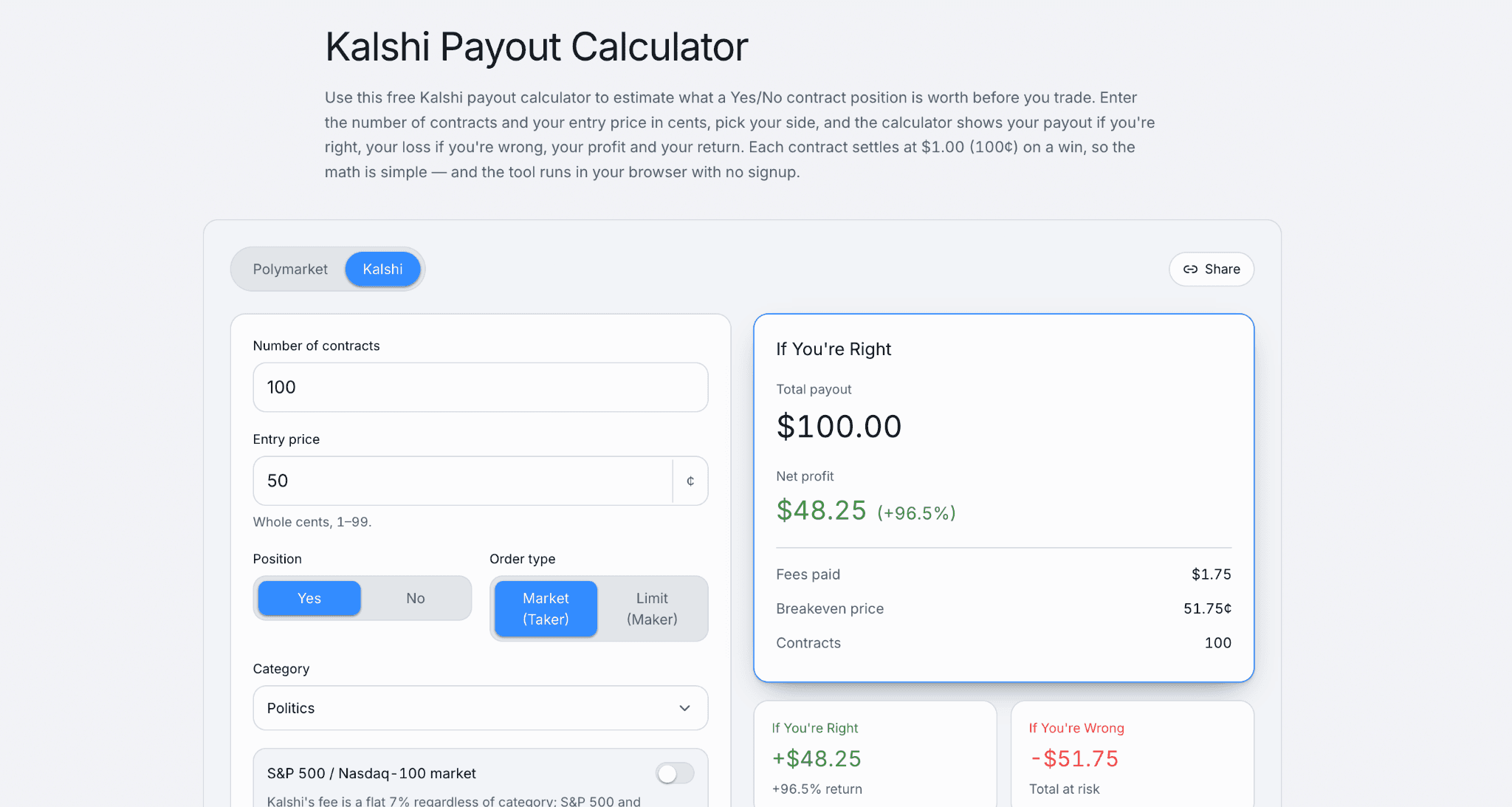
Retail access to margin trading, if it comes at all, is expected to follow institutional rollout rather than launch alongside it, and may apply first to specific new products rather than Kalshi's existing event-contract lineup broadly.Try the Kalshi Payout Calculator to estimate your returns before every trade and make more informed trading decisions.
Current Rollout Status
As of this writing, the margin trading rollout remains institutional-focused and only partially live. The NFA registration that makes it legally possible has been in place since March 2026, a demo API environment has existed for months, and one leveraged product built on adjacent infrastructure, the BTCPERP perpetual, is already trading with real volume. But the broader margin capability for standard event contracts still depends on separate CFTC approval that hadn't been finalized as of the most recent reporting.
This is a genuinely fast-moving story, and the practical rollout details, exactly which contract types are eligible, current margin requirements, and whether access has expanded meaningfully beyond institutional accounts, are worth checking against a current primary source rather than relying on the original March filing. Kalshi's own site at kalshi.com, along with ongoing coverage from financial outlets like Bloomberg and CoinDesk, are the most reliable places to confirm where things stand at the moment you're reading this.
Polymarket's Competing Filing
Kalshi's four-month head start on this regulatory path hasn't gone unanswered. On July 3, 2026, Polymarket's affiliate, operating under the name Coming Home GBA LLC through an entity called PM Derivatives LLC, filed its own applications with the NFA for FCM registration, NFA membership, and swap firm status, the same set of registrations Kinetic Markets already holds.
That filing is a direct response to Kalshi's regulatory lead, and it reflects how much margin access has become a competitive line in the broader platform rivalry. Reported June 2026 volume put Kalshi at roughly $33 billion in monthly trading against Polymarket's combined entities handling about $14 billion over the same period, a gap that helps explain why Polymarket is racing to close the regulatory distance. Kalshi's approach to leverage and margin more broadly, including its already-live perpetual futures product, is covered in more depth in Kalshi vs Hyperliquid Perps: Regulated vs Offshore Crypto Derivatives, which looks at how Kalshi's regulated model compares to a purely offshore leveraged exchange.
Neither platform's margin trading application guarantees a specific timeline for launch, since both still depend on CFTC sign-off beyond the NFA registration step itself. For a side-by-side look at how these two platforms compare on cost structure more generally, independent of the margin question, Prediction Market Fees in 2026: Kalshi vs Polymarket breaks down the standard fee comparison.
What This Means for Traders
For most individual traders, this feature isn't something to plan around yet. It's built for institutional and professional accounts first, the production rollout is still incomplete, and full CFTC approval for broader event-contract margin hasn't landed as of this writing. Retail-facing leverage on Kalshi today runs through the separate, already-live perpetual futures product rather than through the margin infrastructure covered here.
For traders and firms operating at an institutional scale, the calculus is different. The FCM registration is real, the infrastructure exists, and Kalshi has clearly signaled margin as a near-term priority for capital-efficient institutional trading. Understanding how federal oversight of this space works more broadly is useful context regardless of account type; CFTC vs States: Who Really Regulates Prediction Markets in 2026 covers the jurisdictional landscape this approval sits inside, and Kalshi and Polymarket: The Prediction Market Boom, Risks, and Regulation covers the wider regulatory environment both platforms are navigating as they scale. If you're weighing Kalshi against Polymarket more generally rather than specifically on margin access, Kalshi vs Polymarket: Which Prediction Market Is Right for You? covers that broader comparison.
The Bottom Line
Kalshi's regulatory groundwork for margin trading is genuinely ahead of any competitor, built on an FCM registration that took effect in March 2026 and infrastructure that already supports one live leveraged product. But margin trading in the fuller sense, non-fully-collateralized positions across Kalshi's standard event-contract lineup, is still institutional-only where it exists at all, and still waiting on CFTC approval to expand further.
Given how quickly this story is moving, and how directly Polymarket's competing filing signals the stakes, checking current status directly before assuming any specific feature is live is the safer approach for anyone evaluating either platform's leverage offering right now.
FAQ
What is Kalshi margin trading?
Kalshi margin trading is a planned feature that would let eligible traders open positions on Kalshi's event contracts by posting only a fraction of the contract's full value as collateral, rather than the 100% upfront collateral Kalshi has historically required. It's made regulatorily possible by Kinetic Markets' FCM registration, though full rollout still depends on separate CFTC approval.
What are Kinetic Markets?
Kinetic Markets LLC is a Kalshi-affiliated entity registered with the National Futures Association as a futures commission merchant and swap firm. It exists to hold the specific regulatory registrations needed to support margin trading and related leveraged products, rather than operating as an independent, customer-facing exchange.
Does Kalshi offer leverage trading?
Yes, in a limited and specific sense today. Kalshi leverage trading is already live through its CFTC-approved BTCPERP Bitcoin perpetual futures contract, which launched in May 2026. Broader margin trading across Kalshi's standard event contracts, built on Kinetic Markets' FCM registration, is still rolling out and remains institutional-focused as of this writing.
Who qualifies for a Kalshi institutional account?
Kalshi institutional accounts are built for entities rather than individuals, requiring entity-level registration and compliance verification beyond standard individual KYC. Margin trading specifically has been described as launching for institutional and professional clients first, with retail access, if it comes, expected to follow rather than launch simultaneously.
What is Kalshi's FCM license?
The Kalshi FCM license, held through affiliate Kinetic Markets, is a National Futures Association registration that authorizes the entity to accept and hold customer funds posted as margin for derivatives transactions. It's the specific regulatory credential that makes margin trading legally possible, though separate CFTC approval is still required before margin can extend broadly across Kalshi's core event-contract lineup.