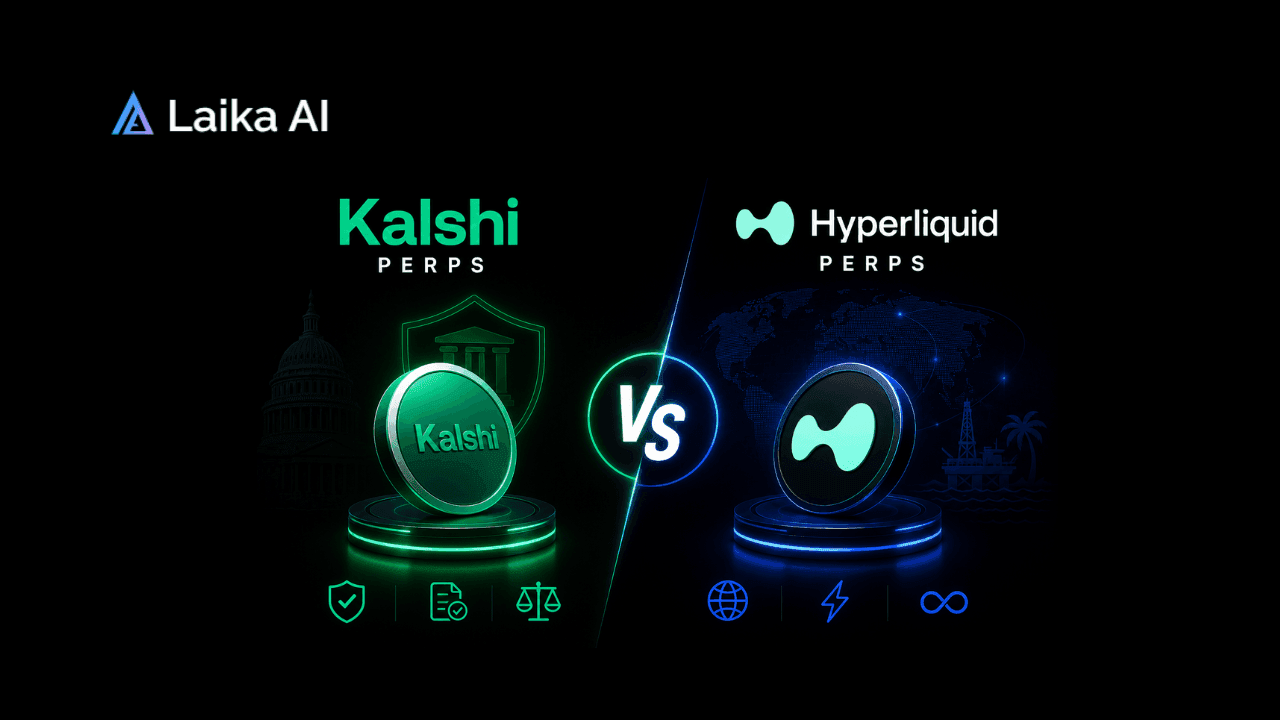
A Kalshi-Hyperliquid comparison is really a comparison between two different philosophies for the same product. Kalshi launched the first CFTC-regulated Bitcoin perpetual futures contract in the US on June 3, 2026, bringing a derivative type that had lived almost entirely offshore into a licensed federal framework. Hyperliquid, by contrast, is the largest decentralized perpetuals exchange in the world by volume, and it built that position entirely outside US regulatory oversight.
This guide breaks down what Kalshi vs Hyperliquid actually means in practice: who can legally use each platform, how their fees and leverage compare, and which one fits a given trader's situation. If you're weighing Kalshi's own perpetuals product against Polymarket's newer perps feature instead, Polymarket Perps vs Hyperliquid: Better for Crypto Traders? covers that specific matchup. This piece focuses on the regulated-versus-offshore question that separates Kalshi from a hyperliquid exchange built for a global, KYC-free audience.
What Is Kalshi's Perpetual Futures Product?
Kalshi's perpetual futures launched under the CFTC's approval of a "true bitcoin perpetual contract," issued on May 29, 2026, and structured through Kinetic Markets LLC, a Kalshi-affiliated, CFTC-registered exchange. The Bitcoin contract, ticker BTCPERP, went live June 3, and an Ethereum perpetual followed a day later.
Key mechanics of the product
- No expiration date, matching how any perpetual future works.
- Funding is charged roughly every 8 hours between long and short holders.
- Leverage available, with some reporting suggesting it can run as high as 50x on certain contracts.
- Liquidation risk if collateral is wiped out by an adverse price move.
- A promotional zero-fee period for early users at launch, with standard fees expected once that period ends.
Kalshi has filed for CFTC approval to add perpetuals on XRP, Solana, Dogecoin, Stellar, Shiba Inu, and Hedera, and is reportedly in talks with the agency to extend the same structure to metals, forex, and energy. Each new asset requires its own separate regulatory review, which is part of why the product's asset list is growing more slowly than a decentralized venue would. For a deeper walkthrough of how this specific product works day to day, Kalshi Perpetual Futures (Timeless) Complete Guide 2026 covers account setup and trading mechanics in full, and How Does Kalshi Work? A Complete Beginner's Guide is the right starting point if you haven't used Kalshi's standard event markets yet.
The approval hasn't been uncontested. The Chicago Mercantile Exchange filed suit against the CFTC and its chairman over the decision, arguing the agency wrongly allowed Kalshi's perpetual contracts to receive different regulatory and tax treatment than comparable products elsewhere in the derivatives market. That legal fight is still playing out, which matters for anyone assessing how settled Kalshi's regulatory position really is.
It's worth noting how unusual this launch is in the context of derivatives history. Perpetual futures have existed since 2016 in crypto markets, almost entirely on offshore venues, generating tens of trillions of dollars in annual volume with essentially no US-regulated equivalent. Kalshi's product is the first attempt to bring that exact contract structure inside a CFTC-approved framework, which is precisely why a Kalshi Hyperliquid comparison draws so much attention: one platform spent years building volume outside US oversight, and the other just built the first legal on-ramp to the same instrument.
What Is Hyperliquid?
Hyperliquid is a decentralized perpetual exchange running on its own layer-1 blockchain, built around an on-chain order book rather than a pooled liquidity model. It requires no KYC, holds no central legal entity registered as an exchange, and has processed well over a trillion dollars in lifetime trading volume, making it the dominant venue in decentralized derivatives.
That scale exists specifically because Hyperliquid operates offshore relative to US securities and derivatives law. Its terms of use define a category of "Restricted Persons" that explicitly includes US residents and citizens, alongside sanctioned and export-controlled jurisdictions. The platform geoblocks US IP addresses, and using a VPN to route around that block violates its own terms, not just a regulator's rule.
Kalshi vs Hyperliquid: Regulated vs Offshore Crypto Derivatives
The comparison below breaks down how each platform treats registration, access, and the trade-offs that come with each model.
Kalshi's version trades regulatory certainty and consumer protections for a narrower, still-expanding asset list. Hyperliquid's version trades that certainty for scale, asset variety, and no KYC, at the cost of being off-limits to US persons entirely.
Is Hyperliquid Regulated?
No. Hyperliquid is not registered with the CFTC, the SEC, or any comparable regulator as a licensed exchange. It operates as a decentralized protocol, and its own terms describe it that way rather than as a traditionally licensed venue. That structure means there's no deposit insurance, no segregated customer funds requirement, and no regulatory body a user can appeal to if something goes wrong.
This isn't unique to Hyperliquid among decentralized perpetual exchanges, but it's the central fact that separates it from Kalshi's product. Kalshi's perpetuals sit inside a framework where the CFTC directly approved the contract structure, even though that approval is currently being challenged in court by the CME. For more on how US regulators have approached prediction markets and adjacent derivatives generally, CFTC vs States: Who Really Regulates Prediction Markets in 2026 covers the broader jurisdictional picture this dispute sits inside.
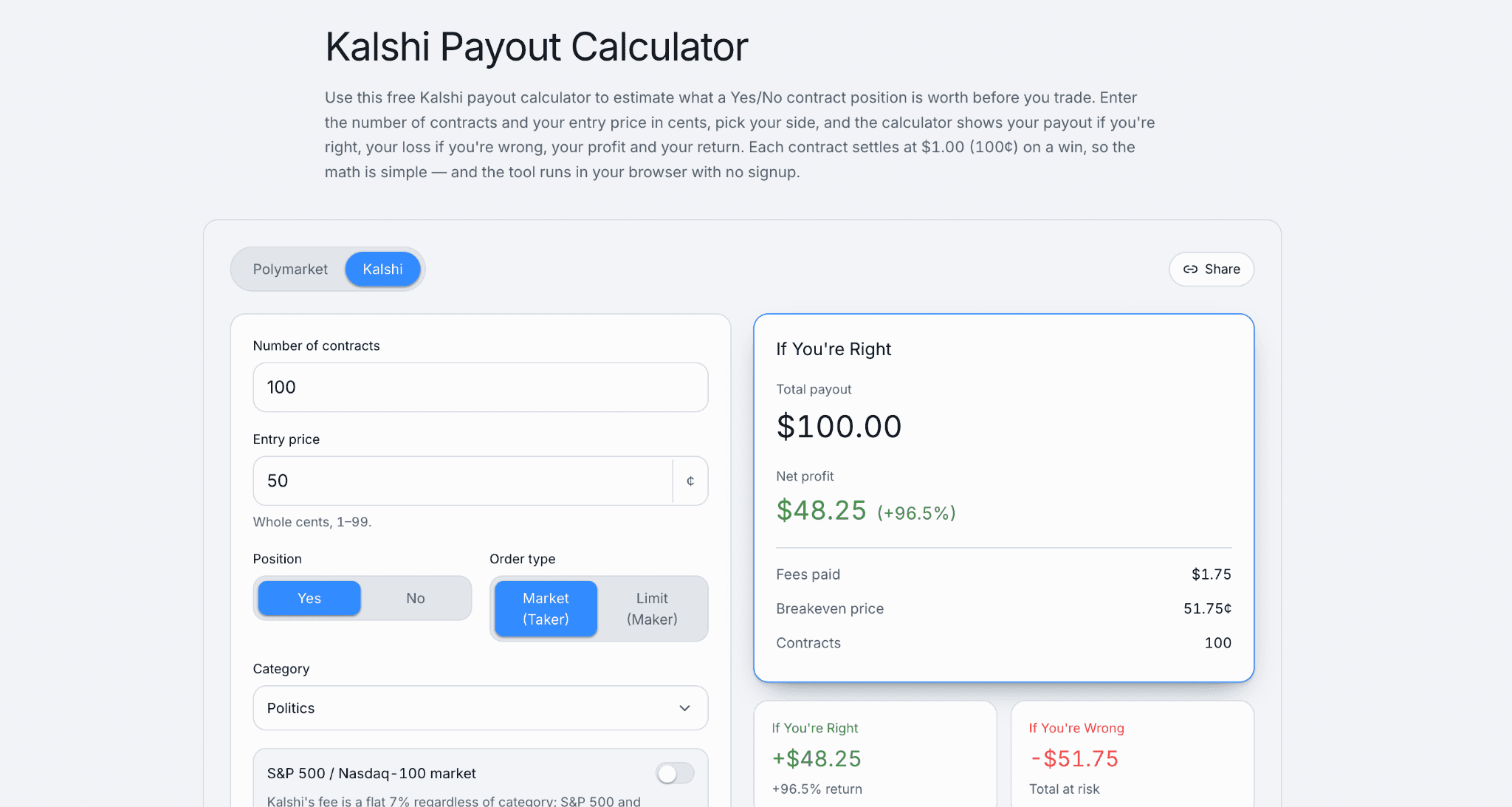
US persons are named directly in Hyperliquid's terms as Restricted Persons, and the platform geoblocks access from US IP addresses as a result. That's a contractual and technical restriction, not merely a suggestion, and it exists specifically because offering leveraged derivatives to US persons without CFTC registration carries real enforcement risk for the platform.Try the Kalshi Payout Calculator to estimate your returns before every trade and make more informed trading decisions.
Fees Compared: Kalshi vs Hyperliquid
Hyperliquid fees follow a published, volume-tiered schedule based on rolling 14-day trading volume, assessed daily. The base tier runs around 0.045% for taker orders and 0.015% for maker orders on perpetuals, with rates improving at higher volume tiers and a flat withdrawal cost.
Kalshi's perpetual fee structure is still taking shape. The platform offered zero trading fees for a limited promotional period to early users on its waitlist, without a specified end date at launch, and a standard fee schedule is expected to follow once that period concludes.
For current, authoritative numbers on either side, Kalshi's own documentation at kalshi.com and Hyperliquid's published fee schedule at hyperliquid.xyz are the most reliable sources, since both are still evolving as Kalshi's product matures past its launch promotion.
Leverage, Liquidity, and Risk
Both platforms report leverage caps as high as 50x on their most liquid contracts, which puts the risk profile of a Kalshi perpetual and a Hyperliquid perpetual closer together than the regulatory gap between them might suggest. A 50x position moves toward liquidation on roughly a 2% adverse price swing regardless of which platform it's opened on.
Where the two diverge is liquidity depth and asset breadth. Hyperliquid's order book spans hundreds of pairs built up over several years of volume, while Kalshi's perpetuals are new, currently limited to Bitcoin and Ethereum, and still expanding through individual regulatory approvals. Thinner liquidity on a newer product can mean wider spreads and less predictable execution, independent of the leverage used.
Traders comparing this decision against Polymarket's own leveraged product may also want the mechanics side by side. Polymarket Perps: How to Trade Perpetual Futures on Polymarket covers a third leveraged option built into a prediction-market platform rather than a pure derivatives exchange, which is a useful reference point for how differently these products can be structured even when the underlying instrument is the same.
Risk management principles carry across all three platforms regardless of regulatory status. A liquidation price should be checked before opening a position, not after it starts moving. Funding payments compound over time and can erode a directional edge even when the price never moves against a trade outright. And leverage should generally be sized around a specific catalyst or short holding window rather than left on indefinitely, since a never-expiring contract makes it easy to forget a position is still accruing funding costs in the background.
Which Platform Should You Use?
For a US-based trader, the practical answer is straightforward: Hyperliquid's terms explicitly restrict US persons, so Kalshi is the only one of the two that's actually usable without violating a platform's own rules. Traders outside the US, or those specifically evaluating decentralized infrastructure, may find Hyperliquid's asset range and track record more compelling, understanding that no regulatory recourse exists if something goes wrong.
Neither platform is free of open questions. Kalshi's approval is being contested in court, and its perpetual fee schedule isn't fully set. Hyperliquid's scale is real, but so is the complete absence of deposit insurance or a regulator to appeal to. Anyone weighing prediction markets more broadly against this leveraged-derivatives question may find Kalshi and Polymarket: The Prediction Market Boom, Risks, and Regulation useful context, and Prediction Markets Legal Status by State 2026: Full 50-State Tracker is worth checking if state-level rules matter as much as federal ones for your situation. For the standard event-market comparison rather than the perpetuals-specific one, Kalshi vs Polymarket: Which Prediction Market Is Right for You? covers that separately.
FAQ
How does Kalshi compare to Hyperliquid?
Kalshi Hyperliquid comparisons come down to regulation versus scale. Kalshi is a CFTC-approved, US-legal platform with a new, narrower perpetuals product. Hyperliquid is a much larger, longer-running decentralized exchange that operates outside US regulatory registration and explicitly restricts US persons from using it.
Is Hyperliquid a regulated exchange?
The short answer to hyperliquid regulation is no. Hyperliquid is not registered with the CFTC, SEC, or any equivalent regulator. It operates as a decentralized protocol without a central licensed entity, which means there's no deposit insurance and no regulatory body overseeing its operations the way there is for Kalshi's CFTC-approved perpetuals.
Is Hyperliquid legal to use in the US?
Anyone searching is hyperliquid legal in us is really asking about platform terms rather than a criminal statute, and the terms are unambiguous: Hyperliquid's own terms of use classify US persons as Restricted Persons and geoblock access from US IP addresses. Using the platform from the US violates its terms, and using a VPN to bypass that restriction doesn't change the underlying legal risk. Kalshi's perpetuals, by contrast, are fully legal for US users under CFTC approval.
What's the difference between regulated and offshore crypto derivatives?
Regulated vs offshore crypto derivatives comes down to who oversees the platform and what protections exist if something goes wrong. A regulated product like Kalshi's perpetuals operates under CFTC approval, with standard compliance and oversight requirements. An offshore product like Hyperliquid operates as a decentralized protocol without that registration, offering broader global access and no KYC in exchange for giving up regulatory recourse and consumer protections.
What are Hyperliquid's fees compared to Kalshi's?
Hyperliquid fees follow a published, volume-tiered schedule starting around 0.045% for taker orders and 0.015% for maker orders. Kalshi's perpetuals launched with a zero-fee promotional period for early users, and a standard post-promotion fee schedule hadn't been fully published as of this writing, so checking each platform's current documentation directly is the most reliable way to compare exact costs.