Polymarket Perps launched on April 21, 2026, giving Polymarket traders a way to hold leveraged, no-expiry positions alongside the platform's original yes/no event markets. Unlike a standard Polymarket share, which settles once at resolution, a perp tracks a price continuously and stays open until the trader closes it.
This guide walks through what the product actually is, how the mechanics work, and the exact steps to open, manage, and close a position. If you're deciding whether perps or Hyperliquid's perpetuals fit your trading style better, that comparison is covered separately; this guide focuses purely on how to use Polymarket's own product.
What Are Polymarket Perps?
These are perpetual futures contracts built into Polymarket, sitting alongside the platform's standard event markets rather than replacing them. A regular Polymarket share pays out $1 or $0 once an event resolves. A perp has no resolution date at all.
Here's what separates the two products
- No expiration. A perp position stays open indefinitely, as long as margin covers it.
- Leverage. Reported caps run up to 20x in the current beta, letting a smaller deposit control a larger position.
- Long or short. Traders can bet on a price rising or falling, not just on a binary outcome.
- Funding rate. A recurring payment between long and short holders keeps the perp price anchored to the underlying spot price.
- 24/7 trading. Funding, margin checks, and liquidations continue through weekends and outside normal market hours.
At launch, the product covered assets traders already track closely: Bitcoin, Ethereum, gold, and a handful of major equities and indexes. Polymarket has indicated the product may eventually extend the same mechanics to event-outcome probabilities, letting a trader take a leveraged position on something like an election or a Fed decision the way they'd trade a token price today. Access currently runs through an invite and waitlist system rather than being open to every account immediately.
How Perps Work on Polymarket
Every Polymarket perpetual futures position is built from three moving parts: margin, funding, and mark price.
Margin is the capital a trader puts up to open a position. With 10x leverage, $1,000 of margin controls $10,000 of notional exposure, and profit or loss is calculated against that full notional amount, not just the margin deposited.
Funding is a periodic payment exchanged between long and short position holders, roughly every 8 hours, that keeps the perp price close to the underlying spot price. Typical funding runs around ±0.01% per 8-hour period in calm conditions, but it can spike considerably higher during volatile stretches. Funding compounds over time, so a small rate can add up to a meaningful cost on a position held for weeks.
Mark price is the reference price used to calculate a trader's unrealized profit or loss and to determine liquidation. It's typically an index of prices across multiple venues rather than a single exchange's last trade, which helps prevent a brief price spike on one venue from triggering unnecessary liquidations.
A position is liquidated when losses consume the margin backing it. Polymarket's interface shows a live liquidation price for every open position, which is worth checking before and after entering a trade, not just at the moment of opening it.
How to Trade Polymarket Perps: A Step-by-Step Guide
Opening a perps position follows a similar flow to opening one on any other perpetual venue, with a few Polymarket-specific steps at the start.
- Set up a wallet. Perps require a funded, self-custodied wallet connected to Polymarket, the same as standard event-market trading. If you haven't done this yet, How to Set Up Your First Polymarket Wallet Without Losing Your Funds on Fees covers the setup process in detail, and Best Polymarket Wallets 2026 compares the wallet options if you're still deciding which one to use.
- Get access. Perps are currently gated behind an invite and waitlist system, so confirm access is live on your account before assuming a market is available.
- Fund your account. Deposit the collateral you plan to use as margin. Only allocate capital you're prepared to lose entirely, given the leverage involved.
- Pick a market and a direction. Choose the asset you want exposure to, then decide whether to go long (betting the price rises) or short (betting it falls).
- Choose an order type. The product supports both limit and market orders with standard time-in-force options. Limit orders that add liquidity to the book are generally cheaper than market orders that take it; How to Use Limit Orders on Polymarket Like a Professional Trader covers order-placement tactics that carry over from standard markets.
- Set your leverage and check your liquidation price. Before confirming, review the liquidation price shown in the interface and make sure it sits beyond a level you consider genuinely unlikely this week, not just mathematically possible.
- Monitor funding and margin. Once the position is open, funding continues to accrue in the background, and margin can shift with the market even without any action from you.
- Close the position when ready. Unlike a standard event share, a perp doesn't resolve on its own. Close it manually to realize profit or loss whenever you're ready to exit.
If you're trading perps in a way that overlaps with Polymarket's standard order book, for example running related positions across both products, Manual vs. Automated Arbitrage on Polymarket: What You Actually Need to Get Started covers the tooling and considerations for running multiple positions at once.
Polymarket Perps Fees
Polymarket has not published a complete, granular fee schedule for perps the way some perpetual exchanges do. Early coverage describes a maker rebate paired with a taker charge on notional value, consistent with how fees already work on Polymarket's standard markets.
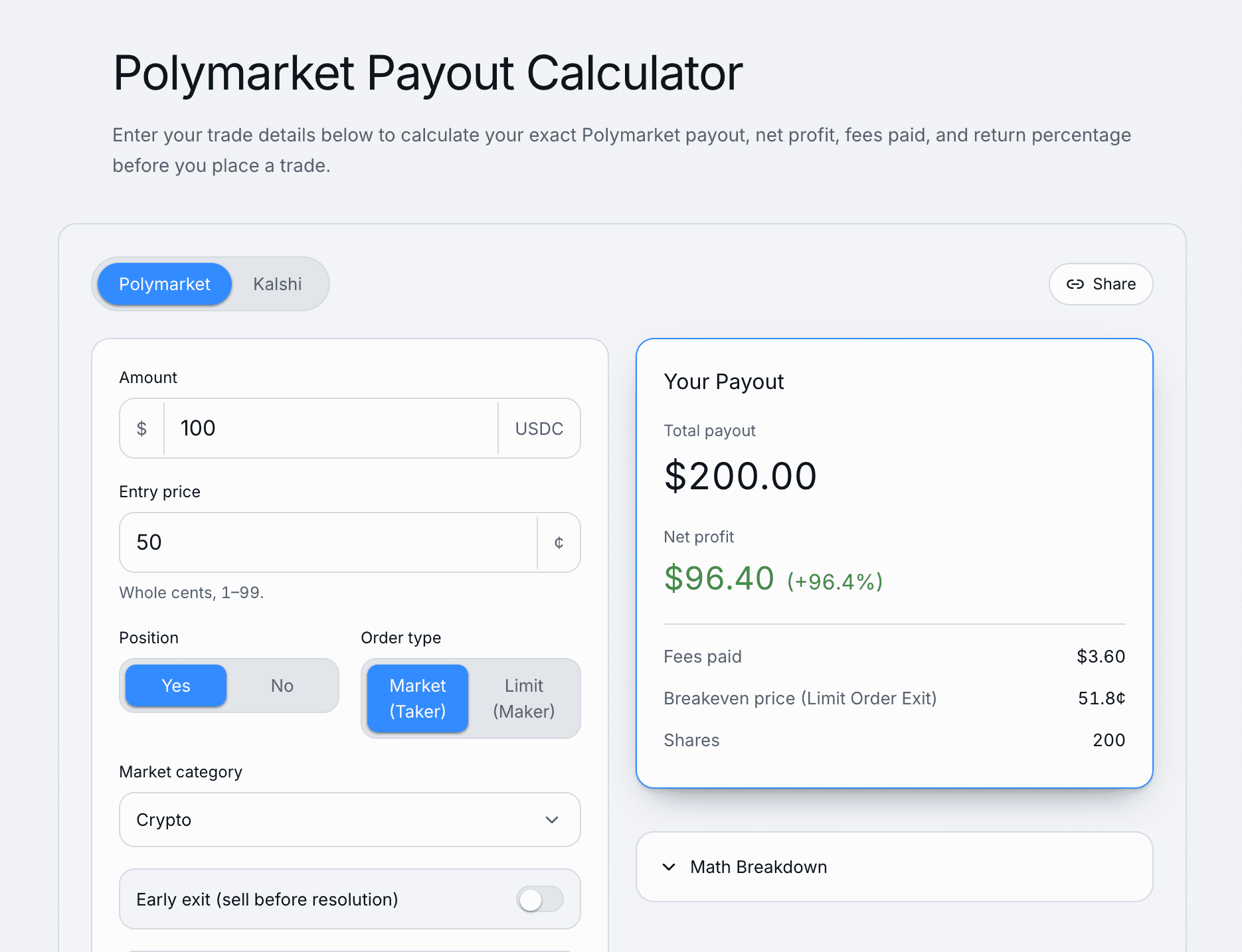
Because exact rates here are still being finalized during the beta period, checking the live fee schedule inside the app before trading is more reliable than relying on any third-party estimate, including this one.Try the Free Polymarket Payout Calculator → Calculate Your Profit Before You Trade
Perps vs Polymarket's Standard Event Markets
Perps and standard shares answer different questions, and mixing them up is one of the more common early mistakes.
A standard share is the better tool for a conviction-based view on how an event resolves. A perp is the better tool for expressing a short-term directional view with leverage, particularly when the size of a price move matters as much as its direction. If you're still getting comfortable with how Polymarket's pricing reflects probability in the first place, Polymarket Probability Guide: How Price Equals Probability and Where Arbitrage Hides is worth reading before adding leverage into the mix.
Risk Management for Perps Traders
Leverage changes the risk profile of a position more than most new perps traders expect going in.
A few practices apply regardless of experience level
- Decide on a liquidation price first, then size leverage around it, rather than picking a leverage multiple and hoping the price cooperates.
- Set a take-profit and a stop-loss at the time of entry, not after a position has already started moving.
- Treat funding as a real, ongoing cost, especially on positions held for more than a day or two.
- Reserve higher leverage for short, high-conviction windows around a specific catalyst rather than holding it open for weeks.
- Start with a small position size until the funding, margin, and liquidation mechanics feel routine.
Traders used to Polymarket's capped-downside shares should treat perps as a fundamentally different risk category. A standard share can only lose what was paid for it; a leveraged perp position can be liquidated in a fast move, wiping out the full margin behind it. It's also worth understanding how other platforms have approached leveraged event trading. Kalshi Perpetual Futures (Timeless) Complete Guide 2026 covers a structurally different leveraged product built specifically around event outcomes, which is a useful point of comparison for anyone weighing Polymarket's version against alternatives.
If you're trading on Polymarket's newer infrastructure more broadly, it's also worth confirming your account and tooling are current. Polymarket V2 Technical Changes 2026: What Traders Need to Do Complete Migration Guide outlines what changed for existing traders and what to check before placing new orders of any kind.
Where to Trade Perps on Polymarket
Perps are accessed directly through Polymarket's own platform rather than a separate app, using the same account and wallet connection as standard event markets once perps access is enabled. The official product page and documentation at polymarket.com is the most reliable source for current asset availability, access requirements, and any fee updates, since all of these are still evolving during the beta period.
The Bottom Line
Polymarket perpetual futures give traders on the platform a way to express leveraged, continuous-price views without leaving the Polymarket ecosystem, something that wasn't possible before April 2026. The trade-off is a product that's still young: leverage caps, fee schedules, and asset coverage are all likely to change as the beta matures.
For traders who already understand funding rates and liquidation math from other perps venues, this product adds a genuinely new tool to an existing account. For traders newer to leveraged trading, it's worth treating this Polymarket perpetual futures product with the same caution as any other new, high-leverage instrument: start small, understand the liquidation math before it matters, and size positions around what you can afford to lose entirely.
For context on how much this platform has grown around the launch of products like this one, What the $15 Billion Polymarket Valuation Actually Means for Retail Traders looks at what that growth could mean for traders going forward.
FAQ
What are Polymarket Perps?
These are perpetual futures contracts on Polymarket that let traders go long or short on an asset's price with leverage, without any expiration date. They differ from Polymarket's standard event shares, which pay out $0 or $1 once an event resolves.
How do Polymarket's perpetual futures work?
Polymarket's perpetual futures use margin, a funding rate, and a mark price to keep a leveraged position open indefinitely while tracking the underlying asset's price. Funding is exchanged between long and short holders roughly every 8 hours to keep the contract price anchored to spot, and a position is liquidated if losses consume the margin backing it.
How do I trade Polymarket Perps?
Trading starts with a funded, self-custodied wallet connected to Polymarket and confirmed perps access, since the product is currently gated behind an invite system. From there, a trader picks an asset, chooses long or short, sets leverage, and places a limit or market order. For the exact steps on how to trade Polymarket Perps from account setup through closing a position, see the walkthrough above.
What are the fees on Polymarket Perps?
Polymarket Perps fees currently follow a maker-rebate, taker-charge model similar to Polymarket's standard markets, though a complete, published rate table isn't yet available since the product is in beta. Funding payments, which aren't a platform fee but a cost exchanged between traders, also apply roughly every 8 hours.
Does Polymarket offer leverage on Perps?
Yes. Polymarket perps leverage currently runs up to 20x during the beta period, meaning a relatively small margin deposit can control a much larger notional position. Higher leverage narrows the gap between entry price and liquidation price, so most guidance points toward using a fraction of the available maximum.
Is there a dedicated app for Polymarket Perps?
There isn't a separate polymarket perps app. Perps are built into Polymarket's existing platform and use the same account, wallet connection, and interface as standard event-market trading, once perps access has been enabled on that account.