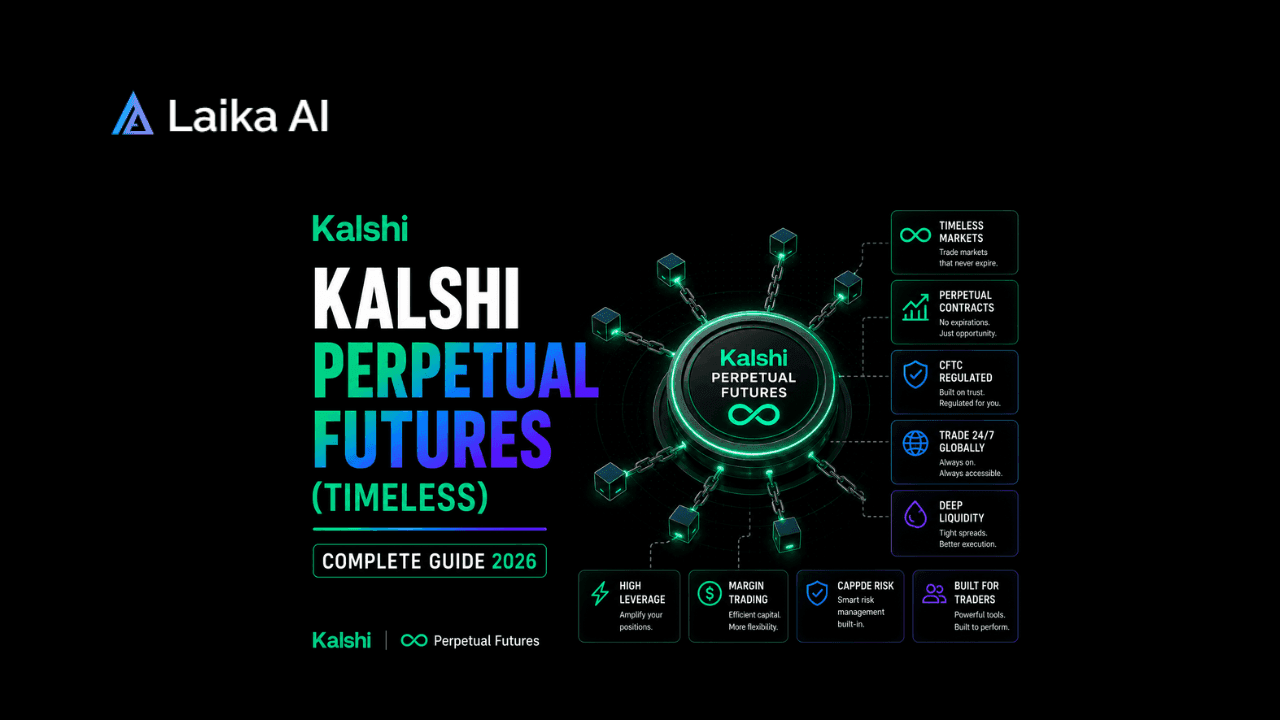
Kalshi perpetuals are CFTC-regulated futures contracts with no expiration date, letting US traders go long or short on crypto assets like Bitcoin and Ethereum using leverage. Kalshi teased the product under the codename "Timeless" in April 2026 before launching it publicly on May 29, 2026, becoming the first company in American history to offer perpetual futures under direct CFTC oversight.
This guide covers how Kalshi perpetuals actually work, how funding rates and leverage function, what "Timeless" means as a product name, and what the access process looks like for anyone wanting to trade them. For the basics of Kalshi's original product line before this expansion, How Does Kalshi Work covers the platform's event-contract mechanics in full.
What Are Kalshi Perpetuals?
A Kalshi perpetual, or "perp," is a derivatives contract that tracks the price of an underlying asset with no fixed settlement date. Unlike Kalshi's traditional event contracts, which resolve on a specific date based on a yes-or-no outcome, perpetuals never expire and can be held open indefinitely, as long as the position maintains enough margin.
Kalshi describes the distinction as the difference between a photograph and a film: an event contract captures a snapshot of what the world thinks right now, while a perpetual is continuously updated and never-ending. Traders open a position, choose a direction, and close it whenever they want rather than waiting for a resolution date.
This is a different pricing logic entirely from Kalshi's standard event contracts, where the contract price itself reflects a probability of an outcome occurring. For readers wanting that underlying concept explained in more detail, how price equals probability in prediction markets breaks down that relationship and where arbitrage opportunities tend to show up.
The mechanics differ meaningfully from Kalshi's core product:
- No expiration date, unlike every other Kalshi event contract
- Leverage is available, letting a trader control a larger position than their posted collateral alone
- Positions can go long or short, profiting from either rising or falling prices
- A funding mechanism, rather than a resolution event, keeps the contract price anchored to the real market
What Is Kalshi Timeless?
"Timeless" was the codename Kalshi used to tease this launch in April 2026, before the perpetual futures product was formally named and released. The teaser used looping imagery and the word "timeless" itself as a hint toward a contract without an expiration date, which is exactly what perpetual futures are.
Once the product launched on May 29, 2026, Kalshi dropped the "Timeless" branding in favor of calling the product simply Perpetual Futures, or Perps, inside the app. The term "Kalshi Timeless" still shows up in searches because of how the product was first introduced to the public, even though the live product page and help center now refer to it as Perpetuals.
How Kalshi Perpetual Futures Work
Trading a Kalshi perpetual comes down to three decisions: which direction to take, how much leverage to apply, and how to manage the position once it's open.
A long position profits when the asset's price rises, similar to a leveraged version of buying the asset outright. A short position profits when the price falls, something that isn't possible with simple spot ownership. This two-sided structure is part of why perpetuals appeal to traders who want to express a bearish view or hedge an existing position rather than only bet on prices going up.
Opening a position requires posting collateral, called margin, which leverage then multiplies into a larger notional position. Kalshi uses isolated margin, meaning the collateral assigned to a specific trade is the amount actually at risk on that trade, rather than a trader's entire account balance.
For example, $1,000 of margin at 5x leverage controls a $5,000 position. A 10% move in the underlying asset then produces a roughly 50% swing in the trader's collateral, in either direction, which is the core trade-off leverage introduces.
Funding Rates Explained
Because a perpetual never expires, there's no settlement date to naturally pull its price back in line with the real market the way a traditional futures contract's expiration does. Kalshi solves this with a funding rate, a recurring payment exchanged directly between traders holding long and short positions.
The mechanism works in both directions:
- When the perpetual trades above the spot price, longs pay shorts, which makes holding a long more expensive and nudges demand back down
- When the perpetual trades below the spot price, shorts pay longs, pushing the contract price back up toward spot
- Funding settles every 8 hours on Kalshi and is capped at plus or minus 2% per period
- Every funding payment appears directly in a trader's transaction history, so the cost or credit is fully visible
Reference pricing for funding and settlement comes from CF Benchmarks indices, an institutional-grade benchmark provider that aggregates data across multiple regulated exchanges. Bitcoin's contract specifically uses the Bitcoin Real-Time Index, which updates every second.
Leverage Limits and Liquidation
Kalshi has positioned its leverage caps as deliberately conservative compared to offshore perpetual exchanges, which often offer 50x, 100x, or higher. At launch, Bitcoin's maximum leverage sits near 5.7x, with most other crypto assets capped lower.
Liquidation happens automatically if a position's losses erode the posted margin down to the maintenance threshold, at which point Kalshi's clearing arm closes the position to prevent further losses. Kalshi's own guidance is direct about the math here: at 5x leverage, roughly a 7% adverse move in Bitcoin's price can be enough to wipe out the margin cushion and trigger liquidation.
Kalshi provides tools to manage this risk directly in the trading interface, including take-profit and stop-loss orders that close a position automatically at a price the trader sets in advance, and a real-time health indicator that turns red and sends an alert when a position is approaching its liquidation price. Traders looking to apply more disciplined risk management to leveraged positions may find it useful to look at proven Kalshi trading strategies built around Kalshi's original event-contract markets, since the same core discipline around position sizing and downside limits carries over to perpetuals.
Which Assets Are Available
Kalshi launched perpetuals with crypto assets only, reflecting both the size of the offshore perpetuals market it's targeting and the pace at which the CFTC approves new contract types. Every new asset requires separate Commission approval, so the lineup expands one asset at a time rather than all at once.
At launch, Kalshi listed 11 perpetual contracts, all tied to major crypto tokens including Bitcoin, Ethereum, Solana, and XRP. Kalshi has stated its intent to expand into other asset classes over time, though agricultural commodity perpetuals have specifically been ruled out of the current roadmap.
Trading volume in the first weeks after launch was significant. Kalshi reported more than $5.5 billion in perpetuals volume within the first two weeks, and the company has said perpetuals became the fastest-growing product in its history, reaching $1 billion in cumulative volume in a matter of days compared to roughly 40 months for its event-contract business to reach the same milestone.
Kalshi isn't alone in this push. Polymarket has also moved toward 24/7 long-short trading with its own perpetuals offering, though it operates outside direct CFTC oversight on its main global exchange. Anyone comparing the two platforms more broadly, beyond just this one product, may find a full breakdown of Kalshi versus Polymarket useful for weighing the two head to head.
Do You Need an Access Code for Kalshi Perpetual Futures?
Perpetual futures are not automatically available to every Kalshi user. Trading them requires a separate margin application, and not every applicant is approved. This is a deliberate safeguard Kalshi has built into the product rather than a temporary rollout limitation.
The access process includes a few distinct steps:
- Applying separately for margin access, which is reviewed before approval
- Completing mandatory product education before placing a first trade
- Funding a perpetual margin account, which is held completely separate from a trader's predictions balance
- Trading within Kalshi's conservative leverage limits once approved
Kalshi opened a waitlist alongside its initial CFTC approval for Bitcoin perpetuals, and public reporting around the launch has referenced early access being granted in phases rather than to all users simultaneously. There is no separate promotional "access code" distributed outside this formal application and waitlist process, so any third-party site offering a shortcut code should be treated with skepticism. A perpetual margin account is also protected as a customer-segregated account under CFTC rules, meaning it's held apart from Kalshi's own operating funds.
That CFTC oversight is central to how Kalshi positions this product against crypto-native competitors, an angle covered in more depth in how Kalshi and Polymarket compare specifically for crypto markets. It also sits inside a much larger jurisdictional fight over prediction markets generally, since the ongoing dispute between the CFTC and individual states shapes what Kalshi and similar platforms can offer and where.
What Are People Saying About Kalshi Perpetuals? (Reddit and Community Reaction)
Community discussion around Kalshi's perpetual launch has centered on a few recurring themes. Traders coming from offshore perpetual platforms have generally noted that Kalshi's leverage caps are far more conservative, which some see as a meaningful safety feature and others see as a limitation compared to the higher leverage available elsewhere.
A second common thread is enthusiasm about regulatory legitimacy. Because Kalshi's perpetuals are CFTC-regulated and use segregated margin accounts, some traders have framed the product as a safer, onshore alternative to offshore exchanges that fall outside US regulatory protection.
A third theme is simple curiosity about the "Timeless" teaser itself, with early speculation before launch correctly guessing that the codename pointed toward a never-expiring contract, based on the imagery and wording Kalshi used in its announcement. As with any fast-growing new product, opinions remain mixed and continue to evolve as more traders gain access and leverage limits or asset coverage change.
Risks of Trading Kalshi Perpetuals
Perpetual futures carry meaningfully more risk than Kalshi's standard event contracts, since leverage magnifies both gains and losses in a way a binary yes-or-no contract does not.
- Leverage amplifies losses as much as gains, and a modest adverse price move can be enough to trigger liquidation
- Liquidation is not a guaranteed stop-loss; rapid or illiquid market conditions can result in execution at prices worse than the liquidation trigger, potentially producing a negative balance
- Funding payments are an ongoing cost or credit while a position stays open, and can erode returns on a position held for an extended period
- Perpetuals are a leveraged product and may not be appropriate for all traders, a point Kalshi itself emphasizes in its own risk disclosures
For traders weighing perpetuals against Kalshi's original event-contract products, understanding overall platform costs is worth reviewing separately. Kalshi's fee structure compared to Polymarket breaks down how trading costs differ across products and platforms.
The Bottom Line
Kalshi perpetuals mark the company's biggest product expansion since it introduced event contracts, moving from single-resolution prediction markets into a leveraged, continuously tradable derivatives product regulated directly by the CFTC. The "Timeless" branding used to tease the launch has since given way to the straightforward Perpetual Futures name inside the app, but the core idea, a contract that never expires, is exactly what shipped.
The product's appeal is real regulatory legitimacy in a market historically dominated by offshore platforms, paired with genuinely conservative leverage limits compared to those competitors. That combination makes it a meaningfully different product from Kalshi's original event contracts, and one that carries real leverage risk anyone considering it should take seriously before applying for access.
Frequently Asked Questions
What are Kalshi perpetuals?
Kalshi perpetuals are CFTC-regulated futures contracts with no expiration date, letting traders go long or short on assets like Bitcoin and Ethereum using leverage. Unlike Kalshi's traditional event contracts, which resolve on a fixed date, perpetuals can be held open indefinitely as long as the position maintains sufficient margin.
How do Kalshi perpetual futures work?
A trader posts collateral called margin, selects a leverage multiplier, and opens either a long or short position. Profit or loss moves directly with the underlying asset's price, and a funding payment is exchanged between longs and shorts every 8 hours to keep the contract price anchored to the real market, since there's no expiration date to do that naturally.
What is Kalshi Timeless?
Kalshi Timeless was the codename used to tease the perpetual futures launch in April 2026, before the product's official name and release. Once perpetuals launched publicly on May 29, 2026, Kalshi moved away from the "Timeless" name and now refers to the product simply as Perpetual Futures, or Perps.
Do I need an access code for Kalshi perpetual futures?
There's no promotional access code involved. Trading perpetuals requires applying separately for margin access, since it is not automatically enabled on every Kalshi account, and completing Kalshi's required product education before placing a first trade. Approval is not guaranteed for every applicant.
What are people saying about Kalshi perpetuals?
Community reaction has generally focused on Kalshi's leverage caps being more conservative than offshore perpetual platforms, viewed by many as a genuine safety advantage given the product's CFTC regulation and segregated margin accounts. Early speculation around the "Timeless" teaser also correctly predicted a never-expiring contract before the official launch confirmed it.