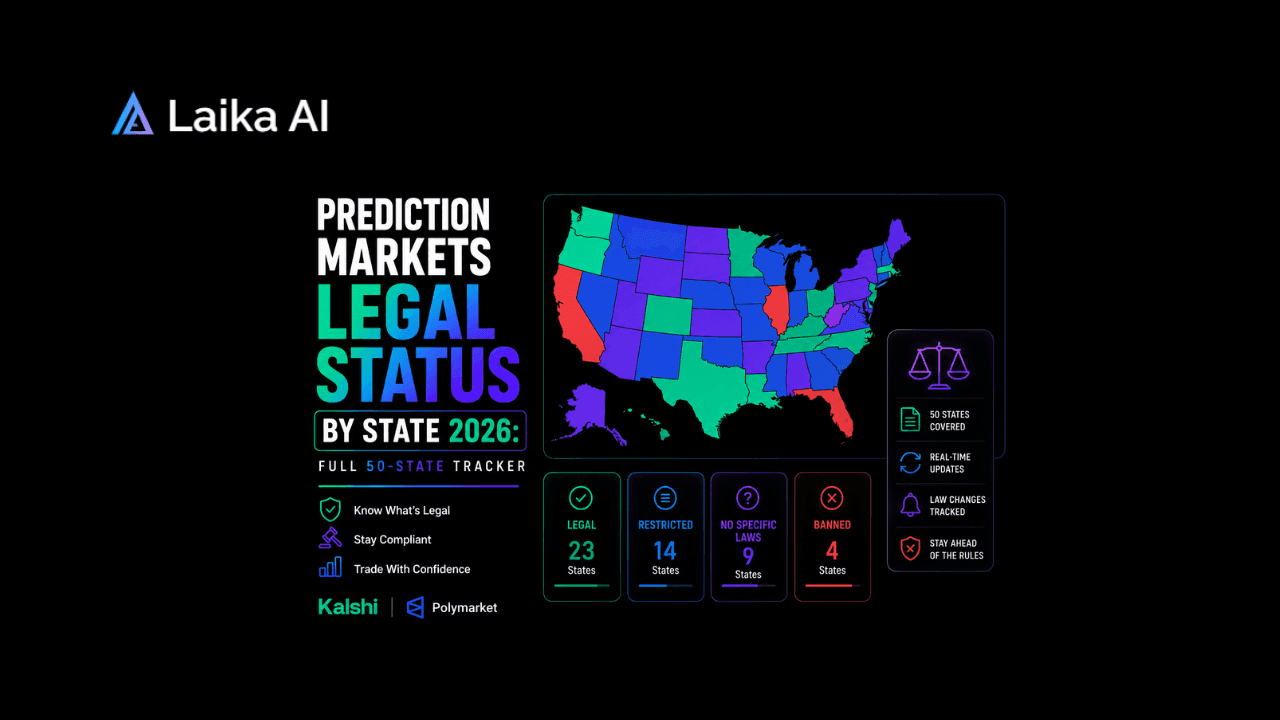
Prediction market law is genuinely unsettled right now. Courts in different circuits have reached opposite conclusions on the same legal question, several of the cases below are still active, and a ruling could flip a state's status between when this is written and when you're reading it. Treat this as a snapshot as of mid-July 2026, not a permanent answer, and confirm your own state's current posture before you trade. This is general information, not legal advice.
Key takeaways
- Prediction markets are legal at the federal level. The CFTC regulates event contracts as derivatives under the Commodity Exchange Act, not as gambling.
- Kalshi holds a CFTC Designated Contract Market license. Polymarket's US arm QCX LLC, doing business as Polymarket US became a Designated Contract Market after acquiring QCEX in 2025, and the CFTC issued an Amended Order of Designation in November 2025 approving intermediated access.
- No state has banned the category outright as of mid-2026, but at least 13-15 states have issued cease-and-desist orders, filed lawsuits, or in one case pursued criminal charges against Kalshi specifically.
- Courts are split. Some federal rulings have sided with Kalshi on preemption grounds; others have sided with states. New Jersey's Third Circuit ruling and Tennessee's federal injunction favor Kalshi; Nevada, Maryland, Massachusetts, Ohio, and New York have all produced rulings or enforcement actions against it.
- Status is platform- and state-specific. There is no single yes/no answer that applies everywhere, and the honest version of this page has to say so.
The current legal landscape
Start with the federal picture, because it's the one part of this that's comparatively settled. The CFTC is the primary federal regulator for prediction markets, and its position reaffirmed under Chairman Michael Selig is that event contracts are financial derivatives, not gambling products, when they're listed on a registered Designated Contract Market and cleared through a registered clearing organization. That framework comes from the Commodity Exchange Act, and it's why Kalshi and Polymarket US can self-certify new contracts with the CFTC rather than seek a state gambling license for each one.
The regulatory direction of travel has been toward more clarity, not less. In March 2026, the CFTC opened an Advance Notice of Proposed Rulemaking specifically on prediction markets, asking for public comment on how the agency should treat this category going forward. That's a meaningful signal agencies don't usually start formal rulemaking on something they're planning to shut down. At the same time, the CFTC opened a new investigation into Polymarket in June 2026 focused on marketing practices, following a letter from Senators John Curtis and Adam Schiff raising concerns about simulated trading demonstrations and undisclosed influencer promotions. So "the CFTC is friendly to this industry" and "the CFTC is actively scrutinizing specific companies in this industry" are both true at once, which is a fair summary of where federal oversight actually stands right now.
What the CFTC's position does not settle is whether individual states can still apply their own gambling laws to sports and political event contracts. That's the fight playing out state by state below, and it's the reason this page exists as a tracker rather than a single paragraph.
State-by-state legal tracker
Every state below reflects what independent legal and news reporting actually documents as of mid-July 2026. Where a state has real enforcement activity a cease-and-desist letter, a lawsuit, a court ruling that's noted with the specific action and outcome. Where research turned up no documented state-level action, the row says so plainly rather than implying a status this page can't actually back up. A few rows are flagged as lower-confidence because only one source reported them; treat those as a starting point for your own check, not a final answer.
If your state shows "Open" with no documented action, that's a reflection of what's publicly reported as of this writing, not a legal guarantee nothing will change. Several states with no action today (Illinois, Connecticut, Arizona) had none twelve months ago either.
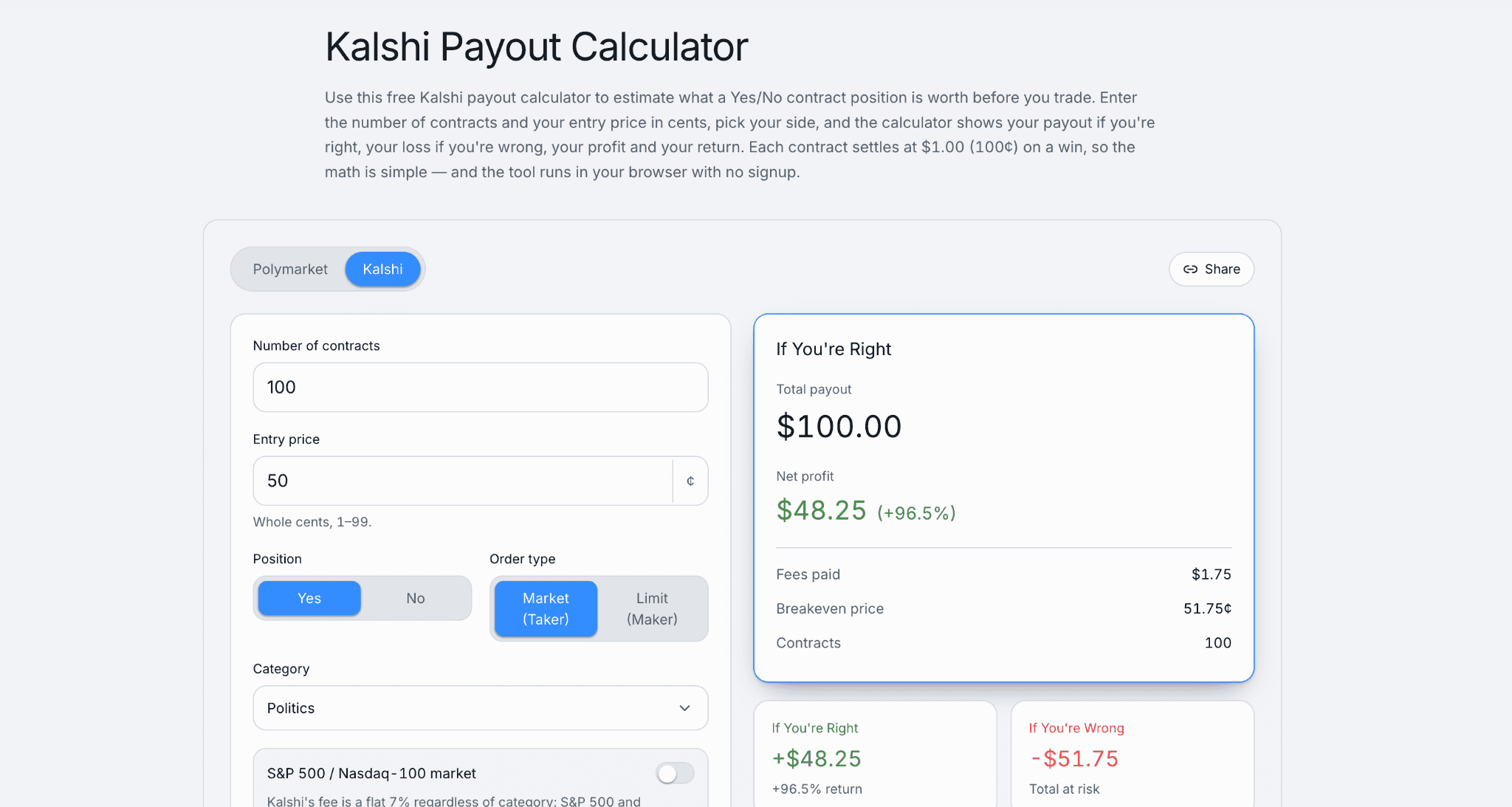
Try the Kalshi Payout Calculator to estimate your returns before every trade and make more informed trading decisions.
Timeline of key legal milestones
- 2022 The CFTC settles with Polymarket (then Blockratize Inc.) for $1.4 million over unregistered event-based binary options, and the company exits the US market.
- March 2025 Nevada's Gaming Control Board and Ohio's Casino Control Commission both issue cease-and-desist letters to Kalshi, opening the current wave of state enforcement.
- July 2025 Polymarket acquires QCEX for $112 million, creating QCX LLC and laying the regulatory groundwork for its US return.
- August 2025 A federal judge denies Kalshi's request for a preliminary injunction against Maryland, finding state gaming authority can coexist with CFTC regulation.
- November 2025 A federal district court rules for Nevada in its dispute with Kalshi. Separately, the CFTC issues an Amended Order of Designation approving Polymarket US for intermediated access.
- December 2025 Polymarket US launches a real-money sports betting mobile app under CFTC oversight.
- January 2026 A Massachusetts state court issues a preliminary injunction blocking Kalshi's sports contracts. Kalshi separately wins a temporary restraining order against Tennessee's cease-and-desist order.
- February 2026 Tennessee's TRO converts into a full preliminary injunction. The CFTC publicly states it will defend its exclusive jurisdiction over event contracts.
- March 2026 The CFTC opens formal rulemaking (an Advance Notice of Proposed Rulemaking) on prediction markets. Arizona's Attorney General files 20 criminal counts against Kalshi. Michigan's Attorney General files a civil enforcement action. Senators introduce the Prediction Markets Are Gambling Act.
- April 2026 The Third Circuit rules 2-1 in Kalshi's favor against New Jersey. The CFTC sues Arizona, Illinois, and Connecticut to block their respective state enforcement actions, and a federal judge halts Arizona's criminal case days later. Polymarket files for CFTC approval to bring its main exchange onshore. The Ninth Circuit clears the way for Nevada's temporary ban.
- June 2026 The CFTC opens a new investigation into Polymarket's marketing practices following a Senate letter raising concerns about simulated trading and influencer disclosures.
- July 2026 Kalshi loses its bid for a preliminary injunction in New York.
What "CFTC regulated" actually means for a trader
It's worth being specific about what CFTC regulation buys you, because "federally regulated" gets thrown around as a marketing phrase more than it gets explained.
Being a Designated Contract Market means an exchange has to segregate customer funds from its own operating capital, submit new contracts for CFTC review (or self-certify under standards the agency has approved), and undergo regular audits of its market integrity practices. Kalshi and Polymarket US have both published enhanced market integrity rules covering exactly this kind of oversight. In practical terms, that's a meaningfully different consumer protection framework than an unregulated offshore book.
What CFTC status does not automatically do is answer the federal preemption question whether that federal framework overrides a state's own authority to regulate gambling within its borders. That's the legal question underneath nearly every dispute on the table below, and courts have not converged on one answer. Some read the Commodity Exchange Act's "swap" definition broadly enough to cover sports event contracts and preempt state gaming law entirely. Others have found that federal commodities regulation and traditional state police power over gambling can coexist, meaning a platform can be fully CFTC-compliant and still be breaking a specific state's gambling statute. The CFTC vs states breakdown goes deeper into the legal mechanics behind that split, if you want the doctrine rather than just the outcomes.
Platform-by-platform US availability
Kalshi has operated as a CFTC-regulated exchange since 2020 and was the first prediction market platform to build its business explicitly around federal derivatives status rather than state gaming licenses. That positioning is also what's made it the target of nearly every state action described below Kalshi has been the party in almost every major case, in part because it markets itself aggressively as available in all 50 states. How Kalshi works, in a complete beginner's guide covers the mechanics of the platform itself.
Polymarket runs two separate things in the US right now. Polymarket US legally QCX LLC, built on the $112 million acquisition of QCEX in 2025 is a CFTC-registered Designated Contract Market offering fully collateralized event contracts with no margin or leverage, and it launched a real-money sports betting mobile app in December 2025. Separately, Polymarket's main global exchange (the one that settles on Polygon in USDC and lists the widest range of markets) is still working through the CFTC approval process to let US residents trade directly on it; the company filed for that approval in April 2026, and a decision hadn't landed as of this writing. If you're trading Polymarket from the US today, you're very likely on the regulated Polymarket US product, not the offshore exchange.
A handful of newer entrants are worth knowing about if you're comparing options: DraftKings' DeX and FanDuel Predicts (built through a partnership with CME Group) both bring the two largest US sportsbook brands into the event-contract space using the same CFTC-regulated derivatives structure. Coinbase has also launched its own prediction market offering.
International snapshot
This page is deliberately US-focused, since the state-by-state legal question doesn't really exist outside the US federal system. If you're trading from outside the US, the more relevant questions are which countries restrict access to these platforms entirely and which support them under local frameworks. Our guide to where Kalshi is legally supported and restricted and our Polymarket restricted-countries breakdown covers the regulations and legal restrictions in countries other than the US.
What's likely coming next
A few things worth watching rather than predicting outcomes on:
1. New CFTC rulemaking.
The March 2026 ANPRM is a formal, public process, and whatever comes out of it will likely set clearer boundaries than the current case-by-case litigation approach.
2. Pending federal legislation.
The Prediction Markets Are Gambling Act, introduced by Senators John Curtis and Adam Schiff, would amend federal law to bar sports and casino-style event contracts from CFTC-regulated platforms entirely. A separate bill, sometimes referred to as the PREDICT Act, targets insider trading on these platforms specifically. Neither has passed as of this writing, and both would meaningfully reshape the legal landscape if they did.
3. A likely Supreme Court case.
Multiple legal commentators tracking this litigation, including analysis from firms like Epstein Becker Green and Holland & Knight, expect the circuit split between pro-Kalshi rulings (New Jersey, Tennessee) and pro-state rulings (Nevada, Maryland, Massachusetts, Ohio, New York) to eventually require Supreme Court resolution, absent new federal legislation that moots the question first.
4. More state legislative activity.
Beyond the litigation, states including Hawaii and Kentucky have bills actively moving through committees that could codify or restrict access independent of how the court cases resolve.
The Bottom Line
Prediction markets are legal at the federal level, full stop the CFTC's regulatory framework for event contracts is real and functioning. What isn't settled is whether that federal status shields platforms like Kalshi and Polymarket US from individual states' gambling laws, and right now the honest answer is: it depends entirely on which state, which court, and which week you're asking. New Jersey and Tennessee currently favor the platforms; Nevada, Maryland, Massachusetts, Ohio, and New York currently don't. If you trade on these platforms regularly, the practical move is checking your own state's current status directly rather than relying on a platform's own "legal in all 50 states" marketing and checking back periodically, because this list has changed multiple times over just the past few months and will likely keep doing so until either Congress or the Supreme Court settles it.
Frequently Asked Questions
Is Kalshi legal in all 50 states?
Not uniformly. Kalshi is a CFTC-regulated Designated Contract Market and operates under federal derivatives law nationwide, but several states including Nevada, Maryland, Massachusetts, Ohio, and New York currently have active enforcement actions, injunctions, or unresolved litigation specifically targeting its sports event contracts. Other states, including New Jersey and Tennessee, currently have federal rulings favoring Kalshi's operation. Check the table above for your specific state.
How is Kalshi legal if some states call prediction markets gambling?
Kalshi's legal argument rests on federal preemption: it holds a CFTC license as a Designated Contract Market, and its position is that federal commodities law under the Commodity Exchange Act overrides state gambling regulation for its contracts. Some federal courts have agreed with that argument; others have found that state gambling authority and federal commodities regulation can coexist, meaning Kalshi can be fully CFTC-compliant and still violate a specific state's gambling law. That split is exactly why this remains an active legal question rather than a settled one.
Why is Kalshi legal at the federal level?
Because it's registered with the CFTC as a Designated Contract Market, and its event contracts are treated as regulated derivatives, specifically swaps under the Commodity Exchange Act, rather than as wagers under any federal gambling statute. That federal registration is the basis for every one of Kalshi's legal arguments against state enforcement, whether or not a given court ultimately agrees with it.
Where is Kalshi legal right now?
As of mid-2026, Kalshi operates without active state-level enforcement in most of the country. States with confirmed active disputes, litigation, or enforcement actions include Nevada, Maryland, Massachusetts, Michigan, Ohio, New York, Arizona, Illinois, Connecticut, and New Mexico, among others detailed in the table above. Because several of these cases are still moving through the courts, "legal right now" in any of these states can change without much notice.
Are Polymarket's legal states the same as Kalshi's?
Not exactly. Polymarket's regulated US arm, Polymarket US (legally QCX LLC), is a separate CFTC-registered entity from Kalshi, and most of the state enforcement actions documented so far have specifically named Kalshi rather than Polymarket, though a few including Connecticut's and Tennessee's cease-and-desist letters named both companies. Because Polymarket US is newer to full CFTC-regulated operation than Kalshi, and because its main global exchange is still seeking separate approval to serve US residents directly, its state-by-state legal exposure is a distinct and still-developing picture from Kalshi's.