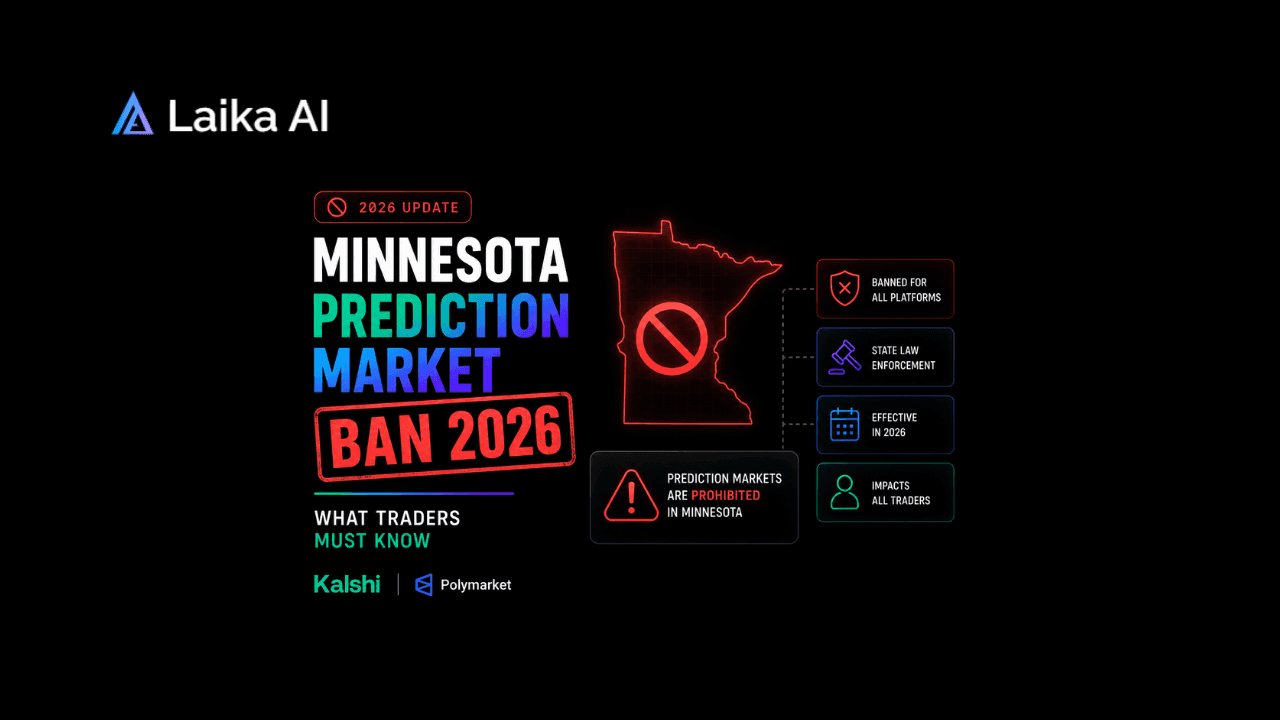
Minnesota became the first state to make operating a prediction market a felony, and the fallout began before the law even took effect. Governor Tim Walz signed the ban, SF 4760, on May 18, 2026, as part of a broader public safety bill. Beginning August 1, 2026, creating, operating, hosting, or advertising a prediction market platform in Minnesota will carry criminal penalties of up to five years in prison and a $10,000 fine. Within days, both Kalshi and the CFTC filed federal lawsuits seeking to block the law before it could take effect, arguing that it directly conflicts with the federal government's authority over event contracts.
This is not a cease-and-desist letter or a regulatory warning shot of the kind several other states have already issued. It is a criminal statute, the most aggressive action any state has taken against the industry so far and it has escalated the ongoing federal-versus-state battle over prediction markets to a new level. This guide explains what the law actually does, the legal basis for the fight now playing out in federal court, which other states have taken similar or different approaches, and what Minnesota residents can realistically do before the August 1 deadline. For the broader jurisdictional conflict this case fits into, CFTC vs. States: Who Really Regulates Prediction Markets in 2026 covers the national landscape, while What Prediction Markets Are and How They Work explains the fundamentals.
What Minnesota's Law Actually Does
The Minnesota law is notably broader in scope than most of the state-level actions that preceded it. Starting August 1, 2026, it becomes a felony to create, operate, host, or advertise a prediction market platform in the state. Critically, the law targets the companies running these platforms, not individual users. Someone in Minnesota who simply places a trade on Kalshi or Polymarket is not committing a crime under this statute; the criminal exposure falls on the operators and anyone facilitating the platform's operation within the state.
The law does carve out specific exceptions. Traditional insurance contracts and legitimate agricultural hedging tools, including weather-related contracts farmers use to protect against a bad harvest, are explicitly excluded. That exception matters given Minnesota's status as one of the largest agricultural producers in the country and reflects a last-minute revision. An earlier version of the bill had explicitly prohibited betting on weather events and catastrophes outright; that provision was removed before final passage specifically in response to concerns about how a blanket ban would affect legitimate futures and hedging markets that farmers rely on.
Beyond those carve-outs, virtually every other category of prediction market contract falls within the ban, including markets tied to sports outcomes, elections, entertainment, war, and public health events. This breadth is what makes Minnesota's law meaningfully more aggressive than earlier state actions, which generally focused narrowly on sports-adjacent contracts specifically because of their overlap with existing state gambling law.
The Legal Basis for the Ban and the Fight Against It
The core legal question is the same one playing out in courts across the country, but Minnesota has pushed it to its most extreme form yet: does a state have the authority to criminalize contracts that the CFTC has already classified as federally regulated derivatives?
Kalshi's lawsuit, filed in federal court, argues that Minnesota's law violates the Supremacy Clause of the US Constitution by attempting to override the CFTC's "exclusive jurisdiction" over event contracts, including those traded on federally designated contract markets. The company has also raised a First Amendment claim, given that the law criminalizes advertising the platform, not just operating it. Kalshi's CEO Tarek Mansour was blunt about the stakes in the company's public statement, noting the law effectively turns lawful operators and participants into felons overnight.
The CFTC itself filed a separate, parallel lawsuit seeking a preliminary injunction to block the law before its August 1 effective date. This is significant beyond the Minnesota case specifically: it reflects a CFTC under the Trump administration that has positioned itself as an active defender of federal jurisdiction over this industry rather than a neutral bystander. President Trump has publicly weighed in as well, describing it as "critically important" for the CFTC to retain exclusive authority over the sector. The White House Office of Management and Budget was, at the time of the Minnesota suit, already reviewing a broader CFTC proposal following a March 2026 advance notice of proposed rulemaking seeking public comment on which event contracts might be barred as contrary to the public interest, a sign that federal rulemaking on this exact question is actively in motion alongside the litigation.
For the broader legal distinction underlying every one of these state fights, whether these contracts are fundamentally financial instruments or a form of gambling under a different name, prediction markets vs gambling: what's the legal difference in 2026 covers that framework directly, and it's the exact tension animating both sides of the Minnesota case. For the fuller regulatory context behind Kalshi and Polymarket's overall risk exposure heading into this fight, Kalshi and Polymarket: the prediction market boom, risks, and regulation covers the wider landscape.
Which Platforms Pulled Back and Which States Have Followed a Similar Path
Minnesota is the most extreme, but far from the only, front in this fight. The state-by-state picture as of mid-2026 shows a genuinely mixed set of outcomes rather than a single trend in either direction.
The pattern that emerges is genuinely inconsistent depending on jurisdiction: Nevada currently has the only enforceable court-ordered ban in effect anywhere in the country. New Jersey lost decisively at both the district and appellate level. Ohio and Massachusetts sit in active appellate limbo. And Minnesota, rather than sending a cease-and-desist letter through a gaming regulator the way most other states have, went straight to criminalizing the conduct through state legislation, a categorically different and more aggressive approach that both Kalshi and the federal government moved immediately to block.
This entire fight is also drawing in figures well outside the immediate industry. Gary Gensler, the former CFTC and SEC chairman, filed an amicus brief in the Ohio case arguing against Kalshi's position, a notable intervention given his own history helping negotiate the Dodd-Frank provisions that are now central to the swap-classification arguments at the heart of these cases.
For the parallel international version of this same access question, useful context for understanding how these platforms handle jurisdiction restrictions more broadly, Kalshi legal countries: where it is supported and restricted and polymarket restricted countries list 2026: complete ban guide both cover how each platform manages country-level access when a jurisdiction moves against them, which is instructive given how quickly Minnesota's situation could evolve into an actual access cutoff. For the specific legal reasoning behind why sports-related contracts in particular keep triggering state gambling law challenges across multiple states simultaneously, Kalshi sports betting: is it legal, is it gambling, and how it works covers that dynamic in detail.
What Minnesota Residents Can Actually Do Right Now
If you're a Minnesota resident currently using Kalshi, Polymarket, or a similar platform, here is the practical, non-speculative reality as of this writing.
1. The law does not currently criminalize you as an individual user
SF 4760 specifically targets operators, not the people placing trades. If the law takes effect as written on August 1, 2026, the criminal exposure falls on the platforms and anyone facilitating their operation within the state, not on you personally for having traded.
2. The effective date is not guaranteed to hold
Both Kalshi and the CFTC have filed for injunctive relief specifically to block the law before its August 1 start date. Given how the equivalent fights have played out in other states, some resolved in favor of the platforms, some in favor of the states, there is no way to predict with confidence whether Minnesota's law will actually take effect on schedule, be delayed pending litigation, or be struck down outright.
3. Check each platform's current state-availability disclosure directly before depositing money
This is the single most important practical step. Platforms update their state eligibility lists as legal situations develop, and the responsible move if you're in Minnesota is to check Kalshi's and Polymarket's current terms directly rather than relying on any article, including this one, for a real-time status that could change before or after publication.
4. If access is cut off, no alternative currently exists that avoids the underlying legal question
Because the ban targets platform operators rather than specific product categories, there isn't a workaround product or a different platform structure that sidesteps Minnesota's law if it takes full effect and platforms choose to geofence the state in response, the way several platforms have already geofenced Nevada following its court-ordered ban. For understanding the underlying mechanics of the platform most directly implicated in the Minnesota litigation, how does Kalshi work: a complete beginner's guide covers what's actually at stake operationally if Kalshi is forced to withdraw from the state.
Frequently Asked Questions
Is Kalshi legal in Minnesota?
As of this writing, yes, Kalshi continues to operate in Minnesota because the state's felony ban, SF 4760, does not take effect until August 1, 2026, and both Kalshi and the CFTC have filed federal lawsuits seeking to block the law before that date. Whether Kalshi remains legally accessible in Minnesota past August 1 depends entirely on the outcome of that pending litigation, which was unresolved as of the law's signing.
What is happening with Minnesota and Kalshi?
Minnesota Governor Tim Walz signed SF 4760 into law on May 18, 2026, making it a felony, punishable by up to five years in prison and a $10,000 fine, to create, operate, host, or advertise a prediction market platform in the state starting August 1, 2026. Kalshi filed a federal lawsuit within days arguing the law violates the Supremacy Clause by overriding CFTC authority over event contracts, and separately raises First Amendment claims given the law's advertising restrictions. The CFTC filed its own parallel lawsuit seeking a preliminary injunction against the state.
Which states have banned Kalshi?
Nevada currently has the only enforceable court-ordered ban against Kalshi in effect anywhere in the country, following a Gaming Control Board cease-and-desist in March 2025 and a subsequent state court ruling that has been extended. Minnesota's law would go further than any prior state action by criminalizing operation outright, but it has not yet taken effect and is being actively challenged in federal court. Ohio and Massachusetts have each seen state-favorable rulings currently under appeal. New Jersey lost its case against Kalshi at both the district and appellate level.
Did Kalshi receive a cease and desist letter?
Kalshi has received cease-and-desist orders or equivalent enforcement actions from multiple states, including Nevada, New Jersey, Ohio, and Illinois, generally issued by state gaming regulators asserting the company is offering unlicensed sports betting. Minnesota's approach was structurally different, a direct criminal statute passed through the state legislature rather than a regulatory cease-and-desist order, which is part of what makes it the most aggressive state action to date.
Will Minnesota's ban definitely take effect on August 1, 2026?
This is not certain. Both Kalshi and the CFTC have filed for injunctive relief specifically to prevent the law from taking effect on schedule, and the outcome depends on how the federal court rules on those requests. Given the mixed results across similar cases in other states, some resolved for platforms, others for state regulators, there is no reliable way to predict the outcome in advance. Check for updated court rulings and each platform's current Minnesota-specific access disclosures directly before relying on any predicted outcome.
The Bottom Line
Minnesota's prediction market ban is the most aggressive state action against this industry to date, criminalizing platform operation entirely rather than issuing the cease-and-desist warnings most other states have relied on, and it arrived with an immediate, coordinated federal response from both Kalshi and the CFTC itself. The core legal question, whether the Supremacy Clause preempts a state's ability to criminalize federally regulated derivatives, is the same question working through courts in Nevada, New Jersey, Ohio, Massachusetts, Illinois, and several other states right now, with genuinely mixed results depending on the jurisdiction and appellate stage.
For Minnesota residents currently using these platforms, the immediate practical reality is that individual users are not criminally exposed under the law as written, the August 1 effective date is actively being challenged and is not guaranteed to hold, and the responsible move is checking each platform's current state-availability disclosure directly rather than assuming today's access will still be there next month.
Track how regulatory developments and platform access changes unfold in real time with Polymetric by Laika AI, so you're never caught off guard by a state-by-state access change before you've had a chance to react.