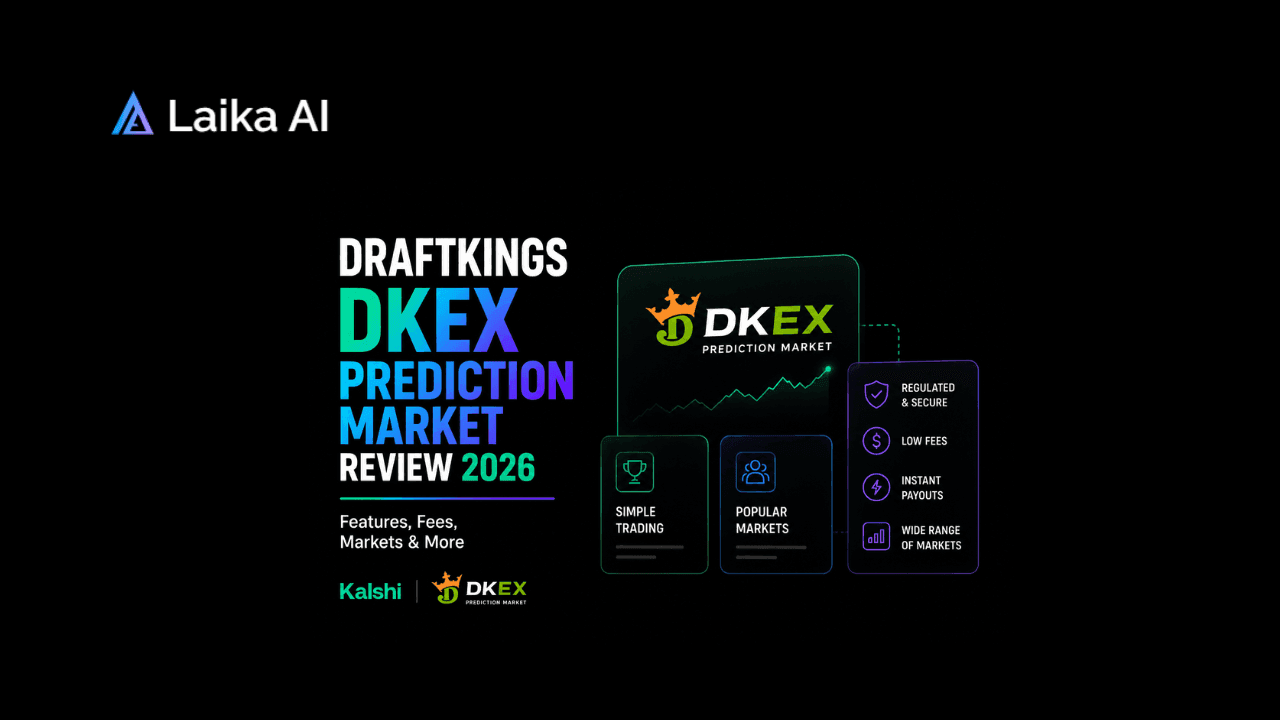
DraftKings DKeX launched on June 26, 2026, and it represents the most significant structural shift in the prediction market industry since Kalshi's original CFTC approval. Rather than continuing to route its prediction market activity through third-party exchange partners, DraftKings built and now owns the actual exchange layer underneath its consumer product, giving the company direct control over contract listings, pricing economics, and trading fees that previously flowed to outside partners. This review covers exactly what DKeX is, how it works for the everyday trader inside the DraftKings app, what it costs, and how it stacks up against Kalshi and Polymarket in 2026.
DKeX did not appear out of nowhere. DraftKings launched its consumer-facing prediction market product, DraftKings Predictions, in December 2025, initially powered by exchange infrastructure from CME Group and later Crypto.com. That arrangement meant every trading fee generated on the platform was being collected by those outside partners rather than DraftKings itself, a meaningful gap given that market-making in this space carries gross margins approaching 95 percent according to Citizens Bank analyst Jordan Bender. DKeX closes that gap entirely, running on the CFTC-regulated designated contract market license and technology DraftKings acquired through its purchase of Railbird Technologies. For the foundational explanation of how event contracts work as a category before getting into DKeX specifics, what are prediction markets and how they work covers the mechanics that underpin every platform discussed here.
How DKeX Works
The exchange behind the app
DKeX is not a separate app you download. It is the exchange infrastructure that now powers the DraftKings Predictions tab inside the existing DraftKings: Sports & Casino app, the same super app that already houses the company's sportsbook and casino products. For a user opening the app today, the experience is functionally unchanged from before the launch: you browse event contracts, buy or sell YES or NO positions, and settle based on the actual outcome, the way a futures contract settles rather than a fixed sportsbook payout. What changed is entirely on the backend. DraftKings now owns the matching engine, the CFTC registration, and the fee structure, rather than leasing that infrastructure from CME Group or Crypto.com.
Federal regulation, not state gambling law
This distinction matters more than almost anything else in this review. DraftKings' traditional sportsbook operates under individual state gaming regulators and is live in roughly 30 states. DraftKings Predictions and the DKeX exchange underneath it operate under the CFTC, a federal regulator, the same framework covering Kalshi and formerly Polymarket's US entity. That federal registration is precisely why event contracts can reach California, Texas, and other large states where DraftKings' conventional sportsbook has no legal path to operate. DraftKings Predictions launched in 38 states in December 2025 and has since expanded to 48 states, with Maine and New Hampshire the only current exceptions, though specific sports event contract availability has been reported at 18 states depending on the contract category and timing of reporting, a gap worth confirming directly in-app for your specific state and market type before assuming full access.
Contract structure and market coverage
DKeX-powered contracts follow the standard binary event contract structure common across the industry: yes/no positions priced to reflect an implied probability, settling to a fixed payout based on the confirmed outcome. Sports coverage spans DraftKings' existing sportsbook categories, with real-time, in-play event contracts available through a live tab alongside standard pregame and futures markets. A notable product feature is Combos, which launched in May 2026 and allows multiple individual contracts to be bundled into a single position, similar in spirit to a parlay but structured as a combined event contract rather than a traditional multi-leg bet. More than 30 percent of DraftKings Predictions users have used Combos since launch, suggesting meaningful product-market fit for a feature that blurs the line between prediction market trading and familiar sportsbook parlay behavior.
For the broader regulatory context that makes this entire federal-versus-state dynamic possible, and the risks embedded in it, Kalshi and Polymarket: the prediction market boom, risks, and regulation covers the underlying framework in depth. For a direct comparison of how Kalshi's own consumer experience is structured, useful context before comparing it to DKeX specifically, how does Kalshi work: a complete beginner's guide walks through the equivalent mechanics on the market leader's platform.
Pricing, Fees, App Experience, and API Access
Fee structure
DKeX uses a tiered, per-contract fee structure that closely mirrors Kalshi's model rather than departing from industry convention. Reported terms put market-taker fees between $0.005 and $0.01 per contract, with market-maker fees set lower at $0.0025 per contract, an arrangement designed to reward traders and firms who provide liquidity to the order book over those who simply take the best available price. This structure is exchange-level economics rather than a simplified flat retail fee, and the effective cost you experience as a casual trader inside the app will depend on contract price and how the trade executes, similar to how Kalshi's own fee schedule works in practice.
For the full side-by-side breakdown of how this compares to Kalshi's published consumer fee schedule and Polymarket's structure, prediction market fees in 2026: Kalshi vs Polymarket covers the detailed math, since the DKeX figures above sit close to, though not identical to, the numbers discussed there for the two incumbent platforms.
App experience
Because DKeX is fully integrated into the existing DraftKings super app, the practical trading experience benefits from something neither Kalshi nor Polymarket can replicate: a single login that already houses sportsbook, casino, and now prediction market products for tens of millions of existing DraftKings users. There is no separate account creation, no separate KYC process for existing customers, and no context-switching between apps to move between a traditional sports bet and an event contract on the same game. DraftKings frames this vertical integration explicitly as the strategic point of building DKeX in the first place, giving the company faster iteration on new contract types and features like Combos than a third-party exchange relationship would allow.
API access
As of this writing, there is no confirmed public trading API comparable to Kalshi's documented API offering, which allows independent developers and systematic traders to connect directly to Kalshi's order book. DKeX's public materials focus on the consumer app experience rather than a developer-facing interface, and prospective algorithmic or high-frequency traders evaluating this platform should not assume equivalent programmatic access exists simply because the underlying exchange is CFTC-registered. Confirm directly with DraftKings before building any trading infrastructure around an assumption of API availability.
Who DKeX Is Actually Built For
DKeX is not competing for the same trader Kalshi built its reputation on. Kalshi's early growth came substantially from traders who came to prediction markets specifically, often people already comfortable evaluating probability-based contracts independent of any sportsbook relationship. DraftKings is approaching this from the opposite direction entirely: it already has an enormous existing sports betting user base, and DKeX exists to convert a share of that existing traffic into prediction market volume without asking anyone to leave the app they already use.
This distinction shows up clearly in the growth numbers. DraftKings Predictions grew from roughly $1 billion in consumer volume in April to $1.3 billion in May, then to an annualized total trading volume of $11.3 billion for the week ending June 21, 2026, a figure meaningfully inflated by World Cup interest but still reflecting real structural growth. That trajectory looks less like organic prediction market adoption and more like cross-sell conversion from an existing sportsbook audience, which is precisely the strategy DraftKings has been explicit about pursuing.
The practical implication for different trader types: if you are already a DraftKings sportsbook customer who wants to try event contracts, particularly the Combos feature that mimics familiar parlay behavior, DKeX inside the existing app is close to frictionless. If you are a dedicated prediction market trader evaluating liquidity, contract variety, or algorithmic access across politics, economics, and niche categories beyond sports, Kalshi's more mature product and documented API remain the stronger fit, and Polymarket continues to offer the deepest non-sports market variety of any major platform. For the specific legal question of whether DraftKings' sports-related event contracts constitute gambling in the same way its traditional sportsbook does, Kalshi sports betting: is it legal, is it gambling covers the underlying legal reasoning that applies equally to DKeX's sports contracts given the shared CFTC framework. For the structural difference between event contracts generally and a traditional sports bet, prediction markets vs sports betting: what is actually different covers the mechanics that explain why this category exists at all. For the deeper regulatory question of which authority actually governs this space long term, CFTC vs states: who really regulates prediction markets in 2026 covers the ongoing jurisdictional tension that determines whether DKeX's state expansion continues unimpeded. And for the equivalent move by DraftKings' primary sportsbook competitor, FanDuel Predicts review 2026: prediction markets via CME Group covers how FanDuel is approaching the identical strategic question with a different infrastructure choice.
Frequently Asked Questions
What is DraftKings DKeX?
DKeX is DraftKings' proprietary, CFTC-regulated prediction markets exchange, launched June 26, 2026. It runs on the technology and designated contract market license DraftKings acquired through its purchase of Railbird Technologies, and it now powers the DraftKings Predictions product inside the DraftKings: Sports & Casino app. Before DKeX, that same exchange layer ran on third-party infrastructure from CME Group and Crypto.com. DKeX replaces that arrangement, giving DraftKings direct control over contract listings, trading fee economics, and how quickly it can launch new event contract types.
Is there a DraftKings prediction market app?
There is no standalone DraftKings prediction market app separate from the company's existing product. DraftKings Predictions, powered by DKeX, is built directly into the existing DraftKings: Sports & Casino app available on iOS and Android, the same app used for the company's sportsbook and casino offerings. Existing DraftKings customers access event contracts through a dedicated tab within that unified app rather than downloading anything new.
Does DraftKings offer a prediction market API?
There is no confirmed public developer API for DKeX comparable to Kalshi's documented trading API as of this writing. DraftKings' public communications around DKeX have focused entirely on the consumer app experience and the underlying exchange economics rather than third-party programmatic access. Traders or developers interested in algorithmic access should confirm current availability directly with DraftKings rather than assuming parity with Kalshi's more established API offering.
How does DKeX compare to Kalshi in terms of fees?
DKeX's reported fee structure, roughly $0.005 to $0.01 per contract for market takers and $0.0025 per contract for market makers, is directionally comparable to Kalshi's published fee schedule rather than a dramatic departure from it. Neither platform has published fees dramatically undercutting the other as of this writing, meaning the choice between them likely comes down to market variety, existing account relationships, and app experience rather than a clear cost advantage on either side.
Which states can access DKeX sports event contracts?
DraftKings Predictions broadly is available in 48 states, with Maine and New Hampshire the current exceptions, though specific sports event contract categories have been reported as available in a narrower set of roughly 18 states depending on contract type and reporting date. Because this figure has moved as DraftKings continues its expansion, confirm current availability for your specific state and desired contract category directly within the app rather than relying on any figure in this article as a permanent number.
Why did DraftKings build its own exchange instead of continuing with CME Group and Crypto.com?
Under the prior arrangement, exchange trading fees, the revenue generated by whichever entity runs the actual marketplace, flowed to CME Group and Crypto.com rather than to DraftKings. Given that market-making carries gross margins near 95 percent according to industry analysts, that represented a substantial forgone revenue opportunity. By acquiring Railbird Technologies and its CFTC license, DraftKings brought that exchange layer in-house, allowing the company to capture trading fees directly while also gaining faster control over which contracts get listed and how quickly new features can launch.
The Bottom Line
DraftKings DKeX review conclusions come down to a straightforward strategic read: this is not a new prediction market platform trying to win over dedicated event contract traders from scratch. It is DraftKings converting existing sportsbook infrastructure and audience into the prediction market category, using a newly-owned CFTC-regulated exchange to capture the trading fee economics that were previously flowing to CME Group and Crypto.com. The growth numbers, from roughly $1 billion in April consumer volume to $11.3 billion in annualized total trading volume by late June, reflect that cross-sell strategy working at real scale, aided substantially by World Cup-driven interest.
For an existing DraftKings customer who wants a low-friction entry into event contract trading, particularly through the Combos feature, DKeX inside the familiar app is a genuinely convenient option. For a trader evaluating the deepest available market variety, the most mature developer API, or the broadest non-sports category coverage, Kalshi and Polymarket both remain the more established choices as of 2026, with DKeX best understood as a serious and fast-growing new competitor rather than a settled leader in either dimension yet.
Track how DKeX, Kalshi, and Polymarket prices move across every major sports and event contract with Polymetric by Laika AI, so you can compare pricing across all three exchanges before deciding where to place a trade.