Rhode Island's attorney general sued Kalshi and Polymarket, arguing that their sports event contracts are functionally identical to sports betting and have already caused an 8% drop in state lottery sports betting revenue. That lawsuit is the sharpest version yet of the prediction market vs sports betting question and the answer determines whether Kalshi can legally operate in 38 US states where sportsbooks have no competition. The platforms disagree with Rhode Island's framing. The CFTC disagrees. This article is not a legal opinion. It is a trader's breakdown of what is structurally, financially, and practically different between the two so you can decide which one makes sense for how you approach sports. For everything currently live across prediction market sports contracts, the polymarket sports markets guide covers the full ecosystem.
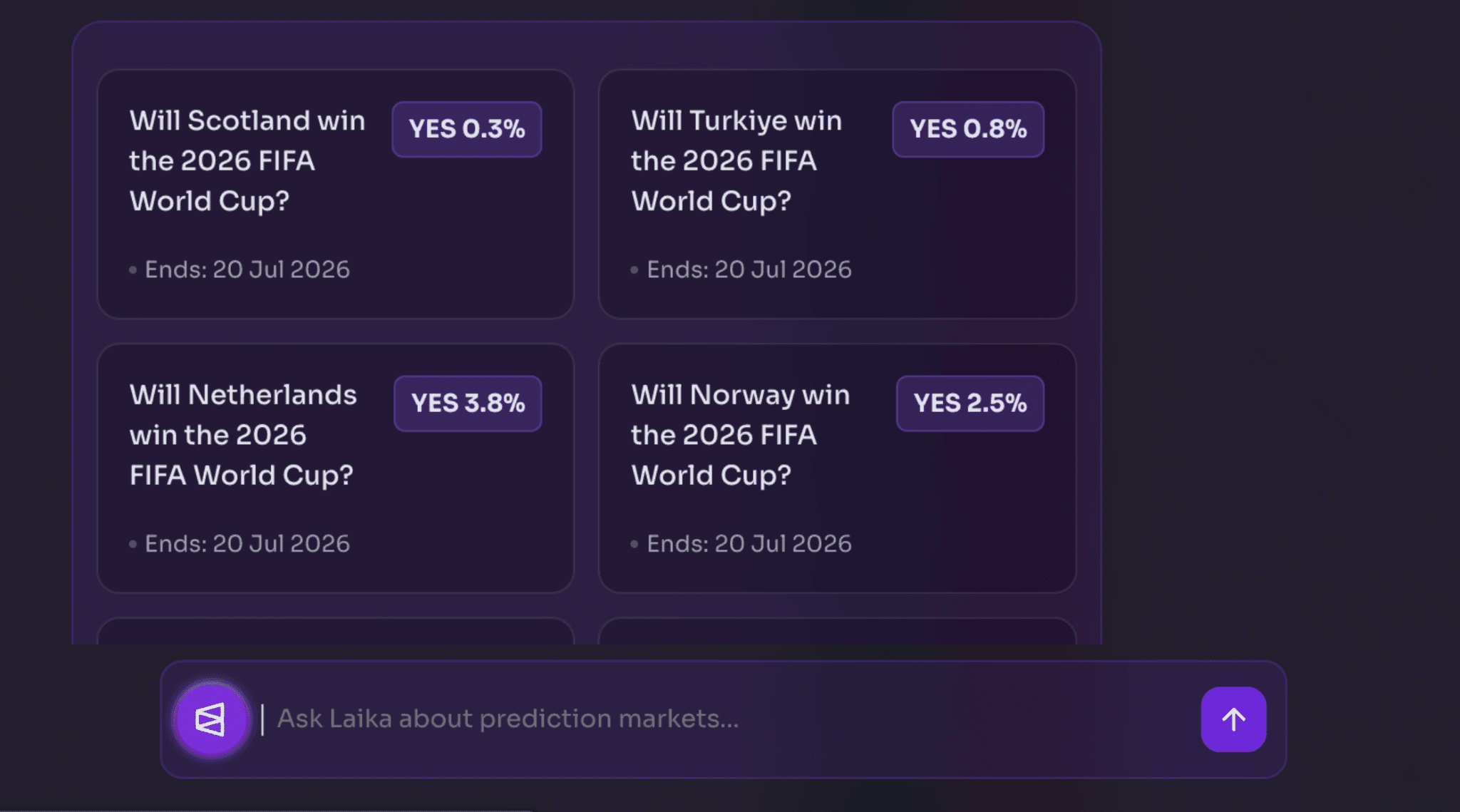
Not every profitable trade comes from favorites. Some of the biggest prediction market opportunities come from mispriced long shots before public sentiment catches up. Ask Laika AI who has hidden value in the 2026 FIFA World Cup markets and compare odds across platforms instantly.
The Core Structural Difference
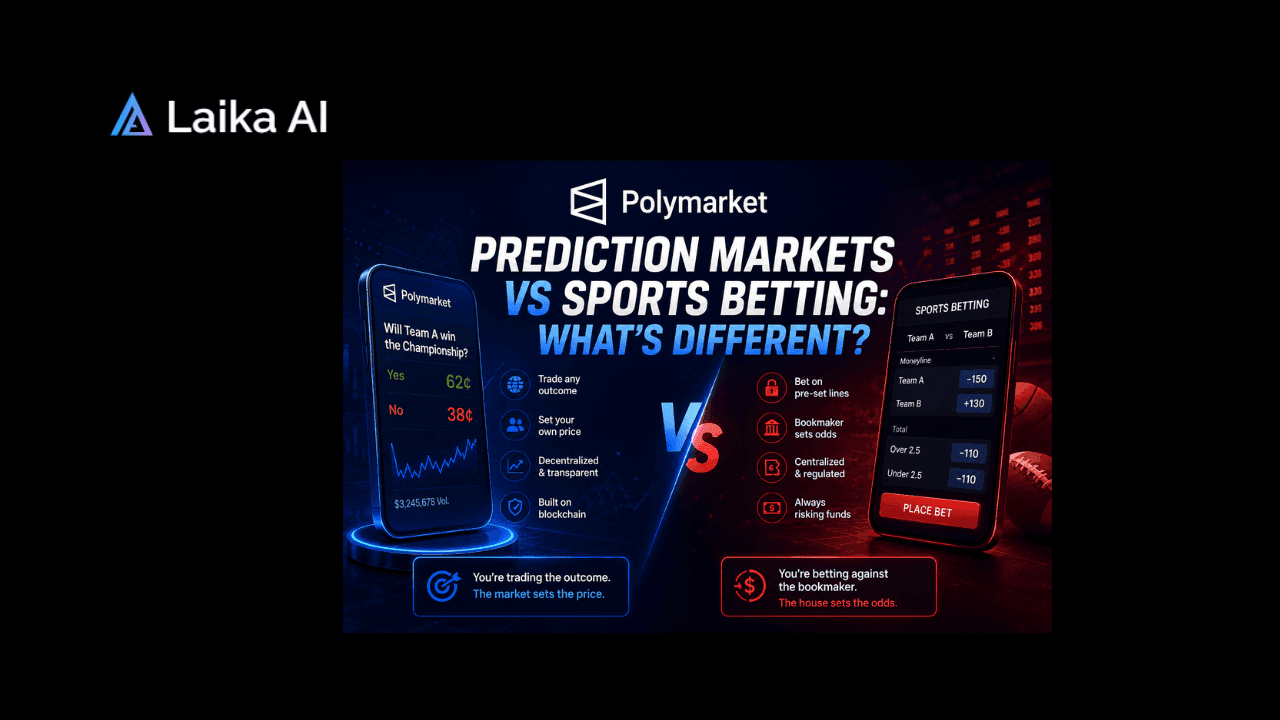
A sportsbook like DraftKings or FanDuel is your counterpart. When you bet $100 on the Chiefs at -110, DraftKings takes the other side of that bet. The book sets the line, manages its risk across millions of bettors, and profits from the vig embedded in every line. DraftKings and FanDuel typically run 5 to 8% overround on standard markets. Pinnacle, the sharpest book in the world, runs 2 to 3%. You never see the vig as a line item; it is baked into the odds. A line priced at -110/-110 on a fair coin flip event is the book's margin made invisible.
A prediction market like Kalshi or Polymarket is a peer-to-peer exchange. When you buy a YES contract on Oklahoma City Thunder at 62 cents, another trader sold that contract to you. The platform matches the trade through a central order book and charges a small explicit fee. Kalshi's fees rarely exceed 2% of expected profit. Polymarket charges no fees on most major sports markets, only blockchain gas costs. The platform is structurally indifferent to who wins.
The practical summary: at a sportsbook, you are betting against a house that is actively pricing you out of long-term profit. At a prediction market, you are trading against other participants and the platform earns whether you win or lose. That single structural difference is what makes polymarket sports betting function more like a financial exchange than a casino window and it cascades into every other comparison in this article.
For a foundation on how prediction market mechanisms work, what prediction markets cover the structure. For how prices are formed and where inefficiency lives, how prediction market prices work is the right framework.
If you are using prediction markets for sports, Polymetric gives you live market intelligence across Polymarket so you can track how odds are moving before the crowd catches up.
The Big Gap: What It Actually Costs You Per Bet
The numbers are concrete. This is where the structural difference becomes financial.
The sportsbook vig
A standard -110/-110 spread market at DraftKings embeds 4.5% vig. For every $100 bet, you start the position already down $4.50 in expected value before the event begins. On $10,000 in annual betting volume, that is $450 extracted by the book before a single ball is thrown. DraftKings and FanDuel run 5 to 8% on many market types. Pinnacle runs 2 to 3% the industry benchmark for a sharp book and a number most retail sportsbooks never approach.
The prediction market fee
Kalshi charges fees that rarely exceed 2% of expected profit, not 2% of stake, 2% of profit. On a 62-cent YES contract that pays $1, your maximum profit is 38 cents. Kalshi's fee on that trade is approximately 2% of 38 cents, less than 1 cent per contract. Polymarket charges no fees on most major sports markets beyond blockchain gas costs, which typically add $1 to $5 per trade depending on network congestion.
The real-world test
One head-to-head test found DraftKings posted -132 on a moneyline where Kalshi quoted the equivalent YES contract at 58.5 cents. The Kalshi price was 1.1 cents tighter than FanDuel's vig-adjusted true probability on the same game. On liquid markets, prediction market prices are consistently tighter than sportsbook lines because the platform earns on fees rather than on the spread.
The overround comparison makes the prediction market vs sports betting cost gap unavoidable: sportsbooks run 102 to 108%. Kalshi and Polymarket run 100 to 100.5%. That gap compounds across volume in one direction only.
For the full breakdown of how fees compare across platforms, prediction market fees Kalshi vs Polymarket covers the numbers in detail.
Account Limiting: The Difference That Matters Most for Sharp Bettors
Any bettor who has been limited at DraftKings or FanDuel already knows what this section is about.
Sportsbooks routinely limit or restrict profitable bettors. This isn’t an exception to the rule it's a fundamental part of the business model. Since DraftKings serves as the counterparty to every wager, consistently successful bettors represent a direct cost to the book. The typical response is to sharply reduce betting limits, sometimes to as little as $5 per wager. There are no regulations preventing this practice. It’s legal, common across the industry, and a reality for anyone who consistently beats the closing line over the long run.
Prediction markets do not limit winners. Because Kalshi and Polymarket earn transaction fees rather than betting against users, a winning trader generates more fee revenue, not less. There is no structural incentive to restrict profitable accounts. Position size caps and order book depth are the only practical constraints and those apply equally to all participants regardless of profitability.
This single difference is the most cited reason experienced sports bettors are moving volume to prediction markets in 2026. DraftKings charges 4.5% vig on every bet and limits the accounts that beat it consistently. Kalshi charges 1 to 2% and has no mechanism to identify or penalize winning traders. For anyone with a genuine edge, the math is not subtle.
The Exit Mechanic: Selling Before Resolution
Another concrete difference most comparison articles skip entirely.
At a traditional sportsbook, a placed bet is locked. You cannot exit a position on a Chiefs moneyline at halftime because the Chiefs are down 17 and you want to cut the loss. The bet resolves at the final whistle regardless of what happens in between. Some books offer cash-out features, but at prices heavily skewed to the book's advantage — the cash-out is designed to extract value from you, not offer a fair exit.
On Kalshi and Polymarket you can sell your position at any time before resolution at the current market price. If you bought OKC Thunder YES at 62 cents and they jump to 78 cents after a strong first quarter, you can sell immediately and take the profit without waiting for the game to end. If your position deteriorates after a second-quarter injury, you can cut the loss at the new market price rather than riding it to zero.
This exit mechanic is what makes polymarket sports betting function more like position management than passive betting. You are holding a live contract against a moving market. The sizing discipline, entry timing, and risk management that apply to trading apply here. The passive waiting that defines traditional sports betting does not.
The Legality Question: Why Rhode Island Is Suing Both Platforms
The core legal question in 2026 is whether prediction market sports contracts are substantively different from sports betting and the answer determines whether platforms like Kalshi can operate in states that have not legalized sportsbooks.
Kalshi has held full CFTC Designated Contract Market status since 2020, making it the longest-standing federally regulated prediction market in the United States. Its contracts are classified as derivatives under federal law, which is why kalshi sports betting markets operate legally even in states where traditional sportsbooks remain banned. In early 2026, the CFTC formally designated prediction markets as swaps, placing them under the agency's exclusive federal jurisdiction and providing structural protection from many state-level gambling bans.
States disagree. Recent reports found that sports wagers accounted for over 85% of all bets on Kalshi, and during one four-day stretch the platform made $25 million in fee revenue from March Madness alone. Nevada and Connecticut issued cease-and-desist orders against Kalshi in early 2026, arguing that its sports event contracts are unlicensed gambling. Traders are currently pricing in significant risk that Kalshi could be forced to geofence up to 15 states by the end of the year.
Yesterday's Rhode Island lawsuit is the most direct legal challenge yet. The state's attorney general cited an 8% drop in lottery sports betting revenue as direct evidence that prediction markets are displacing regulated sportsbooks.
The platforms' counterargument is structural: at Kalshi and Polymarket, you are trading event contracts on a regulated exchange under federal CFTC jurisdiction, not betting against a house under state gaming law. The CFTC Kalshi designated contract market registration page is the formal legal basis for that argument. Whether state courts agree with the prediction market vs sports betting distinction is being decided right now and the outcome will define the regulatory boundary for the next decade.
For the full legal framework of how prediction markets sit relative to gambling law, prediction markets vs gambling covers the detail. For current country and state-level access restrictions in effect, polymarket restricted countries have the updated list.
Where Sportsbooks Still Win?
Prediction markets have real limitations. This section does not pretend otherwise.
Market depth on niche events
Sportsbooks offer spread, totals, and player props on every game lower-league college basketball, international soccer, minor sports. Prediction market liquidity concentrates on major events. An nfl prediction market on a marquee game carries comparable depth on Kalshi. A Wednesday night NBA game between two non-playoff teams does not. If your edge lives in niche markets, sportsbooks have a deeper menu and that is not changing soon.
No parlay products
Sportsbooks offer same-game parlays combining multiple correlated outcomes. Kalshi and Polymarket have no native parlay product. Traders work around this through multiple separate contracts, but the experience is not equivalent. The correlation discount that makes same-game parlays attractive on sportsbooks does not exist in the same form on a prediction market exchange.
Horse racing exclusion
Both Kalshi and Polymarket went dark for the May 2, 2026 Kentucky Derby and will likely do the same for the Preakness and Belmont. The Interstate Horseracing Act carves horse racing out of prediction market jurisdiction entirely. If horse racing is part of your betting portfolio, prediction markets are not a replacement, they are an absence.
Deposit simplicity
Sportsbooks accept cards and bank transfers with immediate fund availability. Polymarket requires USDC on the Polygon blockchain. Kalshi accepts more payment methods but still requires account verification more involved than a DraftKings signup. For casual users who want to place a bet in under three minutes, the sportsbook onboarding experience wins on friction alone.
Frequently Asked Questions
What is the main difference between prediction markets and sports betting?
The core structural difference is counterparty. At a sportsbook, you bet against the house, which sets the odds and profits from the vig embedded in every line. At a prediction market like Kalshi or Polymarket, you trade event contracts with other participants on a peer-to-peer exchange. The platform earns a small transaction fee and is indifferent to who wins. Prediction markets run 100 to 100.5% overround. Major sportsbooks run 105 to 108%.
Are prediction markets legal in the US where sports betting is not?
Currently yes with active caveats. Kalshi holds CFTC Designated Contract Market status and operates under federal jurisdiction, which in early 2026 was formally classified as covering prediction market swaps. This means Kalshi is available in states like California and Texas where traditional sports betting is not legal. However, Nevada, Connecticut, and most recently Rhode Island have filed legal challenges arguing the sports contracts are effectively gambling. The legal landscape is actively contested and changing week to week. For current access restrictions by state, polymarket restricted countries have the updated list.
Do prediction markets have a vig like sportsbooks?
Prediction markets have fees, but they are structurally different from sportsbook vig. Sportsbooks embed 4.5 to 8% overround into every line invisibly. Kalshi charges explicit fees that rarely exceed 2% of expected profit not 2% of stake. Polymarket charges no fees on most major sports markets beyond blockchain gas costs. On an equivalent bet, the total cost of trading on prediction markets is consistently lower than on major retail sportsbooks.
Can you exit a prediction market position before the event ends?
Yes. On both Kalshi and Polymarket you can sell your position at any time before resolution at the current market price. This is a fundamental difference from traditional sportsbooks where placed bets are locked until the event resolves. The exit mechanic means you can take profit on a position that has moved in your favour mid-event, or cut a loss before it reaches zero, without waiting for the final result.
Do sportsbooks limit winning accounts the way prediction markets do not?
Sportsbooks routinely limit or ban winning accounts because they act as the counterparty and profitable bettors directly cost the book money. Prediction markets earn transaction fees regardless of who wins, so there is no structural incentive to limit winners. Position size caps exist but apply equally to all participants. This is one of the primary reasons experienced sports bettors have moved significant volume to sports betting prediction markets in 2026.
Are prediction markets and sports betting taxed differently in the US?
The tax treatment of prediction market winnings in the US is not fully settled. Sportsbook winnings are taxed as gambling income. Prediction market contracts are classified as derivatives under CFTC regulation, which could mean treatment closer to commodity trading gains than gambling winnings. The One Big Beautiful Bill passed in 2026 changed sports betting loss deductibility to 90% from 100%, which may create further incentive to use prediction markets for sports exposure. Always consult a tax professional for your specific situation before making decisions based on tax treatment.
Which One Should You Use?
The decision framework directly, without hedging.
If you bet recreationally on a few games a week and want the deepest market menu, easiest deposits, and a familiar interface sportsbooks win on user experience. DraftKings and FanDuel are better products for casual users. The onboarding is faster, the parlay menu is richer, and the depth on niche games is unmatched at this stage.
If you bet with genuine edge, if you track closing line value, have been limited at books, or are serious about long-term profitability the structural math of prediction markets is compelling. Lower vig, no account limiting, live exit mechanics, and 24/7 trading are real advantages that compound across volume. The sports betting prediction markets fee gap on a major event with comparable liquidity is meaningful enough to matter over any serious betting volume.
The two are not mutually exclusive. Most sophisticated bettors in 2026 use both: sportsbooks for depth, parlays, and niche markets prediction markets for major events where liquidity is comparable and fees are measurably lower. The choice is knowing which venue gives you the better price on the specific market you are entering.
For a complete breakdown of how to find value across prediction markets, how to make money on Polymarket covers the practical framework. For everything running across the full prediction market ecosystem right now, the polymarket sports markets guide is the complete picture.
If you are using prediction markets for sports, Polymetric gives you live market intelligence across Polymarket so you can track how odds are moving before the crowd catches up. → Start at laikalabs.ai