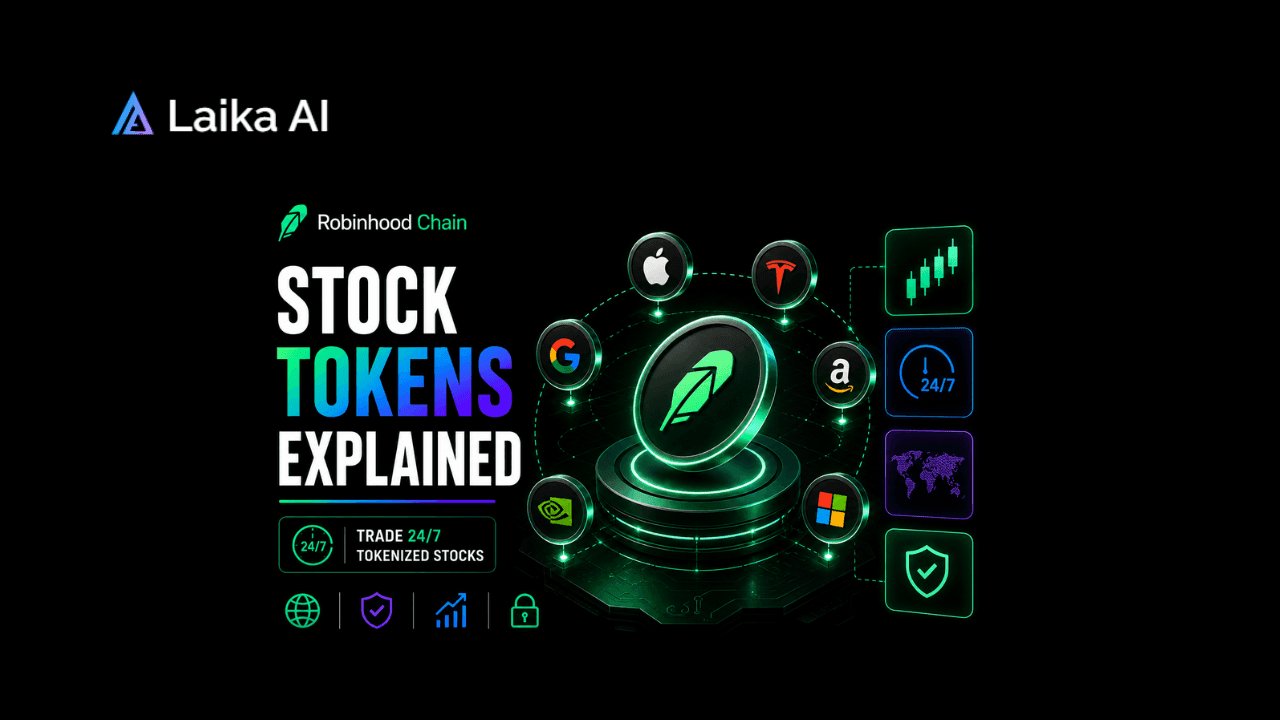
Robinhood stock tokens are on-chain instruments issued on Robinhood Chain that track the price of real-world equities and ETFs, including names like Apple, Nvidia, and Tesla. Unlike a regular brokerage holding, they trade 24/7, live directly in a self-custodied wallet, and can plug into DeFi apps for lending or collateral. They launched alongside Robinhood Chain's mainnet on July 1, 2026, and are structured as tokenized debt securities rather than direct share ownership.
This guide breaks down how these tokens actually work, how they differ from Robinhood's earlier European stock token product, which assets are available, and what the real trade-offs are compared to holding shares directly. For background on the network these tokens run on, What Is Robinhood Chain covers the underlying blockchain in full.
What Are Robinhood Stock Tokens?
Robinhood stock tokens are ERC-20 tokens, each corresponding to a specific underlying equity or ETF identified by its ticker symbol. They are issued by Robinhood Assets (Jersey) Limited and structured as tokenized debt securities, meaning holders get economic exposure to price movement without legal or beneficial ownership of the underlying stock.
Each token has a live Chainlink price feed publishing the reference price on-chain, so the token's value tracks the real equity in near real time. Because the tokens are standard ERC-20 contracts with 18 decimals, they can move freely between compatible wallets and interact with any application built to accept that token standard.
What holders get and don't get is worth being explicit about
- Price exposure to the underlying stock or ETF, tracked via on-chain oracle data
- Self-custody, since the tokens live in a user's own wallet rather than a brokerage account
- No shareholder voting rights and no legal claim on the underlying company
- No guarantee of identical dividend treatment to holding the actual shares
New Stock Tokens vs. Classic Stock Tokens
Robinhood now runs two generations of tokenized equity products side by side, and the naming matters because they behave differently. The original European product, launched in June 2025, has been renamed Classic Stock Tokens to distinguish it from the new Robinhood Chain-native version.
Classic Stock Tokens remain live and unchanged inside the Robinhood Europe app. The new Stock Tokens are a separate product built specifically for Robinhood Chain's DeFi ecosystem, and they're the ones this guide focuses on. If you're specifically looking at the original EU product, Robinhood's EU tokenized stock offering covers that version and its asset list in more depth.
How 24/7 Trading Actually Works
Traditional exchanges like the NYSE and Nasdaq only match orders during set hours, so any tokenized stock is, by definition, trading on a schedule the underlying market doesn't share. Robinhood's new Stock Tokens close that gap by moving execution on-chain entirely, rather than routing trades back to a traditional exchange.
Here's the mechanism in practice
- During US market hours, the token price tracks the exchange-listed price closely, since arbitrage between the token and the real share keeps them in line
- Outside market hours, no new shares are trading, so the token's price is instead driven by on-chain supply and demand across the decentralized exchanges where it's listed
- Chainlink's price feeds and market data continue publishing reference pricing, which venues and smart contracts use to anchor valuations even when the underlying market is shut
- When the underlying market reopens, the token price typically converges back toward the real share price as arbitrage traders step back in
This is a different mechanism from Robinhood's separate, US-facing 24 Hour Market feature, which lets brokerage customers place limit orders on real shares outside standard hours but still pauses over the weekend. Stock tokens, by contrast, can theoretically trade every hour of every day, since they never depend on a traditional exchange being open at all.
The trade-off is liquidity risk. When the real market is closed, token spreads tend to widen and price discovery becomes thinner, since fewer participants are actively arbitraging the token against the underlying share.
Where Stock Tokens Trade
New Stock Tokens aren't confined to a single app. Robinhood has connected them to a handful of decentralized exchanges, so liquidity is spread across venues rather than sitting only inside Robinhood's own interface.
This multi-venue structure is part of what separates the new tokens from Classic Stock Tokens, which only ever traded inside Robinhood's own European app. Before connecting a wallet or approving a token contract on any of these venues, it's worth applying the same scrutiny used for any on-chain asset. Auditing a token's smart contract before buying is a reasonable habit here too, even for a token issued by a familiar brokerage brand.
Which Stocks Are Available as Robinhood Stock Tokens?
Robinhood's tokenized equity catalogue has grown quickly since the original 2025 launch. The Classic Stock Tokens product opened with roughly 200 US-listed equities and ETFs, covering household names investors ask about most, including Apple, Microsoft, Nvidia, Tesla, Amazon, and Meta, alongside broad market ETFs like SPY and QQQ.
Robinhood has said the catalogue is expandable on demand and has continued adding names through 2025 and into 2026, with company statements referencing a goal of covering thousands of tokenized US equities over time. Separately, Robinhood also offers tokens tied to pre-IPO companies like OpenAI and SpaceX, though these work differently. They're wrapped in exposure to special-purpose vehicles holding private-company shares rather than tokenized versions of publicly listed stock.
Exact ticker availability for the new Stock Tokens varies by wallet region and is still expanding, so checking Robinhood's current live catalogue directly before assuming a specific ticker is supported is the safer approach.
Regional Availability: US, EU, and Beyond
Access to the underlying Robinhood Chain network is open to anyone, but the Stock Tokens product carries jurisdiction-specific restrictions layered on top of that open infrastructure.
Robinhood has disclosed that Stock Tokens are not available to US users at all, reflecting the same securities-law uncertainty affecting tokenized real-world assets broadly. EU users who already hold Classic Stock Tokens in the Robinhood Europe app aren't required to move anything, since that product continues operating independently of the new Robinhood Chain rollout.
Stock Tokens vs. Owning Real Shares
The core question for anyone comparing a stock token to a brokerage account is what exactly is being given up in exchange for 24/7 access and DeFi composability.
Neither structure is strictly better across the board. A stock token trades whenever the market is open on-chain and can be put to work in DeFi, but it comes without the ownership rights and regulatory protections that come standard with a real brokerage-held share. Investors weighing the two are really deciding between flexibility and composability on one side, and traditional ownership guarantees on the other.
Risks Worth Understanding Before Trading
Stock tokens introduce a layer of risk that doesn't exist with a plain brokerage account, on top of the market risk of the underlying stock itself.
- Thin liquidity outside market hours can widen spreads and make execution less predictable overnight or on weekends
- Smart contract risk exists on any ERC-20 token, even one issued by a recognizable brand, so the contract itself is worth verifying before trading
- Regulatory status of tokenized equities is still evolving in multiple jurisdictions, and today's access could change
- Self-custody shifts responsibility for wallet security onto the user, unlike a traditional brokerage account, which is worth pairing with proper key management, including a crypto hardware wallet for meaningful balances
- No shareholder rights means holders can't vote on corporate matters or claim direct legal ownership if something goes wrong with the issuer
These risks sit within a broader shift toward institutional adoption of blockchain infrastructure, where more traditional financial products are being wrapped into tokenized form. That trend is likely to continue, but it doesn't remove the underlying trade-offs each product carries.
The Bottom Line
Robinhood's new Stock Tokens turn equity exposure into something that behaves more like a crypto asset than a brokerage holding: tradable around the clock, self-custodied, and usable across DeFi apps. That flexibility comes at the cost of the ownership rights and regulatory protections that come with holding real shares directly.
For traders comfortable with self-custody and on-chain trading mechanics, the round-the-clock access and composability are a genuine upgrade over waiting for a market to open. For anyone prioritizing legal ownership, voting rights, or the protections of a traditional brokerage account, real shares remain the more conservative choice. Checking current regional availability and the specific token contract before trading is worth doing regardless of which side of that trade-off matters more to you.
Frequently Asked Questions
What are Robinhood stock tokens?
Robinhood stock tokens are ERC-20 tokens issued on Robinhood Chain that track the price of real-world stocks and ETFs like Apple, Nvidia, and Tesla. They provide price exposure through a tokenized debt structure rather than direct share ownership, and they can be held in a self-custody wallet or used across DeFi applications.
Can you trade Robinhood stock tokens 24/7?
Yes. Unlike traditional shares, which only trade during exchange hours, Robinhood's new Stock Tokens are designed to trade around the clock on decentralized exchanges connected to Robinhood Chain. Prices track the underlying stock most closely during market hours and can see wider spreads when the real exchange is closed.
Are Robinhood stock tokens available in the EU?
Availability depends on which product is being asked about. Classic Stock Tokens, Robinhood's original 2025 product, remain available inside the Robinhood Europe app. The new Robinhood Chain Stock Tokens are accessible through Robinhood Wallet in more than 120 countries, with EU availability varying by specific country regulation.
Which stocks are available as Robinhood stock tokens?
The original catalogue launched with roughly 200 US-listed stocks and ETFs, including major names like Apple, Microsoft, Nvidia, Tesla, Amazon, and Meta, along with ETFs like SPY and QQQ. Robinhood has continued expanding this list and has stated the catalogue is designed to grow over time, so checking the current live list directly is the most reliable way to confirm a specific ticker.
How does Robinhood's 24/7 trading actually work?
Trading happens entirely on-chain through decentralized exchanges connected to Robinhood Chain, rather than routing back through a traditional stock exchange. During market hours, arbitrage keeps the token price close to the real share price. Outside market hours, the price is driven by on-chain supply and demand, anchored by Chainlink price feeds, until the underlying market reopens and prices converge again.