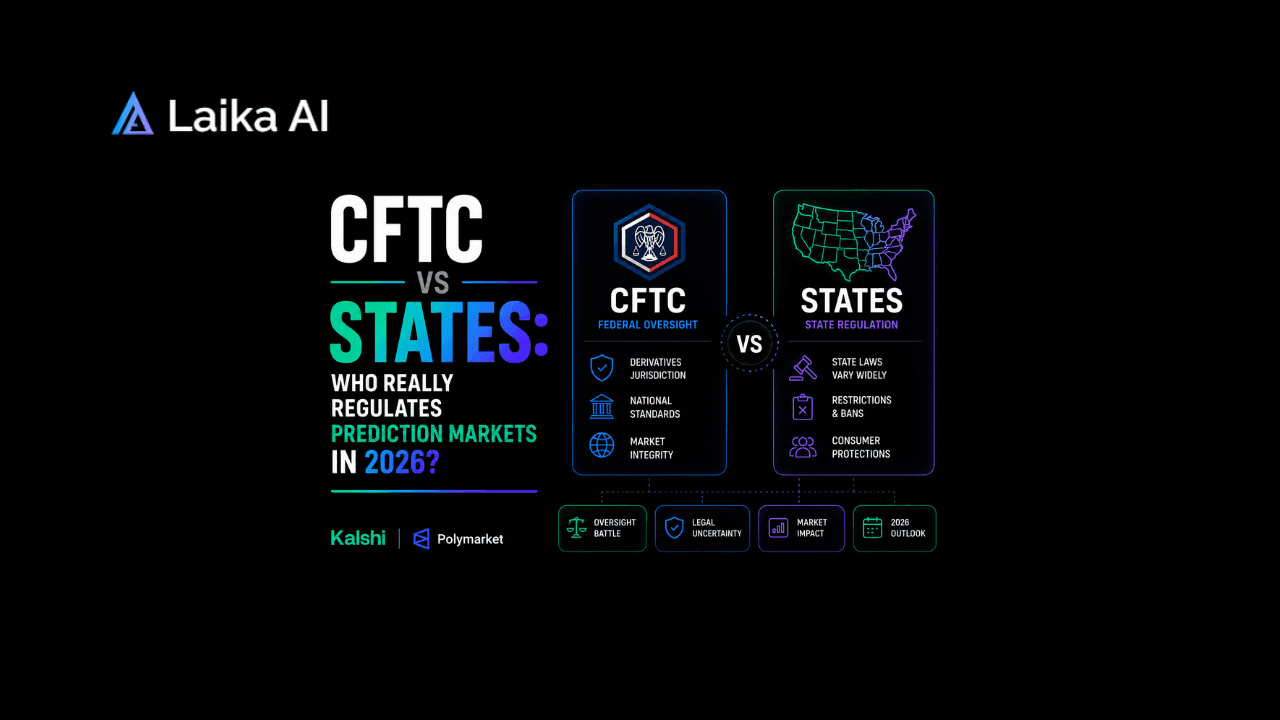
The honest answer to who regulates Kalshi is that no single authority has settled the question yet, and 2026 has become the year federal courts finally started ruling on it directly, with genuinely contradictory results. The Commodity Futures Trading Commission asserts exclusive federal jurisdiction over event contracts traded on its registered exchanges. A growing number of state gambling regulators argue that sports-related contracts are simply sports betting wearing a different label, and that state law still applies. Both positions have now won in court. Both have also lost. That split is not a temporary quirk of early litigation. It reflects a genuine, unresolved constitutional question that is very likely headed to the Supreme Court.
This guide explains how the CFTC's authority over designated contract markets actually works, how state regulators have pushed back through cease-and-desist orders and, in Minnesota's case, outright criminal legislation, and what all of this means practically for anyone trading on Kalshi, Polymarket, DraftKings DKeX, FanDuel Predicts, or Coinbase right now. For the foundational explanation of how these contracts function before getting into the jurisdictional fight over them, what are prediction markets and how do they work covers the basics, and for the broader risk landscape shaping the industry as a whole, Kalshi and Polymarket: the prediction market boom, risks, and regulation provides fuller context.
How the CFTC's Authority Over Designated Contract Markets Actually Works
The CFTC's claim to exclusive jurisdiction rests on a specific legal structure that predates the current boom in prediction markets by decades. A platform like Kalshi registers with the CFTC as a Designated Contract Market, the same regulatory category that governs traditional futures exchanges. The CFTC has taken the position that event contracts listed on these registered exchanges are "swaps" under the Commodity Exchange Act, and that swaps traded on CFTC-registered DCMs fall under the agency's exclusive jurisdiction. Under this reading, state gambling law simply does not apply, because Congress specifically chose a national regulatory framework for derivatives markets rather than a fragmented, state-by-state patchwork.
This is not a new or improvised legal theory. CFTC-registered exchanges have listed event contracts since the 1990s, beginning with the Iowa Electronic Markets, a university-run futures market where traders bought and sold contracts tied to outcomes like presidential elections and corporate earnings. Later contracts covered insured property losses, bankruptcy counts, and weather-related outcomes such as temperature and precipitation. What changed in 2024 and 2025 was scale, not novelty: sports-related event contracts exploded in popularity, and their resemblance to traditional sports betting drew far more scrutiny from state gambling regulators than earlier, less consumer-facing contract types ever had.
The agency's posture shifted meaningfully after the 2024 election and a change in CFTC leadership.
Under current Chairman Michael Selig, the CFTC has taken an increasingly assertive stance defending its own exclusive authority rather than staying neutral while private litigation plays out.
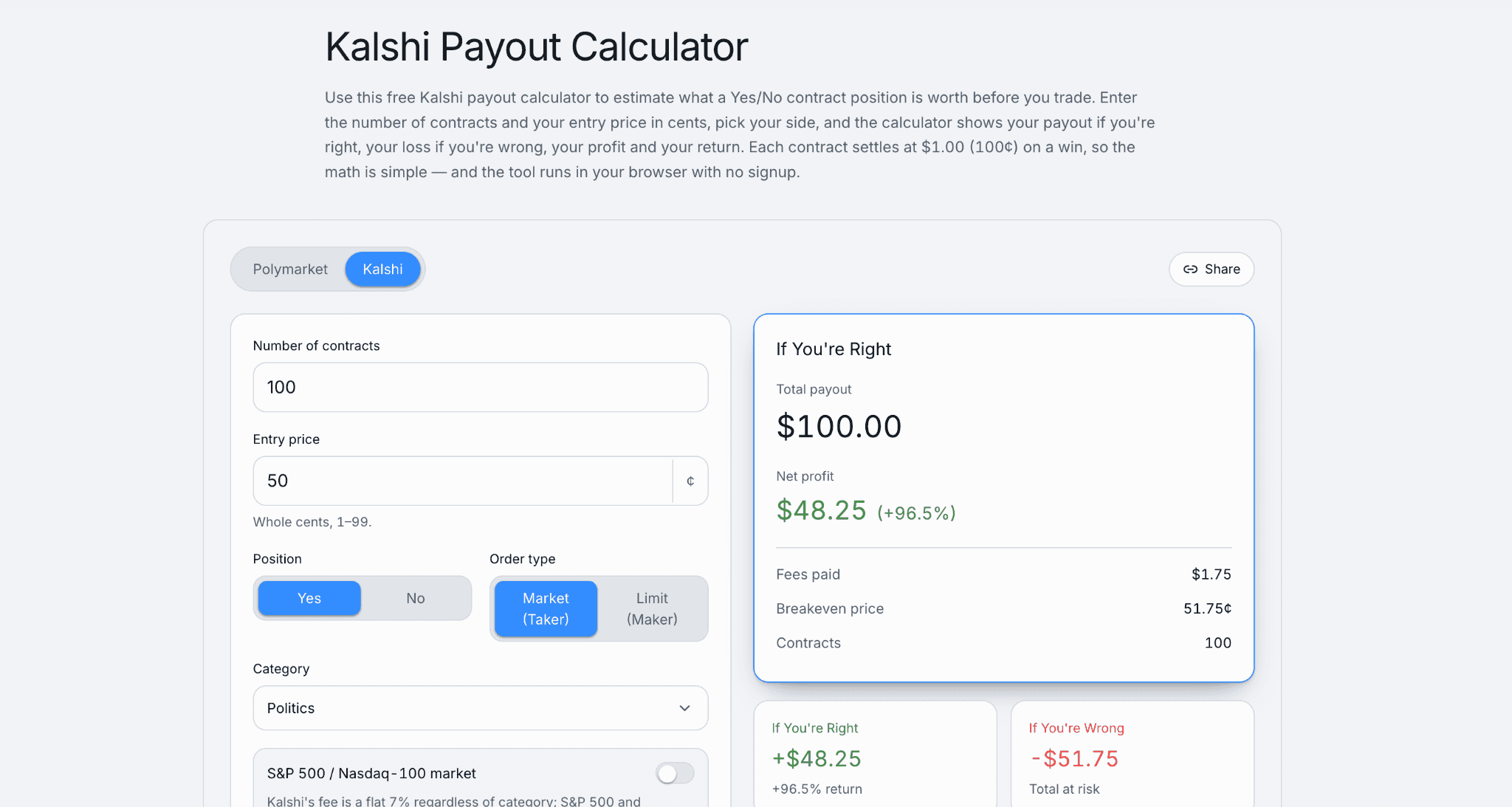
For a deeper look at how this federal registration process actually functions in practice from a trader's perspective, how does Kalshi work: a complete beginner's guide walks through the platform's mechanics directly. For the underlying legal distinction the entire fight turns on, whether these products are financial instruments or gambling by another name, prediction markets vs gambling: what's the legal difference in 2026 covers that framework in full.Try the Kalshi Payout Calculator to estimate your returns before every trade and make more informed trading decisions.
State-Level Pushback: Cease-and-Desist Letters and the Minnesota Escalation
State gambling regulators have not accepted the CFTC's exclusive-jurisdiction position quietly. Nevada, New Jersey, Ohio, Massachusetts, Tennessee, Maryland, and Illinois have all taken direct enforcement action against Kalshi, typically through cease-and-desist orders issued by a state gaming commission alleging the company is offering unlicensed sports betting. The results across these cases have been genuinely inconsistent, which is exactly what makes this such an unsettled area of law.
In New Jersey, Kalshi won decisively. The Third Circuit majority found that Kalshi's contracts are probably swaps under federal law and that both field preemption and conflict preemption shield them from New Jersey's gambling statute. The dissenting judge disagreed sharply, describing Kalshi's products as "virtually indistinguishable from the betting products available on online sportsbooks" and arguing that a presumption against preemption should apply with special force in an area states have traditionally regulated.
Elsewhere, state regulators have prevailed. Courts in Nevada, Maryland, and Ohio have each ruled against Kalshi at the preliminary injunction stage, finding either that sports event contracts are not swaps under the Commodity Exchange Act at all, or that even if they are, federal law does not preempt state gambling regulation. The result is a genuine circuit and district split, with different courts reaching opposite conclusions on the identical legal question.
Minnesota then took the fight to an entirely different level. Rather than issuing a cease-and-desist order through a gaming regulator, the state passed legislation making it a felony, punishable by up to five years in prison and a $10,000 fine, to operate, host, or advertise a prediction market platform within the state, effective August 1, 2026. Both Kalshi and the CFTC itself filed federal lawsuits seeking to block the law before it takes effect. For the full detail on Minnesota's specific statute and what it means for residents there right now, Minnesota prediction market ban 2026: what traders must know covers that case in depth. For how this same jurisdictional uncertainty plays out at the international level rather than the state level, Kalshi legal countries: where it is supported and restricted in 2026 covers the parallel question of country-by-country access.
What This Legal Battle Means for Traders Right Now
The practical reality for anyone trading on these platforms in 2026 is that legal access can genuinely differ by state, can change with little notice as new rulings come down, and does not currently follow any single, predictable national rule. This uncertainty is not limited to Kalshi and Polymarket directly. It extends to every platform now built on top of the same federal registration structure, since each one inherits the identical unresolved jurisdictional question.
DraftKings built its own CFTC-registered exchange, DKeX, specifically to reach states where its traditional sportsbook cannot legally operate under state gambling law. That strategy depends entirely on the CFTC's exclusive-jurisdiction argument holding up in court. If a state successfully bans prediction markets the way Minnesota has attempted, or if a higher court ultimately sides with state gambling regulators the way several district courts already have, DKeX's ability to operate in restricted states becomes directly threatened.
FanDuel Predicts took the more cautious path by design, deliberately limiting sports contracts to states where legal online sports betting does not already exist, and pulling sports contracts from any state that later legalizes traditional betting. That approach reflects an implicit hedge against exactly this kind of regulatory uncertainty rather than a full bet on federal preemption prevailing everywhere.
Coinbase, meanwhile, routes its entire prediction markets offering through Kalshi's existing exchange rather than building independent infrastructure, which means Coinbase's users are exposed to precisely the same state-by-state legal uncertainty Kalshi itself faces, without any additional insulation from the underlying dispute.
The practical advice for traders on any of these platforms is the same regardless of which one you use: check the platform's current state-availability disclosure directly before depositing funds, understand that a state where trading is legal today could see that status challenged or reversed with little warning, and recognize that the underlying legal question will likely not be fully resolved until either the Supreme Court takes up the preemption issue directly or Congress passes legislation clarifying it. Given the current circuit split and the volume of active litigation, most legal analysts following this fight expect Supreme Court review to be a matter of when, not if.
Frequently Asked Questions
Who regulates Kalshi?
Kalshi is registered with the Commodity Futures Trading Commission as a Designated Contract Market, and the CFTC asserts exclusive federal jurisdiction over the event contracts Kalshi lists. Several state gambling regulators dispute this, arguing that Kalshi's sports-related contracts are subject to state gambling law instead. Federal courts have not reached a consistent conclusion: the Third Circuit ruled in Kalshi's favor in April 2026, while district courts in Nevada, Maryland, and Ohio have ruled against the company on the same underlying legal question. As of 2026, there is no single settled answer to who has final regulatory authority.
Has Kalshi received cease-and-desist letters from states?
Yes. Kalshi has received cease-and-desist orders or equivalent state enforcement actions from multiple states, including Nevada, New Jersey, Massachusetts, Ohio, Maryland, and Tennessee, generally issued by state gaming commissions alleging that Kalshi is offering unlicensed sports betting. Kalshi has responded to each of these actions by suing the relevant state in federal court, arguing that the Commodity Exchange Act preempts state gambling law as applied to its CFTC-registered contracts.
Is prediction market regulation the same in every state in 2026?
No. Regulatory treatment currently varies significantly by state and remains in active flux. States including New Jersey and Tennessee have seen courts side with federal preemption arguments, while Nevada, Maryland, and Ohio have seen courts side with state gambling regulators instead. Minnesota has gone further than any other state, criminalizing prediction market operation outright through legislation set to take effect August 1, 2026, though that law is currently being challenged in federal court by both Kalshi and the CFTC itself.
Does federal preemption protect Kalshi from state gambling laws?
It depends entirely on which court is asked. The Third Circuit held in April 2026 that federal preemption likely does apply, protecting Kalshi's sports-related contracts from New Jersey's gambling laws. District courts in Nevada, Maryland, and Ohio have reached the opposite conclusion, finding either that Kalshi's contracts are not swaps under federal law at all or that state gambling law still applies regardless. This direct conflict between courts is a major reason legal observers widely expect the question to eventually reach the Supreme Court.
The Bottom Line
The fight over who regulates prediction markets in 2026 is not a settled question with a clear winner, and treating it as one would be inaccurate. The CFTC has built a genuinely strong legal argument for exclusive federal jurisdiction, backed by decades of DCM history and a recent, favorable ruling from the Third Circuit. State gambling regulators have built an equally serious counter-argument grounded in traditional state police powers over gambling, and they have already won at the district court level in multiple jurisdictions. Both sides are actively litigating, both sides have real momentum in different courts, and the eventual outcome will likely shape not just Kalshi and Polymarket, but every platform now built on the same federal registration structure, including DraftKings DKeX, FanDuel Predicts, and Coinbase's prediction markets offering.
Until the Supreme Court or Congress resolves this definitively, the safest approach for any trader is to verify current state-level legal status directly with whichever platform you use, rather than assuming today's access will remain unchanged.
Track how regulatory developments affect platform access across every major exchange with Polymetric by Laika AI, so you always know where things stand before you place a trade.