In January 2026, prediction markets crossed $20 billion in monthly trading volume. Over 840,000 unique wallets participated in that single month alone, more than tripling the user base from just six months earlier. What started as a niche concept tied to crypto platforms has become one of the fastest-growing financial products in the world.
Yet most people still do not fully understand what a prediction market actually is, how the pricing mechanism works, or which platforms are worth using. This guide answers all of those questions in a beginner-friendly language.
What Is a Prediction Market?
A prediction market is a financial exchange where you trade contracts on the outcome of real-world events. Instead of buying shares in a company, you buy shares in an outcome, such as "Will the Federal Reserve cut interest rates in June 2026?" or "Who will win the NBA Championship?"
Each contract is priced between $0.00 and $1.00. The price reflects the collective probability that all traders assign to that outcome happening. If YES is priced at $0.65, it means the market collectively believes there is a 65% chance the event will occur.
If the event happens, YES contracts pay out $1.00 each. If it does not happen, they pay $0.00.
How prediction markets differ from sportsbooks
This distinction matters. Most people encounter the term and assume prediction markets are just another form of sports betting. They are structurally different in several important ways.
The absence of a house edge is the most structurally important difference. On a prediction market, you are trading against other people, not against a platform that profits when you lose. The platform earns a small fee on transactions, but the pricing is set entirely by supply and demand from traders.
How Prediction Markets Work: Step by Step
Step 1: A market is created
Someone creates a market around a specific, verifiable question. For example: "Will Bitcoin trade above $90,000 at any point before June 30, 2026?"
The question must have a clear, objective resolution criteria. Both the outcome and the data source used to determine it are specified upfront.
Step 2: Traders buy YES or NO shares
Traders assess the probability of the outcome and buy shares accordingly. If you believe Bitcoin will reach $90,000, you buy YES shares. If you think it will not, you buy NO shares.
Share prices update in real time as new traders enter, new information becomes available, and sentiment shifts. The price at any moment represents the market's collective best estimate of the probability.
Step 3: You can exit before resolution
You do not have to hold your position until the event resolves. If you buy YES at $0.40 and the price rises to $0.70 as sentiment shifts in your favour, you can sell at $0.70 and take a profit without waiting for the outcome.
This is one of the most important features of prediction markets. They function like financial exchanges, not like fixed bets. Your position has a live market value at all times.
Step 4: The market resolves
When the event concludes, the platform resolves the market based on the pre-specified data source. If Bitcoin exceeded $90,000 before June 30, YES contracts pay $1.00 each. NO contracts pay $0.00.
There is no ambiguity. The rules are set before the market opens, and the resolution is automatic and objective.
Step 5: Profits are distributed
If your position won, the $1.00 per share is credited to your account. You can then withdraw or use those funds to trade in other markets.
What Can You Trade on Prediction Markets?
Prediction markets in 2026 cover a remarkably wide range of categories.
- Sports: Game winners, championship outcomes, player milestones, season records. Sports currently drives the majority of trading volume on most platforms. Kalshi generated $9.9 billion of its $11.39 billion March 2026 volume from sports contracts alone.
- Politics and elections: Election outcomes, legislative votes, cabinet appointments, approval ratings, and government policy decisions. The 2024 US presidential election was the defining moment that proved prediction markets could outperform traditional polling.
- Economics and finance: Will the Federal Reserve raise or cut interest rates? Will inflation hit a specific target? Will GDP reach a given number? Zero-days-to-expiration (0DTE) economic contracts around CPI prints and Fed meetings have seen a 300% surge in volume on platforms like Kalshi in 2026.
- Crypto and technology: Will Bitcoin hit a specific price? Will a specific AI model be released by a given date? Will a major tech company reach a market cap milestone? These markets have attracted significant volume from crypto-native traders.
- Geopolitics: Current conflicts, diplomatic events, and international decisions. The Strait of Hormuz crisis beginning in late February 2026 drove Polymarket to host over 153 active oil markets alone as of April 2026.
- Culture and entertainment: Box office performance, award show outcomes, celebrity events, viral moments. Polymarket hosts over 360 active culture markets as of April 2026.
- Weather and climate: Daily temperature ranges, hurricane formation, precipitation events. Weather markets have emerged as one of the most data-driven and systematically tradeable categories on the platform.
The Top 5 Prediction Market Platforms in 2026
1. Polymarket
- Type: Decentralised, on Polygon blockchain
- Global monthly volume: Over $10 billion (March 2026 all-time record)
- Available to: Global users; US users on invite-only waitlist
- Fees: Zero on most markets
- Categories: Sports, politics, crypto, economics, weather, culture, geopolitics
Polymarket is the largest prediction market in the world by trading volume. It operates entirely on-chain using the Polygon blockchain, with all positions settled automatically in USDC. Every trade is publicly visible on the blockchain, which provides full transparency.
The platform hosts over 4,000 active sports markets and 360 active culture markets as of April 2026. Its prices have earned a reputation as the most reliable real-time indicator of event probabilities available anywhere.
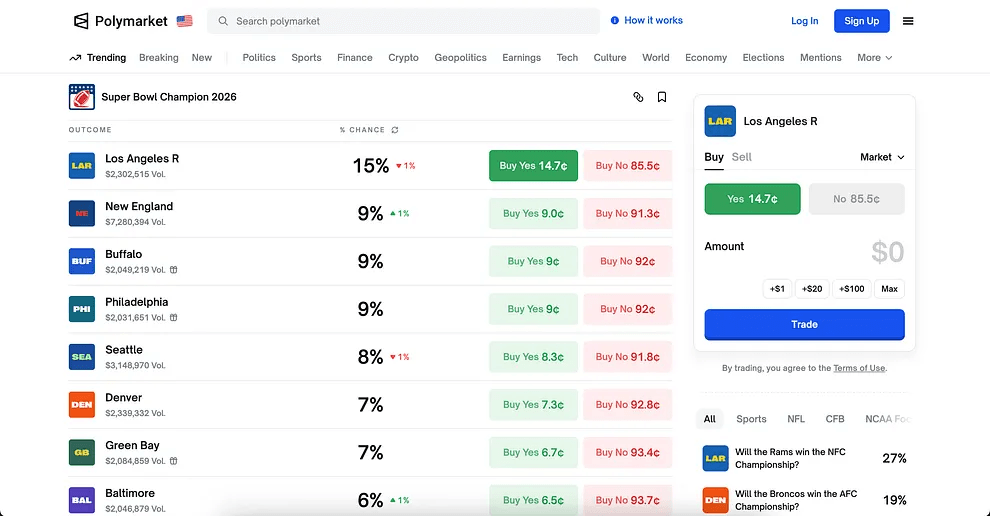
Zero trading fees on most markets is Polymarket's biggest structural advantage. The platform earns revenue through a small spread on certain market types rather than charging explicit fees.
US access is currently via an invite-only waitlist after Polymarket acquired QCEX, a CFTC-registered derivatives exchange, to facilitate a regulated US re-entry. Sports markets were the first category to launch for US users, with broader categories expected later in 2026.
Best for: Global traders who want the highest liquidity, zero fees, and full on-chain transparency. Requires a crypto wallet funded with USDC.
2. Kalshi
- Type: Centralised, CFTC-regulated
- US monthly volume: $12.35 billion (March 2026 all-time record)
- Available to: All 50 US states
- Fees: Up to approximately 2% of maximum profit
- Categories: Sports, politics, economics, crypto, culture, weather
Kalshi is the dominant prediction market for US traders. It is a federally regulated exchange licensed by the CFTC as a Designated Contract Market, the same classification that governs the Chicago Mercantile Exchange. This means US users have the full consumer protection framework of federal derivatives regulation behind every trade they make.
Kalshi's October 2024 court victory, which upheld its right to offer election contracts, was the moment that triggered mainstream awareness of prediction markets in the United States. Its January 2025 launch of sports event contracts in all 50 states, and the subsequent Super Bowl volume exceeding $1 billion, established it as the leading regulated platform.
In March 2026, Kalshi set its all-time monthly volume record at $12.35 billion, driven primarily by NCAA Tournament trading. All 10 of its top markets in March were college basketball games.
Kalshi also powers Robinhood's prediction markets product, meaning its order book is accessible to Robinhood's 27 million funded brokerage accounts without those users needing a separate Kalshi account.
Best for: US traders who want the broadest regulated sports and economics market coverage with CFTC consumer protections and no crypto wallet required.
3. Robinhood Predictions
- Type: Centralised, powered by Kalshi's CFTC-regulated infrastructure
- Volume: 4 billion contracts traded in the first months of 2026
- Available to: All 50 US states
- Fees: No explicit user fees
- Categories: NFL, NBA, NHL, MLB, NCAA, expanding
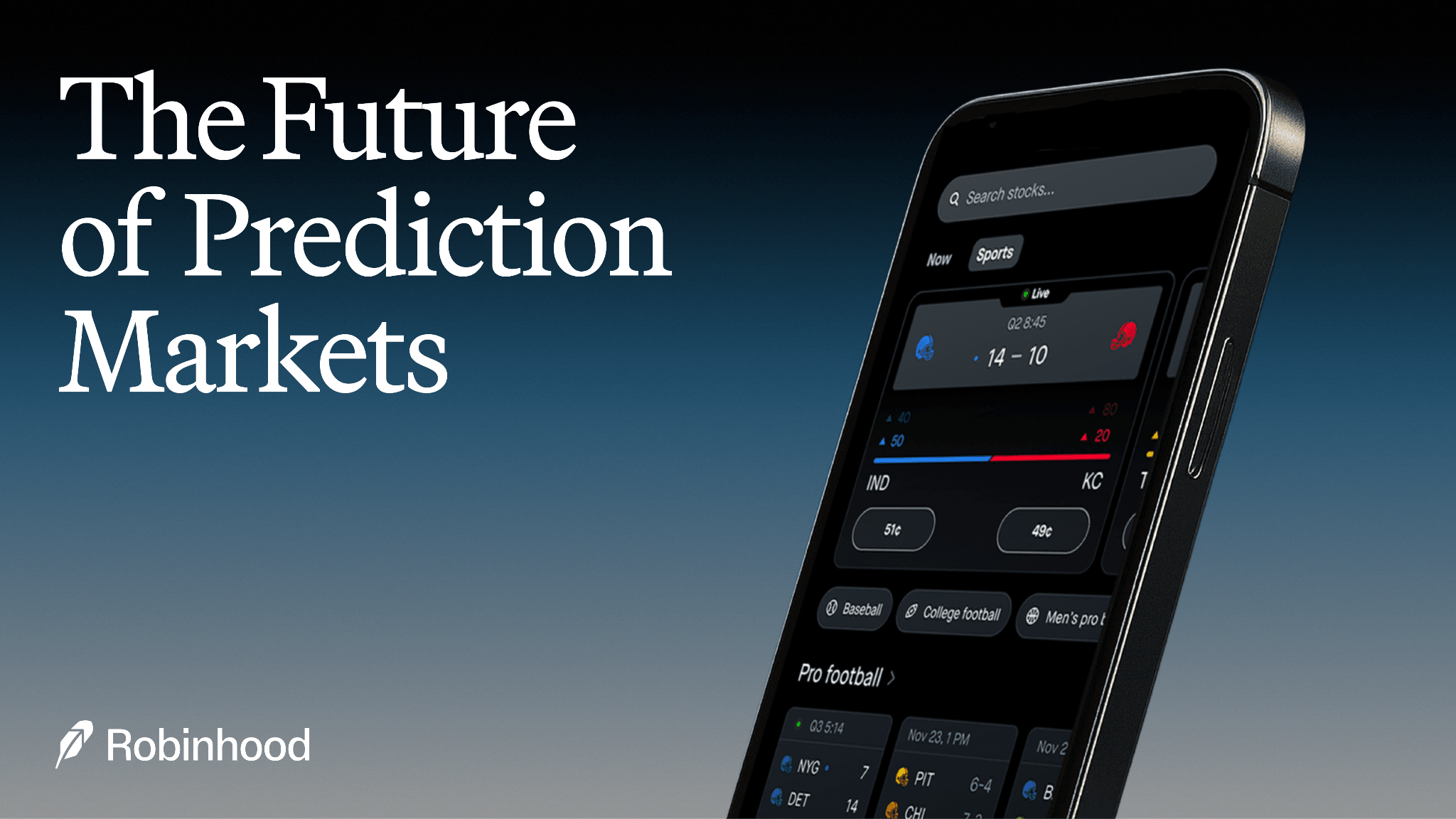
Robinhood Predictions is the most accessible entry point into prediction markets for US users who already have a Robinhood brokerage account. The product launched in March 2025 through a partnership with Kalshi and immediately became the fastest-growing business in Robinhood's history.
Because it runs on Kalshi's regulated infrastructure, Robinhood users access the same order book and pricing as Kalshi users directly. There is no need to open a new account, fund a separate wallet, or learn a new interface. If you already have a Robinhood account, you can start trading prediction market contracts in under two minutes.
Robinhood's CEO described event contracts as the fastest-growing product in the company's history, with the platform reporting a 300% rise in event contract-related revenue following the Super Bowl alone.
Best for: Beginners and existing Robinhood users who want the lowest-friction entry into prediction market trading without opening a separate account.
4. DraftKings Predictions
- Type: Centralised, regulated via CME Group CFTC infrastructure
- Available to: 38 US states at launch
- Fees: Built into CME-routed contract pricing
- Categories: NFL, NBA, MLB, NCAA, financial and economic indicators
DraftKings Predictions launched on December 19, 2025, and quickly became one of the most significant entries into the space given DraftKings' existing user base of tens of millions of sports bettors.
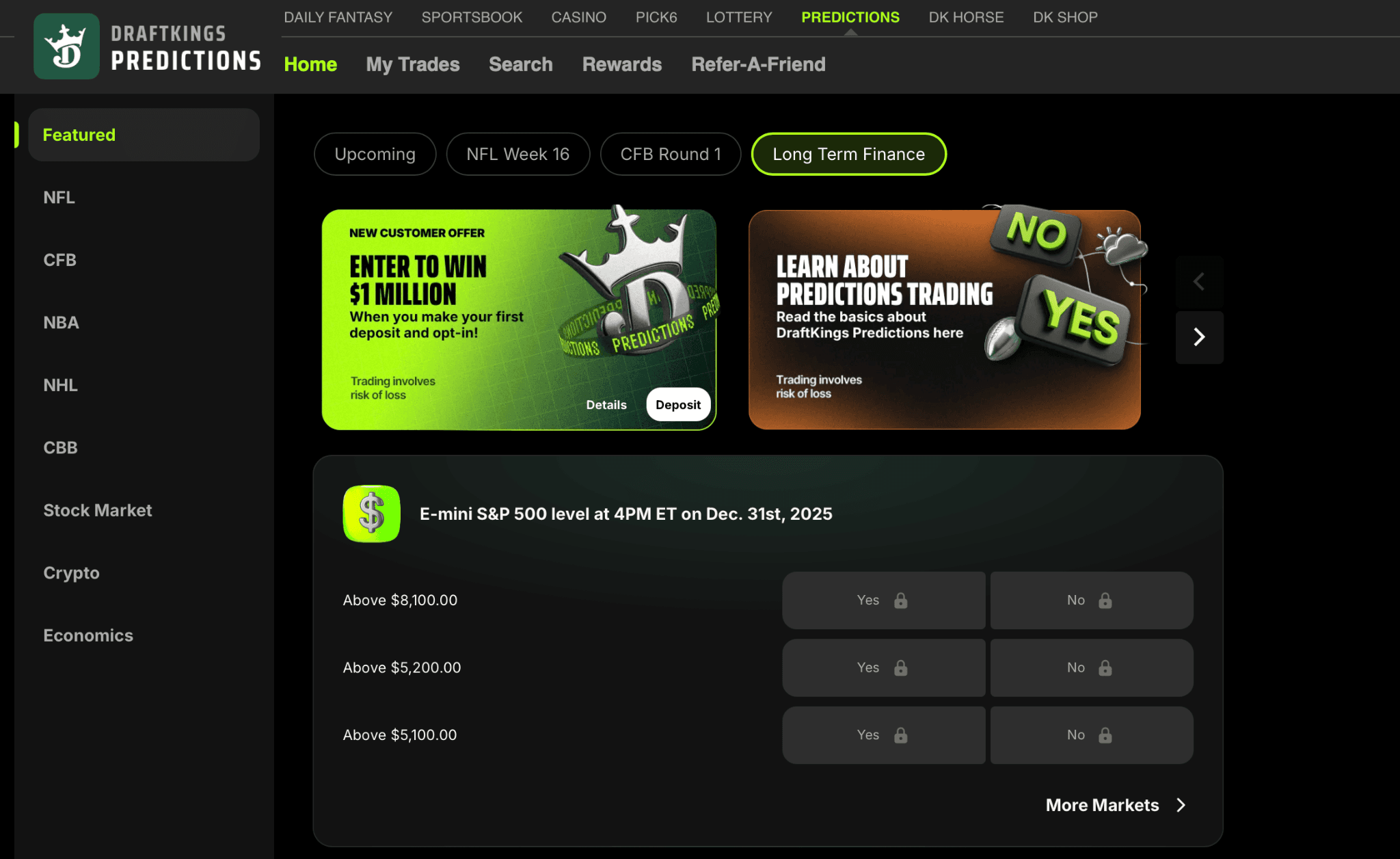
The product routes through CME Group's CFTC-regulated infrastructure, the same gold-standard framework used by institutional futures markets. This gives it among the strongest regulatory foundations of any platform currently operating. The most important feature for many users is that DraftKings Predictions is available in states where traditional sports betting is not yet legal, including California, Texas, and Georgia, because prediction market contracts are federally regulated derivatives rather than state-level gambling products.
Best for: DraftKings users in non-sports-betting states who want a familiar interface and brand for event contract trading. Also ideal for existing DraftKings sportsbook users transitioning to prediction markets.
5. Crypto.com Prediction Markets

- Type: Licensed prediction market and sports trading platform
- Global weekly volume: approximately $158 million (early March 2026)
- Available to: Select US states and globally
- Fees: $0.10 to $0.20 per trade
- Categories: NFL, NBA, MLB, NHL, soccer, UFC, crypto, economics, culture
Crypto.com operates as a regulated prediction exchange with a broad category of coverage spanning sports, crypto, economics, and culture. It sits between the pure financial exchanges like Kalshi and the sportsbook-backed products like DraftKings, making it a strong option for traders who want diverse market exposure in a single platform.
Crypto.com is particularly well-positioned for crypto-native traders who want prediction market exposure alongside their crypto trading activity, as the platform integrates naturally with Crypto.com's broader ecosystem of exchange, wallet, and DeFi products.
For those who primarily want crypto prediction markets covering Bitcoin price milestones, Ethereum upgrades, and altcoin outcomes, Crypto.com offers the deepest category coverage among regulated platforms.
Best for: Crypto-native traders wanting a regulated platform with strong crypto prediction markets alongside sports and economic categories. Good alternative for traders outside Kalshi's strongest geographic markets.
Platform Comparison at a Glance
How to Make Money on Prediction Markets
There are two core ways to profit.
Hold to resolution: You believe the market is mispriced. You buy the undervalued outcome at $0.30 when you believe the true probability is closer to 60%. If the outcome occurs, the contract pays $1.00 and you collect a 233% return on your position.
Sell before resolution: You buy YES at $0.40. As new information comes in and other traders adjust their views, the price rises to $0.72. You sell your position and lock in a profit without waiting for the event to resolve.
The biggest edge in prediction markets comes from identifying situations where the crowd's collective probability estimate is wrong, and acting on that before the market corrects. Traders with genuine domain knowledge in a specific category, whether that is sports analytics, economic modelling, meteorology, or geopolitics, consistently outperform generalists who trade across all categories without deep expertise.
Frequently Asked Questions
Are prediction markets legal in the United States?
Yes. Federally regulated platforms including Kalshi, Robinhood Predictions, and DraftKings Predictions operate legally across most US states as CFTC-regulated derivatives exchanges. On February 19, 2026, a federal court ruled that Kalshi's contracts are legally classified as swaps under the Commodity Exchange Act, establishing federal preemption over state gambling regulations. Polymarket is accessible to US users via an invite-only waitlist following its acquisition of CFTC-registered exchange QCEX.
What is the difference between a prediction market and a sportsbook?
A sportsbook sets its own odds and you bet against the house, which has a 5% to 10% built-in edge on every bet. A prediction market is a peer-to-peer exchange where prices are set by other traders and there is no house edge. You are trading contracts, not placing bets. Prediction markets also cover far more than sports, including economics, politics, crypto, weather, and culture, and are regulated federally rather than state by state.
How much money do you need to start trading prediction markets?
You can start with as little as $5 to $10 on most platforms. Kalshi, Robinhood, and DraftKings accept funding via bank transfer or debit card with no minimum balance requirement. Polymarket requires USDC on the Polygon network, which can be acquired for any amount through a crypto exchange. There is no minimum position size on most platforms.
Why have prediction markets grown so fast in 2026?
Three events drove rapid growth. First, a US court ruling in October 2024 confirmed Kalshi's right to offer election contracts, triggering mainstream awareness. Second, Robinhood's March 2025 partnership with Kalshi exposed prediction markets to 27 million funded brokerage accounts for the first time. Third, Polymarket's accurate prediction of the 2024 US presidential election, when traditional polls were showing different results, provided a highly publicised proof of concept for prediction market accuracy. Monthly volume grew from $1.2 billion in early 2025 to over $20 billion by January 2026.
Do I need a crypto wallet to use prediction markets?
No, not for all platforms. Kalshi, Robinhood Predictions, and DraftKings Predictions all accept regular bank transfers and debit card funding with no crypto wallet required. Polymarket's global platform requires a Polygon-compatible crypto wallet funded with USDC. If you want to start without any crypto, Kalshi or Robinhood is the easiest starting point.
Conclusion
Prediction markets have moved from a niche crypto experiment to a mainstream financial product in under 24 months. Over $20 billion in monthly volume, 840,000 active participants, and 13 federally regulated US platforms confirm that this is no longer an emerging category. It is an established market.
The structural advantages are real. No house edge. Peer-to-peer pricing. The ability to exit positions at any time. Federal regulation. And a demonstrated track record of accuracy that has consistently outperformed traditional forecasting methods.
Whether you are a trader looking for an edge, an investor wanting to hedge real-world risk, or simply someone curious about what the collective wisdom of financial markets says about the future, prediction markets in 2026 offer something traditional markets cannot: a direct, tradeable price for almost any outcome in the world.
Disclaimer: This article is for educational purposes only. Always verify the legal status of prediction markets in your jurisdiction and conduct your own research before trading.