Short answer: the trading on a crypto prop firm funded account is almost always simulated, but the payouts are real money. If you have searched “prop firm scam” or “is a crypto prop firm legit,” this is the confusion behind those searches. The word “funded” sounds like the firm hands you real capital. In most cases, it does not.
This guide explains what the account actually is, where payout money comes from, and how to check any firm before you pay. It is the companion to our explainer on what a crypto prop firm is and how funded trading challenges work.
The Short Answer: Simulated Trading, Real Payouts
Our 2026 review found that nearly every crypto prop firm, including some of the largest, funds traders with simulated or notionally calculated capital rather than a live brokerage deposit.
The payout is different. When you hit the profit target and meet the firm’s conditions, the firm pays real cash from its own funds. The amount is a share of your simulated results.
Firms generally disclose this in their terms. FTMO’s terms say every account it provides is a demo account with fictitious funds. Propr, a crypto firm built on Hyperliquid, says all its accounts, funded ones included, are 100% simulated, and that a payout is a performance-based reward rather than an investment return.
How a Crypto Funded Account Works Mechanically
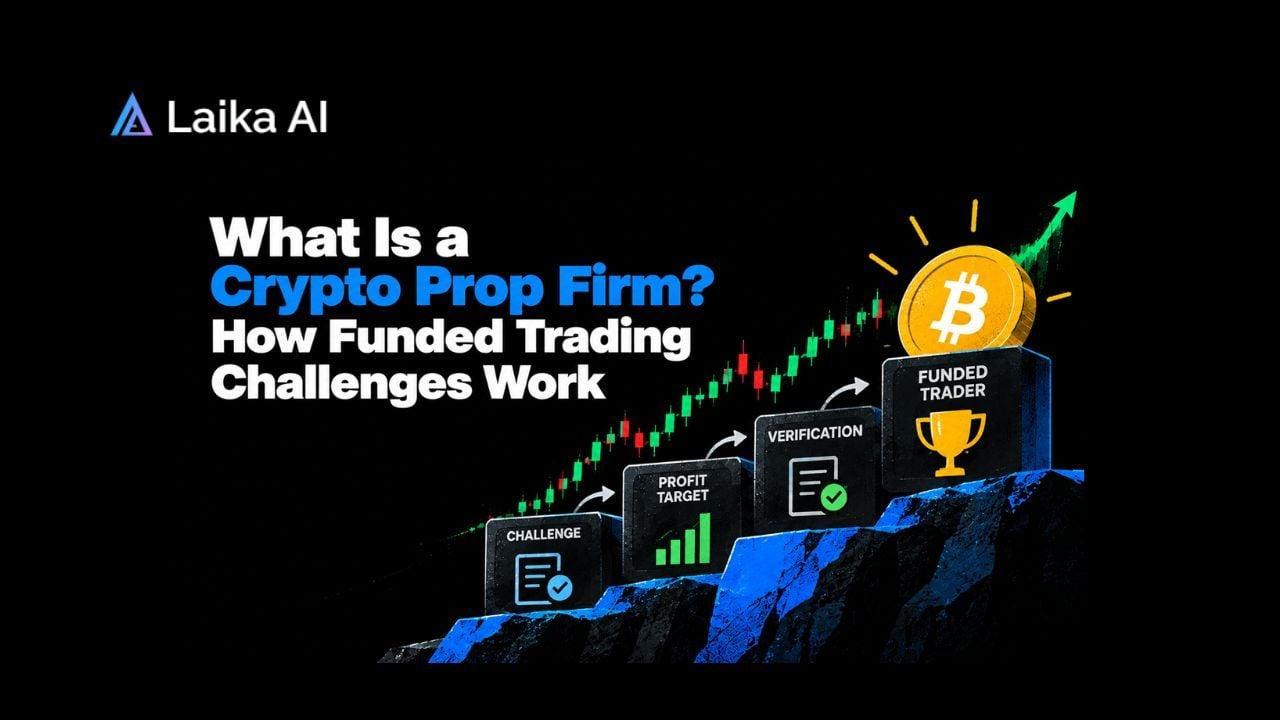
Here is the typical path from purchase to payout
- You pay a one-time challenge fee.
- You trade a simulated account that uses real-time market data.
- You hit the profit target without breaching the daily loss or maximum drawdown limit.
- The firm verifies you, often through KYC, and activates the funded account.
- You keep trading simulated capital under the same rules.
- You request a payout, and the firm pays a share of your simulated profit.
At step 2, your orders do not reach an exchange order book. They go to the firm’s own system.
Some firms then decide what to do with your trades. Propr, for example, says it copies some signals to Hyperliquid (A-book) and keeps others internal (B-book). If it copies a trade, the resulting position belongs to the firm.
Compare that with margin on a regulated venue, where the balance is real capital held in your account. Our guide to Kalshi margin trading shows how that works in practice.
Where the Payout Money Comes From
The dominant model is fee-funded. Firms earn revenue from
- Evaluation (challenge) fees
- Reset fees after a failed attempt
- Activation fees or subscriptions on some programs
Payouts to successful traders come out of the firm’s own funds, which that revenue helps build. The odds explain why the model works for the firm.
Topstep is a futures firm, so treat its figures as a benchmark for how the model works, not as a crypto pass rate. Its two pass rates differ because one counts attempts and the other counts people. Repeat attempts lift the per-person rate, and they also mean repeat fees.
The pattern is familiar from other speculative markets. Our guide to making consistent profit on Polymarket makes the same point: most traders lose through bad sizing, not bad picks.
Critics argue that a fee-based model gives a firm little financial reason to want traders to succeed. Defenders reply that firms want to keep consistently profitable traders, and some refund the fee on a first payout. AdvoraHQ’s review lays out both views. Neither is a legal ruling.
Simulated-Funded vs Live-Funded Firms
Not every firm works the same way. There are three common models.
Some crypto firms sit between these. Recent notes that HyroTrader starts passed traders on a simulated funded account, then makes them eligible for real capital after consistent performance.
So at most firms, a funded account works like a prop firm demo account with a payout contract attached. The market data is live. The money at risk is not.
Real orders mean real exposure for the firm, which is closer to how institutional desks operate. For that side of the market, see our institutional crypto adoption analysis.
Profit Splits, Tiered Payouts and the Rules That Decide Who Gets Paid
Advertised splits commonly fall between about 70% and 90%. Some firms advertise higher shares on early payouts before moving to a standard split, and some refund the challenge fee with a first payout, according to AdvoraHQ.
The split matters less than the rules. As listed in a September 2026 review, Propr’s challenge rules are
These rules most often delay or block payouts across the industry:
- Consistency or “best day” rules that cap how much profit can come from one day
- News-trading windows around selected releases
- Minimum trading or winning days before a payout unlocks
- Payout caps and discretionary call-ups to live accounts
- Prohibited-practice clauses, such as limits on automated trading
Because drawdown limits are tight, position sizing is the skill being tested. Our prediction market bankroll management guide covers sizing logic that applies here too.
How to Check a Specific Crypto Prop Firm Before You Pay
Start with three checks in the firm’s terms of service
- Does it describe the account as simulated, demo or virtual?
- Does it claim any live order routing, and to which exchange or liquidity provider?
- How are payouts funded: challenge fees, the firm’s own trading profit, or both?
Propr’s site shows what plain disclosure looks like, including its A-book and B-book wording. Use it as a benchmark when you read another firm’s terms.
Then run these further checks
Some crypto firms publish payouts onchain, so you can inspect the wallet the way you would inspect a token contract. If that is new to you, read how to audit a token smart contract before buying.
Save a dated copy of the terms at purchase. Terms change, and the version you agreed to is your evidence.
Is Prop Trading Legit? What Courts and Regulators Have Said
The biggest test case is My Forex Funds. The CFTC sued its parent company in August 2023, alleging fraud in how it sold simulated-account challenges.
Here is where that stands
- In May 2025, a federal judge dismissed the case with prejudice as a sanction against the CFTC and awarded the company attorney’s fees.
- The dismissal rested on the agency’s conduct, so the fraud allegations were neither proven nor rejected on the merits, as AdvoraHQ explains.
- No court has ruled that simulated-account prop trading is lawful, or that it is fraud, according to Curved Trading.
Outside the US, Belgium’s FSMA warned in March 2024 about retail “challenges” on simulated accounts where no client money reaches a live market, as reported by The Industry Spread.
In July 2026, the Financial Commission launched a voluntary Prop Firm Certification. It is self-regulation, not a government licence.
For buyers, that means the contract is the main protection. Payouts are contractual claims against private firms.
Is a Crypto Prop Firm a Scam? The Fair Answer
A simulated account is not automatically a prop firm scam. In many cases it is a disclosed business model. The structural point still matters: much of a firm’s disclosed revenue comes from fees paid by traders, and most traders are never paid.
The fair counterpoint is that real, repeated payouts are meaningful evidence of good faith:
- Topstep disclosed that 33.3% of individuals at its funded level received a payout in 2025.
- Propr says it pays rewards in USDC onchain, where anyone can verify them.
- A firm cannot sustain recurring cash disbursements indefinitely on nothing.
Closures are not proof of fraud either. Finance Magnates has estimated that 80 to 100 prop firms closed in 2024 after MetaQuotes reduced its support for the sector. The documented red flag is a firm changing rules after traders pass, not a shutdown by itself.
The same payout test applies anywhere crypto rewards are promised. Our guide to free crypto mining apps for Android shows how to separate real payouts from bait.
Conclusion: What to Do Before You Pay for a Challenge
A crypto funded account is usually simulated capital with a real payout contract. Before you pay
- Read the terms for “simulated,” “demo” or “virtual.”
- Confirm who executes orders and whether any live routing is claimed.
- Identify the legal entity and check its history.
- Price in repeat attempts, not just one fee.
- Risk only money you can afford to lose.
If you also follow prediction markets, Polymetric by Laika AI adds AI research, whale tracking and a screener on top of Polymarket’s public on-chain data. Laika AI provides insights, not financial advice.
Frequently Asked Questions
Is a prop firm legit?
Many are, but legitimacy depends on the specific firm. Check that the terms say what the account is, the legal entity is verifiable, and payouts arrive within the stated window.
prop trading legit?
Buying a challenge is legal in most places, but the product is largely unregulated, so your contract is your main protection. For a comparison with a fully regulated venue, see our answer to is Kalshi legit.
What is a prop firm demo account?
It is a simulated account that uses live prices but fills orders on the firm’s own platform. At most firms, the funded account is also a demo account with a payout contract attached.
Is there a free prop firm demo account?
Sometimes. One Hyperliquid-based challenge offers a limited number of free $1,000 accounts. Check whether a free account is eligible for payouts before treating it as more than practice.
Is a crypto prop firm legit?
Some are, some are not. For crypto firms, check whether the terms disclose A-book and B-book handling and whether payouts can be verified Onchain.
Is prop trading real money?
The payouts are real money. The trading usually is not. A few firms add a live stage with real capital, but it is rare: Topstep called up 0.71% of its Express Funded traders in 2025