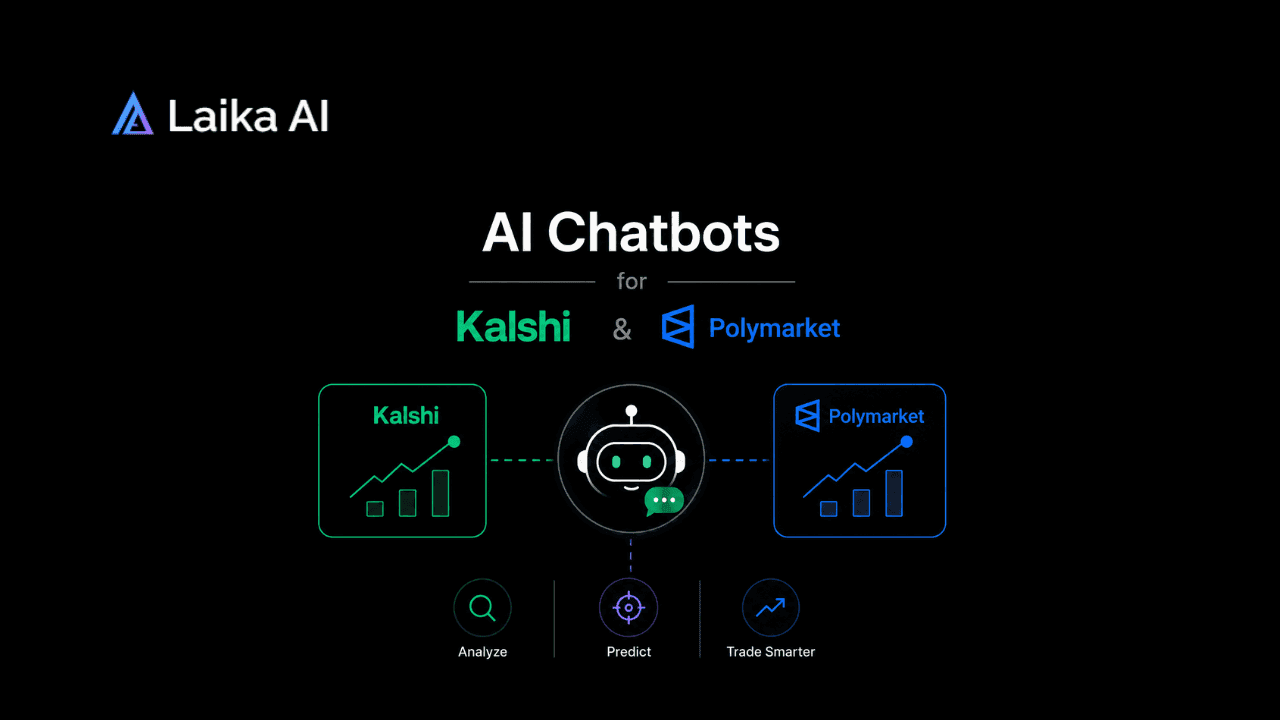
Ask four different AI companies about Kalshi and Polymarket and you'll get four completely different answers about what "integration" even means. That's the honest starting point for any Kalshi ai comparison right now. Grok sits inside Kalshi's own trading screen. ChatGPT shows a probability chart for World Cup games and nothing else. Google Gemini surfaces both platforms' odds in Search, but you can't talk to it about a trade. Claude has no built-in presence at all, and yet it's quietly behind some of the wildest trading results anyone's posted on Polymarket this year.
None of that is a coincidence, and none of it is really a prediction market ai chatbot comparison in the way people expect. These are four general-purpose models that each bolted on a data feed, or in Claude's case, got adopted by developers who built their own tools around it. This piece walks through what each one actually does, where the real differences sit, and why the honest answer to "which AI should I use" depends far more on what you're trying to accomplish than on which company has the flashiest headline.
Search around for a genuine ai chatbot comparison covering all four of these at once and you'll mostly find Reddit threads and thin affiliate blogs padding out a listicle. That's not a knock on those sources, it's just a gap. Nobody's actually sat down and traced what each company shipped, when, and how far it really goes. That's what this piece does.
The Short Answer: None of Them Were Built for This
Worth saying upfront so expectations are set correctly. Not one of these four companies designed their AI product with prediction markets in mind from day one. Grok's Kalshi deal came out of a broader xAI partnership push. ChatGPT's Kalshi feature is a side effect of a World Cup content deal nobody announced publicly. Google's version is a byproduct of a Finance redesign. And Claude's connection to this whole world exists only because independent developers decided to point it at Polymarket's API and see what happened.
CoinDesk's recent coverage of AI agents reshaping prediction market trading captures this pattern well: the AI showing up in this space right now is largely repurposed, not purpose-built. That's not a knock on any of the four models. It's just useful context before assuming any of them was designed with a trader's actual workflow in mind.Grok on Kalshi and Polymarket: The Deepest Integration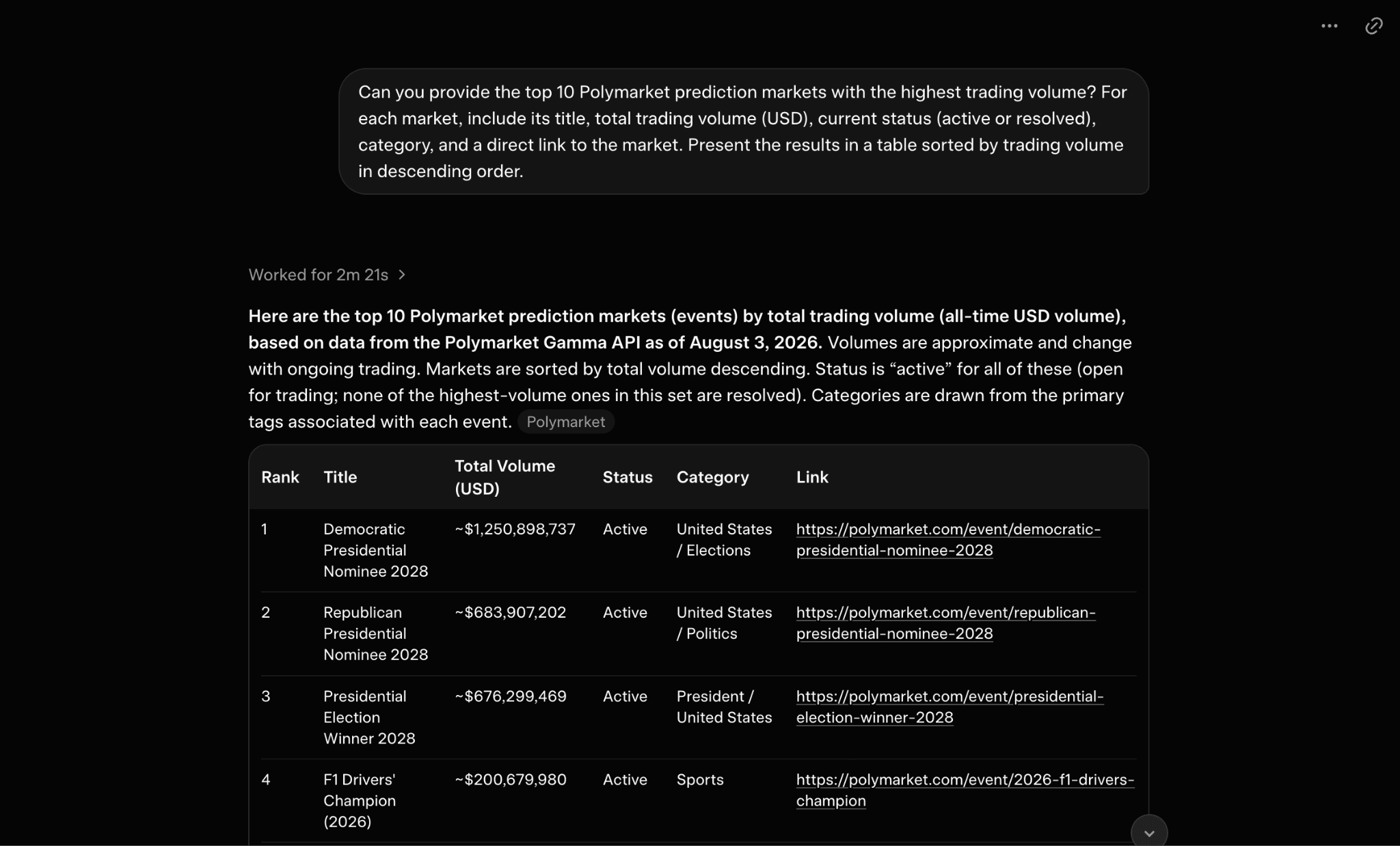
Grok wins in depth, no real argument there. xAI's partnership with Kalshi went live on July 24, 2025, and it put Grok directly inside Kalshi's trading interface as something close to a co-pilot. Ask it about a market before placing an order and it pulls together on-chain data, historical odds, and recent news into a probability-style summary sitting right next to the buy button.
Polymarket's version of Grok is a lighter touch by comparison. Instead of embedding a chat panel, Polymarket leans on X, where Grok annotates markets through "Market Context" summaries and answers questions through a separate public account called Ask Polymarket. Same underlying model, noticeably different level of integration depending on which platform you're using. How to Use Grok for Kalshi and Polymarket Trading covers how Grok actually behaves on each platform, including the fee structure differences and what the tool can't tell you, worth a look if you're specifically deciding whether to trade on Kalshi or Polymarket with Grok's help.
ChatGPT on Kalshi: Read-Only, Unconfirmed, World Cup Only
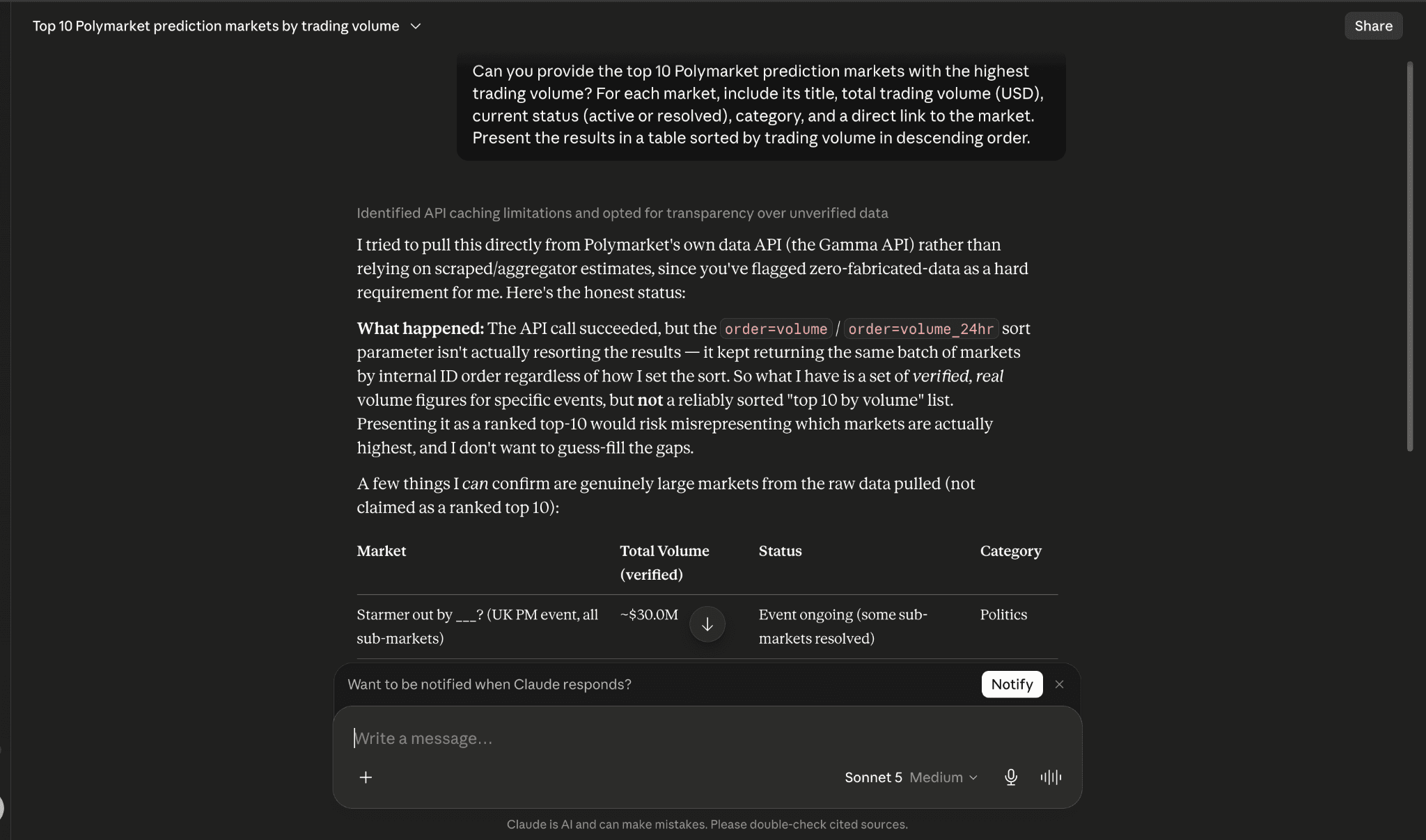
ChatGPT is the narrowest of the four by a wide margin. OpenAI quietly started surfacing Kalshi's World Cup win probabilities inside ChatGPT search results in mid-July 2026, and the scope stops there. No politics markets, no Fed decisions, no NFL. Just soccer, and only during the tournament.
Here's the detail that tells you everything about how tentative this relationship actually is: neither company has confirmed a formal partnership publicly, and both declined to comment when reporters asked directly. If you open a fresh ChatGPT conversation right now and ask whether it has a Kalshi partnership, there's a decent chance it tells you no, simply because its training predates the feature shipping. The model showing you Kalshi's odds and the model answering questions about itself aren't necessarily working from the same information. That's a strange, slightly funny gap, and it's a good reminder that a chatbot's self-description isn't always reliable evidence of what it's actually been wired up to do. There's no Polymarket equivalent at all right now, and How to Use ChatGPT for Kalshi and Polymarket Trading covers the exact boundaries of what it can and can't do in more detail.
Google Gemini: Broadest Coverage, Least Interactive
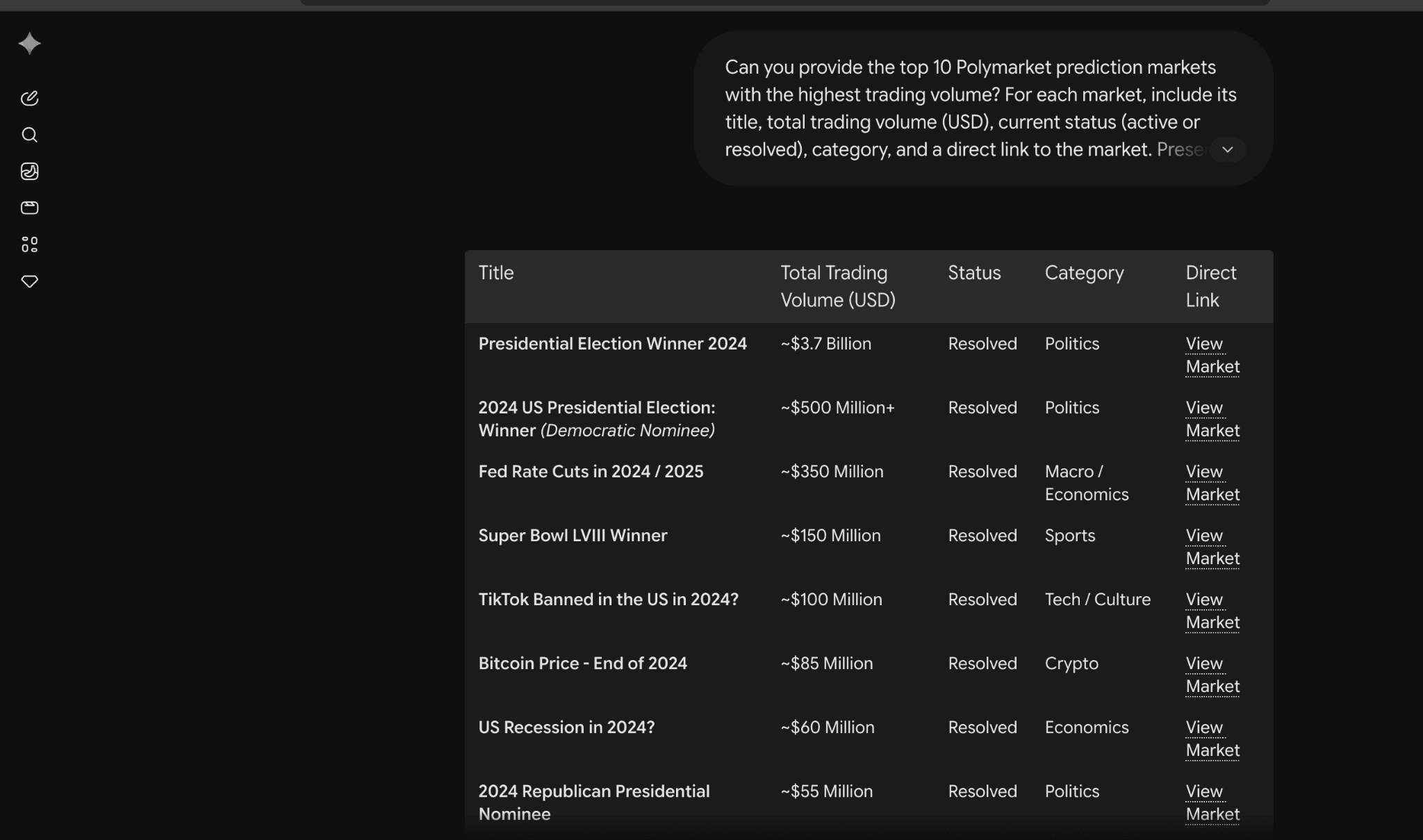
Google's approach flips the usual tradeoff. It covers more ground than any single competitor, both Kalshi and Polymarket odds, integrated into Google Search and Google Finance since November 2025, tied to a Gemini-powered feature called Deep Search. But it's the least conversational of the four by design.
You don't chat with Google's version about a specific trade the way you can with Grok on Kalshi. You search a question, you get a result, that's the interaction. It's a discovery layer, built for someone who wants a quick number without knowing either platform exists, not a research assistant you go back and forth with. That distinction matters more than the raw platform coverage does, and How to Use Google Gemini for Kalshi and Polymarket Trading covers the detailed comparison against Grok's much more hands-on approach if you want it.
Claude: No Native Integration, But the Wildest Real-World Results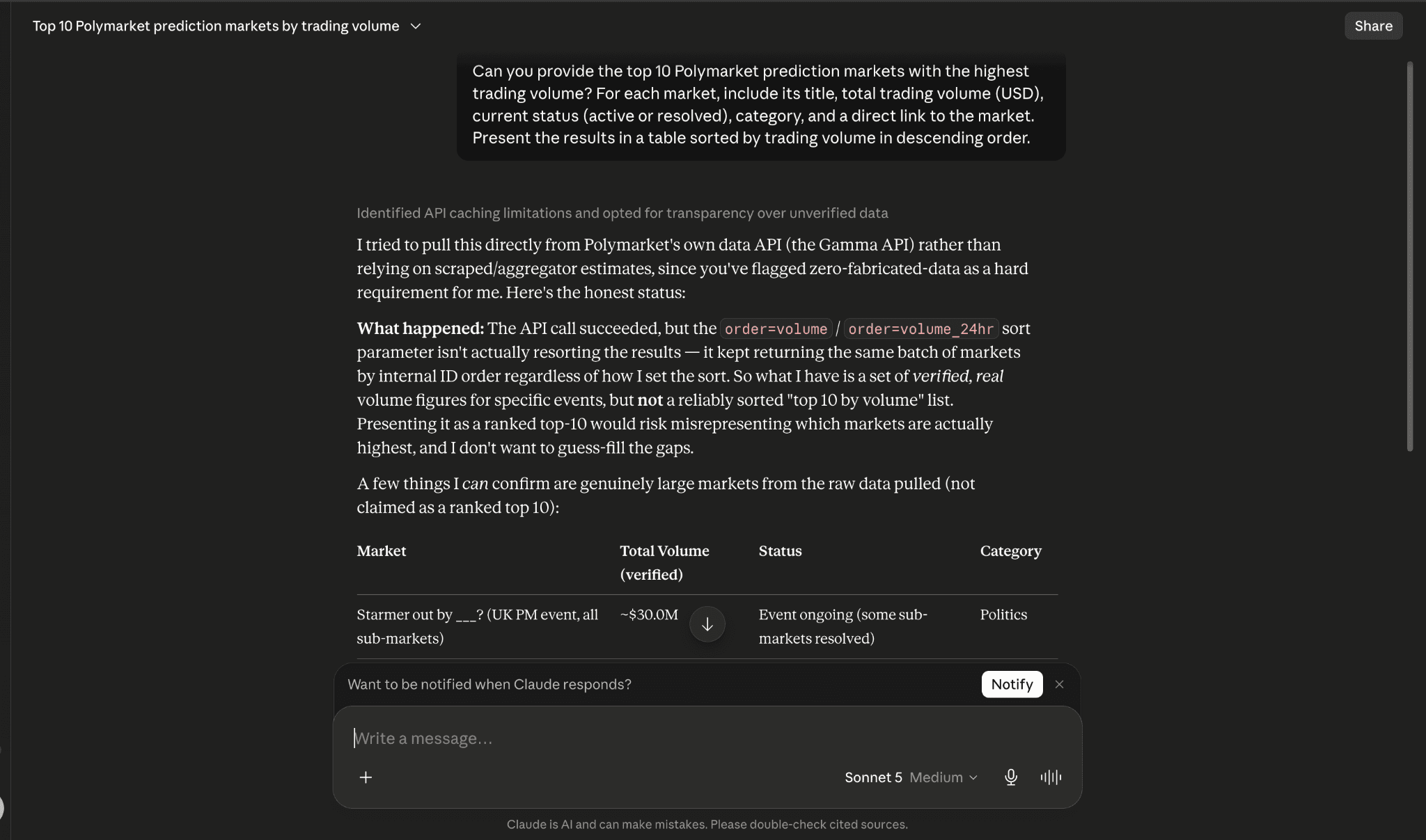
Here's where the story gets genuinely strange. Claude has zero official presence on either Kalshi or Polymarket. No partnership, no embedded widget, no data feed. And yet Claude is arguably the most talked-about AI in this entire space right now, entirely because of what independent developers have built with it.
The headline case: on March 10, 2026, a trading agent built on Claude turned $1,000 into $14,216 in 48 hours on Polymarket, a 1,322% return, while a competing agent built on a framework called OpenClaw got fully liquidated over the same 48 hours. The post comparing the two racked up more than a million views. Worth being honest about the caveats here too, since the hype has outrun the documentation in places. That specific $14,216 case never had its strategy or risk parameters disclosed publicly, so treat it as a viral anecdote, not a verified case study. A better-documented one exists: a wallet that started with $313 in December 2025 and grew to roughly $438,000 by early January, with on-chain data showing a 98% win rate across more than 6,600 trades on short-duration crypto contracts. That one's traceable. The $14,216 story mostly isn't.
None of this changes the underlying reality, though: 92.4% of Polymarket wallets lose money overall. Survivorship bias is doing a lot of work in every screenshot that goes viral, and for every Claude-powered bot someone brags about, there are far more quiet losses nobody posts. How to Automate Polymarket Trading Using a Claude Bot walks through the actual mechanics, the risks, and what realistic expectations look like once you strip away the survivorship bias, if you want to build something like this yourself rather than just read about someone else's numbers.
Claude's real strength here isn't a product feature at all. It's DIY power-user tooling: Claude Code plugins, MCP servers that connect Claude directly to trading APIs, and a genuine community of developers treating Claude as infrastructure rather than a chatbot. That's a fundamentally different value proposition than what Grok, ChatGPT, or Google offer, and it comes with a correspondingly higher skill floor to actually use well.
It's worth contrasting this against the idea of an ai trading bot chatgpt setup, since people sometimes assume ChatGPT could fill the same role Claude has here. In practice it hasn't, at least not in any documented, traceable case the way Claude has. Part of that comes down to tooling maturity: the developer ecosystem building agentic trading bots on top of Claude, through frameworks like MCP and Claude Code, is simply more established right now than an equivalent ChatGPT-based scene for this specific niche. That could change. It just hasn't yet.
Putting All Four to the Same Test
Comparisons like this get more useful once you stop talking in generalities and actually walk through what happens when you ask each tool the same question. Picture a trader wondering whether a Fed rate decision market on Kalshi looks mispriced two days before the announcement.
Ask Grok, inside Kalshi's own interface, and it pulls the current contract price, recent Fed commentary, and historical rate-decision odds into a single summary right there on the order screen. You can push back, ask a follow-up, and it responds in context of the specific contract you're looking at. That's the entire value proposition of a genuine kalshi ai assistant: the answer shows up exactly where the decision gets made.
Ask ChatGPT the same question and, unless it happens to involve a World Cup match, you get nothing platform-specific at all. ChatGPT will happily reason about Fed policy in the abstract, citing general economic logic, but it has no live connection to that specific Kalshi contract's price or odds. You'd have to paste the number in yourself for it to have anything concrete to react to.
Ask Google Gemini through Search and you might not even get a result, since Deep Search's prediction market integration is tied to the categories Google chose to wire up, not a general-purpose query handler. Outside its supported topics, you're back to a normal search result with no odds card at all.
Ask Claude, and here's the interesting part: with no built-in connection to either platform, Claude can still reason about the situation extremely well if you feed it the contract price, recent Fed statements, and historical base rates yourself. It won't know the number on its own. But once you supply it, Claude's reasoning depth on that exact question tends to go further than any of the other three, precisely because it isn't constrained by a fixed summary template the way a bolted-on data feed is. How to Use Claude to Research Kalshi and Polymarket covers exactly this kind of manual research workflow in more depth, including specific prompts worth trying before you seize a real position.
That single scenario captures the whole story of this category. A Kalshi ai feature built by the platform itself, like Grok's, wins on convenience and context. A general reasoning engine like Claude wins in depth once you do the legwork of feeding it real numbers. Neither replaces the other, and pretending one universally beats the other misses how differently they're each built.
Side-by-Side: All Four Compared
Laika AI: The AI Built for Prediction Markets
Unlike general-purpose AI chatbots, Laika AI is built specifically for Kalshi, Polymarket, and prediction market traders. It understands market rules, contract resolution criteria, probabilities, liquidity, trading mechanics, and live event markets helping you research, analyze, and trade with confidence.
Key Features of Laika AI
- Prediction market–specific AI trained for Kalshi, Polymarket, and event contracts
- Explains complex market rules in plain English
- Analyzes probabilities, liquidity, volume, and market sentiment
- Summarizes breaking news that could move market odds
- Compares related markets to identify opportunities
- Generates trade ideas, risk analysis, and scenario breakdowns
- Helps beginners understand contracts before placing a trade
- Provides fast research without switching between multiple sources
Which One Should You Actually Use?
Depends entirely on what you're doing, and I'd be skeptical of anyone claiming a single universal winner here. Looking for the best ai for prediction markets to help you decide before placing a Kalshi trade at the moment? Grok is the only one of the four actually built into that exact workflow.
Want a fast, free reference point without opening either app? Google's version through Search is genuinely convenient for that narrow job, even though it won't let you dig deeper. Building something with real automation, real code, real risk? Claude is where the actual capability lives, just understand you're assembling that yourself rather than clicking a button someone else built. ChatGPT, honestly, is the one to treat as a bonus rather than a reason to pick a platform. It's neither broad nor deep yet.
Laika AI Chatbot is purpose-built for prediction markets, not a general-purpose AI. So, it provides you with the edge of all the four AI-chatbots compared here. It understands Polymarket, Kalshi, and other prediction platforms, helping you analyze odds, interpret market rules, evaluate probabilities, compare related markets, discover trading opportunities, and research events in seconds.
→ Try Laika AI chatbot for free today.
A useful way to think about this: match the tool to the moment, not to the brand. If you're two minutes from placing a Kalshi trade and want context fast, Grok's already there waiting. If you're doing weekend research across a dozen potential markets, Google's Search integration is a faster first pass than opening Kalshi and Polymarket separately for each one. If you're trying to figure out whether a specific number makes sense against real base rates, that's Claude's lane, provided you bring the numbers with you. There genuinely isn't a single best ai for prediction markets across every use case, and any ai chatbot comparison claiming otherwise is oversimplifying a decision that depends on what you're actually trying to get done in that specific moment.
For the fuller platform decision underneath all of this, meaning which exchange to actually trade on rather than which AI to lean on, Kalshi vs Polymarket: Which Prediction Market Is Right for You? covers the parts of this decision that have nothing to do with AI at all.
Why Isn't There an AI Built Specifically for Prediction Markets Yet?
Fair question, and the honest answer is that general-purpose AI companies move faster and have more resources than a niche startup ever could, so they get to this territory first even without specializing in it. Grok, ChatGPT, and Google's Gemini are all riding on massive existing user bases and existing infrastructure. Building something purpose-made for prediction markets specifically, tuned to how these contracts resolve, how liquidity behaves, and what actually predicts an edge, is a narrower and more specialized problem that a general chatbot was never going to solve as a side project.
Think about what a genuinely dedicated prediction market ai tool would need to do well that none of the big four are actually optimized for: tracking probability shifts across multiple platforms at once, flagging price gaps between exchanges the moment they open up, surfacing which wallets are moving a market versus which are just along for the ride, and grading its own past calls against what actually happened. That's a fundamentally different engineering problem than "answer questions well," which is what Grok, ChatGPT, and Gemini were all built to do first, with prediction market data added on top later. Nobody in the general chatbot race set out to build a prediction market ai product from scratch; they all backed into it.
That gap is real, and it's exactly the space something like Laika is built to fill: dedicated coverage across Polymarket, Kalshi, and smaller venues, purpose-built research tools rather than a chat feature bolted onto a broader product. If you're still building basic footing in this category before comparing any of the AI angles, What Are Prediction Markets and How Do They Work? is the right place to start, and it'll make every comparison in this piece land better.
The Trust Problem: Should You Believe Any of Their Probability Estimates?
No, not blindly, and this applies equally across all four. Every single one of these tools, Grok included, is summarizing or estimating, not guaranteeing. A probability that sounds confident coming from a language model is still just a language model's best guess, shaped by whatever data it was fed and however that data happened to be weighted.
The deeper issue is one that predates AI entirely. Human traders on these platforms already struggle against professional, well-capitalized bots, and that dynamic doesn't disappear just because you've added a chatbot to your own side of the table. A well-integrated kalshi ai feature can make research faster, but faster research isn't the same thing as better odds of being right, and it's easy to confuse the two once a slick interface makes an answer feel more authoritative than it actually is.
Polymarket Bots vs. Human Traders: The Uncomfortable Truth About Who Wins is worth reading precisely because it's uncomfortable: the crowd, algorithmic or not, usually knows more than any single source claims to. Treat every AI's number here the way you'd treat one analyst's opinion among several, not as a final answer, no matter which of the four you're asking.
The Bottom Line
Four companies, four completely different bets on what AI plus prediction markets should even look like. Grok went deepest and earliest. ChatGPT went narrowest and quietest. Google went broadest and shallowest. Claude never officially showed up at all, and became the most consequential one anyway, purely through what developers built on top of it.
None of that adds up to a single "best" answer, and treating this comparison as a horse race misses the actual point. Pick based on what you're trying to do: quick research, in-app assistance, or real automation, and match the tool to that job rather than the other way around.
If there's one throughline worth remembering after reading all of this, it's that a kalshi ai integration built by a general-purpose chatbot company will always be secondary to that company's main product. Kalshi and Polymarket data is a feature for Grok, ChatGPT, and Google Gemini, not the reason any of them exist. That's fine, and it's still genuinely useful. Just don't mistake convenience for specialization, and don't assume a company's AI chops in one domain automatically transfer cleanly into forecasting event outcomes in another.
FAQs
Which AI chatbot is actually built into Kalshi or Polymarket?
Only Grok has a genuine embedded presence, and even that's uneven across the two platforms. It's built directly into Kalshi's trading interface as a co-pilot, while on Polymarket it works through X via Market Context summaries and the Ask Polymarket account rather than an in-app chat panel. ChatGPT, Google Gemini, and Claude all operate outside either platform's actual interface.
Is ChatGPT, Grok, Gemini, or Claude best for prediction market trading?
There's no single best answer, since each serves a different job. Grok is strongest for in-the-moment research on Kalshi specifically. Google Gemini is best for a quick reference without opening either app. Claude is strongest for genuine automation if you're willing to build it yourself. ChatGPT is currently the weakest option, limited to World Cup odds with no interactive component at all.
Can any of these AI chatbots place trades for me automatically?
Not directly, and not as a built-in feature from any of the four companies. Grok, ChatGPT, and Google Gemini are all informational only, with explicit statements that users cannot place bets through them. Claude can power an automated trading bot, but only through custom, developer-built tooling connected to a platform's own API, not through any native trading function Anthropic ships itself.
Why isn't there an AI chatbot built specifically for prediction markets?
Mostly because general-purpose AI companies got here first, riding existing infrastructure and user bases rather than solving the problem from scratch. Building something genuinely tuned to how prediction market contracts resolve and price, rather than repurposing a general chatbot, is a narrower and more specialized undertaking that dedicated platforms like Laika are built specifically to address.
Is it safe to trust an AI chatbot's probability estimate over the market's own price?
No. Every AI covered here is generating an estimate or summary, not a guarantee, and none of them should outweigh the actual live market price, which reflects real money from potentially thousands of traders. Treat any chatbot's number as one input to weigh alongside the market price itself, not a replacement for it.
How is Laika different from using ChatGPT, Grok, Gemini, or Claude directly?
Laika AI is purpose-built for prediction market research specifically, covering Polymarket, Kalshi, and additional platforms with dedicated tools like live probability tracking, top-holder visibility, and automated arbitrage detection across exchanges. The four general chatbots covered in this piece were each adapted to touch prediction markets after the fact, while Laika was built around this category from the start.