Three structures cover almost everything you'll ever trade on Kalshi or Polymarket. Binary asks a yes-or-no question and pays a dollar to whoever guessed right. Categorical asks you to pick from a list: an election, an award, a championship. Scalar asks where a number will actually land, and it's the one you'll bump into least. Prediction market contract types sound like jargon until you realize you've probably already traded two of the three without knowing there was a name for it.
This piece breaks down how each one actually works mechanically, where the platforms genuinely differ underneath the hood, and which one deserves most of your attention if you're still fairly new to this.
Binary Markets: The One You'll Actually Trade
Binary is the default. Overwhelmingly so nearly everything a retail trader touches on either platform falls into this bucket, and it's not close.
The structure is about as simple as prediction markets get. One question, two outcomes, Yes or No, and the contract settles at a full dollar if you're right or nothing at all if you're wrong. "Will it rain in Chicago on Monday?" "Will the Fed cut rates this meeting?" Same shape every time, just a different question bolted on. Price and probability collapse into the same number here, which is genuinely one of the cleaner things about this contract type. A Yes share trading at 73 cents means the market's pricing roughly a 73% chance, no conversion required, no side math, and how that price-equals-probability relationship works, along with where it occasionally breaks into real arbitrage opportunities, is worth understanding in full once you've got the basic mechanic down.
Kalshi runs binary contracts through its own CFTC-regulated exchange infrastructure, dollar-denominated, settling in cents from 1 to 99. Polymarket runs the same underlying idea through the Conditional Token Framework, an open standard adapted from Gnosis, where every Yes and every No gets minted as its own ERC-1155 token, fully collateralized one-to-one against locked stablecoin. Different plumbing entirely. Same contract, same 0-to-100 pricing, same "one dollar to the winner" logic sitting underneath both.
Categorical Markets: More Than Two Doors
Categorical markets swap the coin-flip structure for a lineup. Multiple discrete, mutually exclusive outcomes, and you're picking which one actually happens rather than guessing yes or no on a single proposition. "Who wins the election?" is the textbook example: one contract per candidate, and only one of them ever pays out.
Here's where the platforms genuinely diverge, and it's worth being precise about it rather than hand-waving. Polymarket doesn't build a categorical market as one big multi-choice contract. It structures it as an event, a container object holding several individual binary markets underneath, one Yes/No pair per candidate or outcome. Under the hood, each of those outcomes gets its own token ID, computed using the same three-step process every Polymarket contract uses, and the platform's technical documentation is explicit that a market is always fundamentally a single binary question; events are just the organizational layer stacked on top.
There's a wrinkle worth knowing if you trade these regularly: negative-risk mechanics. In a standard multi-outcome event, betting against one candidate means buying that candidate's No shares, and those shares have zero relationship to anyone else in the race. Negative-risk markets change that: a No share in any outcome can convert into a Yes share across every other outcome in the same event, through a dedicated adapter contract, which is what keeps the combined pricing across a crowded field from drifting away from something close to 100%.
Categorical markets show up constantly in sports, awards shows, and party primaries, basically anywhere the question has a fixed roster of possible winners. And if you find yourself wanting to combine your view across several of these into one position, stacking picks across multiple candidates or outcomes rather than trading each one separately, that's what multi-leg contracts are built for, a genuinely different structure worth understanding on its own terms before you try it.
Scalar Markets: Where a Number Lands, Not Just Whether
Scalar is the odd one out, and it's worth saying plainly: this is the contract type you'll see least often on a consumer-facing platform. One industry source describes it flatly as rare outside institutional settings, and that's the honest framing rather than pretending it's a common third pillar sitting equally alongside the other two.
The idea itself is straightforward. Instead of a discrete outcome, a scalar contract resolves along a continuous range, and the payout scales based on where the actual number lands within that range rather than paying a flat dollar to one side and nothing to the other. Kalshi's own technical documentation confirms genuine scalar markets exist in this proportional form; both the Yes and No sides can receive a partial payout based on where the final value actually settles, not a binary all-or-nothing split.
Worth flagging a distinction most explainers blur together. A lot of what gets colloquially called a "scalar-style" market for something like CPI inflation is actually structured as a ladder of separate threshold contracts stacked next to each other, "CPI over 0.3%" as one contract, "CPI 0.3% or under" as a different one, each still paying a flat dollar or nothing individually. Academic research on Kalshi's own transaction data confirms this bucket-ladder structure is how most of its inflation and jobs-number markets actually work, mechanically closer to several binary contracts bundled into one screen than a single continuously-scaled payout. A genuine proportional scalar contract, one instrument, one number, one sliding payout, is the rarer of the two, even though both get lumped under the same "scalar" label casually.
Economic data releases are where you're most likely to run into either version: CPI prints, jobs numbers, GDP growth bands. Fed policy specifically has generated some of the most heavily traded scalar-adjacent markets on either platform, and how Polymarket has actually priced Fed rate cut odds across 2026 is a useful real-world case study for seeing this contract type in action rather than just in the abstract. And if a continuously priced instrument is genuinely what you're after rather than a single fixed-date resolution, Kalshi's perpetual futures product is the closer cousin worth understanding, a different product entirely but one that shares scalar's core idea of tracking a moving value rather than settling a single yes-or-no question.
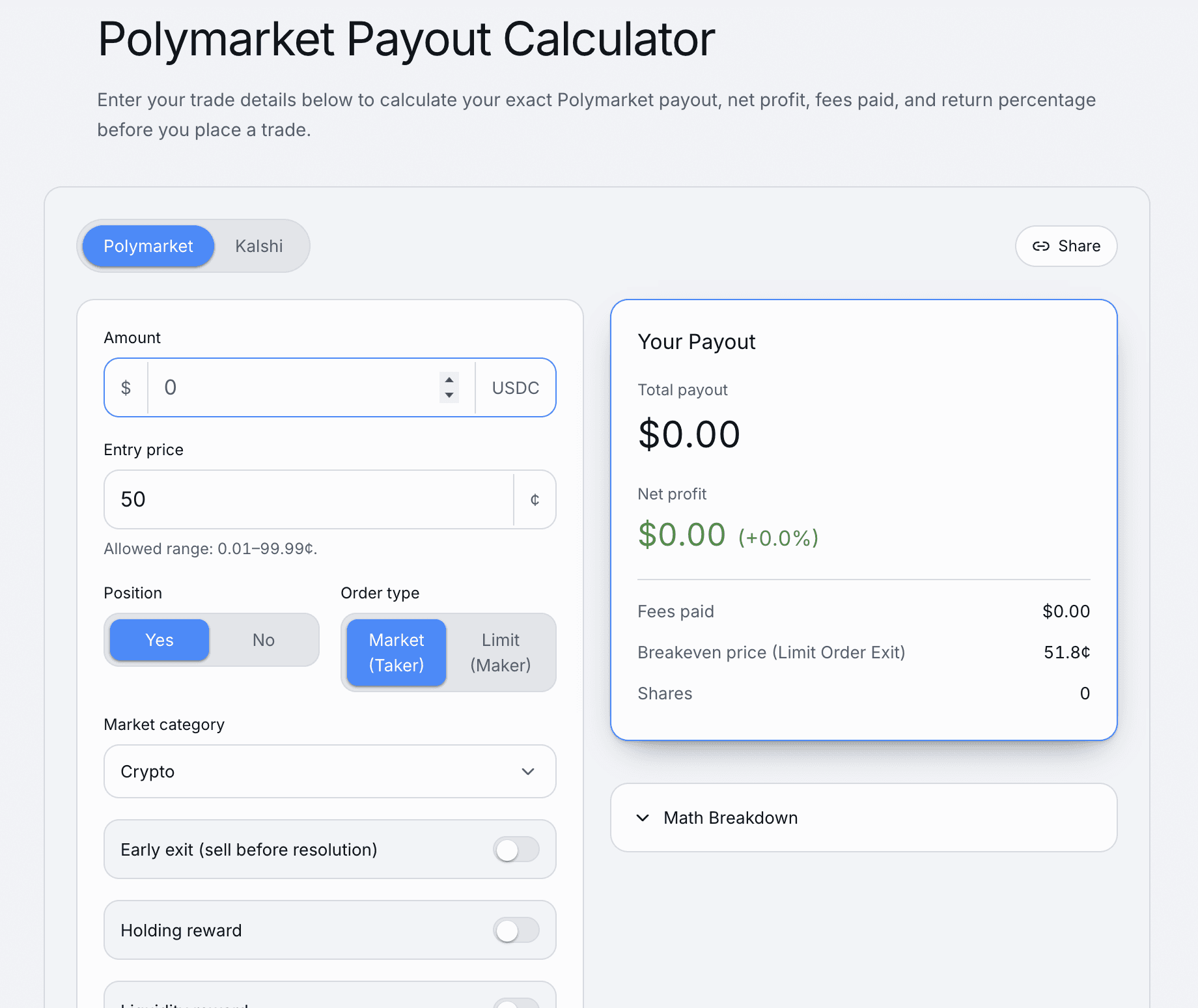
Calculate your Polymarket payout for free →
Quick Reference: All Three, Side by Side
Bottom Line
If you're new to any of this, spend your energy understanding binary contracts well before worrying about the other two. That's genuinely where nearly all of your trading time will actually go. Categorical markets are worth knowing cold the moment you touch sports, politics, or awards season, since you'll hit them constantly there. Scalar contracts are the one to understand conceptually rather than expect to trade often, useful mental models, rare in practice. And if any of this still feels abstract rather than concrete, what prediction markets actually are and how they work as a category, before you get into contract types at all, is worth backing up to first.
Frequently Asked Questions
What is a binary prediction market?
A binary prediction market is a contract with exactly two possible outcomes, Yes or No, that settles at $1 for the correct side and $0 for the incorrect one. It's the dominant contract type on both Kalshi and Polymarket, covering the overwhelming majority of markets a typical retail trader will encounter.
What is a categorical prediction market?
A categorical prediction market offers multiple discrete, mutually exclusive outcomes, such as each candidate in an election or each nominee for an award, with only one outcome ultimately paying out. Polymarket structures these technically as an event containing several individual binary markets rather than one single multi-choice contract.
What is a scalar prediction market?
A scalar prediction market resolves along a continuous numerical range rather than a fixed set of outcomes, with the payout scaled proportionally to where the actual value lands within that range. These are genuinely rare on consumer-facing platforms, showing up mostly around economic data releases and in more institutional trading contexts.
Which contract type is most common on Kalshi and Polymarket?
Binary contracts are by far the most common on both platforms. Categorical markets appear regularly around elections, sports championships, and awards shows, while true scalar markets remain the least common of the three, largely confined to specific economic-data contexts.
What's the difference between binary vs scalar markets?
A binary market pays a flat $1 or $0 based on a single yes-or-no outcome, while a scalar market pays a proportional amount based on where a final number actually lands within a defined range. Binary is a two-outcome bet; scalar is closer to owning a slice of an entire range of possibilities at once.