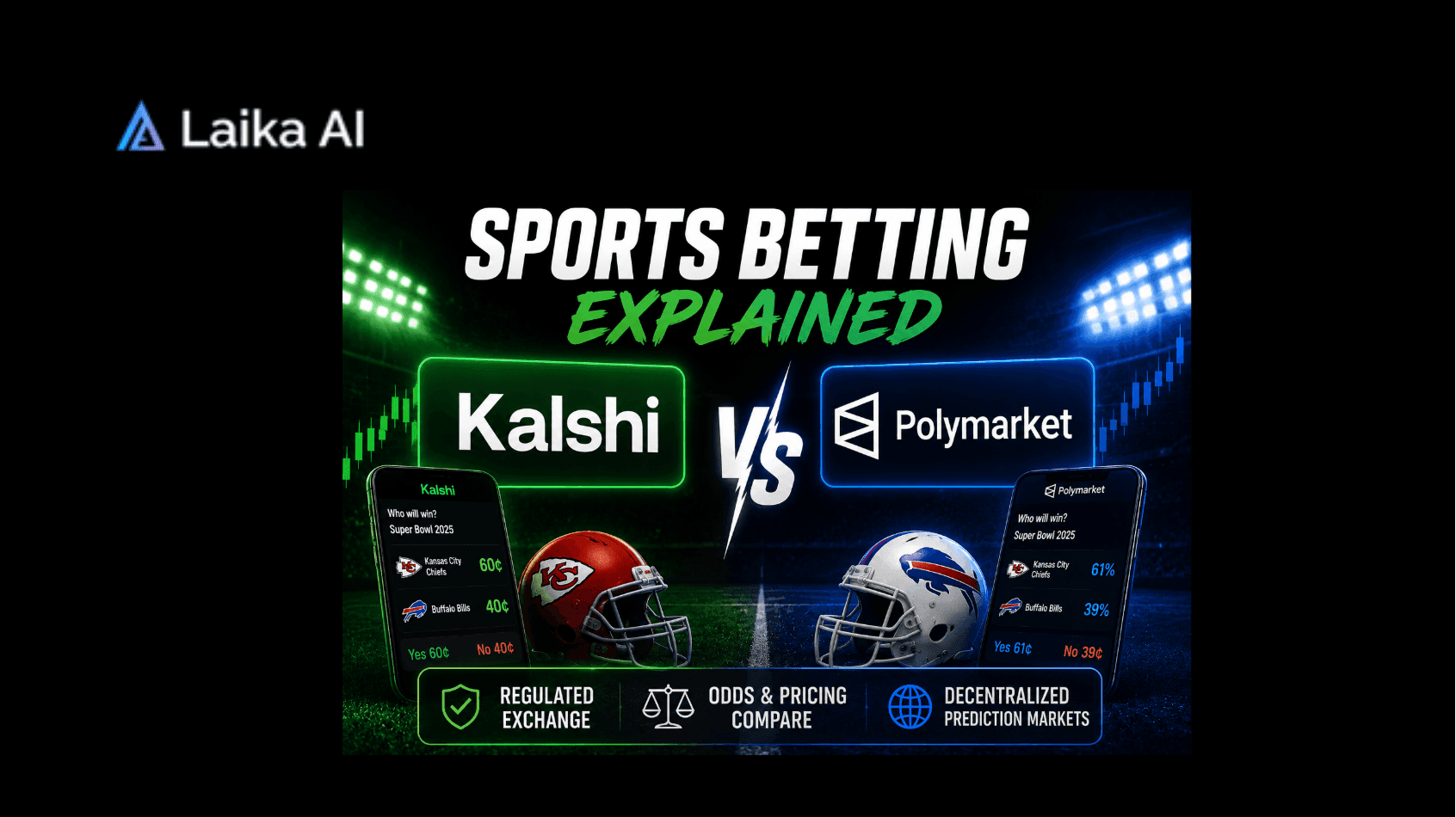
In January 2026, Kalshi processed $9.1 billion in trading volume with 91.1% tied to sports event contracts, more monthly sports volume than most state-regulated sportsbooks handle in a quarter. Kalshi sports betting is no longer a niche product for political traders. It is one of the largest sports trading platforms in the United States, operating legally in over 40 states including California and Texas where DraftKings and FanDuel cannot. Within the broader polymarket sports markets guide ecosystem, Kalshi sits as the primary regulated US alternative to Polymarket and the platform most traditional sports bettors encounter first.
This article covers what Kalshi sports betting is, how it works, what sports are available, what the legal picture looks like in May 2026, and how it compares to Polymarket for traders deciding between the two.
What Is Kalshi Sports Betting?
Kalshi is not a sportsbook. It is a CFTC-regulated prediction market exchange with the same regulatory status as the Chicago Mercantile Exchange. Users trade binary event contracts on real-world outcomes including sports games. When you trade on an NFL game through Kalshi, you are not placing a bet against the house. You are buying a YES or NO contract from another trader at a price set by the market. Each contract pays $1 if it resolves in your favour and $0 if it does not. The price you pay determines your return.
A contract priced at 62 cents means the market assigns a 62% probability to that outcome. If you buy YES at 62 cents and the event resolves YES, you receive $1 per contract, a profit of 38 cents. The platform charges a small fee on the trade rather than embedding a margin in the odds.
The practical difference from a sportsbook is the counterparty structure. You are trading against other participants on an open order book, not against a house with a structural incentive to beat you. Kalshi earns transaction fees regardless of who wins. That single structural difference is what makes kalshi sports a fundamentally different product from a DraftKings account, even when both let you trade on the same NFL game.
One development worth noting for new users: Robinhood now offers Kalshi sports contracts directly through the Robinhood app, which is how many US retail traders first encounter the platform. If you already have a Robinhood account, you may already have access.
For a full foundation on how prediction market mechanisms work before going further, what prediction markets cover the structure clearly.
Not every profitable trade comes from favorites. Some of the biggest prediction market opportunities come from mispriced long shots before public sentiment catches up. Ask Laika AI who has hidden value in the 2026 FIFA World Cup markets and compare odds across platforms instantly.
What Sports Are Available on Kalshi?
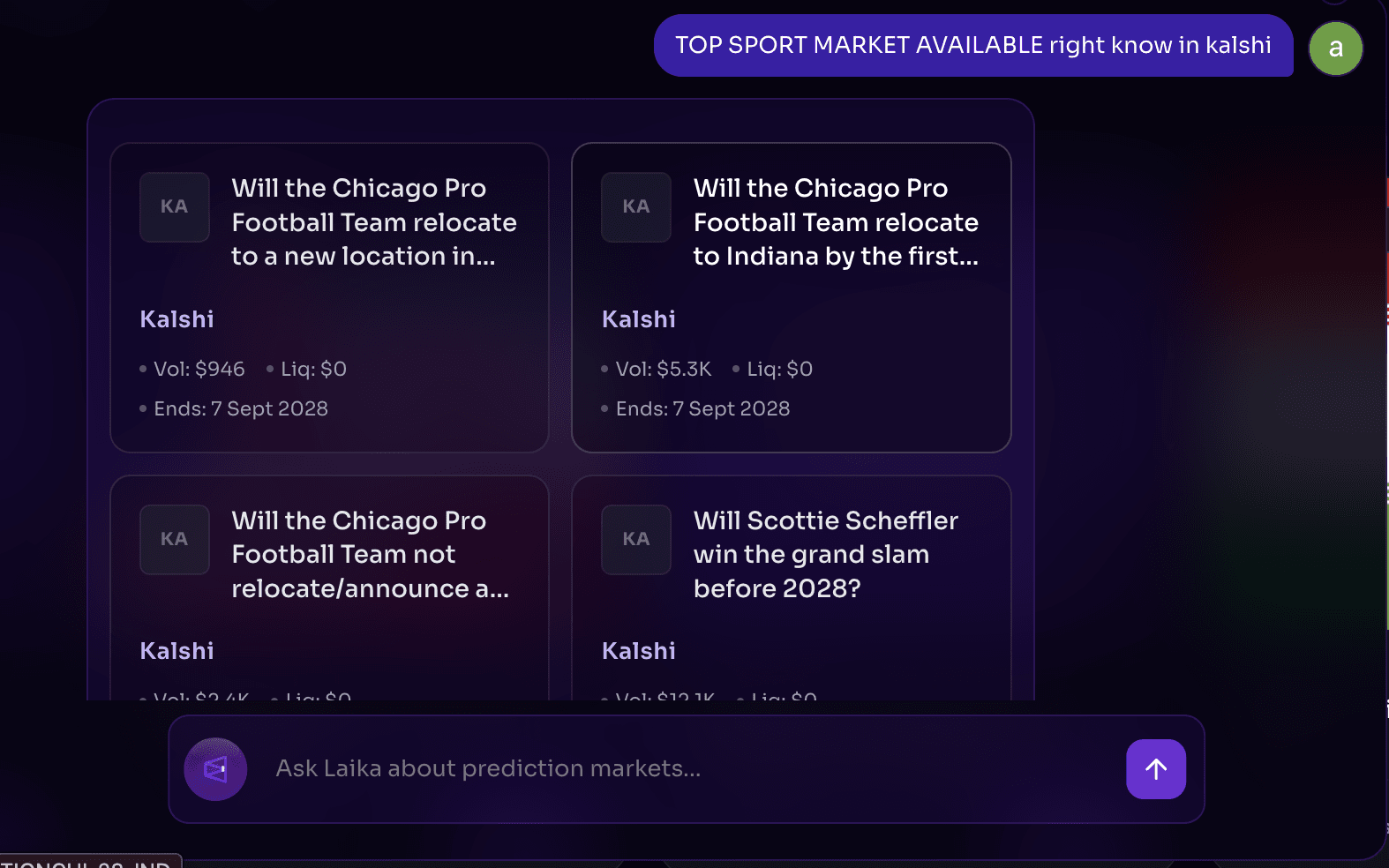
Kalshi currently offers contracts across 17 sports. The full menu as of May 2026 covers NFL, NBA, NCAA football and basketball, MLB, NHL, UFC, and European soccer leagues including the Premier League and Champions League. Users can trade on live sporting events, upcoming events, and longer-term markets including championships and individual awards.
The contract types available go beyond simple moneylines.
Futures cover NFL Champion, NBA Champion, Super Bowl winner, and individual team season win totals across major leagues.
Awards markets include MVP, Finals MVP, and Rookie of the Year across the NFL and NBA. These run from preseason open through award announcement, giving traders a multi-month window to position.
Player props cover points, assists, and rebounds over/under on major NBA and NFL games. These are available on high-volume matchups rather than the full game slate.
Live markets are in-play contracts on active games that update in real time as the game progresses.
What kalshi sports betting does not offer relative to sportsbooks is worth being direct about. Same-game parlays are not available. Horse racing markets are excluded entirely under the Interstate Horseracing Act. Both Kalshi and Polymarket went dark for the Kentucky Derby. Player prop depth on lower-volume games is thinner than what major retail sportsbooks carry.
For the full menu of live markets currently active, visit the live Kalshi sports markets
How Kalshi Sports Betting Works: Step by Step
Step 1: Create an account
Kalshi account creation requires standard identity verification including name, address, date of birth, and government-issued ID. The process takes approximately five minutes. No credit check is required, and there is no state gaming license verification beyond the nine restricted states covered in the legality section below.
Step 2: Deposit funds
Kalshi accepts PayPal, Venmo, Cash App, ACH bank transfer, debit cards, and USDC crypto transfers. Debit card withdrawals typically arrive within 30 minutes. ACH bank transfers take two to four business days. The minimum deposit is $1. This is the clearest practical advantage Kalshi has over Polymarket for US users. No crypto wallet is required, no Polygon blockchain setup, no USDC purchase. Standard US bank infrastructure works from day one.
Step 3: Find a sports market
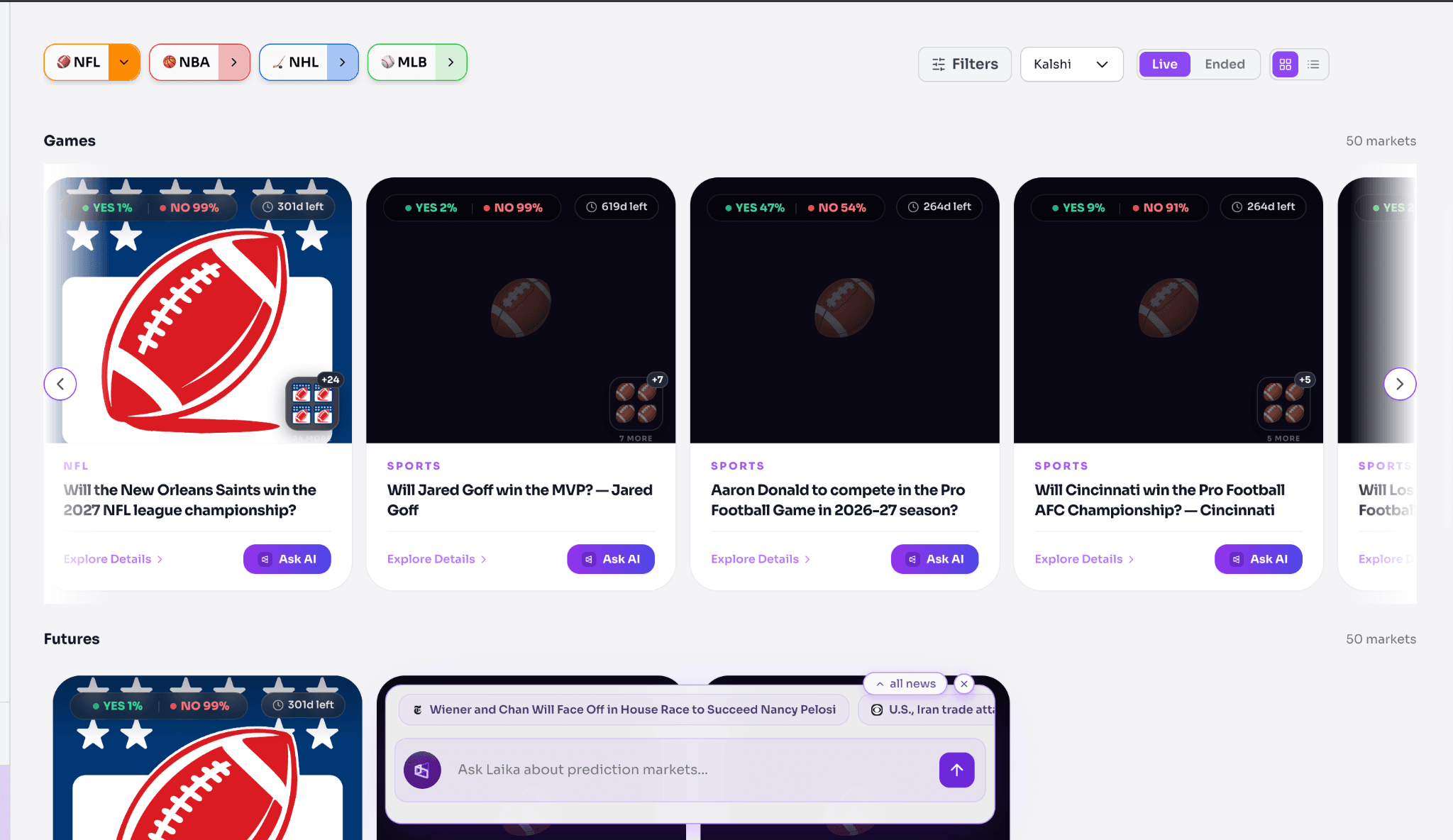
Sports markets appear on the home screen sorted by volume. NFL, NBA, and MLB games appear in a game slate view similar to sportsbook apps. Futures and awards markets sit under the Sports hub. The Robinhood integration means some users trade directly from the Robinhood interface without visiting Kalshi directly, though a separate Kalshi account gives access to the full market menu.
Step 4: Place a trade
Select the market, choose YES or NO, and enter the number of contracts and the price you want. Both limit orders and market orders are available. The order book shows depth, meaning how many contracts are available at each price level. Contracts settle automatically at $1 for a win or $0 for a loss once the event resolves. You can sell your position at any time before resolution at the current market price.
The exit mechanic is the most important structural difference from a traditional sportsbook bet. A placed kalshi sports betting position is not locked until resolution. If your team jumps to a strong lead and the contract moves from 62 cents to 78 cents, you can sell and take the profit without waiting for the final whistle.
Kalshi Sports Fees: What You Actually Pay
Kalshi charges fees on every trade. The fee structure is based on expected earnings per trade and varies by contract price and market type, but it rarely exceeds 2% of your maximum profit on a single trade. This is structurally different from sportsbook vig, which runs at 4.5 to 8% on most retail books.
The practical comparison on a standard NFL moneyline is concrete. Where DraftKings charges -110 on both sides, embedding approximately 4.5% overround, Kalshi's equivalent contract at competitive pricing costs approximately 1 to 1.5% in fees on the same notional position. Over a month of active trading, that fee differential compounds meaningfully in the trader's favour.
One important caveat: Kalshi charges on every trade regardless of frequency. A trader making five to ten trades per month on standard markets will pay roughly $20 to $40 per month in fees depending on position size. Polymarket charges zero fees on most major sports markets beyond blockchain gas costs, which typically add $1 to $5 per trade. For high-frequency traders on major markets, Polymarket is cheaper on paper. For US traders who want simple bank funding and no crypto infrastructure, Kalshi's slightly higher fees are the direct cost of that accessibility.
The kalshi vs polymarket sports fee gap is real but not prohibitive for most retail traders. Where it becomes significant is on long-duration futures markets with large position sizes. The full fee breakdown across both platforms is covered in kalshi vs polymarket fees. For the structural comparison between prediction market fees and sportsbook vig more broadly, prediction markets vs sports betting covers the framework.
Is Kalshi Sports Betting Legal? The State-by-State Picture in May 2026
The federal picture
Kalshi has held full CFTC Designated Contract Market status since 2020, making it the longest-standing federally regulated prediction market in the United States. Its contracts are classified as derivatives under federal law. The Third Circuit Court of Appeals ruled on April 7, 2026 that sports event contracts are swaps under the Commodity Exchange Act, meaning CFTC preemption applies and state gambling laws cannot block them. This is the strongest legal ruling Kalshi has received to date
The state picture
As of May 2026, Kalshi is restricted or limited in nine states: Arizona, Illinois, Massachusetts, Maryland, Michigan, Montana, New Jersey, Nevada, and Ohio. Users in these states are either blocked entirely or have access to limited market categories with sports contracts unavailable. Every other state including California, Texas, Florida, and New York has full access to the complete sports market menu.
The Ninth Circuit wildcard
The Third Circuit ruled for Kalshi in April. The Ninth Circuit heard Nevada's appeal on April 16, 2026 and the panel appeared to lean toward Nevada during oral arguments. A split between the two circuits would likely require Supreme Court review and could reshape the state access map significantly before the end of 2026.
The Rhode Island development
Rhode Island filed a lawsuit against both Kalshi and Polymarket on May 25, 2026. The state's attorney general cited an 8% drop in lottery sports betting revenue as direct harm caused by the platforms. This is the most direct state-level legal challenge yet and represents a new front in an active multi-state legal battle.
Is kalshi sports betting legal in your state? The answer for most US residents is yes, but the nine restricted states and the evolving Ninth Circuit situation make it worth checking the current eligibility page before depositing. Is kalshi sports betting legal in Nevada, New Jersey, or Massachusetts? Currently no, and that status may expand depending on how the Ninth Circuit rules. For current country and state-level access restrictions across both platforms, polymarket restricted countries have the updated list.
Kalshi vs Polymarket for Sports: Which One Is Better?
The decision framework depends on who you are and how you trade.
Where Kalshi wins for sports traders
US accessibility is the primary advantage and it is not close. Kalshi accepts standard US bank transfers, debit cards, PayPal, and Venmo with no crypto wallet required. For any US trader who does not already have a crypto setup, Kalshi is the path of least friction. The Robinhood integration makes it even simpler since millions of existing Robinhood users can trade Kalshi sports contracts without creating a separate account at all.
Regulatory clarity is the second advantage. Kalshi has been CFTC-regulated since 2020. For institutional traders or anyone who wants their sports trading activity on a federally regulated exchange with clear legal documentation behind it, Kalshi is the cleaner structural choice.
Where Polymarket wins for sports traders
Volume and market depth on major events is where Polymarket's global platform dominates clearly. The 2026 NBA Champion market has $437 million in volume on Polymarket. Kalshi's equivalent market has a fraction of that liquidity. For long-duration futures markets on major sports events, Polymarket's depth means tighter spreads and the ability to enter and exit larger positions without moving the market against yourself.
Fees on major markets favour Polymarket. A trader making five to ten trades per month on standard markets pays zero in platform fees on Polymarket beyond minimal gas costs. Kalshi charges on every trade.
Exotic market depth is another Polymarket advantage. Halftime performer markets, player milestone specials, and award parlays exist on Polymarket at a depth that Kalshi does not currently match.
The practical decision
US-based trader with no crypto infrastructure who wants NFL and NBA game markets: use Kalshi. Non-US trader or a trader comfortable with USDC who wants deep futures and exotic markets on major events: use Polymarket global. Active trader with both setups: use Kalshi for US game markets and regular props, use Polymarket for major event futures where liquidity is meaningfully deeper.
For the full head-to-head breakdown across fees, liquidity, market depth, and access, kalshi vs polymarket full comparison covers every dimension. The polymarket sports betting versus Kalshi comparison ultimately comes down to infrastructure preference for most US traders, not a significant difference in market quality on the events both platforms cover.
The Robinhood Factor: What It Means for Kalshi Sports
Many readers will have discovered Kalshi through Robinhood. Here is the full context.
Robinhood launched NFL and NCAA football prediction markets via a Kalshi partnership ahead of the 2026 season, giving users the ability to trade on all regular season NFL matchups and all college Power 4 schools directly from the Robinhood app under Robinhood Derivatives. No separate Kalshi account is required for basic access, though a standalone Kalshi account gives access to the full market menu including futures, awards, and international sports.
The Robinhood partnership has been Kalshi's single most significant retail distribution channel. Robinhood's 25 million active users represent the largest untapped audience for prediction market sports trading in the US, and the majority of Kalshi's current retail flow is coming through that integration.
There is one material risk in this relationship worth understanding. Robinhood acquired its own CFTC-registered exchange clearinghouse in late 2025 with the stated intent to launch a competing prediction market exchange in 2026. When that launches, Robinhood will no longer need to route through Kalshi. For traders using Kalshi primarily through Robinhood, that transition could change the interface, the market menu, and the fee structure they are currently experiencing.
Frequently Asked Questions
What sports can you trade on Kalshi?
Kalshi offers sports event contracts across 17 sports including NFL, NBA, NCAA football and basketball, MLB, NHL, UFC, and major European soccer leagues. Markets cover game moneylines, futures including the NFL and NBA champion, awards including MVP and Rookie of the Year, and player props on high-volume games. Live in-play contracts are also available on active games. Visit kalshi.com/sports for the current full market menu.
Is Kalshi sports betting legal in the US?
Kalshi operates under CFTC Designated Contract Market status as a federally regulated derivatives exchange, which gives it legal status in most states where traditional sportsbooks cannot operate. As of May 2026, Kalshi is available in over 40 states. It is currently restricted or limited in nine states: Arizona, Illinois, Massachusetts, Maryland, Michigan, Montana, New Jersey, Nevada, and Ohio. The Third Circuit ruled in Kalshi's favour in April 2026, but the Ninth Circuit's Nevada ruling is still pending and could expand the restricted states list. For current state-by-state access status, polymarket restricted countries have the updated list.
How does Kalshi sports betting work mechanically?
You buy YES or NO contracts on a sports outcome. Each contract pays $1 if it resolves in your favour and $0 if it does not. The contract price reflects the market's implied probability. A 62-cent YES contract means the market assigns a 62% chance to that outcome. You can sell your position at any time before resolution at the current market price. Kalshi charges a small fee per trade, typically under 2% of expected profit.
What states is Kalshi sports betting available in?
Kalshi is available in over 40 states as of May 2026. It is restricted or limited in Arizona, Illinois, Massachusetts, Maryland, Michigan, Montana, New Jersey, Nevada, and Ohio. In some of these states only sports markets are blocked while other contract categories remain accessible. The legal situation is actively evolving. Check Kalshi's current availability page before signing up if you are in any of those states.
What is the difference between Kalshi and Polymarket for sports?
The main differences are accessibility and market depth. Kalshi accepts US bank accounts and standard payment methods with no crypto required, making it the easier entry point for US traders. Polymarket's global platform requires USDC on the Polygon blockchain but has significantly deeper liquidity on major futures markets. The 2026 NBA Champion market has $437 million in volume on Polymarket versus a fraction of that on Kalshi. For game-by-game US sports markets, Kalshi is competitive. For long-duration futures on major events, Polymarket global wins on depth and spread quality.
Does Kalshi limit winning accounts like sportsbooks do?
No. Because Kalshi earns transaction fees rather than acting as the counterparty to your trades, there is no structural incentive to limit profitable accounts. Position size caps and order book depth are the only practical constraints, and they apply equally to all participants regardless of profitability. This is one of the primary reasons experienced sports bettors are moving volume from sportsbooks to Kalshi and Polymarket in 2026.
Should You Use Kalshi for Sports Trading?
Kalshi is not a sportsbook and is not trying to be one. It is a federally regulated exchange that offers sports event contracts with lower fees, no account limiting, exit mechanics before resolution, and legal access in states where DraftKings and FanDuel cannot operate.
For US sports bettors who have been limited at major sportsbooks, who bet in California or Texas, or who want to trade long-duration futures without a house margin embedded in every position, Kalshi is worth using. The Robinhood integration makes the barrier to entry effectively zero for the 25 million existing Robinhood users already on that platform.
The caveats are real. Nine states are restricted. The Ninth Circuit ruling could expand that list before the end of 2026. Market depth on major futures is thinner than Polymarket global. And the Robinhood distribution relationship that drives most of Kalshi's retail flow has a structural risk as Robinhood builds its own competing exchange.
For everything running across sports prediction markets and the broader prediction market ecosystem, the polymarket sports markets guide is the complete picture. For traders who want to understand where to find the best value across both platforms, how to make money on Polymarket covers the practical framework that applies to Kalshi as well.
For traders using Kalshi strategies specifically, kalshi prediction market strategies covers the platform-specific approach in detail.
If you are trading sports on Kalshi or Polymarket, Polymetric gives you live market intelligence to track how odds are moving before the crowd catches up. Start at laikalabs.ai