There is a specific approach to prediction markets that separates retail traders placing $500 bets based on gut feelings from sophisticated operators managing six-figure positions with institutional discipline.
Hedge funds do not bet on outcomes. They construct portfolios. They hedge risk. They size positions mathematically. They operate systematic processes that remove emotion from decision-making. They treat every trade as one execution in a long-term strategy designed to extract edge consistently.
Most Polymarket users trade like gamblers. They see a market, form an opinion, place a bet, and hope they are right. When they win, they feel smart. When they lose, they feel unlucky. This approach produces negative returns for 97% of participants.
The 3% who profit consistently trade like institutions. They build position portfolios across multiple markets. They hedge directional exposure. They calculate position sizes using quantitative frameworks. They maintain discipline through systematic processes immune to emotional swings.
This article breaks down the institutional approaches hedge funds would use in trading prediction markets, translated into practical strategies accessible to individual traders with $5,000 to $50,000 capital.
Portfolio Construction Over Single Bets
Retail traders think in individual bets. Institutional traders think in portfolios.
The diversification principle
A retail trader sees the Pennsylvania Senate race priced at 58 cents and thinks: "I believe the Democrat wins. I will bet $5,000 on this outcome."
That is a single concentrated bet. If the Democrat loses, the entire $5,000 is gone. The trader has binary exposure to one outcome.
An institutional approach looks at the same opportunity and thinks: "I believe Democrats outperform their polling in 2024 Senate races by 1-2 points on average based on turnout patterns. This creates an edge across multiple races."
The institutional trade is
- $1,000 on Pennsylvania Democrat at 58 cents
- $1,000 on Arizona Democrat at 52 cents
- $1,000 on Wisconsin Democrat at 61 cents
- $1,000 on Michigan Democrat at 68 cents
- $1,000 on Nevada Democrat at 55 cents
Total capital deployed: $5,000 across five races.
If the thesis is correct that Democrats outperform polling by 1-2 points, multiple positions should win. If one race has a local factor that breaks differently, the other four races still capture the thesis.
The diversified portfolio reduces idiosyncratic risk while maintaining exposure to the systematic factor you have edge in.
Correlation awareness
Naive diversification spreads capital across markets without considering correlation. Five Senate races all correlated with the national political environment is not true diversification.
Institutional diversification accounts for correlation:
- 20% in political markets (Senate races, presidential outcomes)
- 20% in economic markets (Fed decisions, CPI predictions)
- 20% in sports markets (championship outcomes, playoff series)
- 20% in crypto markets (Bitcoin price predictions, Ethereum milestones)
- 20% in weather markets (temperature predictions, precipitation)
These categories have low correlation. A political wave election does not correlate with whether Bitcoin hits $150,000. Weather outcomes are independent of Fed decisions.
When you lose in one category, other categories buffer the drawdown. Your portfolio remains stable even when individual positions lose.
Kelly Criterion for position sizing
Hedge funds use Kelly Criterion to determine optimal position size based on edge and probability estimates.
The formula: f = (bp - q) / b
Where:
- f = fraction of bankroll to bet
- b = decimal odds received on the bet
- p = probability of winning
- q = probability of losing (1 - p)
Example: You estimate 65% probability of an outcome. Market price is 58 cents (implying 58% probability).
- Your edge: 7 percentage points
- Decimal odds: 0.72 (if you pay 58 cents and win, you get $1.00, netting 42 cents profit on 58 cent investment)
- Kelly calculation: ((0.72 × 0.65) - 0.35) / 0.72 = 0.168
Kelly suggests betting 16.8% of your bankroll on this position.
Most professionals use fractional Kelly (often 25-50% of full Kelly) to reduce variance. Half Kelly would be 8.4% of bankroll.
This mathematical approach ensures position sizing scales with edge size rather than with confidence feelings.
Position limits and concentration risk
Institutional risk management sets hard limits:
- Maximum 10% of capital in any single position
- Maximum 30% of capital in any single market category
- Maximum 50% of capital in correlated positions
These limits prevent catastrophic losses from any single event or correlated group of events.
When positions approach limits, you either reduce size elsewhere in the portfolio or skip new opportunities until existing positions resolve.
Hedging Strategies Reduce Directional Risk
Hedge funds do not take pure directional bets. They hedge exposure to reduce risk while maintaining upside.
Direct hedging across platforms
You believe Trump wins the election but are uncertain about the margin. You want exposure to Trump victory without full directional risk.
Hedged structure:
- Buy Trump wins at 62 cents on Polymarket: $6,200 for 10,000 shares
- Buy Trump loses at 35 cents on Kalshi: $3,500 for 10,000 shares
- Total capital: $9,700
Outcomes:
- If Trump wins: Polymarket pays $10,000, Kalshi pays $0. Net: $300 profit (3.1%)
- If Trump loses: Polymarket pays $0, Kalshi pays $10,000. Net: $300 profit (3.1%)
You locked in 3.1% profit regardless of outcome by exploiting price differential between platforms. This is arbitrage, which institutions execute continuously.
Correlation hedging
You have large exposure to Republican Senate candidates winning multiple races. You are concerned about a correlated downside if the national environment shifts Democratic.
Hedge structure:
- Maintain long positions on individual Republican Senate candidates
- Buy Democratic control of Senate market as portfolio hedge
If individual Republicans win but Democrats capture overall control through unexpected races, your hedge position cushions the loss. If Republicans win as expected, your individual positions profit while the hedge loses a small amount.
This is correlation hedging. You pay a small cost (the hedge premium) to reduce tail risk from correlated negative outcomes.
Dynamic hedging as markets move
Positions that move strongly in your favor create profit but also increased risk exposure. Institutional traders dynamically hedge as positions gain value.
Example: You bought YES at 45 cents. The market now trades at 72 cents. You have $2,700 unrealized profit on $4,500 initial capital (60% gain).
Rather than hold to expiry risking reversal, you lock in partial profit:
- Sell 60% of position at 72 cents, locking $1,620 profit
- Hold remaining 40% for full upside if market reaches 90 cents
This dynamic approach locks guaranteed profit while maintaining upside exposure. Pure directional traders hold everything to expiry, risking complete reversal. Institutional traders take partial profits systematically.
Quantitative Analysis Over Gut Feelings
Hedge funds make decisions based on quantitative models, not opinions.
Building probabilistic models
Retail traders see polls and think: "Looks like Candidate X is ahead."
Institutional traders build models:
Poll aggregation model
- Collect all polls from past 30 days
- Weight by pollster quality (FiveThirtyEight ratings)
- Weight by recency (recent polls weighted higher)
- Adjust for known house effects (some pollsters consistently lean left/right)
- Calculate weighted average
- Adjust for historical polling error in this state
- Generate probability distribution with confidence intervals
The output is not "Candidate X is ahead." The output is "Candidate X has 64% probability of winning with 95% confidence interval of 58-70%."
This quantitative approach provides edge by incorporating information systematically rather than selectively.
Backtesting strategies before deploying capital
Before trading real money, institutions backtest strategies against historical data.
Example backtesting process:
- Download historical Polymarket price data for 100 resolved political markets
- Define your strategy: "Buy when market price is 8+ points below my poll-based probability estimate"
- Simulate what would have happened executing this strategy on all 100 markets
- Calculate: win rate, average profit per trade, maximum drawdown, Sharpe ratio
- If the backtest shows positive expectation, deploy capital. If not, refine strategy.
Backtesting reveals whether your edge is real or imaginary before you risk capital.
Statistical arbitrage using regression models
Advanced institutional traders build regression models predicting market outcomes based on multiple variables.
Example: Predicting Fed rate decisions using regression on:
- Current Fed funds futures pricing
- Change in CPI over past three months
- Change in unemployment rate
- Recent Fed governor speech sentiment scores
- Historical Fed behavior in similar conditions
The regression outputs the probability estimate. Compared to market price. If regression says 72% and market shows 63%, you have a statistical edge justifying a position.
This approach requires data infrastructure and modeling skills but represents how institutions extract consistent edges.
Professional Tools and Infrastructure
Institutional trading requires infrastructure beyond checking prices on websites.
Automated price monitoring
Hedge funds use APIs pulling real-time prices across all markets into centralized dashboards.
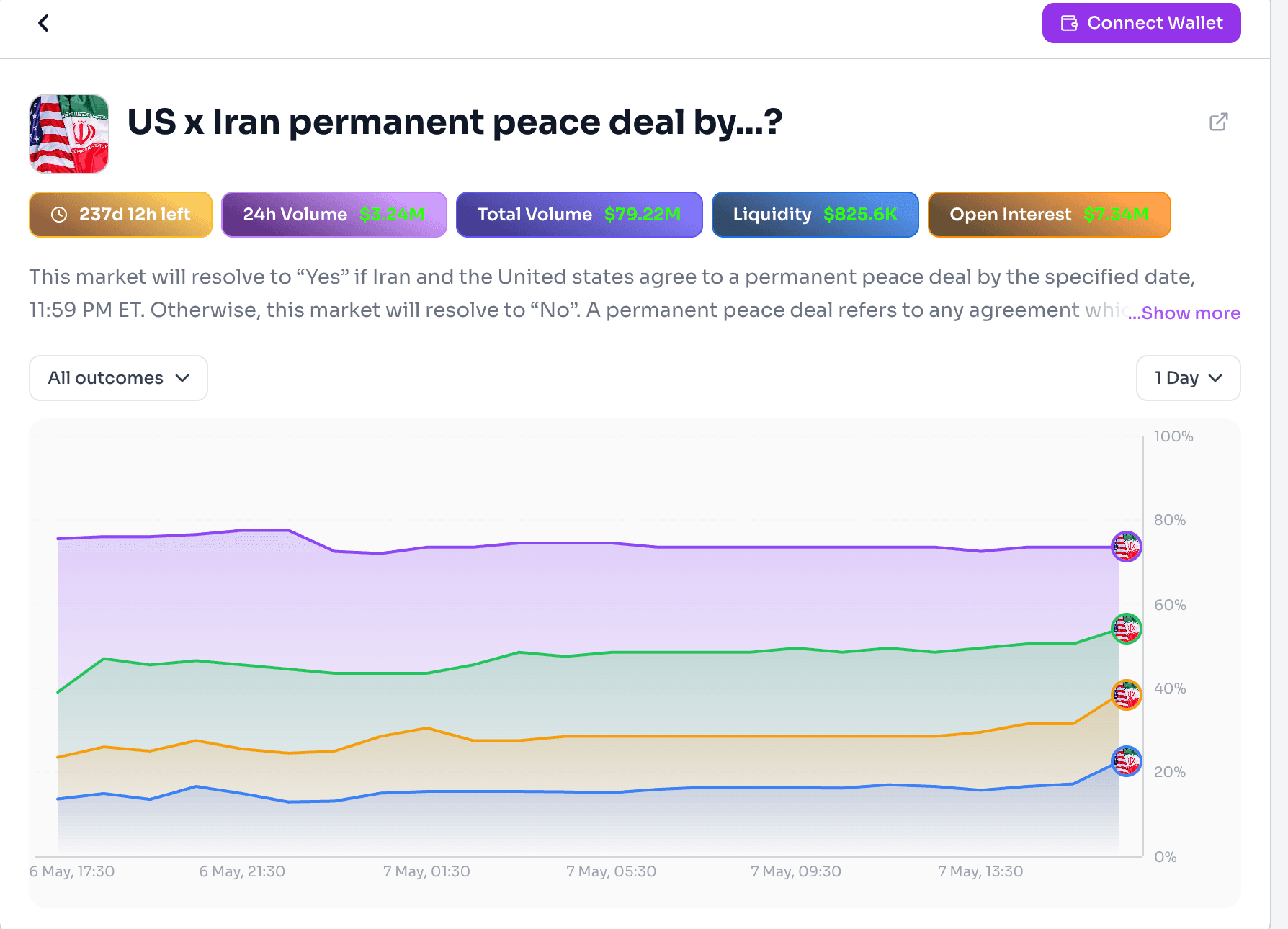
Laika Labs provides institutional-grade monitoring for prediction markets without requiring custom development
Features supporting institutional approach
- Real-time price tracking across thousands of markets
- Whale wallet monitoring showing large trader positions
- Automated alerts when markets meet your criteria
- Historical price charts for backtesting and analysis
- Order book depth analysis for liquidity assessment
Rather than manually checking market prices constantly, systematic alerts notify you when opportunities meeting your quantitative criteria emerge.
Position tracking and P&L monitoring
Professional traders maintain detailed position logs tracking:
- Entry price and date for every position
- Current market price and unrealized P&L
- Realized P&L from closed positions
- Performance by market category
- Win rate and average profit per trade
- Maximum drawdown from peak equity
This data infrastructure enables the quantitative analysis institutions require for strategy refinement.
Correlation matrices and risk analytics
Advanced traders build correlation matrices showing how different positions move together.
If the Pennsylvania Senate, Arizona Senate, and Wisconsin Senate all move together (high correlation), you have concentrated risk disguised as diversification.
Understanding correlation across your portfolio informs position sizing and hedging decisions.
News aggregation and sentiment analysis
Institutional traders monitor news systematically rather than randomly scrolling Twitter.
Laika Labs newsroom feature aggregates news across 200+ sources relevant to prediction markets, providing systematic information flow without manual monitoring burden.
Frequently Asked Questions
How much capital do I need to trade prediction markets like a hedge fund?
Minimum recommended capital is $10,000-$25,000 to properly diversify across 10-20 positions at meaningful sizes while maintaining liquidity reserves. Professional institutional approaches work best with $50,000+ capital allowing adequate diversification and position sizing flexibility without overconcentration risk.
What is Kelly Criterion for Polymarket position sizing?
Kelly Criterion is a mathematical formula calculating optimal position size based on your edge and odds. Formula: (edge × odds - probability of loss) / odds. Most traders use fractional Kelly (25-50% of full Kelly) to reduce variance. A 7 percentage point edge might suggest 8-12% position size using half Kelly.
How do hedge funds hedge prediction market positions?
Hedge funds use cross-platform arbitrage buying opposite sides when price gaps exist, correlation hedging buying portfolio-level hedges against correlated risks, and dynamic hedging taking partial profits as positions move favorably. Hedging reduces directional risk while maintaining upside exposure through diversified portfolio construction.
Should I diversify across different prediction market categories?
Yes. Institutional portfolios spread capital across uncorrelated categories like politics, economics, sports, crypto, and weather. This reduces portfolio volatility since categories have low correlation. A 20% allocation per category prevents concentration risk while maintaining adequate position sizes for meaningful returns.
What is the difference between institutional and retail prediction market trading?
Institutional trading uses portfolio construction across multiple positions, quantitative models for probability estimation, systematic position sizing like Kelly Criterion, hedging strategies reducing directional risk, and rigorous risk management with stop losses and drawdown limits. Retail trading typically involves single concentrated bets based on opinions without systematic process.
How do I backtest a Polymarket trading strategy?
Download historical resolved market data, define your strategy rules, simulate what would have happened executing those rules on past markets, and calculate win rate, average profit, maximum drawdown, and Sharpe ratio. If backtest shows positive expectation over 50+ trades, strategy may have genuine edge. If not, refine before risking capita