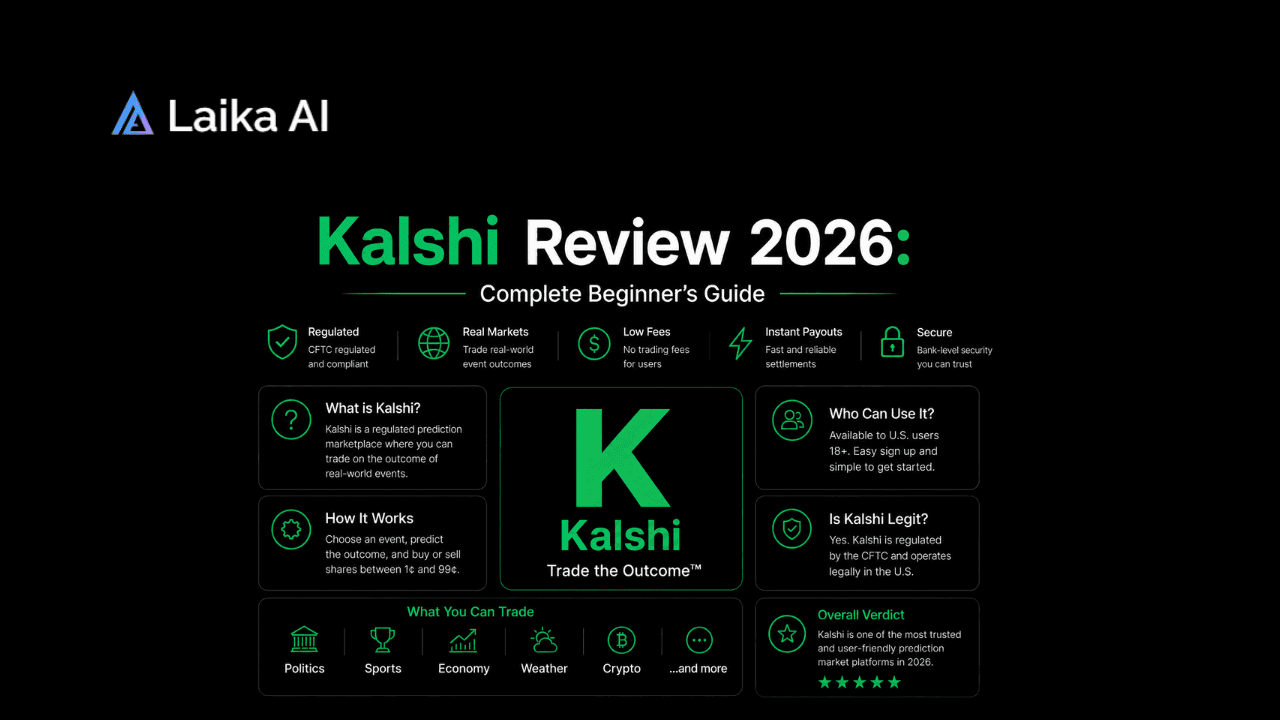
Quick verdict first, since that's what most people actually want before reading a few thousand words: Kalshi is a real, federally regulated exchange, not a scam, and for most people the honest answer to "is Kalshi legit" is yes. Whether it's the right platform for you depends more on what you want to trade and how much you care about things like withdrawal speed and customer support response times, both of which come up a lot in user complaints even though the platform itself is legitimate.
If you're reading this because you just downloaded the app, you're part of a genuinely huge wave. Kalshi's app was downloaded roughly 3 million times in the US in January 2026 alone, more in a single month than DraftKings Sportsbook or FanDuel Sportsbook had ever seen, driven by momentum heading into Super Bowl LX. That's almost certainly why so many people were searching for a Kalshi review that same month: a lot of new users downloading an app they'd never heard of a few weeks earlier, wanting to know what they'd actually signed up for before putting money in. This guide is written for that exact situation.
Is Kalshi Legit?
Yes, and this isn't a hedge. Kalshi is a Designated Contract Market regulated by the Commodity Futures Trading Commission, the same federal body that oversees exchanges like the CME and Nasdaq's futures arm. That means real audits, real rules against insider trading, and real consequences if the company breaks them. It's not an offshore operation running in a legal gray zone.
That said, "legit" and "flawless" aren't the same word, and it would be dishonest to pretend Kalshi has a clean track record on everything. A few things worth knowing before you assume this section is just a rubber stamp
Trustpilot Ratings Remain Low
Trustpilot ratings are genuinely low, hovering somewhere around 2 out of 5 depending on when you check, with slow withdrawals and high fees as the most common complaints. The Better Business Bureau lists Kalshi with an F rating, tied to well over a hundred complaints in the past few years, mostly about unpaid winnings or frozen accounts.
App Store Ratings Tell a Different Story
App store ratings sit around 4.7 on the App Store and 4.5 on Google Play, a real gap worth noticing. People who leave a one-star Trustpilot review after a bad withdrawal experience aren't the same people leaving a quick five-star app rating after a smooth week of trading.
State-Level Legal Challenges Are Ongoing
Washington state sued Kalshi in March 2026, joining more than twenty other civil suits nationally that argue Kalshi's sports contracts amount to unlicensed gambling rather than legitimate derivatives trading. Kalshi disputes this and points to its federal CFTC status as controlling, and so far federal courts have generally sided with that argument, but the legal picture isn't fully settled state by state. For the full current breakdown of where Kalshi operates without restriction, see our guide to Kalshi's legal and supported countries.
Insider Trading Scrutiny and Exchange-Level Oversight
Kalshi has also faced scrutiny over insider trading concerns, common to any exchange dealing in real-world event outcomes where some participants may have earlier access to relevant information than others. In response, the company announced expanded surveillance and enforcement efforts, and CEO Tarek Mansour has pointed to the same enforcement mechanisms used by traditional exchanges like the Nasdaq as the standard Kalshi is held to, since it operates under identical CFTC oversight.
None of this means don't use Kalshi. It means go in with realistic expectations: the regulatory foundation is solid, but the day-to-day support experience gets mixed reviews. Most of the horror stories in those complaint counts trace back to a specific type of situation, a large withdrawal request during a high-volume period, rather than routine account activity. If you ever run into a slow withdrawal yourself, our step-by-step guide on how to withdraw from Kalshi covers what's normal timing versus what's actually worth escalating to support.
How Kalshi Actually Works?
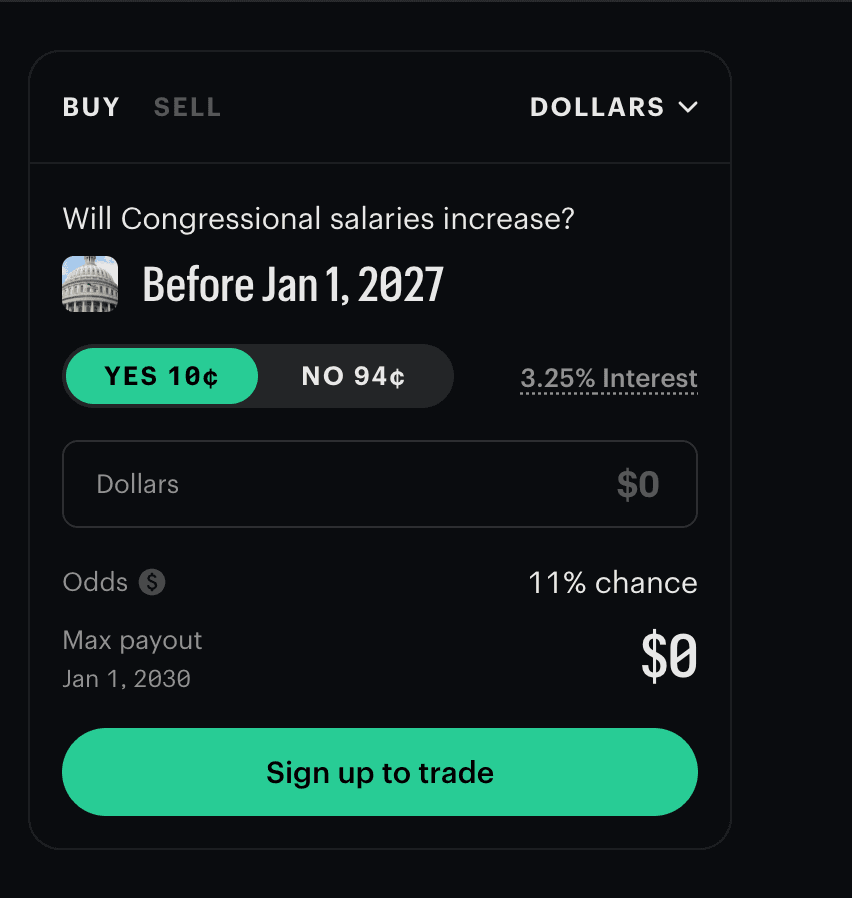
At the core, Kalshi lets you trade Yes or No contracts on the outcome of real-world events. Every contract settles at $1 if you're right and $0 if you're wrong, and the price you pay to buy in, somewhere between 1 cent and 99 cents, roughly reflects the market's collective view of how likely that outcome is. Buy a contract at 30 cents and it settles. Yes, you make 70 cents per contract. Buy it and it settles No, you lose your 30 cents. There's no leverage on the standard product, so you can't lose more than what you put into a given position.
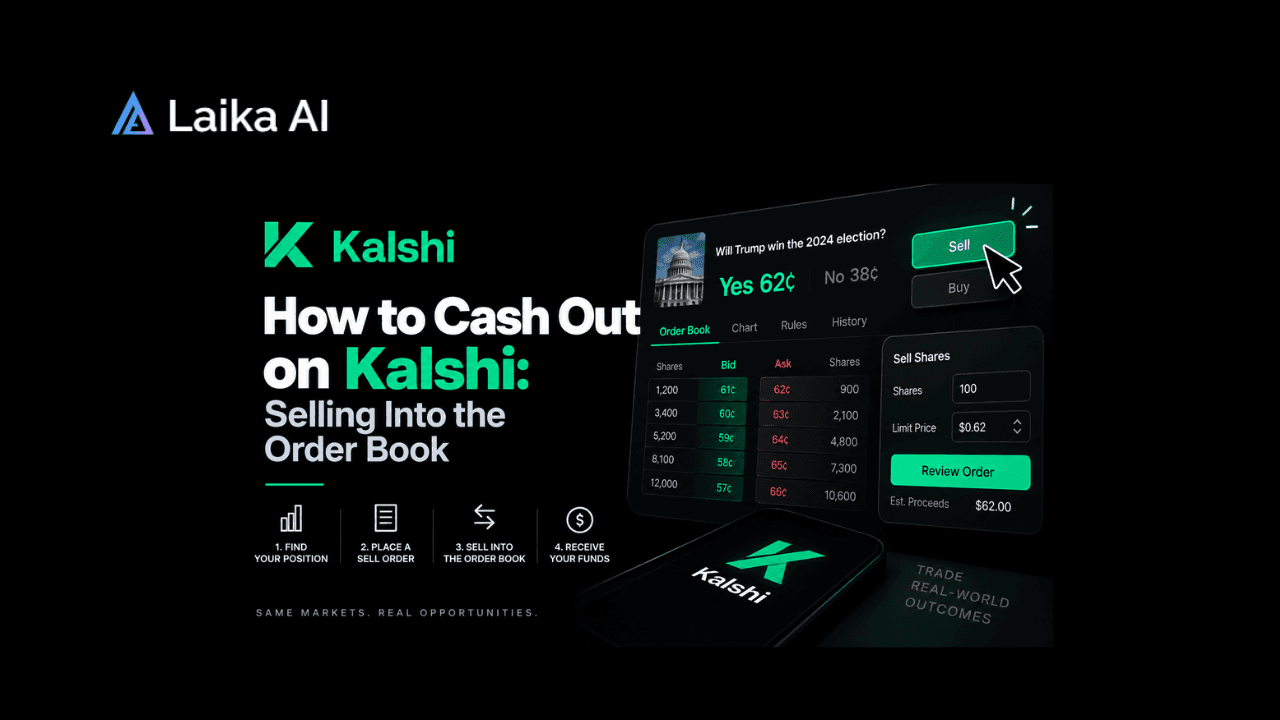
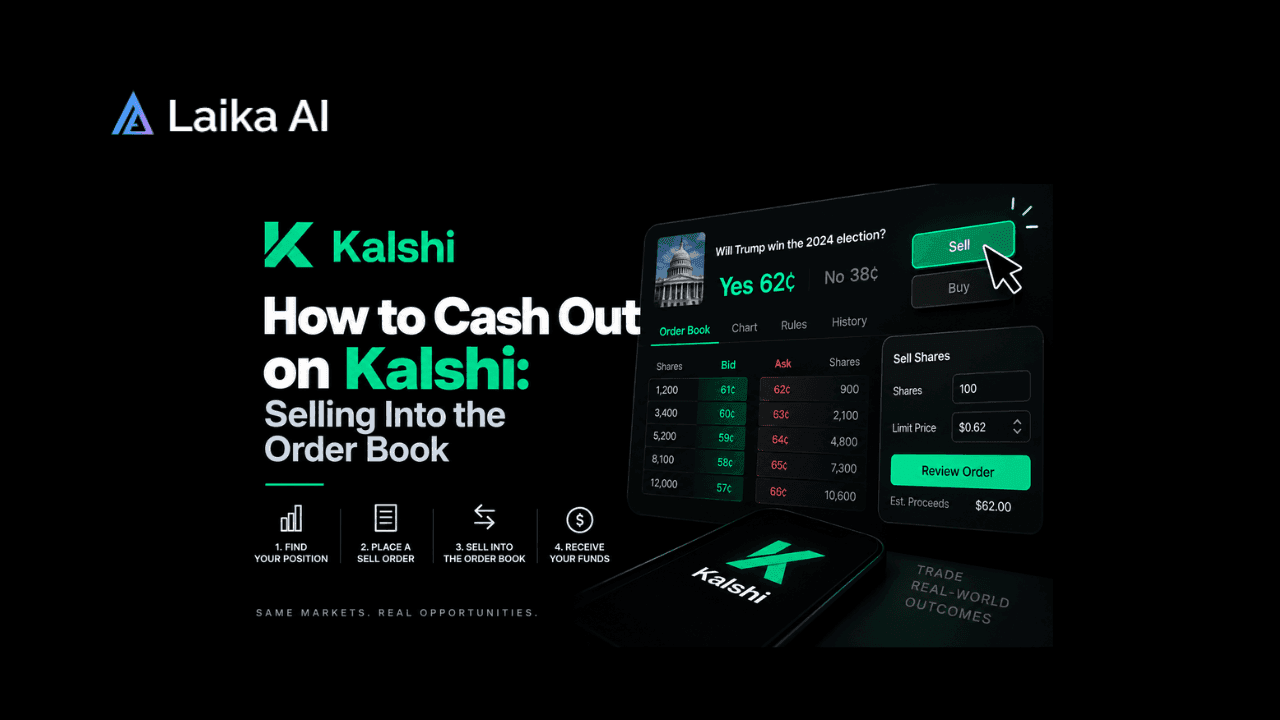
That structure is simple enough to explain in a paragraph, but there's more nuance once you get into order types, market resolution rules, and how Kalshi actually determines a contract's final settlement. Limit orders sit on the book until someone else takes the other side, market orders fill immediately against whatever's currently available, and you can exit a position before it settles rather than holding to the end, which is a detail a lot of first-time users miss. Our full explainer on how Kalshi works goes through all of that in more depth than a review section really should, if you want the complete mechanical picture before you place a first trade.
Kalshi Fees and Costs
Kalshi's fee structure trips up a lot of new users because it isn't a flat number. Trading fees follow a formula tied to the contract's price, roughly 7% of price times the inverse of price, rounded to the cent, which means fees peak around a 50-cent contract and shrink toward either extreme. In practice that tends to land somewhere under 2 cents per contract at the worst case, and often less.
The upside of a price-weighted formula is that it's harder to get overcharged on lopsided contracts than a flat per-trade fee would be. The downside is that it's genuinely less intuitive at a glance than "you pay $X per trade," and it's a common source of the "why did I pay more than I expected" confusion that shows up in reviews. If you're weighing Kalshi's costs against a competitor, our full breakdown comparing Kalshi and Polymarket's fee structures lines both up side by side rather than in isolation, which matters more than either number alone.
The App and Platform Experience
[Image: Kalshi mobile app screenshot, trading screen]
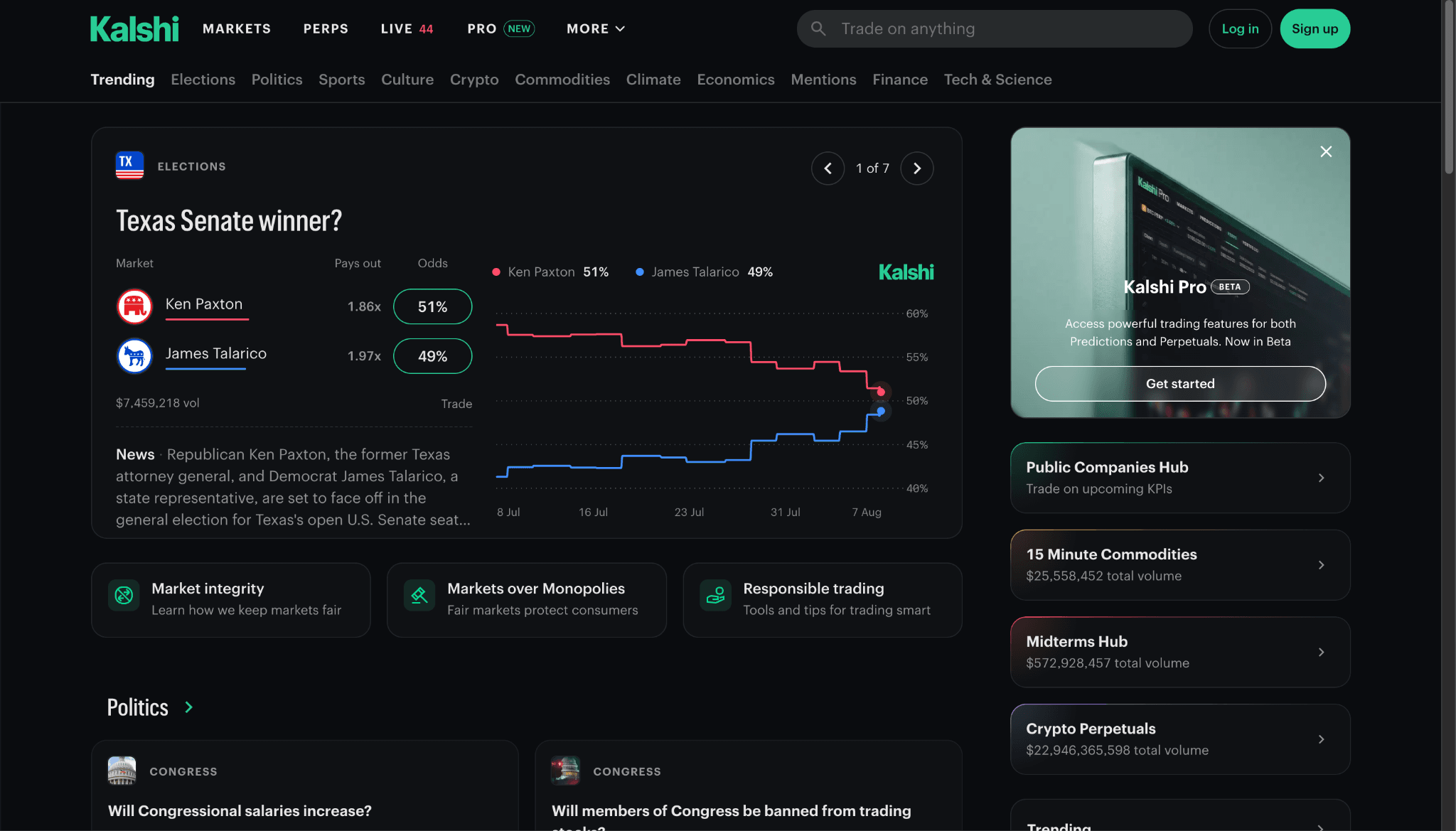
This is genuinely one of Kalshi's stronger points across nearly every review we looked at while researching this piece, including competitors we don't always agree with. The interface is clean, contracts are labeled clearly, and pricing is front and center rather than buried in a menu. It doesn't feel like a spreadsheet wearing a trading app's skin, which is a real complaint about some competitors in this space.
Desktop and mobile are close enough in functionality that switching between them isn't jarring, though heavier order types and combo building tend to be easier on desktop simply because there's more screen real estate to work with. The mobile app handles the basics, browsing markets, placing standard buy and sell orders, checking your position, without much friction.
Where the app experience gets criticized isn't the interface itself, it's what happens when something goes wrong. Multiple app store reviewers describe support chats that get closed without a real resolution, and email responses that take days or, in some cases, never arrive at all. That's consistent with the Trustpilot pattern mentioned earlier: the product itself tests well, the support layer behind it is the weaker link.
What You Can Actually Trade
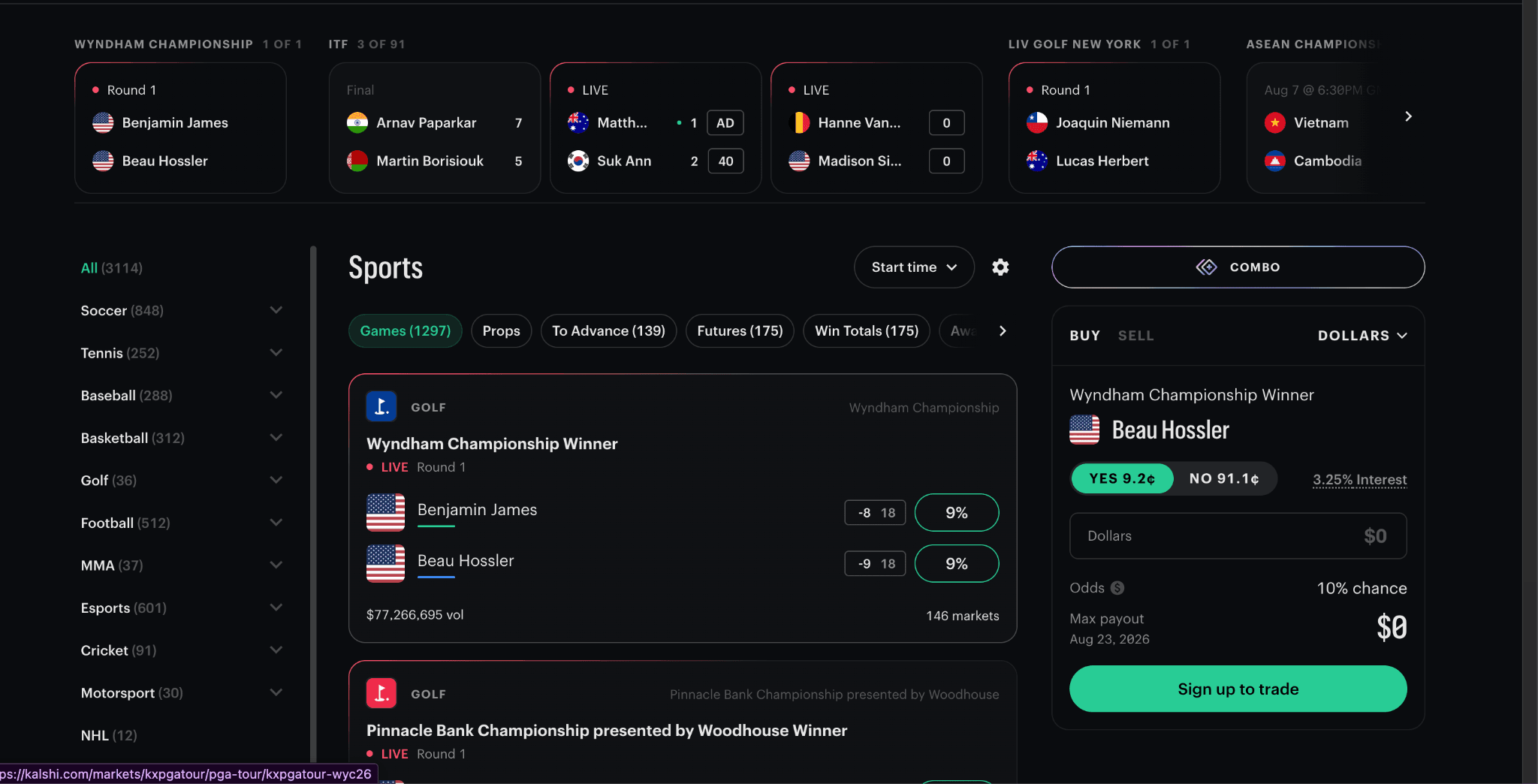
Kalshi's market range has grown considerably, and sports now dominates activity, accounting for more than 90% of trading volume on the platform by some estimates. That's a meaningful shift from Kalshi's earlier identity as primarily a politics-and-economics exchange, and it's worth knowing going in if you assumed otherwise. Categories currently available include:
- Sports (NFL, NBA, NHL, MLB, plus niche categories like darts, motorsports, and rugby)
- Politics and elections
- Economic indicators (Fed rate decisions, jobs reports, inflation data)
- Culture and entertainment (awards shows, entertainment milestones)
- Weather
- Crypto price milestones and financial benchmarks
The sports concentration raises a fair question that shows up constantly in searches: is this just sports betting with different branding? It's a reasonable thing to wonder, especially given how much Kalshi's marketing has leaned into sports over the past year. The short answer is that the CFTC classifies these as derivatives contracts, not wagers, which is the legal distinction the ongoing state lawsuits mentioned earlier are actually arguing about, and the honest answer is nuanced enough that we gave it its own full explainer on whether Kalshi's sports contracts count as gambling, since the short version genuinely doesn't do the legal distinction justice.
Kalshi's Newer Products: Perps, Margin, and Combos
This is the part of Kalshi that's changed the most in the last several months, and it's also where a review like this one can actually add value beyond what a generic finance blog would cover, since these products are newer and less understood than standard Yes/No contracts.
Perpetual futures (Perps)
Kalshi became the first US exchange to offer CFTC-regulated perpetual futures contracts, starting with a Bitcoin perpetual that launched in May 2026 and reportedly cleared more than $5.5 billion in trading volume within its first couple of weeks. Unlike a standard contract, a perp has no expiration date. You hold a long or short position on an asset's price for as long as you want, with a funding rate mechanism keeping the contract price tethered to the spot market. Our full guide on Kalshi's perpetual futures product walks through how funding rates actually work and what the added risk profile looks like compared to a standard event contract.
Margin trading via Kinetic Markets. Kalshi itself doesn't hold the regulatory registrations needed to offer leveraged trading directly, so it operates through a separate but closely affiliated entity called Kinetic Markets, registered with the NFA as both a futures commission merchant and a swap firm. Kalshi holds at least a 10% stake in Kinetic, and its co-founders are listed as indirect owners, so it's fair to think of margin trading as a Kalshi-adjacent product rather than something bolted on by an unrelated third party. Our deeper explainer on Kalshi's margin trading and Kinetic Markets setup covers exactly how that relationship works and what it means for account holders.
Combos
Kalshi doesn't officially call these parlays, but functionally, that's what they are: bundling multiple event outcomes into a single trade, where every leg has to resolve in your favor for the full payout. A built-in combo builder makes assembling these fairly painless in the app. Worth flagging honestly here, since it's relevant to a review and not just a features list: data on combo trading shows these bets get priced at far lower true probabilities than standard contracts, averaging under 10% likelihood versus over 40% for non-combo markets, which mirrors exactly why sportsbooks push parlays so heavily. They're fun and can pay out big, but they're a meaningfully worse expected-value trade than trading legs individually. If multi-leg trading interests you beyond just Kalshi's version of it, our broader guide to prediction market parlays and how multi-leg contracts work covers the mechanics across platforms, not just this one.
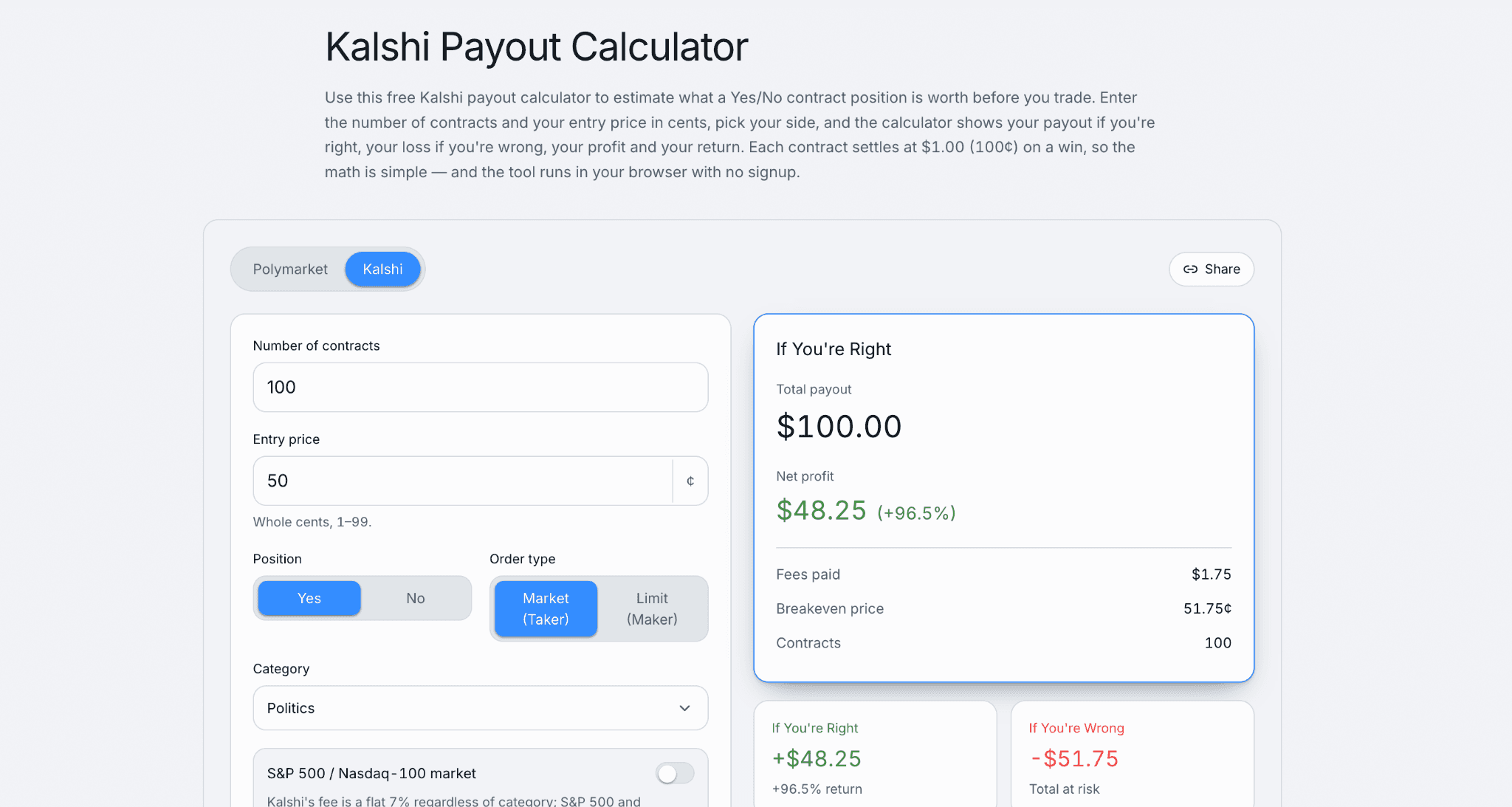
Try the Kalshi Payout Calculator for free →
Who Kalshi Is Actually Built For
Kalshi makes the most sense if you're a US-based trader who wants a straightforward, no-leverage way to take a position on real-world outcomes, with a genuine regulatory backstop behind the platform rather than an offshore promise. It's also a solid fit if sports contracts are your main interest and you want that activity happening through a CFTC-regulated exchange instead of a traditional sportsbook.
It's a worse fit if you're outside the US and looking for equivalent access, since availability varies significantly by country, or if you're specifically looking for the deepest possible liquidity and widest contract variety, where a platform like Polymarket currently has an edge on non-sports categories. It's also not the platform for you if fast, friction-free customer support is a priority, based on the pattern in user reviews above, or if you're someone who trades heavily in political and economic markets specifically, since sports has increasingly become the platform's center of gravity rather than a side category. For a full side-by-side on how the two platforms actually compare rather than just picking one, our complete Kalshi vs Polymarket comparison breaks it down by fees, depth, and regulatory footprint.
The Bottom Line
Kalshi is legitimate, federally regulated, and genuinely well-built as a product. The complaints that show up repeatedly, slow support and inconsistent withdrawal experiences, are real and worth taking seriously, but they're operational friction rather than evidence of anything close to a scam. If you're trading with money you can afford to have tied up for a few extra days in a worst-case scenario, Kalshi is a reasonable, well-regulated place to do it. If you want a second opinion on whether your specific trade actually makes sense once you're in, comparing Kalshi's pricing and depth against other platforms is exactly what Polymetric is built to help with, so you're evaluating an edge rather than just trusting the first number you see.
Frequently Asked Questions
Is Kalshi legit?
Yes. Kalshi is a Designated Contract Market regulated by the CFTC, the same federal regulator overseeing major US futures exchanges. It's subject to audits and enforcement rules, which puts it in a fundamentally different category than an unregulated offshore platform, even though user reviews on support and withdrawal speed are mixed.
What are people saying about Kalshi on Reddit?
Kalshi review threads on Reddit skew more positive than Trustpilot, with users generally discussing strategy and results rather than venting about frozen funds. Reddit sentiment tends to focus on liquidity in specific markets and fee mechanics more than legitimacy questions, which most threads treat as settled.
Is Kalshi legit and safe to use?
Yes, in the sense that matters most: your funds sit in segregated accounts under federal oversight, and trades are fully cash-collateralized, meaning you can't lose more than you put in on a standard contract. Safety concerns that do come up tend to be about withdrawal timing and support responsiveness rather than fund security itself.
Is Kalshi legal and legit in the USA?
Kalshi holds federal approval nationwide, though sports-related contracts specifically face ongoing legal challenges in a handful of states that argue they function as gambling. The federal regulatory status itself isn't in question; the sports carve-out in certain states is the part still being litigated.
What does the Kalshi app review look like?
Across most independent reviews, the Kalshi app review pattern is consistent: strong marks for a clean, intuitive interface with clear pricing, and weaker marks for customer support responsiveness when something goes wrong. App store ratings sit around 4.7 on iOS and 4.5 on Android, notably higher than Kalshi's Trustpilot score.
Is Kalshi good for beginners?
Reasonably, yes. The core Yes/No contract structure is easy to grasp, there's no leverage on standard trades so you can't lose more than you commit, and the interface doesn't require much of a learning curve. The fee formula and the sheer amount of sports-driven noise on the platform are the two things beginners tend to find confusing at first.