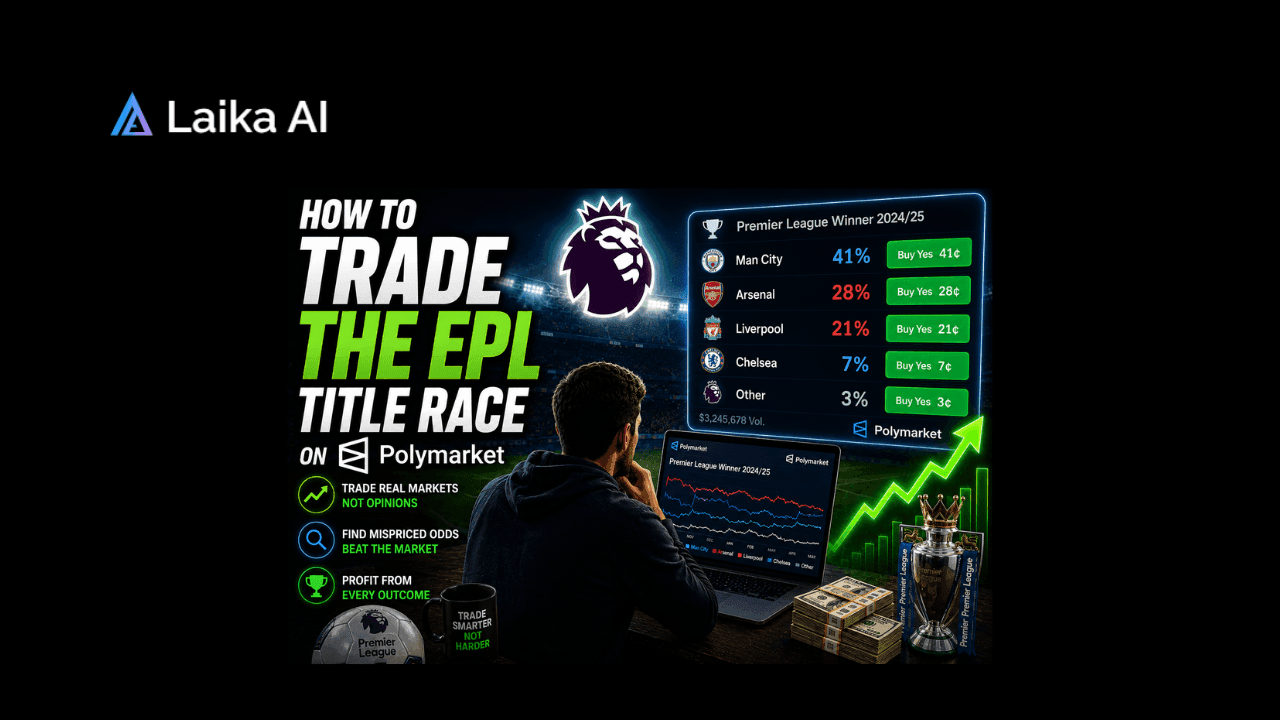
The polymarket Premier League title market is one of the most interesting long-duration sports contracts on the platform, and one of the most consistently mispriced. A 38-game season played across nine months creates more information update cycles than almost any other sports market on Polymarket, which means more repricing events, more entry windows, and more opportunities for a statistically grounded trader to find gaps between market price and true probability.
The EPL title race is also a different trading instrument from match betting in a way that matters before you commit capital to it. When you trade a Premier League prediction market on Polymarket, you are not trading a single game outcome. You are trading a probability that compounds across 38 rounds of fixtures, injuries, managerial decisions, and table dynamics. The price you see on Manchester City or Arsenal in August is the crowd's estimate of championship probability before any of that information exists. The price in February reflects nine months of accumulated data. The edge available in each phase of the season is completely different.
For the foundational framework on how long-duration sports markets work across the full Polymarket ecosystem, the complete guide to trading sports markets on Polymarket covers the structure before going into EPL-specific tactics.
Discover where the market is moving before the headlines. Browse live prediction markets, track real-time odds, and trade on sports, crypto, politics, and breaking global events, all in one place.
Explore Live Prediction Markets
How Polymarket Prices the EPL Title Race and Where Inefficiencies Appear
The Polymarket EPL title market is a categorical prediction market with one contract per realistic title contender. Each contract is priced as the implied probability of that team winning the Premier League. All contracts across all teams sum to approximately 100%, reflecting the constraint that exactly one team wins the title each season.
Before the season opens, prices reflect three inputs: historical title-winning base rates, preseason squad assessment, and any significant summer transfer activity. These inputs produce the opening market, which is the price least supported by actual performance data and therefore the most vulnerable to systematic mispricing.
Where inefficiencies appear most reliably
The EPL title market has four specific windows where prices consistently diverge from true probability in ways that a statistically prepared trader can exploit.
The early-season overreaction window occurs in September and October when teams that open the season with strong results see their title probability spike above what the underlying data supports. The sample size problem is acute in the Premier League's early weeks. Three consecutive wins against favorable opposition can push a team from 8% implied probability to 22% within a month, even though the expected points table and underlying performance metrics have not changed meaningfully. Markets that are pricing early-season results rather than underlying performance indicators are offering exploitable positions in both directions.
The fixture swing window occurs in December and January when the congested fixture schedule creates short-term table movements that do not reflect season-long quality. A title contender who plays three games in nine days over Christmas against difficult opponents may slip five points behind the leader and see their probability contract sharply. If their underlying expected goals and defensive performance metrics remain consistent with title-winning levels, that price contraction is almost always temporary and tradeable.
The injury news window is the fastest-moving inefficiency in the EPL title market. When a key player for a title contender suffers a significant injury, the immediate market reaction overshoots the true impact on championship probability. Polymarket reprices within hours of injury news breaking. The crowd anchors on the worst-case scenario for the injured player's absence. Markets where the initial repricing has gone further than the statistical impact of the specific player's absence justifies are consistently tradeable in the direction of the team whose probability has been excessively punished.
The late-season compression window occurs in March and April when the title race narrows to two or three teams and the probability gap between contenders compresses. At this stage the market becomes more efficient because the remaining fixture list is known, the squad depth is visible, and the points gap to be closed is mathematically definable. The edge here is smaller than in earlier windows but the positions are easier to size because the uncertainty range has narrowed significantly.
For the framework on how Polymarket prices are constructed as probability estimates and what the price you see actually represents, Polymarket explained: how prediction markets work covers the complete mechanics. For the parallel framework applied to the highest-volume sports market of the year, World Cup 2026 live trading on Polymarket covers how live repricing works in real time.
Using expected points to calibrate fair value
The most reliable quantitative input for EPL title market analysis is expected points, or xPTS, which converts a team's expected goals data from every game into the points total their underlying performance deserved rather than the points they actually accumulated. xPTS data is available through understat.com alongside expected goals metrics for every team and every game in the Premier League going back multiple seasons.
A team whose actual points total is five points below their xPTS figure is almost certainly underpriced in the title market, because their actual table position does not reflect their true performance level. A team whose actual points total is five points above their xPTS figure may be overpriced because they have been outperforming their underlying performance metrics in ways that are unlikely to sustain across 38 games.
The divergence between actual points and xPTS is the single most reliable indicator of mispricing in the EPL title market, and it is systematically ignored by the retail crowd because it requires more analytical work than simply looking at the table.
A Season-Long Strategy for EPL Title Trading
Trading the EPL title market profitably across a full season requires treating it as a portfolio management problem rather than a single trade decision. The optimal approach involves multiple entry windows, active position management as new information arrives, and deliberate hedging when your core position approaches near-certainty.
Phase 1: Pre-season positioning (July to August)
The pre-season window is the highest-risk and highest-potential-reward entry point. Prices reflect squad assessment and historical base rates rather than any actual performance data, which means the variance around true probability is at its maximum. The correct position size is small: 1 to 2 percent of your sports trading budget on any single team at this stage.
The pre-season edge opportunity comes from identifying teams where the market is anchored to last season's narrative rather than current squad quality. A team that finished third last season but has made significant targeted improvements in the areas where their expected goals data showed weakness may be underpriced relative to their true title probability. A team that won the title on the back of unsustainable shot conversion rates from outside the box may be overpriced if their squad has not addressed the underlying xG deficit.
Preseason transfer activity is the primary information input at this stage. Assess transfers not on headline fee or player reputation but on whether they address specific statistical weaknesses identified in the previous season's data.
Phase 2: Early-season calibration (September to November)
By September, six to eight games of actual data are available. xPTS figures are beginning to stabilize. Defensive expected goals against data is showing whether preseason defensive improvements have materialized. The market is beginning to price actual performance but is still heavily influenced by early-season table position.
This is the window to make your primary title market allocation based on the divergence between xPTS and actual table position. Teams that are underperforming their xPTS due to poor finishing or bad luck on set pieces are underpriced. Teams that are overperforming their xPTS through high conversion rates are overpriced. The market has not yet made these adjustments because retail traders are anchoring on the table.
Add to your position on underpriced contenders and fade overpriced ones in this window. The expected points regression typically begins to show up in actual results by November, which is when the market will reprice in the direction your analysis suggested in September.
Phase 3: Mid-season management (December to February)
The December to February period is where active position management generates the most value. The congested fixture schedule, winter transfer window, and managerial sack cycles create rapid table movements that often temporarily reprice title contenders away from their true probability.
When a team you are long on slips three points behind the leader over a difficult December fixture run, the market will contract their price. If your xPTS analysis suggests their underlying performance has not changed, the contraction is a buying opportunity to add to your position at a lower price before the market corrects.
The winter transfer window creates the year's second major information event after summer transfers. Assess January signings with the same framework as summer signings: does the acquisition address a specific statistical weakness identified in the current season's xG data, or is it a narrative-driven signing that looks better in a press release than in the underlying numbers?
Phase 4: Late-season management (March to May)
As the title race narrows to two or three teams with the fixture list fully visible, the strategy shifts from finding mispricing to managing existing positions. The expected value of continuing to hold a winning position decreases as probability compresses toward certainty, and the risk-reward of full holds through to resolution deteriorates.
When your long position moves from $0.35 to $0.70 as a team builds a commanding lead, you are risking $0.70 to make $0.30 on an outcome that still has some uncertainty. Partial exits that lock in 60 to 70 percent of the realized gain while maintaining some exposure to the remaining probability are the correct position management approach at this stage. For the Polymarket arbitrage: how to find price gaps framework that applies specifically to late-season EPL title market inefficiencies, the methodology covers cross-contract gaps that appear as the race narrows.
For the complete framework on position sizing, partial exit mechanics, and bankroll management across season-long prediction market positions, the prediction market bankroll management guide covers the methodology in full.
Common Mistakes in EPL Title Market Trading
Mistake 1: Over-weighting early-season table position
The most expensive mistake in Premier League prediction market trading is adjusting position sizes significantly based on the table after six games. Six games of Premier League football produce enough variance that the table tells you almost nothing about true title probability that the preseason analysis had not already suggested.
Manchester City finished a full season in fifth place one year despite being the best team in the league on expected goals metrics because their shot conversion rate was historically low. A retail trader who adjusted their City position downward based on the early-season table would have missed the entire subsequent reversion to mean.
The rule: do not make significant position adjustments based on table position until at least twelve games of data are available and the xPTS figure has had time to stabilize around the team's true performance level.
Mistake 2: Ignoring market depth on secondary contenders
The EPL title market on Polymarket concentrates its volume on the top two or three title favorites. The fourth and fifth-placed contracts in probability terms often have significantly thinner order books, which creates two problems for traders who want to take positions on dark horse contenders.
First, entering a position on a thin contract moves the price against you before you have finished building your position. A 5 to 8 cent spread on a contract where your expected edge is 10 percentage points consumes most of the available value before the market has even moved. Second, exiting a position on a thin contract when the market has moved in your favor requires finding buyers who may not exist at the price you want.
Check order book depth before entering any EPL title position outside the top two or three favorites. If the depth is insufficient to support your target position size without significant slippage, reduce the size or skip the market entirely regardless of how attractive the price appears.
Mistake 3: Failing to account for the points-per-game compounding effect
Small differences in expected points per game compound dramatically over a 38-game season in ways that the linear price adjustments in the EPL title market often fail to reflect. A team that is running at 2.1 expected points per game rather than 1.9 expected points per game will finish the season with four additional expected points, which can be the difference between winning the title and finishing second.
Markets that price expected-points-per-game differences of 0.2 or 0.3 as negligible in September are systematically mispricing the cumulative effect of those differences over the full season. Identifying teams where small but statistically meaningful performance differences are being underweighted in the early-season market price is the most consistent analytical edge in EPL title trading.
Mistake 4: Treating managerial change as uniformly negative
When a title contender sacks their manager, the immediate market reaction is almost always a price contraction for that team. The crowd treats managerial instability as a negative signal. In some cases, particularly when the replacement manager is a demonstrably strong tactical operator and the underlying squad quality has been underperforming in the previous manager's system, a managerial change is actually a positive catalyst.
A team whose underlying xG data shows high-quality chances being wasted due to tactical misuse of players has significant upside from a managerial change that addresses those tactical problems. The initial price contraction after a managerial sacking is often an entry opportunity rather than a confirmation of decline.
Frequently Asked Questions
Does Polymarket have Premier League title markets?
Yes. Polymarket runs an EPL title winner market that opens before the season starts and resolves when the Premier League officially crowns the champion, typically in May. The market includes contracts for all realistic title contenders priced as individual implied probability contracts. Check the live markets at polymarket.com for the current active contracts and pricing on the 2026 to 2027 season.
How are EPL title odds priced on Polymarket?
EPL title contracts are priced between $0.01 and $0.99, with each price representing the market's implied probability of that team winning the Premier League. All team contracts across the market sum to approximately $1.00. Prices are set by the aggregate of all buy and sell orders on the platform's central order book, not by a house or algorithm. The price updates continuously as traders enter and exit positions in response to new information including match results, injury news, and transfer activity.
What is the best strategy for trading the Premier League title race on Polymarket?
The most consistently profitable approach combines preseason positioning based on squad quality assessment and xPTS analysis, early-season additions when the xPTS-to-actual-points divergence identifies underpriced contenders, active management through fixture swings and injury news windows in December through February, and partial exits in the late season when your winning positions have moved toward near-certainty and the remaining risk-reward does not justify full holds. On polymarket EPL markets specifically, the xPTS divergence trade in September and October is the highest-quality systematic edge available across the full nine-month season.
Can US users trade Premier League markets on Polymarket?
Yes. Polymarket US launched in December 2025 under CFTC oversight and Premier League title markets are accessible to US residents in eligible states. Nine states have active restrictions: Arizona, Illinois, Massachusetts, Maryland, Michigan, Montana, New Jersey, Nevada, and Ohio. US users outside those states have full access to EPL title markets. For deeper liquidity on the international platform, US users comfortable with USDC on the Polygon blockchain can access the global platform where EPL title market volume is higher. On polymarket Premier League reddit, the prediction markets subreddit carries active discussion of EPL title market positioning and xPTS analysis during the season.
The Bottom Line
The polymarket Premier League title market rewards a specific type of analytical work that the retail crowd is not doing: comparing xPTS figures to actual table position, identifying preseason squad improvements that address specific statistical weaknesses, and managing positions actively through the fixture swings and injury news cycles that temporarily reprice title contenders away from their true probability.
The nine-month season creates more information update cycles than any other sports market on Polymarket, which means more entry windows and more opportunities for statistically grounded analysis to generate edge. Early-season overreactions to small samples, mid-season fixture congestion repricing, and injury news overshooting are the three most reliable mispricing patterns, and they appear in roughly the same windows every season regardless of which specific teams are competing for the title.
The traders who consistently extract value from EPL title markets are not the ones who pick the right winner in August and hold to May. They are the ones who identify and trade the mispricing windows throughout the season, manage positions actively as the information environment changes, and use xPTS data to maintain a statistically grounded view of true probability even when the table and the media narrative are pointing in a different direction.
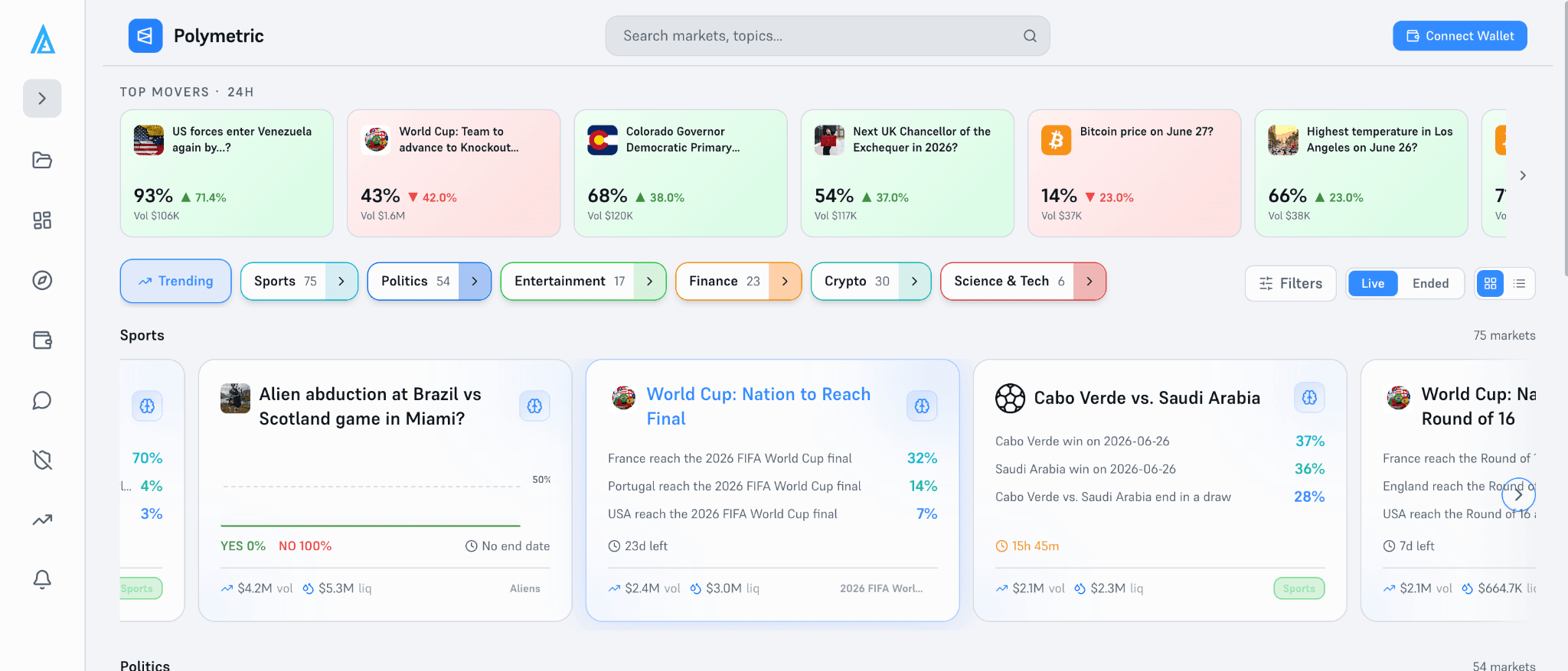
Track how Premier League title market prices move in real time across every active Polymarket contract with Polymetric by Laika AI. Live market intelligence for traders who want to see the statistical edge windows before the crowd closes them.