The 2026 FIFA World Cup starts June 11 and the polymarket FIFA world cup winner market has already crossed $1.2 billion in trading volume before a single game has been played. That number is not just a record for soccer prediction markets. It is a record for any sports prediction market on any platform. Knowing how to trade FIFA world cup prediction markets on Polymarket is not the same as knowing who will win. It is knowing which markets to enter, when to enter them, how to seize positions across a 48-team tournament that runs six weeks, and how to manage live positions as results reshape the entire market in real time. Within the broader polymarket sports markets guide ecosystem, the World Cup is the single largest event of 2026 by volume and by the number of distinct trading opportunities it creates.
This guide covers every market type currently active, phase-by-phase strategy from group stage through the final, entry timing, position management, and where the edge actually lives across the tournament's distinct phases.
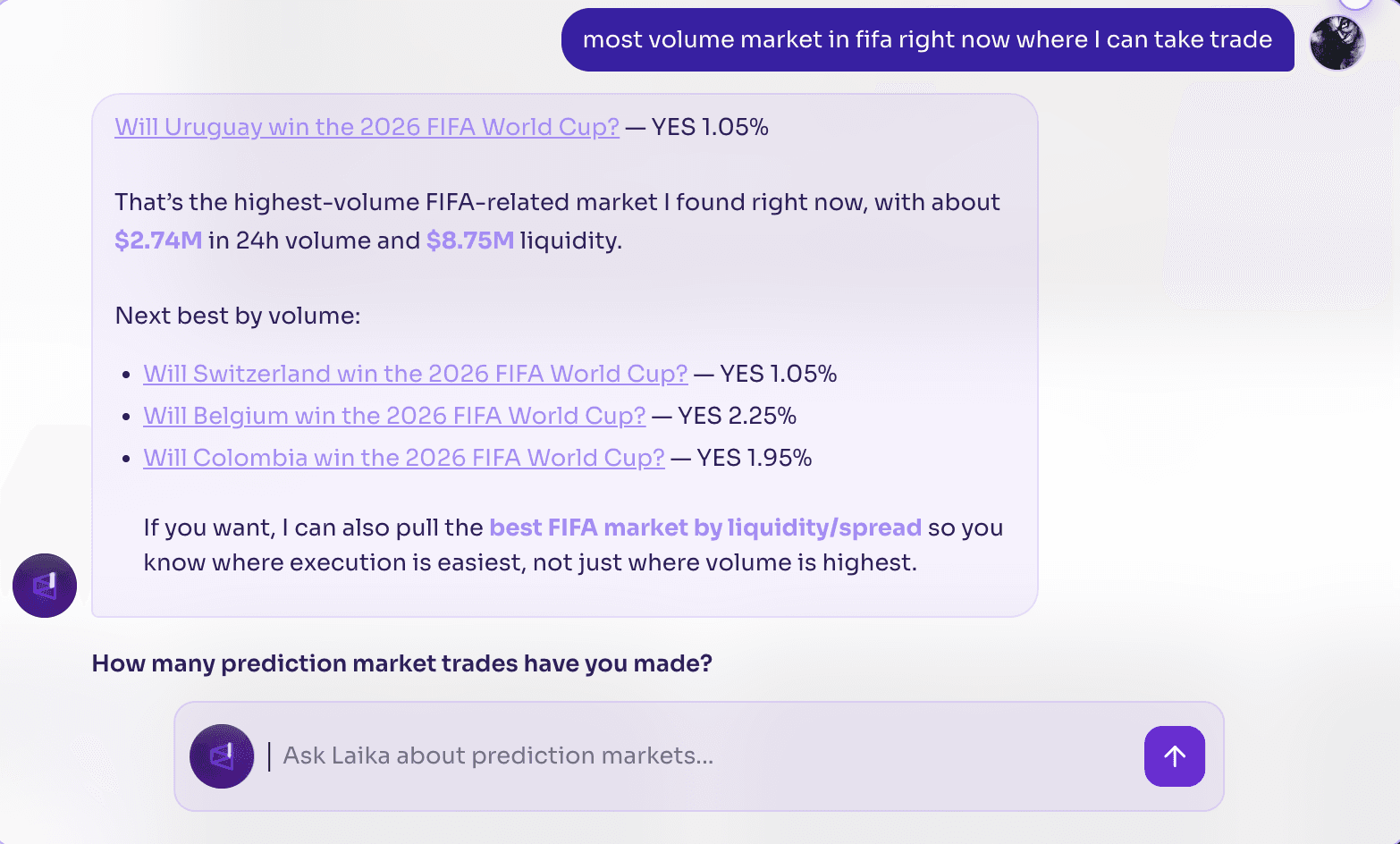
Millions of dollars are already positioned on the 2026 FIFA World Cup. Discover the highest-volume markets and where traders are finding opportunities before the crowd.
What World Cup Markets Are Currently Active on Polymarket
Before building a trading strategy, understanding the full market menu is essential. Most traders know about the winner market. Polymarket currently hosts 100 active World Cup markets across five categories, and each one requires a different approach.
Outright winner market
The flagship. $1.2 billion in trading volume with France and Spain currently priced as co-favourites. Resolves after the final on July 19, 2026. The most liquid sports prediction market on any platform anywhere. For a full breakdown of the current winner market odds and how they compare across platforms, best polymarket world cup 2026 markets covers every active contract.
Group stage winner markets
Twelve group winner markets, one per group, resolving around June 27. The fastest resolution of any World Cup market category. England leads Group L at 73%, Belgium leads Group G at 68%, Netherlands leads Group F at 56%. These markets close within the first two weeks of the tournament and return capital faster than any other World Cup contract.
Knockout round markets
Individual game markets for the Round of 32, Round of 16, quarter-finals, semi-finals, and the final. These open as the bracket forms and generate the highest single-game volumes of the entire tournament. They do not exist yet but will dominate trading activity from late June onwards.
Player award markets
Golden Boot, Golden Ball, and Golden Glove contracts. The Golden Boot market is among the most actively traded award contracts on the full World Cup page. Mbappe leads at +600 with Kane at +700 on sportsbook lines. For the full player-by-player Golden Boot analysis including the Raphinha platform divergence, the Polymarket World Cup Golden Boot Market covers the complete breakdown.
Special props
Binary yes/no contracts on tournament milestones: will Messi play, will the tournament produce an unbeaten champion, will there be a first-time winner. Lower liquidity but the crowd rarely has an edge on these, which is why they occasionally misprice.
Understanding how these prices are formed and what they actually represent as probabilities is covered in how to read polymarket sports odds. For the full comparison of how polymarket world cup 2026 prices diverge from sportsbook lines and where those gaps are currently widest, polymarket world cup odds vs sportsbooks covers the methodology.
Pre-Tournament Phase: Now Until June 11
This is the phase you are in right now. The window closes when France plays their first group game.
The pre-tournament phase is when the polymarket FIFA world cup winner market is least efficient relative to the information that will exist after June 11. Prices reflect squad announcements, historical tournament form, and qualifying results. They do not yet reflect actual tournament performance.
What to do in this phase
The winner market entry decision is binary: either you have a directional view based on pre-tournament analysis or you do not. If you do, enter before June 11. After the first round of group games, prices on surviving favourites will have already moved based on actual results. The pre-tournament edge disappears the moment the first game is played.
The specific angles worth examining before kickoff.
Squad fitness and injury news moves Polymarket prices within hours of publication. The Lamine Yamal hamstring injury that created a brief dip in Spain's price before his expected availability was confirmed is the clearest 2026 example. Tracking official team injury reports and confirmed squad selections in the days before June 11 is the last clean information window before the broader crowd catches up simultaneously on June 11.
Group stage markets are live right now and closing in days. England at 73% for Group L, Belgium at 68% for Group G, Netherlands at 56% for Group F. If any of these look mispriced based on your read of the specific group difficulty, the window to act is measured in days, not weeks. These markets resolve by June 27 regardless of what happens in the knockout rounds, which means you get capital back fast and can redeploy into knockout markets with confirmed bracket information.
The Golden Boot pre-tournament entry window is also closing. After a player scores two or three group stage goals, their price compresses rapidly. Mbappe, Kane, and Vinicius Jr at their pre-tournament prices have not yet been adjusted by actual tournament performance. That adjustment begins June 12.
Group Stage Phase: June 11 to June 27
The group stage is the most active trading period by number of markets. Every group game generates a match winner market. Group stage winner markets reprice dramatically after each matchday. The 48-team format creates 12 groups instead of 8, which means more groups where the outcome is genuinely uncertain and more repricing events than any previous tournament.
How the polymarket world cup group stage markets behave
After Matchday 1, the probability landscape shifts significantly. A traditional favourite that loses their opening game sees their group winner probability collapse and their tournament winner probability drop simultaneously. The redistribution from that collapse is where the first major trading opportunity of the tournament lives.
The redistribution follows media narrative, not team quality. In the 24 to 48 hours after a major group stage upset, the team that caused the upset absorbs less probability than its actual remaining tournament chances justify because the crowd is still focused on the narrative of the fallen favourite. That underpricing of upset survivors is the most consistent edge in group stage trading.
The Matchday 3 tactical market
The final round of group games creates a specific situation: teams that have already qualified or been eliminated play with different tactical objectives than teams fighting for their lives. A team that has clinched first place may rest key players. A team that needs a specific result may play unusually high-risk. These tactical realities reprice Polymarket group stage markets in real time as team news and lineup information emerges on game day, often before the broader crowd has processed the tactical implications.
Managing the Golden Boot position during the group stage
This is the phase where Golden Boot market positions become most dynamic. A player who scores in all three group games sees their probability triple or quadruple. If you entered the pre-tournament, this is when you decide whether to exit into the group stage or hold through the knockout rounds. The correct decision depends on your player's team knockout prospects. A player from a team eliminated in the group stage has no further scoring opportunities regardless of their group stage tally.
Knockout Phase: Late June Through Semi-Finals
The knockout phase changes the market dynamic entirely. Each game is elimination, which means each result eliminates a team's probability across both the group stage markets that have already been resolved and the ongoing winner and conference-equivalent futures markets. The pace of information compression accelerates with each round.
Round of 32 and Round of 16
This is the new round that did not exist in previous World Cups. The 48-team format's Round of 32 creates an additional elimination layer before the traditional Round of 16. For traders, this adds one more repricing event before the bracket fully narrows. Teams that were priced at 3 to 5% as dark horses entering the tournament either confirm or destroy that thesis in the Round of 32.
The edge in these early knockout rounds is in the injury report window. Teams play every four to five days in the knockout rounds. Recovery information, lineup confirmations, and practice participation reports emerge in the 48 hours before each game and move Polymarket prices faster than sportsbook lines adjust. That gap, narrow in time but real in magnitude, is where informed traders extract value from the knockout round game markets.
Quarter-finals and semi-finals
By the quarter-finals the winner market has narrowed to eight teams and then four. Prices compress toward certainty on the top contenders. New entry positions become increasingly capital-inefficient because the remaining upside on any team priced above 30% is smaller than the binary downside of a single loss. This is the phase where partial exits on pre-tournament positions locked in early make more sense than new entries at elevated prices.
The Golden Boot market also enters its most volatile phase here. Leading scorers from teams that are eliminated see their Golden Boot probability collapse to near zero. Leading scorers from teams advancing see their probability spike as remaining scoring opportunities multiply. The tiebreaker mechanic, fewer minutes played if multiple players finish level on goals, also becomes live as a consideration. Monitoring which contenders are being rested or substituted early has real pricing implications for the resolution outcome.
The world cup 2026 prediction market strategy for the knockout phase
Three specific actions for this phase. First, assess whether existing winner market positions have reached the point where remaining upside does not justify continued full exposure. Partial exits that lock in profit while maintaining Finals upside is how experienced traders manage compressed positions. Second, enter knockout round game markets in the injury report window on the day before each game rather than at the 48-hour volume spike when the market is most efficient. Third, monitor the Golden Boot race for tiebreaker implications as the field narrows to two or three realistic candidates.
Final Phase: Semi-Finals Through July 19
By the semi-finals the winner market reflects near-maximum efficiency. Four teams, each with a real path to the final, priced by one of the most liquid and most informed prediction market audiences ever assembled on a single event. New entry on the winner market at this stage means paying for confirmation rather than edge.
Where the edge moves in the final phase
The edge does not disappear in the final phase. It migrates. From the winner market to three specific categories.
Knockout round game markets. Each semi-final and the final each generate their own game markets with volumes exceeding anything from the group stage. The semi-final game markets are where the highest single-game volumes of the entire tournament will concentrate. The injury report window before each semi-final and the final is the most valuable remaining information edge in the entire six-week tournament.
Golden Boot markets. The race typically narrows to two or three players by the semi-final stage. A tightly contested race where two players are level on goals entering the semi-final creates genuine pricing inefficiency around who plays more minutes in the remaining games. The minutes tiebreaker is still underpriced by most traders at this stage.
Props and specials. The halftime performer market and any remaining binary props attract casual money in the week before the final. Casual money creates pricing inefficiencies on contracts where resolution criteria are clearly defined but the crowd has not read them carefully. Reading the full resolution criteria before entering any special contract in the final week is the prerequisite for extracting value from this category.
How to Manage Live Positions Across the Tournament
Managing a World Cup position is different from placing a single game bet. The tournament runs for six weeks. Prices change every day. Every result reshapes the entire market simultaneously. Position management discipline determines outcomes more than entry timing on any individual market.
The exit mechanic is your primary risk management tool
Unlike a sportsbook futures bet that locks you in until July 19, Polymarket positions can be sold at any time at the current market price. A France position entered at 17% that moves to 28% after two strong group games can be partially exited at 28% to lock in profit while maintaining exposure to further upside. That partial exit converts an unrealized gain into realized profit without abandoning the position entirely.
The correct use of partial exits is not to predict when a position has peaked. It is to manage the binary risk of a single bad result destroying an otherwise profitable position. A team at 35% entering the quarter-final that loses goes to 0%. Selling half the position at 35% before the quarter-final ensures that even a loss recovers substantial value from the pre-tournament entry.
Correlation across positions
If you hold France in the winner market and also enter France in a specific knockout game market, your total France exposure is the sum of both positions. A loss compounds across both simultaneously. Track your total exposure to each team across all market types, not just the individual contract you are looking at when entering.
The 48-hour rule for new entries
In the knockout rounds, the market is most efficient in the 48 hours before kickoff when volume peaks and casual money has already moved prices toward fair value. New entries in this window mean paying near-fair value for a binary event. The best entries across all knockout round game markets are in the injury report window 24 to 72 hours before kickoff, before the volume spike, when real information is available but the crowd has not yet fully processed it.
For the full entry timing framework across tournament phases, how to time your Polymarket entry builds the complete structure. For identifying specific market inefficiencies systematically, how to find mispriced markets on Polymarket covers the methodology. The predictable crowd errors that repeat across every major tournament, recency bias after group stage results, narrative anchoring after upsets, underweighting of injury severity, are all documented in common biases in prediction markets.
Frequently Asked Questions
How do you trade the World Cup on Polymarket?
Trading the World Cup on Polymarket involves buying YES or NO contracts on specific outcomes across five market categories: the outright winner, group stage winners, knockout round game markets, player award markets including the Golden Boot, and special props. Each contract is priced in cents representing the implied probability of that outcome. A 17-cent contract means a 17% implied probability. Contracts pay $1 per share if they resolve correctly and $0 if they do not. You can sell your position at any time before resolution at the current market price.
What World Cup markets are currently active on Polymarket?
Polymarket currently hosts 100 active World Cup markets across five categories: the outright winner market at $1.2 billion in volume, 12 group stage winner markets resolving around June 27, knockout round game markets that open as the bracket forms, player award markets including Golden Boot and Golden Ball, and special props on tournament milestones. The group stage winner markets and the outright winner market are the two highest-volume categories currently living and taking positions before June 11.
When is the best time to enter Polymarket World Cup markets?
Pre-tournament is the highest-value window for the outright winner and Golden Boot markets. After June 11 when the first games are played, prices on group stage survivors will have already moved based on actual results. The group stage window from June 11 to June 27 is the most active period by number of markets, with every game generating a new market and replaying events after each matchday. The knockout rounds offer the injury report window as the most repeatable edge in game-by-game markets. By the semi-finals, winner market efficiency is near-maximum and new entry positions are largely capital-inefficient.
How does the group stage affect World Cup winner odds on Polymarket?
Group stage results directly and immediately reprice the polymarket FIFA world cup winner market. When a traditional favourite loses their opening group game, their winner probability drops sharply and the redistributed probability follows media narrative rather than actual team quality. The 24 to 48 hours after a major group stage upset is when winner market prices are least rational and most tradeable. The polymarket world cup group stage markets and the winner market move together in real time as each group game resolves, creating continuous repricing opportunities across the six-day group stage matchday cycle.
Can you exit a Polymarket World Cup position during the tournament?
Yes. Every Polymarket position can be sold at the current market price at any time before resolution, including during the tournament while the contract is still live. This exit mechanic is the most important structural difference between Polymarket and a traditional sportsbook futures bet. A pre-tournament winner position that has moved from 17% to 28% after the group stage can be partially exited to lock in profit while maintaining exposure to further upside. The exit mechanic is the primary risk management tool for tournament positions held across multiple phases. For live market prices and current active contracts, check the live World Cup winner market at polymarket
What is the most liquid World Cup market on Polymarket right now?
The outright winner market is the most liquid, with $1.2 billion in total trading volume as of late May 2026. France and Spain sit as co-favourites at approximately 17% each. The group stage winner markets collectively have $1.3 million in volume with the Group C market showing the most competitive pricing at $222,000 in volume. The Golden Boot market is the most actively traded award contract. By knockout round volume will surpass all current category totals as the bracket narrows and individual game markets attract concentrated trading activity.
The Bottom Line on Trading the World Cup on Polymarket
The World Cup is not a single trade. It is six weeks of sequential markets, each with different liquidity profiles, different edge windows, and different position management requirements. The traders who extract consistent value from the polymarket world cup 2026 market across the full tournament are not the ones who make the best pre-tournament pick and hold it to resolution. They are the ones who enter at better times, manage positions across phases, exit intelligently when the remaining upside does not justify the binary risk, and identify the specific windows where market prices diverge most from reality.
Pre-tournament is the highest-value entry window for winner and Golden Boot positions. Group stage is the most active window for game-by-game markets and the first elimination cascade trades. Knockout rounds shift the edge to injury report windows and partial exits on existing positions. The final phase moves the edge into game markets and props where casual money creates the last remaining inefficiencies in an otherwise efficient winner market.
The window before June 11 is the last clean entry opportunity on pre-tournament pricing. It does not reopen.
For everything running across the full prediction market ecosystem including every active World Cup contract, the polymarket sports markets guide is the complete picture.
Tracking how World Cup odds shift in real time across every market type, every round, and every injury report is exactly what Polymetric is built for. Live market intelligence for every phase of the tournament. Start at laikalabs.ai