Most Polymarket traders focus on being right about the outcome. The traders who consistently make money focus on something different. They focus on when to enter.
Being right about an outcome and profiting from it are not the same thing. A contract correctly priced at 65% when you buy it at 65% produces no edge at all. The edge comes from buying at 40% when the true probability is closer to 65%. The window where that gap exists does not stay open indefinitely. It opens at a specific moment, lasts for a specific amount of time, and closes when enough informed capital moves the price toward fair value.
Entry timing is the skill that determines whether you capture that window or spend your time buying into prices that have already moved against you.
Most Polymarket traders rely on headlines, emotions, and market momentum. That’s why they lose. Polymetric by Laika AI gives you a real trading edge with AI-powered market analysis, whale wallet tracking, probability breakdowns, sentiment monitoring, and live market intelligence across politics, crypto, sports, and macro events.
If you're trading Polymarket without data, you're trading blind.
Why Timing Matters More Than It Did Two Years Ago
Polymarket in 2024 was a fundamentally different market from Polymarket today. Weekly volumes crossed $10 billion for the first time in March 2026. ICE's $1.6 billion investment brought institutional infrastructure and professional participants who monitor markets continuously.
The practical consequence is that obvious mispricings in high-volume markets close significantly faster than they used to. Information lag windows that lasted 30 to 60 minutes in 2023 now close in 2 to 15 minutes in heavily traded markets. Strategies that worked at casual execution speed have been compressed.
The strategies that still offer retail traders a meaningful edge are those that exploit mispricings which persist longer, either because the market is low-volume and understaffed by sophisticated traders, because the correct analysis requires domain knowledge that most participants lack, or because the timing window is structural rather than information-driven.
Understanding which type of window you are trading in determines everything about how quickly you need to act and how large you should size the position.
The Five Entry Timing Windows That Generate Real Edge
The New Market Opening Window
When Polymarket creates a new market, the initial prices are set by whoever trades first. On a brand-new market, that is typically a small handful of traders rather than the platform's full participant base. The collective wisdom of thousands of informed traders has not yet been applied to that price.
This creates a structural mispricing window that is unique to prediction markets. First prices on new Polymarket contracts frequently deviate from the true probability by 10 to 20 percentage points in either direction, simply because not enough informed people have looked yet.
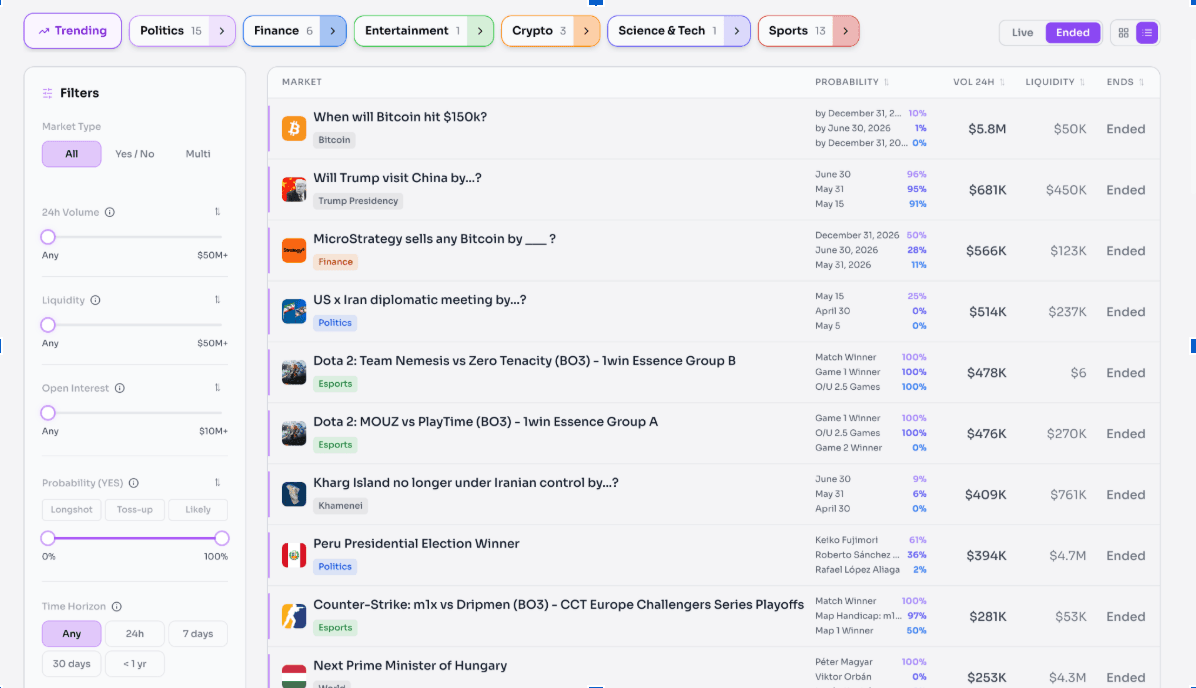
The process for exploiting this is straightforward. Sort the Polymarket market list by newest created rather than by volume. New markets appear with small volume numbers and recent creation timestamps. When you find a new market in a category where you have genuine domain expertise, generate your own probability estimate from primary sources before you look at the price. If the gap between your estimate and the initial price exceeds 12 to 15 percentage points, you have a potential new market mispricing worth entering.
New market mispricings in low-attention categories, such as regional elections, obscure economic indicators, and international events not heavily covered in English-language media, can persist for 12 to 48 hours before the market finds fair value. High-attention markets touching Bitcoin, major US elections, or prominent sports resolve their opening mispricings within minutes as sophisticated participants arrive immediately.
Volume and open interest tell you exactly which situation you are in. Low volume in the first few hours means inefficiencies last longer. High volume on a new market means competition has already arrived.
The 10 to 21 Day Pre-Event Sweet Spot
There is a specific window before every major Polymarket event where prices are most likely to be systematically wrong. It is not immediately after the market opens, when information is genuinely sparse. It is not in the final 48 hours, when the outcome is nearly determined. It is 10 to 21 days before resolution, when the event has been in the news long enough for casual traders to have formed opinions but before serious analytical participants have fully processed the primary source data.
In this window, market prices tend to reflect what people feel about an outcome rather than what the evidence actually shows. Retail participants price based on media sentiment and surface-level coverage. The analytical community has not yet converged on the market. The gap between crowd sentiment and careful probabilistic reasoning is at its widest.
Federal Reserve decision markets are the clearest and most repeatable example of this pattern. Ten to fourteen days before an FOMC meeting, Polymarket prices regularly diverge from CME FedWatch probabilities, which aggregate institutional positioning in actual Fed Funds Futures contracts. When FedWatch shows 62% probability of no change and Polymarket shows 45%, that 17-point gap is driven by the crowd's lag in processing the same primary data that institutional futures traders have already priced in.
Set calendar reminders 21 days before every major event in your chosen market category. Review the current Polymarket price against your primary-source probability estimate on that date. If the divergence exceeds 10 to 12 percentage points, size a position and monitor daily as the event approaches.
The Post-News Overreaction Fade
The first two hours after major breaking news is consistently one of the worst times to enter a Polymarket position in the direction of the news. This is counterintuitive but well-documented across trading environments in 2026.
When a significant headline drops, volume spikes and prices move far in one direction as emotional traders pile in. The initial move typically overshoots the true probability adjustment by 8 to 15 percentage points. Within two to four hours, calmer analysis replaces the initial reaction and prices correct back toward fair value.
The profitable entry is almost never during the news event itself. It is after the initial overreaction has peaked and you can identify the price beginning to stabilise or reverse.
Research from multiple Polymarket strategy analyses in 2026 confirms this pattern directly. The first two hours after major news are the worst time to trade because overreaction is systematic, not random. Liquidity arbitrage across related markets is one of the most underexploited strategies precisely because it requires waiting rather than acting immediately on news.
The practical application: when breaking news hits a market you follow, wait 60 to 90 minutes before considering any entry. Then assess whether the price has moved proportionately to the actual information content of the news or significantly beyond it. Overreaction fades with a two to six hour holding period are one of the most systematic edge sources still accessible to retail traders in 2026.
The Resolution Lag Window
This is the simplest and most mechanically reliable entry timing on the platform. It requires no probability estimation, no deep domain knowledge, and no special research skills. It only requires paying attention at the right moment.
When a real-world event concludes but the Polymarket contract has not yet officially been resolved, a gap opens between what the price should be and what it currently is. The winning outcome should be trading at or very close to $1.00. If it is still at $0.88 to $0.95 because the official resolution confirmation has not yet been processed, buying the confirmed winner at $0.90 is a near-certain 10% to 14% return within hours.
This happens on Polymarket regularly. Election calls happen hours before official certifications. Sports results are confirmed before the contract resolutions process. Federal Reserve announcements post before the market resolution timer triggers. The window is typically two to eight hours wide and closes as other traders notice the same discrepancy.
The process is to monitor markets you track continuously in the 12 to 24 hours after an underlying event concludes. When you see a confirmed real-world outcome still priced below $0.95 on the winning contract, that is your entry. The constraint is simply having the capital available to deploy in these windows, since the percentage gain per trade is modest even when the risk is minimal.
The Pre-Volume-Event Positioning Window
Predictable volume events on Polymarket follow a consistent pattern. When volume is about to surge into a market, early positions entered before the surge carry better pricing than positions entered after the crowd arrives.
The surge moments are largely predictable in advance. Federal Reserve meeting dates are published months ahead. Volume on rate decision markets typically doubles in the 48 hours before the FOMC statement. Entering 72 hours before the meeting, when prices still reflect pre-meeting uncertainty, gives you a better average entry than waiting until meeting day when every casual participant has also decided to take a position.
Major elections, championship games, and scheduled political votes follow the same pattern. Volume spikes sharply in the 24 to 48 hours before resolution. As volume grows, prices become more efficient and harder to beat with an edge. Trading 3 to 7 days before the volume peak means trading a less efficient market where your probability estimate is more likely to represent genuine value relative to the current price.
The practical shorthand: build your entry calendar around your market category's event schedule and target the quiet period before the crowd arrives, not the high-activity window when everyone has already formed their view.
How to Generate Your Own Probability Estimate Before Looking at the Price
The discipline that separates systematic traders from reactive ones is generating an independent probability estimate before looking at the current market price. This sounds simple and is genuinely difficult to maintain consistently.
Before you look at any Polymarket contract price, estimate the probability yourself and commit to a specific number. Not a range. A number. Write it down or force yourself to state it clearly before you open the market.
Use whatever analytical process is appropriate for the market type. For political markets, look at base rates for similar historical events alongside current polling and structural factors. For economic markets, check primary data sources directly, including Fed minutes, BLS releases, and CME FedWatch for rate decisions. For sports markets, use current standings, injury reports, and historical performance in comparable situations.
Only after you have committed to your own estimate do you look at the market price. If your estimate and the current price are within five to eight percentage points of each other, there is likely no trade worth taking. The edge is too small to compensate for the inherent uncertainty in your own analysis. If the gap is 10 or more percentage points in either direction, you have found a potential mispricing worth investigating with full attention.
This process directly prevents the anchoring problem that costs most traders a significant edge. Looking at the price first and then doing research produces analysis that unconsciously gravitates toward confirming whatever the existing price suggests. Estimating independently first removes that anchor entirely.
The Role of Resolution Criteria in Timing
One of the most durable and underappreciated timing edges on Polymarket comes not from predicting outcomes better but from understanding when the resolution criteria differ from how most participants are reading the market.
Read the Rules section of any market before looking at the price. This is non-negotiable and almost nobody actually does it first. The resolution source, the specific metric measured, and the exact conditions for YES and NO can differ meaningfully from the headline question in ways that only become clear when you read the full criteria.
A market asking whether unemployment will exceed 4.5% resolves against a specific BLS measurement taken at a specific point. A market asking whether a bill will pass resolves against a specific procedural vote, not general legislative progress. A market asking whether a country will enter recession resolves against a specific technical definition, not the general economic experience people associate with the word.
When traders price the general narrative rather than the specific resolution criteria, the gap between those two things is a genuine and bot-resistant edge. Bots can read resolution criteria text. They cannot easily reason about the institutional or legal nuances that determine whether a specific edge case triggers YES or NO. This type of edge does not require speed to exploit because it is not information-driven. It is analytical and it persists until enough participants do the same careful reading you did.
Sizing Based on Timing Window Type
Not all timing windows justify the same position size. The type of window you are entering determines how much capital you should allocate to the position.
New market openings and resolution lag trades carry different risk profiles. A resolution lag trade where you are buying a contract at $0.92 after the underlying event is already confirmed carries very low risk and justifies a larger allocation. A new market entry at a price you believe is wrong based on a quick estimate carries more uncertainty and justifies a smaller initial position that can be added to as your thesis develops.
The consistently profitable traders on Polymarket, roughly 7.6% of all wallets based on 2026 data, share a common sizing discipline. They never allocate more than 5% of their total trading capital to a single market regardless of how confident they feel. They adjust that percentage down, not up, for longer-duration markets where more things can go wrong before resolution. And they size proportionally to their estimated edge, not proportionally to their conviction level, which are different things.
A trade where you estimate 60% true probability against a market price of 45% has a 15-point edge. A trade where you estimate 52% against a market price of 45% has a 7-point edge. Both feel compelling if you have done good research. Only the first justifies meaningful capital. The discipline to notice that difference in real time, while a market is moving and the impulse to act is strong, is what separates traders who compound returns from traders who give them back.
Frequently Asked Questions
When is the best time to enter a Polymarket position?
The five consistently productive entry windows are: new market opens within the first 12 to 24 hours before the crowd prices them correctly, the 10 to 21 day pre-event window when crowd sentiment diverges from primary-source probability, the 60 to 90 minutes after major breaking news when initial overreactions peak and begin reversing, the resolution lag window when confirmed outcomes are still trading below $0.95, and the 3 to 7 days before predictable high-volume events when prices are least efficient. Each window requires a different speed of execution and justifies different position sizes based on the risk profile involved.
Why is entering immediately after breaking news usually the wrong move?
Research consistently shows that the first two hours after major breaking news represent the worst time to enter a Polymarket position in the direction of that news. The initial crowd response to breaking headlines is systematically emotional and overshoots the true probability adjustment by 8 to 15 percentage points on average. Prices typically correct back toward fair value within two to four hours as calmer analysis replaces the initial reaction. The profitable entry is almost always in the correction phase, not in the initial spike.
How do you generate an independent probability estimate before looking at the market price?
Commit to a specific probability number before you open the market contract. Use primary source data appropriate to the market type, including Fed minutes and CME FedWatch for economic markets, official polling and historical electoral base rates for political markets, and injury reports plus team performance data for sports markets. Write down your estimate before you look at the current price. Only after committing to your number do you compare it to what the market is showing. A gap of 10 or more percentage points between your estimate and the current price signals a potential edge worth investigating further. Smaller gaps generally do not justify a trade.
How long do new market mispricings typically last on Polymarket?
It depends entirely on the category and how much attention the market is receiving. High-attention markets covering Bitcoin, major US elections, or prominent sports championships see their opening mispricings corrected within minutes of launch as sophisticated participants arrive immediately. Low-attention markets in niche regional politics, obscure economic indicators, or international events not heavily covered in English-language media can remain mispriced for 12 to 48 hours or more. Sorting by newest created and filtering for your specialist categories is the most practical way to find new market mispricings before they attract the volume that drives efficient pricing.
What is resolution lag trading and how does it work?
Resolution lag trading occurs when a real-world event has been conclusively decided but the Polymarket contract has not yet officially resolved. The winning outcome should be priced near $1.00 but may still trade at $0.88 to $0.95 while the official resolution processes on-chain. Buying the confirmed winner at $0.90 and receiving $1.00 at resolution produces a near-certain 10% to 14% return within hours. Monitor your markets continuously in the 12 to 24 hours after the underlying event concludes and enter immediately when you see this gap. The window closes as other traders notice the same discrepancy, typically within two to eight hours of the real-world event confirming.