The 2025-26 NBA MVP market on Polymarket told the story clearly before the voters did. Jokic opened as the sportsbook favorite at +200 in October. By February, SGA was sitting at 56% on Polymarket and the race was effectively over four months before the award was announced. Traders who positioned in SGA in October at 29% watched the market move to near-certainty by April. That is the polymarket nba mvp market in one season. Within the broader polymarket sports markets guide ecosystem, the MVP market is one of the few long-duration trades that rewards a prepared thesis over a seven-month window.
This article covers everything: how the market is structured, how prices moved across the full 2025-26 season as a live case study, where the edge actually exists, and how to position for the 2026-27 season market that is already open.
What Is the Polymarket NBA MVP Market?
For traders coming from a sportsbook background, the structure here is different enough to matter.
The NBA MVP market on Polymarket is a categorical market individual yes/no share contracts for each candidate player. Each share is priced in cents representing implied probability. A share at 29 cents means the market assigns a 29% chance of that player winning. If they win, the share pays out $1. If they do not, it pays $0. You can buy or sell at any time before resolution at the current market price.
The market opens in October at the start of the NBA season and resolves when the NBA officially announces the MVP winner, typically in late May during the playoffs. The 2025-26 market ran from approximately October 2025 to May 2026 a seven-month trading window.
Multiple player contracts trade simultaneously. The 2025-26 market included individual contracts for every realistic candidate: SGA, Jokic, Wembanyama, Cunningham, Luka, Giannis, Brunson, and others. The total implied probabilities across all players sum to approximately 100%.
One thing to get straight before going further: this is not the same as the Finals MVP market. That is a separate contract that opens during the playoffs and resolves at the end of the NBA Finals. Both live simultaneously at different points of the season; they are different instruments with different edge windows. This is what makes the NBA an nba prediction market ecosystem rather than a single bet.
For full context on every NBA market type running on the platform, the polymarket nba guide covers the complete picture.
Current Polymarket NBA MVP Odds: What the 2027 Market Looks Like Now?
The full resolved price history is available at the live 2025-26 Polymarket NBA MVP market for anyone who wants to study the complete movement arc from October open through February consensus to final resolution.
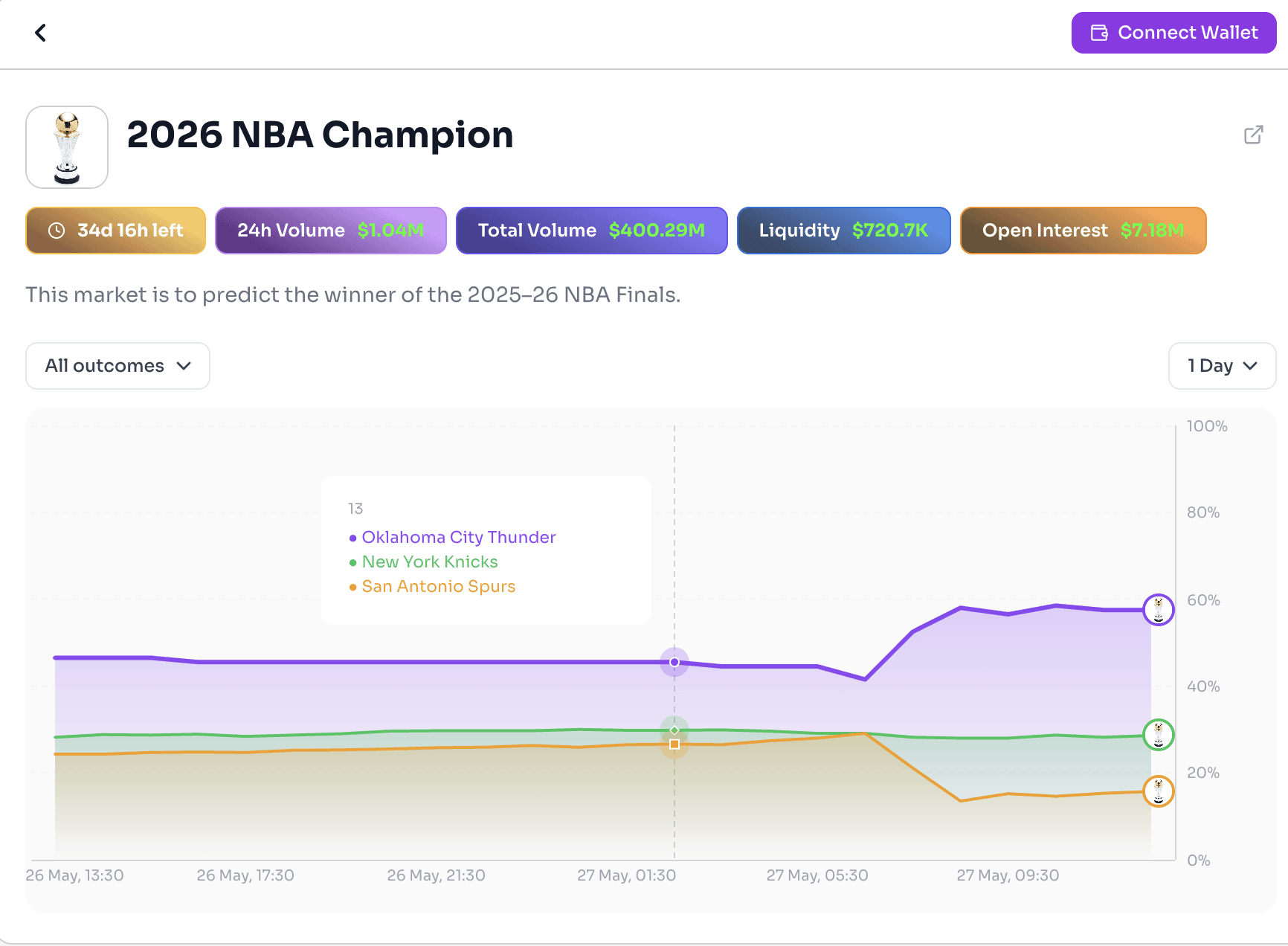
The NBA 2027 Champion market is already live with $559,000 in volume. The dedicated 2026-27 MVP market opens in October 2026 when the new season begins. Based on current trajectory, the early candidates will be SGA seeking a third consecutive award, Wembanyama as the long-term favourite given his age and development curve, Jokic as the perennial contender, and whoever emerges from the East.
For nba mvp odds 2026 context and how those opening lines compared to where the market ultimately settled, the resolved market page is the cleanest reference available. For the mechanics of how probability prices are constructed, how prediction market prices work is the right framework before placing your first position.
The 2025-26 Season: A Complete Case Study in How the MVP Market Moves
No other article can walk through this arc with live data. Here is the full season chronologically using it as the playbook for every future MVP market.
1 - October 2025 season opens : Jokic opens as the sportsbook favorite at +200. Polymarket immediately tells a different story: SGA leads at 29%, Wembanyama at 25%, Luka at 20%, Jokic at 14%. The crowd on Polymarket was already pricing SGA's back-to-back chances higher than the books were. That divergence was the first signal when Polymarket and sportsbooks open a season with significantly different implied probabilities on the same player, one of them is wrong.
The early Polymarket crowd had identified three things the sportsbook opening lines had not fully priced: SGA's consistency across a full season, OKC's depth removing any "team success" argument against him, and the fact that Jokic had already won three times making voter fatigue a real factor that opening lines rarely capture.
2- November to January the race takes shape : Wembanyama's price, which opened at 25% on Polymarket well ahead of his +1800 sportsbook price, began declining as SGA's scoring streak extended. Luka's price collapsed when he missed the games played threshold. Cunningham emerged briefly as a candidate before also falling short of the 65-game minimum.
The key lesson here: Polymarket priced the games played eligibility risk into Luka and Cunningham's contracts faster than sportsbooks did. The market was discounting players with availability risk in November. Sportsbooks were still offering Luka at competitive odds in January.
3 - February the race effectively ends : SGA hits 56% on Polymarket. Kalshi matches at 56%. Sportsbooks have him at -10000. Three sources have converged on the same answer. At this point the polymarket nba mvp market no longer offers a meaningful edge if you are paying near-fair value for a near-certain outcome.
The tradeable window in the 2025-26 MVP market was October through December. By February the market had done its job. Anyone entering in March was paying for confirmation, not edge. That is the lesson the full arc teaches, and it will repeat next season.
How Polymarket NBA MVP Prices Move: The Mechanics
Three specific price drivers that every MVP market trader needs to understand before October.
Games played eligibility. The NBA requires 65 games played to qualify for MVP. Polymarket prices discount this risk early. When a star player misses a stretch of games in December or January, their MVP contract drops sharply often faster than sportsbooks adjust. This creates a buy opportunity if you believe the player will return and hit the threshold. The 2025-26 season showed this with Cunningham and Doncic: both dropped on eligibility risk, neither made the finalist cut.
Team seeding. MVP voters historically favour players on top-seeded teams. When a player's team drops from a top-3 seed to a 6 or 7 seed in January standings, their MVP probability on Polymarket decreases downward even if their individual stats have not changed. This is a market overreaction when the seeding drop is driven by opponent schedule rather than actual team decline. That overreaction is a buy signal.
Media narrative momentum. A player who dominates ESPN, The Athletic, and sports Twitter for two consecutive weeks sees their Polymarket price climb regardless of whether the underlying statistical case has improved. This is the most consistent fade opportunity in the nba mvp odds 2026 cycle and in every MVP market that follows. The crowd buys the narrative. The edge is in selling into it.
When to Enter the Polymarket NBA MVP Market?
The calendar tells you more than volume data does. Each window has a different risk-reward profile.
→ October (season opens) the highest-value window: The market opens with preseason narratives, not real performance data. Opening prices reflect last season's storylines and sportsbook opening lines, not actual 2026-27 form. This is where the widest gap between price and true probability exists. The 2025-26 season showed Wembanyama at 25% in October before he dropped to 5.6% by February. A trader who shorted Wembanyama early based on eligibility analysis and SGA's consistency had a clear edge unavailable to anyone entering in January.
→ November to January the information window: Real performance data flows in. Games played totals become visible. Team seedings stabilize. This is the last window where a meaningful edge exists on the market leader. Once a player crosses 60% implied probability, the risk-reward on the favourite deteriorates; you are risking 60 cents to make 40 cents on a near-certain outcome.
→ The contrarian window longshots in October: Players priced between 5% and 15% in October represent the highest-variance, highest-upside positions. Wembanyama at +1800 on sportsbooks and 25% on Polymarket in October 2025 was a genuine value position for anyone with a strong view on his breakout season. He did not win, but his October price significantly underpriced his eventual finalist position. That gap was a real edge regardless of outcome.
→ February onwards no edge on the favourite: The market leader is near-certainty and entry is capital-inefficient. The only live play is on outsiders if you have information about a late-season surge the market has not yet priced. Most traders do not. Most traders entering in February are buying a feeling, not an edge.
For the full entry timing framework across Polymarket's market lifecycle, how to time your Polymarket entry covers the mechanics in detail.
Where the Edge Is and Where Most Traders Give It Away?
Four specific angles grounded in the 2025-26 market evidence.
The October divergence trade
When Polymarket and sportsbooks open the season with significantly different implied probabilities on the same player, that divergence is information. In 2025-26, Polymarket had SGA at 29% and sportsbooks had Jokic as the favorite at +200 implied roughly 33%. Polymarket traders were pricing SGA higher than the books from day one. That early Polymarket signal was correct. Tracking the divergence between Polymarket opening prices and sportsbook opening lines is a systematic entry signal for the October window. Not a guarantee. A signal.
The eligibility discount opportunity
When a top candidate misses five to seven consecutive games in November or December, their Polymarket price drops sharply on eligibility risk. If your read is that the injury is minor and the player will comfortably hit 65 games, that drop is a buy. The market is pricing a risk that may not materialize. This requires genuine conviction on recovery timelines — it is not a casual trade, and being wrong means holding a contract that is heading toward zero.
Fading narrative momentum spikes
A player who dominates sports media for two consecutive weeks sees their MVP probability spike on Polymarket. In most cases that spike is temporary, one strong performance does not change a season-long statistical case. The correct play is to sell into the price jump, not buy the momentum. The crowd is chasing recent events. Common biases in prediction markets explains exactly why this pattern repeats so reliably.
The back-to-back pricing discount
Voter fatigue is real in MVP voting. Winning back-to-back is genuinely difficult because voters often want to reward a different player. Polymarket historically underprices this voter psychology when valuing incumbents. SGA was the exception in 2025-26 because his statistical case was overwhelming and no challenger sustained a serious run. In normal seasons, the reigning MVP opens at a price that does not fully account for voter fatigue risk. That opens a structural short on the incumbent in October.
For the methodology behind identifying these setups systematically, how to find mispriced markets on Polymarket is the right framework.
NBA MVP vs Finals MVP: Two Different Markets, Two Different Strategies
Many traders conflate these and lose money on both. They are structurally different instruments.
The regular season MVP market runs seven months from October to late May. It rewards patience, early positioning, and statistical analysis over a long window. The edge is in October and January. It is a slow market that punishes reactive trading.
The polymarket nba finals mvp market opens during the playoffs and resolves at the end of the NBA Finals a three to four week window. It is a completely different beast. Currently the 2026 Finals MVP market has SGA at 38 to 45% with $81,600 to $91,800 in volume, reflecting OKC's position in the Western Conference Finals. This market replicates after every game of every Finals series. It requires active monitoring and short positioning windows, not the patient thesis-building that works in the season-long market.
Do not size the Finals MVP market like a season-long trade. The duration is different, the liquidity profile is different, and the edge windows are measured in hours, not months.
Frequently Asked Questions
What is the Polymarket NBA MVP market and how does it work?
The Polymarket NBA MVP market is a categorical prediction market where traders buy and sell share contracts for individual players to win the AP NBA MVP award. Each share price represents the market's implied probability of that player winning. Shares pay out $1 if the player wins and $0 if they do not. You can buy or sell your position at any time before the market resolves.
When does the Polymarket NBA MVP market open and resolve?
The NBA MVP market opens in October at the start of the NBA regular season and resolves when the NBA officially announces the MVP winner, typically in late May during the playoffs. The 2025-26 market ran approximately seven months from October 2025 to May 2026.
How accurate has Polymarket been at predicting the NBA MVP winner?
The 2025-26 season showed strong accuracy. Polymarket had SGA leading at 29% from October and at 56% by February both ahead of or in line with sportsbook odds at each stage. The market correctly identified SGA's statistical dominance early while sportsbooks still had Jokic as the opening favourite. Polymarket also priced eligibility risk for Luka and Cunningham faster than traditional books adjusted their lines. That is what an nba prediction market does when the crowd is informed: it finds the right answer before the official channels do.
Who are the early favorites for the 2026-27 NBA MVP on Polymarket?
The 2026-27 MVP market opens in October 2026. Based on current trajectory, SGA is the reigning two-time MVP and the expected early market leader. Wembanyama coming off a strong 2025-26 regular season as a finalist is the most likely challenger given his age and development curve. Jokic remains a perennial contender. The 2027 NBA Champion market is already live at $559,000 in volume. Check the NBA futures pages for early MVP market signals before October.
Can US residents trade the NBA MVP market on Polymarket?
The global Polymarket platform where the full NBA MVP market is available is not accessible to US residents due to regulatory restrictions. US traders can use Kalshi for regulated NBA awards contracts, though with narrower market depth than the global platform. Full comparison in the kalshi vs polymarket breakdown. Always verify current access rules before depositing.
When is the best time to enter the Polymarket NBA MVP market?
October is the highest-value entry window. Opening prices reflect preseason narratives rather than real performance data, creating the widest gap between market price and true probability. The 2025-26 season showed the full market move from October opens to February consensus traders who entered in October captured the majority of that move. By February when the leader crosses 50% implied probability, the risk-reward on the favourite deteriorates significantly. The edge does not wait for consensus. It lives in the period before consensus forms.
Is the Polymarket NBA MVP Worth Trading?
The NBA MVP market is one of the most consistently tradeable long-duration sports prediction markets on Polymarket. Seven months, a clear price evolution pattern that repeats across seasons, and a structure that rewards traders who enter early with a thesis over those who follow consensus in February.
The 2025-26 season gave the clearest demonstration in recent memory. The market correctly identified SGA from October. It correctly priced down eligibility risk for Luka and Cunningham before sportsbooks adjusted. It converged on near-certainty by February with no meaningful divergence from the award outcome. Every one of those moves was a tradeable signal for a prepared trader.
The edge does not exist in March. It exists in October and November, when the polymarket nba mvp market is still pricing storylines instead of statistics. That window opens again in October 2026.
For everything happening across NBA markets right now championship futures, game markets, conference odds the polymarket sports markets guide is the complete picture.
Tracking how NBA MVP probabilities shift from October opening through February consensus is exactly the kind of long-duration market intelligence Polymetric is built to surface. Live odds movement so you never miss an entry window. → Start your journey with Laika's Polymetric Intelligence today at laikalabs.ai