The 2026 NBA Champion market on Polymarket has crossed $437 million in total trading volume, and the Oklahoma City Thunder, San Antonio Spurs, and New York Knicks are still alive in the conference finals. This is not a market you watch from the sideline, it is the most actively traded sports prediction market currently live on the platform. If you are serious about polymarket nba trading, understanding every market type available is not optional. Polymarket sits at the center of the broader polymarket sports markets guide ecosystem, and NBA markets are where the volume, the volatility, and the genuine edge all converge right now.
This guide covers everything: every market type Polymarket offers for the NBA, where the current odds sit, how each market behaves differently, and how experienced traders approach them. Not just futures. Game markets, awards, player props, and the markets most casual traders never find.
Every NBA Market Type on Polymarket, Explained
Most people who find their way to Polymarket NBA markets start with the championship futures and never go deeper. That is a mistake. The platform runs six distinct market categories for the NBA, each with its own liquidity profile, resolution timeline, and edge windows.
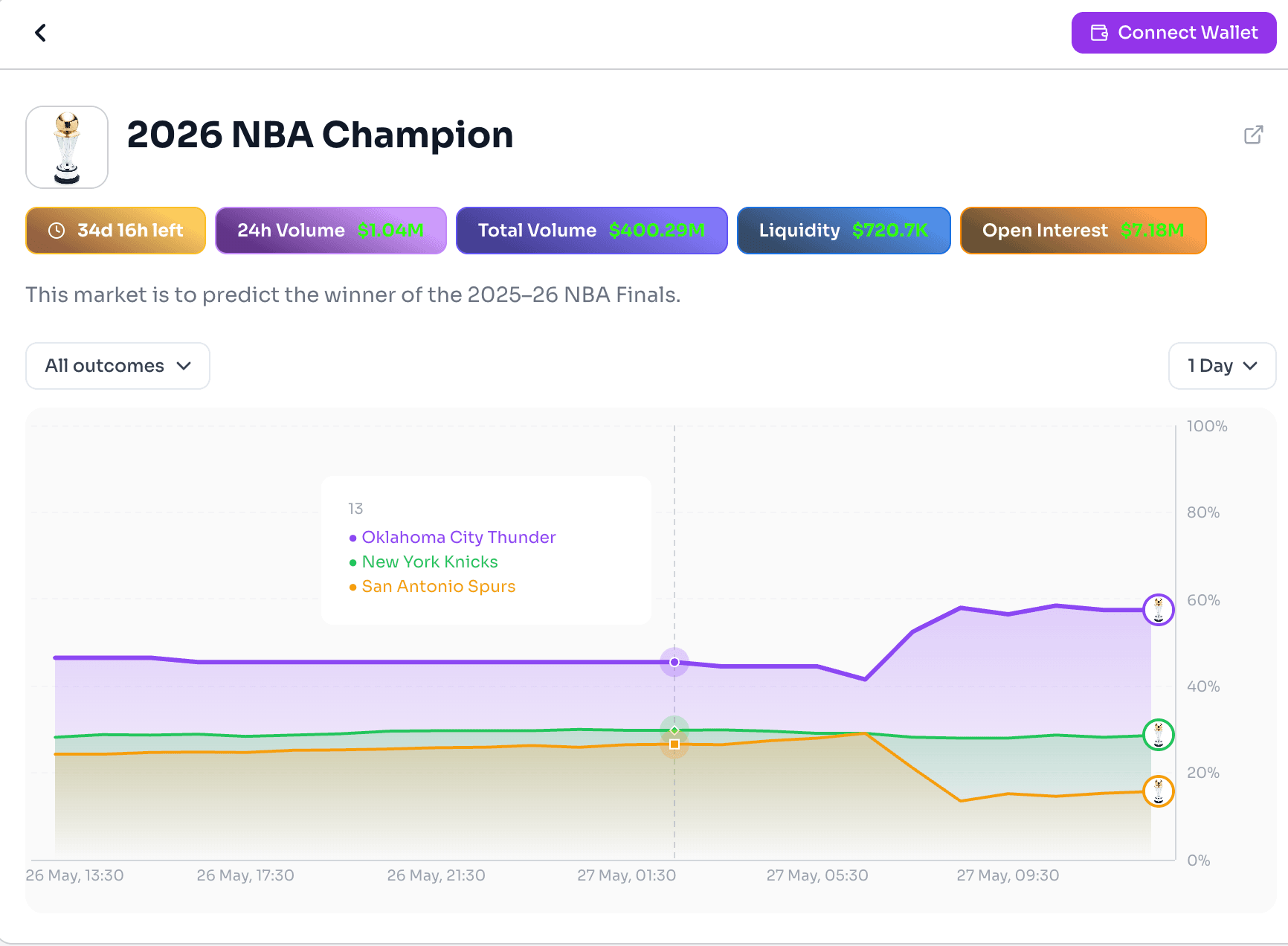
NBA Champion market: The flagship. $437 million in volume for the 2026 season. It is a categorical market with one outcome per team, one winner. Currently OKC Thunder sits at 48%, San Antonio Spurs at 26%, New York Knicks at 17%, Cleveland Cavaliers under 3%. Resolves when the NBA Finals winner is confirmed.
Conference champion markets: These run independently from the main championship market and are worth treating that way. The Eastern Conference Champion market has $19.7 million in volume with the Knicks pricing at 98%. The Western Conference market carries $23 million in volume, split between OKC at 64% and the Spurs at 36%. The prices here do not perfectly mirror the championship market; that gap is sometimes tradeable.
Game-by-game markets: Individual moneyline, spread, and totals markets for every NBA game across the regular season and playoffs. Player props points, rebounds, assists over/under run on major matchups. The Timberwolves vs Spurs game market is currently one of the most actively traded markets on the entire platform.
Awards markets: MVP, Finals MVP, Conference Finals MVP, Rookie of the Year, Defensive Player of the Year. SGA won the 2026 MVP after closing at near-certainty on both Polymarket and sportsbooks. Conference Finals MVP markets are live right now: Wembanyama at 52% for the West, Brunson at 63% for the East.
Player props and parlays: Long-term player performance markets and award combination parlays. The SGA Award Parlay market currently sits at 41%.
Season-long specials: Will LeBron James retire before next season? Will a player record a quadruple-double? Lower liquidity, tradeable year-round, and mostly ignored by the crowd which is exactly why they occasionally price wrong.
This is what polymarket nba actually looks like at full depth. The nba prediction market ecosystem on Polymarket is not one market. There are dozens running simultaneously, each with its own rhythm.
If you are newer to how these mechanisms work, read our guide on what are prediction markets before going further →
Current Polymarket NBA Championship Odds (2026)
The current Polymarket NBA Championship market as it stands today.
OKC entered the Conference Finals on a dominant 8-0 run having swept both the Suns and Lakers without a close game. The Thunder's structural argument is depth: when SGA sat out the second half of Game 2 in the WCF, OKC still won with seven players in double figures. That kind of redundancy is what a 48% price reflects.
The Spurs counter-argument is Victor Wembanyama's trajectory. San Antonio's three-point shooting climbed to 38.4% in the playoffs from 35.9% in the regular season, and the series is still alive. At 26%, the market is pricing a meaningful chance that Wembanyama changes the series.
For full live figures, check the live 2026 NBA Champion market directly. For context on how these probabilities are constructed and where inefficiency tends to live, how prediction market prices work is the right framework.
Polymarket NBA MVP: How the Market Works and What SGA's Win Tells Us
The polymarket nba mvp market opens each October at the start of the season and resolves when the award is officially announced, typically in late May. Multiple player outcome shares trade simultaneously; each price represents implied probability for that player winning. The market runs for roughly seven months, which is what makes it different from game markets. Seven months of price movement means seven months of entry and exit windows.
The 2026 season is the clearest case study available. SGA closed at near-certainty on Polymarket before the finalists were even announced Wembanyama sat at 5.6% implied probability, behind SGA, Jokic, and Cunningham. Sportsbooks had SGA at -10000. Polymarket and sportsbook prices tracked almost identically through the final stretch because the outcome was no longer contested.
The lesson is not that the market was efficient at the end. The lesson is that it became efficient by the end. The edge was gone by March. Anyone who positioned themselves in October or November when OKC's odds were built on preseason expectations rather than performance data had already extracted most of what the market had to offer.
The 2026-27 polymarket nba mvp market opens in October. Wembanyama, Jokic, and whoever emerges from OKC's core next season will anchor the early prices. The crowd will anchor 2026 narratives. That gap between last season's story and next season's reality is where the value will be.
For a deeper breakdown of MVP market mechanics and historical price movement, see our full polymarket nba mvp guide
Game-by-Game NBA Markets Playoffs vs Regular Season
By raw number of markets, game-by-game is where most of Polymarket's NBA activity lives. But the behavior changes significantly between the regular season and the playoffs, and sizing accordingly is what separates traders who understand these markets from those who treat them all the same way.
Regular season. Moneylines, spreads, totals, and player props for every game. Volume is moderate; marquee matchups pull significantly higher activity than small-market games. Resolution happens the same night. The edge windows are narrow and the markets are reasonably efficient on major games because the crowd is large and informed.
Playoffs. Volume multiplies. The Timberwolves vs Spurs playoff market became one of the most traded markets on the entire platform. Spreads tighten because more sophisticated traders are active. But the injury information dynamic cuts both ways teams play every two to three days, rest decisions matter more, and official injury statuses can move a moneyline by 8 to 12 percentage points in minutes. Conference Finals MVP markets are live right now Wembanyama at 52%, Brunson at 63%.
The critical distinction is duration. Game markets close in hours, not months. Do not size a game market position the way you would size a championship futures position. The compounding risk of being wrong on a short-duration binary is structurally different from holding a futures position through a seven-month season. These are different instruments that happen to share a sport.
For the full NBA playoffs market hub, Polymarket has every live market in one place at current series prices.
The polymarket nba finals specifically runs as a market category in its own right the Finals matchup, game-by-game lines, and Finals MVP run simultaneously once the bracket is set. And if you are active during the regular season, polymarket nba playoffs markets tend to see a volume surge in the final two weeks of the regular season as playoff positioning gets locked in that is worth anticipating.
How to Find Edge in Polymarket NBA Markets
Three specific edges grounded in how these markets actually behave. Not principles. Mechanics.
The injury report window
NBA teams release official injury reports before every game. On game day, updated statuses available, questionable, out drop approximately 90 minutes before tip-off. Polymarket prices within minutes. Sportsbooks typically take 15 to 30 minutes longer to adjust lines after key injury news.
That window is a real edge on game markets, particularly in the playoffs when a single player's availability can shift a moneyline by 8 to 12 percentage points. Being first to an injury update is not a speed game, it is a source game. Official team accounts, beat reporters who cover that specific franchise, and NBA injury aggregators. Not ESPN alerts, which routinely arrive 10 to 20 minutes after the primary sources have already posted.
The award market early-season window
MVP, Rookie of the Year, and Defensive Player of the Year markets are most mispriced in October and November. The crowd anchors on the previous season's narrative last year's winner, last year's dominant storyline. Polymarket prices in October often reflect media conversations from the prior June rather than actual roster construction entering the new season.
This is where the most consistent edge in NBA awards markets lives. By February the field had narrowed and the market had caught up to reality. The early window closes fast once November games start providing actual performance data.
The elimination cascade in conference markets
When a team gets eliminated, their probability in both conference and champion markets redistributes immediately. The redistribution follows media attention, not team quality. The 24 to 48 hours after a major upset elimination are when conference market prices are least rational. Teams that survive but are not in the current media spotlight absorb less redistributed probability than their actual Finals chances justify.
This is the buy window for underexposed survivors. You are not predicting outcomes, you are buying a price that the market will correct on its own once attention catches up.
For deeper tactical frameworks, how to find mispriced markets on Polymarket covers the structural methodology, and how to find liquid markets on Polymarket covers which markets have enough depth to enter and exit positions at scale.
When to Enter Polymarket NBA Markets
The NBA calendar is the most useful entry framework. Each market type has a distinct window where it is most valuable and windows where the edge has already been competed away.
→ October (season opens): Championship, MVP, and all awards markets open simultaneously. Lowest liquidity, highest mispricing across every category. Prices are anchored in preseason narratives. The OKC Thunder sat at approximately 15% in October 2025 and closed at 48% by late May 2026. Traders who positioned in October captured the majority of that move. This is the most asymmetric window of the entire NBA calendar.
→ November to January: Regular season data starts informing prices. Teams outperforming preseason expectations see championship probability move upward. Injury patterns emerge. The MVP market begins consolidating toward two or three candidates. Enough uncertainty remains to find value — but the October window is already closing.
→ February (All-Star break): The market's midpoint. Championship prices reflect actual standings and real injury situations rather than projections. MVP race is typically narrowed to three or four players. Edge still exists if you have a strong view on the final stretch, but the margin is smaller.
→ April (playoffs begin): Game-by-game markets dominate. Championship futures compress as the field narrows. Conference champion markets become the primary futures vehicle. The optimal entry window for game markets is Monday and Tuesday of each playoff week, before volume spikes later in the week.
→ June (Finals): Near-maximum efficiency on the championship market. At $437 million in volume, the 2026 NBA Champion market is among the most liquid sports prediction markets on the platform. Edge on futures has been largely competed away by this point. Game markets and player props are where remaining inefficiency lives.
For more on timing entries across Polymarket's market lifecycle, how to time your Polymarket entry builds the full framework.
Polymarket NBA vs Sportsbooks What Is Actually Different
Three concrete differences. Not philosophy.
No vig. Polymarket takes 0 to 2% on resolution only. Sportsbooks build 4 to 6% into every line. On a $437 million market, that structural difference compounds. You are not fighting the house on every trade.
24/7 trading. Polymarket replicates instantly after injury news, game results, and trade announcements at 2am, mid-game, whenever. Sportsbooks close lines before tip-off and reopen slowly. The gap between a late-breaking injury report and a sportsbook line adjustment is where polymarket nba traders extract edges that simply do not exist on traditional platforms.
Exotic market depth. Conference Finals MVP markets, award parlays, player milestone markets Polymarket offers market types that no sportsbook runs. This depth creates more opportunities, but it also creates more resolution ambiguity. Always read the resolution criteria before entering a market type you have not traded before. The edge and the risk live in the same place.
For US-based traders, Kalshi is the regulated domestic alternative. The depth is narrower, but access is straightforward. Full comparison in the kalshi vs polymarket breakdown.
Frequently Asked Questions
1. What NBA markets are available on Polymarket?
Polymarket offers six main categories of NBA markets: the NBA Champion futures market, conference champion markets for East and West, game-by-game moneyline and player prop markets for every game, awards markets covering MVP, Finals MVP, Rookie of the Year and Defensive Player of the Year, player milestone markets, and award parlay combinations. The NBA Championship category alone currently hosts 147 active markets. If you are new to how these mechanisms work, what are prediction markets is the right starting point before trading any of them.
2. How much volume does the Polymarket NBA Championship market get?
The 2026 NBA Champion market has generated over $437 million in total trading volume as of late May 2026, making it one of the largest sports prediction markets on the platform. For comparison, the Western Conference Champion market has $23 million in volume and the Eastern Conference Champion market has $19.7 million, significant individually but a fraction of the main championship market.
3. Who is the current favorite to win the 2026 NBA Championship on Polymarket?
As of late May 2026, the Oklahoma City Thunder lead the 2026 NBA Champion market at approximately 48%, followed by the San Antonio Spurs at 26% and the New York Knicks at 17%. OKC entered the Conference Finals on a dominant 8-0 playoff run, sweeping both the Suns and Lakers. These odds move in real time check for live figures before making any trading decisions.
4. Can US residents trade NBA markets on Polymarket?
The global version of Polymarket where full NBA market depth and volume is available is not accessible to US residents. US-based traders can use Kalshi, which offers regulated NBA event contracts, though with narrower market depth than the global Polymarket. Always verify current platform access rules before depositing.
5. How does Polymarket NBA pricing compare to sportsbook odds?
Polymarket prices are pure crowd-sourced probabilities with no house edge built in. Sportsbooks build a vig of 4 to 6% into every line. Polymarket also replicates faster particularly after injury news because there is no line-adjustment delay and trading is 24/7. The gap between Polymarket probability and Vegas implied probability on specific outcomes is where experienced traders look for value, especially in the 15 to 30 minutes after official injury status updates.
6. When is the best time to enter the Polymarket NBA Championship market?
October and November offer the most value. Championship prices in the early season reflect preseason narratives rather than actual performance data, which creates mispricing. The OKC Thunder's move from approximately 15% in October 2025 to 48% by May 2026 is the clearest example from the current cycle. By the time the playoffs begin in April and the market is carrying $400 million in volume, most of the available edge on futures has already been competed away.
The Bottom Line on Trading NBA Markets on Polymarket
Polymarket offers more NBA market depth than any sportsbook from $437 million championship futures down to Conference Finals MVP markets with five-figure daily volume and player prop markets that resolve the same night. But these markets are not equally tradeable at all times, and treating them like they are is how most casual traders leave value behind.
Championship and MVP futures are most valuable in October to February. Game markets offer edge in the injury report window and in the 24 to 48 hours after a major upset redistributes probability irrationally. Conference markets are most tradeable in the final two rounds, when elimination cascades create short windows of mispricing that the crowd is too slow to close.
The traders who extract consistent value from polymarket nba markets are not predicting outcomes better than everyone else. They are entering at better times, in better markets, with better sizing discipline. That is the actual edge, not prediction. Execution.
For the broader context of how NBA markets sit within Polymarket's full offering across every sport, the polymarket sports markets guide is the complete picture.
Tracking how NBA market odds move across every round, every game, and every injury report is exactly what Polymetric is built for. Live market intelligence for traders who want to be ahead of the crowd, not in it.
→ Start your journey with Laika’s Polymetric Intelligence today!