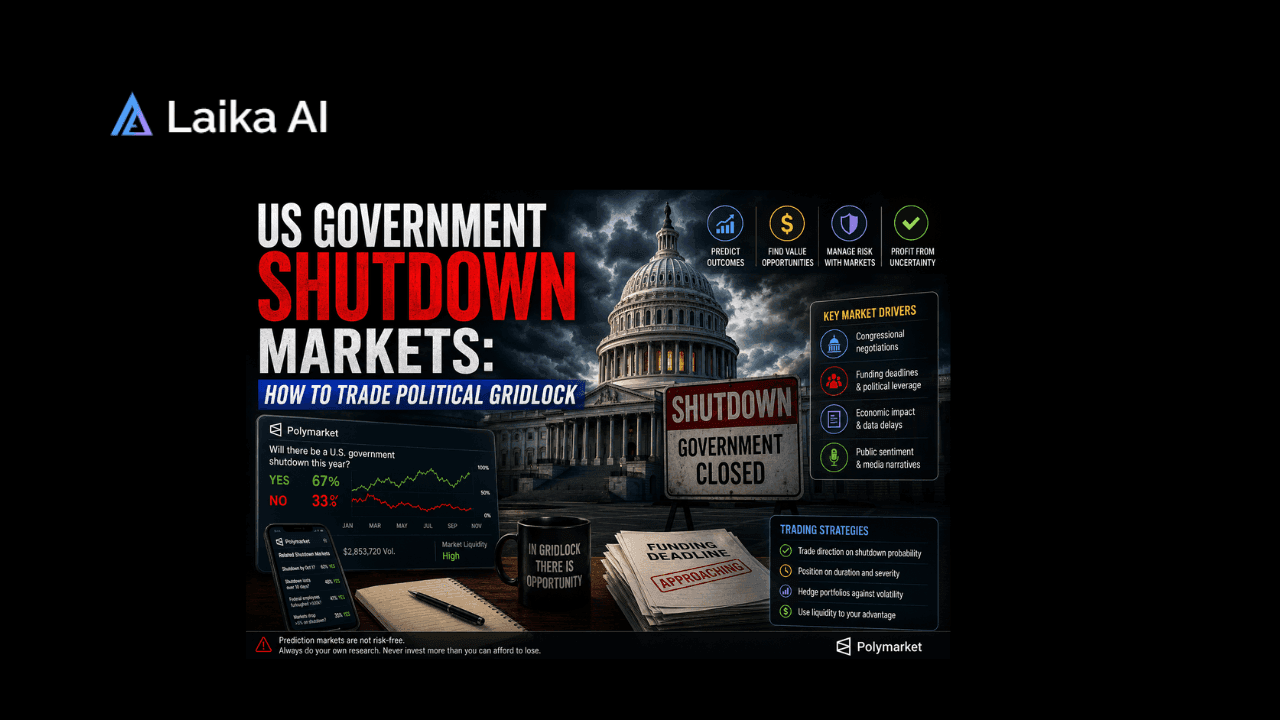
US Government Shutdown Markets: How to Trade Political Gridlock
The polymarket government shutdown market is one of the most mechanically clean prediction market contracts on the entire platform, and also one of the most volatile in the final hours before resolution. Unlike elections, which build toward a single known date over months, or military conflict markets, which can stay elevated for extended periods without resolving, a government shutdown market resolves on a hard deadline that is set by statute, tracked publicly, and resolved within hours of the deadline passing. That structure creates a specific trading rhythm: long stretches of relatively quiet pricing punctuated by sharp, fast-moving repricing in the final 48 to 72 hours before a funding deadline.
This guide covers exactly how these contracts are structured and resolved, what specific legislative and political signals move the price, a practical playbook for trading through a shutdown cycle from the early positioning window through deadline resolution, and the risk management framework these binary, fast-resolving markets require. For the foundational mechanics of how prediction market prices function as probability estimates, Polymarket explained: how prediction markets work covers the structure before going into shutdown-specific dynamics.
How Government Shutdown Markets Work on Polymarket
A government shutdown market is, at its core, a single binary question: will a portion or all of the federal government experience a funding lapse before a specific date. The mechanics are straightforward but the resolution criteria require careful reading, because the line between a clean continuing resolution, a partial shutdown affecting some agencies, and a full government shutdown is determined by specific statutory and procedural definitions.
The contract structure
Most polymarket government shutdown contracts are framed around a specific appropriations deadline, the date by which Congress must either pass a continuing resolution, pass full-year appropriations bills, or allow funding to lapse. The contract typically asks whether a shutdown will occur, defined as a lapse in appropriated funding affecting government operations, by a specific date and time.
Resolution is based on the official confirmation that funding has lapsed, typically evidenced by Office of Management and Budget guidance to federal agencies, official agency furlough notices, or confirmed news reporting from established outlets that funding has lapsed past midnight on the deadline date. The precise resolution source is listed in each contract's rules and should be read before trading, since some contracts specify a particular government source while others rely on aggregated news confirmation.
Partial versus full shutdown distinctions
Not every funding lapse looks the same, and not every Polymarket contract treats them identically. Congress sometimes passes appropriations for some federal departments while failing to fund others, producing a partial shutdown that affects specific agencies rather than the entire federal government. Some Polymarket contracts specifically define what counts as a qualifying shutdown for resolution purposes, while others may require a more comprehensive funding lapse to trigger a YES resolution.
This distinction matters enormously for traders. A contract that resolves on "any funding lapse affecting any federal agency" has a structurally higher probability of resolving YES than a contract requiring "a lapse affecting the majority of federal discretionary spending." Reading the exact resolution language before entering a position is not optional in this market category, because the difference between contract types can represent a meaningful probability gap on the same underlying legislative situation.
Duration and reopening contracts
Beyond the basic will-it-happen contract, Polymarket frequently runs related markets on shutdown duration, including whether a shutdown that has begun will extend beyond a specific number of days, and reopening contracts that ask whether government funding will be restored by a specific date once a shutdown is already underway. These secondary contracts require a different analytical approach than the initial will-it-happen market because they depend on negotiating dynamics that develop once a shutdown is already in progress, rather than on the pre-deadline legislative process.
What Moves Government Shutdown Probabilities
Understanding the specific signals that drive price movement in this category is the foundation of trading it effectively, because unlike sports or weather markets, the underlying process is entirely procedural and substantially observable through public legislative tracking.
Continuing resolution status
The single most important input to any government shutdown prediction market is the status of the continuing resolution or appropriations bills currently moving through Congress. A continuing resolution is temporary legislation that extends current funding levels past a deadline without requiring full-year appropriations agreement, and tracking whether one has been introduced, whether it has cleared committee, and whether it has scheduled floor votes in both chambers provides the clearest real-time signal of shutdown probability.
Congress.gov's budget and appropriations bill tracking provides the primary source for this information, showing bill status, sponsor information, and procedural history for every piece of relevant legislation moving through the House and Senate. Checking this directly rather than relying on secondary news summaries gives traders a meaningful speed advantage, since procedural status updates often post to the official tracker before they are picked up and summarized by political journalists.
Congressional vote counts and leadership statements
As a deadline approaches, the market increasingly prices specific vote count assessments from congressional leadership and whip counts reported by political journalists with access to internal vote tallies. A statement from House or Senate leadership expressing confidence in passage moves shutdown probability down. A statement expressing concern about insufficient votes, or a leadership team publicly distancing itself from a specific compromise proposal, moves probability up.
These signals require careful interpretation because political statements in the days before a deadline are themselves strategic communications designed to apply pressure rather than neutral information. A leader claiming they "don't have the votes" may be accurately describing the situation or may be using that framing as a negotiating tactic to extract concessions. Traders who can distinguish between genuine vote count uncertainty and strategic positioning have a real analytical edge in this category.
Deadline pressure dynamics and historical base rates
Government shutdown probability has a documented historical pattern: probability of passage increases sharply in the final 24 to 48 hours before a deadline as the political cost of an actual shutdown becomes more concrete and visible to both parties. Markets that price shutdown probability linearly across the days leading up to a deadline, without accounting for this last-minute resolution pattern, are systematically mispriced relative to the historical base rate.
Since 1980, the majority of potential shutdowns that reached within 72 hours of a funding deadline were ultimately averted through last-minute continuing resolutions, short-term funding patches, or negotiated compromises. This is not a guarantee for any specific cycle, since actual shutdowns have occurred and can occur again, but it is a relevant base rate that should inform how you weight market pricing in the final hours before any given deadline, particularly when the contract has been trading at an elevated probability for an extended period without genuine legislative progress toward resolution.
Government funding bill complexity and rider attachments
Appropriations fights frequently become entangled with unrelated policy riders, controversial spending provisions, or unrelated legislative priorities that one party attempts to attach to must-pass funding legislation. The presence and nature of these riders is a meaningful signal: a clean continuing resolution with no controversial attachments has historically passed with significantly higher probability and speed than a funding bill loaded with contested policy riders that one party considers a poison pill.
Tracking the specific content of proposed legislation, not just its existence, provides traders with information that a purely headline-driven market participant misses. A market that treats "a continuing resolution has been introduced" as uniformly positive for avoiding a shutdown, without distinguishing between a clean bill and a rider-loaded one, is missing a meaningful piece of the actual probability picture.
For the parallel framework of how prediction markets price a different category of recurring binary political risk with similar deadline-driven dynamics, how to trade US midterm elections on Polymarket covers election-specific timing windows. For how geopolitical risk markets behave under a different but related information environment, Iran war markets on Polymarket covers the conflict-specific dynamics.
A Trading Playbook for Shutdown Cycles
Shutdown markets reward a specific cadence of positioning that differs meaningfully from longer-duration political markets like elections, given the compressed timeline and the procedural transparency of the underlying process.
Phase 1: Early-cycle baseline positioning
In the weeks following a previous funding resolution, when the next deadline is still distant, government shutdown markets trade at relatively stable, low-volume prices reflecting historical base rates more than any specific developing situation. This is the lowest-conviction entry window because there is limited specific information to differentiate the current cycle from historical patterns, but it is also the window with the widest spreads and lowest liquidity.
Most traders should treat this phase as observation rather than active positioning unless a specific structural factor, such as an unusually narrow congressional majority, a particularly contentious policy environment, or early signals of leadership conflict over spending priorities, suggests this specific cycle carries meaningfully different risk than the historical average.
Phase 2: Bill introduction and committee tracking
As the deadline approaches and specific continuing resolution or appropriations legislation is introduced, the market begins pricing the actual content and trajectory of that legislation rather than historical base rates alone. This is the window to begin building a position based on your assessment of the specific bill's prospects, informed by direct tracking through Congress.gov rather than secondary reporting.
Watch specifically for whether the introduced legislation is a clean continuing resolution or contains contested riders, whether it has bipartisan co-sponsorship or is moving on a party-line basis, and what the committee markup process reveals about points of contention that may need resolution before floor votes can proceed. A bill that clears committee with bipartisan support carries meaningfully lower shutdown risk than one that clears on a contested party-line vote, and the market does not always fully price this distinction in the early stages.
Phase 3: The 72-hour resolution window
The final 72 hours before a funding deadline is where the most significant price movement and the highest volume concentrate. This window requires active monitoring rather than a set-and-hold position, because legitimate new information, including vote count updates, leadership statements, and procedural developments, can move the market multiple times within a single day.
The historical pattern of last-minute resolution means that a contract still pricing meaningful shutdown probability inside the final 24 hours, without a clear procedural path to passage having emerged, deserves closer scrutiny rather than dismissal. Some shutdowns genuinely do occur, and the base rate toward resolution is not a guarantee for any specific cycle. The practical approach is to weight the historical base rate as one input among several, increasing your confidence in an averted shutdown specifically when you can also observe concrete procedural progress, such as a scheduled vote with sufficient announced support, rather than relying on the base rate alone when no such progress is visible.
Phase 4: Overnight risk through the deadline
Funding deadlines typically expire at midnight, and the final hours before that exact moment carry specific overnight risks that traders need to account for explicitly. Congressional votes scheduled for late evening can be delayed, procedural votes can fail and require renegotiation, and the market can experience significant volatility in low-liquidity overnight hours as the deadline passes without clear resolution.
Traders holding positions through the literal deadline moment should understand that Polymarket's resolution timing depends on confirmed funding status, which may not be immediately clear at the exact stroke of midnight if a vote is in progress or a short-term patch is being negotiated in real time. Positions held through this window carry genuine overnight execution risk, including the possibility of being unable to exit cleanly if liquidity thins during the critical hours.
For the broader framework on using prediction markets to hedge portfolio exposure to political and fiscal risk, including how a confirmed shutdown affects specific sector exposures, geopolitical hedging with prediction markets covers the complete methodology for treating these positions as portfolio insurance rather than purely directional bets.
Risk Management for Shutdown Markets
Government shutdown markets carry a specific risk profile that requires deliberate position sizing and timing discipline distinct from longer-duration political contracts.
Binary outcome concentration risk
Unlike a diversified portfolio of individual congressional race positions in a midterm election cycle, a shutdown market position is typically a single concentrated bet on one binary outcome with one resolution date. This concentration means the position carries full binary risk without the portfolio-level diversification that spreads risk across multiple uncorrelated outcomes. Size any individual shutdown market position with this concentration explicitly in mind, treating it as a single high-variance bet rather than assuming portfolio-level risk reduction that does not actually exist within a single contract.
Rapid resolution timing risk
Shutdown markets can resolve extremely quickly relative to other political market categories, sometimes within hours of a deadline passing or a last-minute deal being confirmed. This compressed resolution timeline means there is limited opportunity to adjust a position based on new information once the final hours begin, compared to a market that resolves over weeks or months where positions can be actively managed as the situation develops.
Plan your position sizing and entry timing with the recognition that your ability to react to late-breaking developments in the final hours is genuinely limited by how fast this specific market category moves. Entering a large position in the final hour before a midnight deadline, hoping to react to news as it breaks, is structurally riskier than building a position over the preceding days when you have more time to process information and adjust.
Liquidity contraction near deadline
While overall volume in shutdown markets typically increases as a deadline approaches, the depth at any specific price level can actually contract during the most volatile final hours as market makers and informed traders pull back from providing liquidity during periods of maximum uncertainty. This means the spread between buy and sell prices can widen meaningfully in exactly the window when traders most want to enter or exit positions based on breaking news.
Check current order book depth before assuming you can execute a position of your intended size at the displayed price during the final hours before a deadline. A contract showing a tight spread on moderate volume during a calm afternoon may show a significantly wider spread on much higher volume during the tense final hours, and the effective execution price for any meaningful position size reflects that wider spread, not just the best displayed bid or offer.
Correlation with related political and market positions
Traders who hold positions in shutdown markets alongside related political contracts, including specific congressional race outcomes, Federal Reserve policy markets affected by fiscal uncertainty, or broader market volatility hedges, should explicitly account for the correlation between these positions rather than treating them as independent. A genuine shutdown that occurs alongside heightened political dysfunction tends to move multiple related markets in the same direction simultaneously, meaning your effective portfolio risk concentration may be higher than the sum of individually assessed position risks suggests.
For the complete framework on sizing positions across correlated political market categories and managing capital through fast-resolving binary events, the prediction market bankroll management guide covers the methodology in full detail.
Frequently Asked Questions
What is the Polymarket government shutdown market?
The polymarket government shutdown market is a binary prediction market contract that asks whether a lapse in federal government funding will occur by a specific deadline date. Contracts are priced between $0.01 and $0.99, representing the market's implied probability of a shutdown occurring under the contract's specific resolution criteria. Polymarket also runs related contracts on shutdown duration and reopening timelines once a shutdown has begun. Check the live government shutdown markets page at polymarket.com for the current active contracts and their specific resolution language.
How does Polymarket determine if a government shutdown has occurred?
Resolution is based on official confirmation of a funding lapse, typically evidenced by Office of Management and Budget guidance, federal agency furlough notices, or confirmed reporting from established news outlets that appropriated funding has lapsed past the relevant deadline. The exact resolution source and the specific definition of what qualifies as a shutdown, whether a partial agency-specific lapse or a more comprehensive funding gap, is listed in each individual contract's rules and varies between specific market listings.
What drives government shutdown probabilities on Polymarket?
The primary drivers are the status of continuing resolution and appropriations legislation moving through Congress, tracked directly through Congress.gov's bill tracking system, congressional leadership statements and reported vote counts as the deadline approaches, the presence of controversial policy riders attached to funding legislation that can complicate passage, and the historical base rate showing that the majority of potential shutdowns are averted through last-minute agreements within the final 24 to 72 hours before a deadline.
What is the best strategy for trading Polymarket government shutdown markets?
The most effective approach tracks specific legislative procedural developments directly through official sources rather than relying on headline-driven news coverage, distinguishes between clean continuing resolutions and rider-loaded bills that carry meaningfully different passage probability, weights the historical base rate toward last-minute resolution as one input alongside concrete observable procedural progress rather than relying on the base rate alone, and sizes positions with explicit awareness of the binary concentration risk and the compressed resolution timeline that limits the ability to react to late-breaking developments in the final hours before a deadline. For community discussion of specific shutdown cycle dynamics, polymarket government shutdown reddit threads in the prediction markets subreddit tend to carry useful real-time tracking of legislative developments during active deadline periods.
The Bottom Line
The polymarket government shutdown market is one of the more procedurally transparent categories on the platform, given that the underlying process, congressional appropriations, is publicly tracked through official government sources rather than depending on opaque or hard-to-verify information. That transparency is the trading edge available in this category: traders who track Congress.gov directly, distinguish clean continuing resolutions from rider-loaded bills, and weight the historical last-minute resolution pattern appropriately against concrete observable progress have a genuine analytical advantage over traders reacting purely to headline coverage.
The risk profile is distinct from longer-duration political markets specifically because of the compressed resolution timeline. Most of the meaningful price movement and risk concentrates in the final 72 hours before a deadline, and the binary concentration of a single shutdown position combined with potential liquidity contraction during the most volatile hours means position sizing discipline matters more in this category than in markets that resolve gradually over weeks or months.
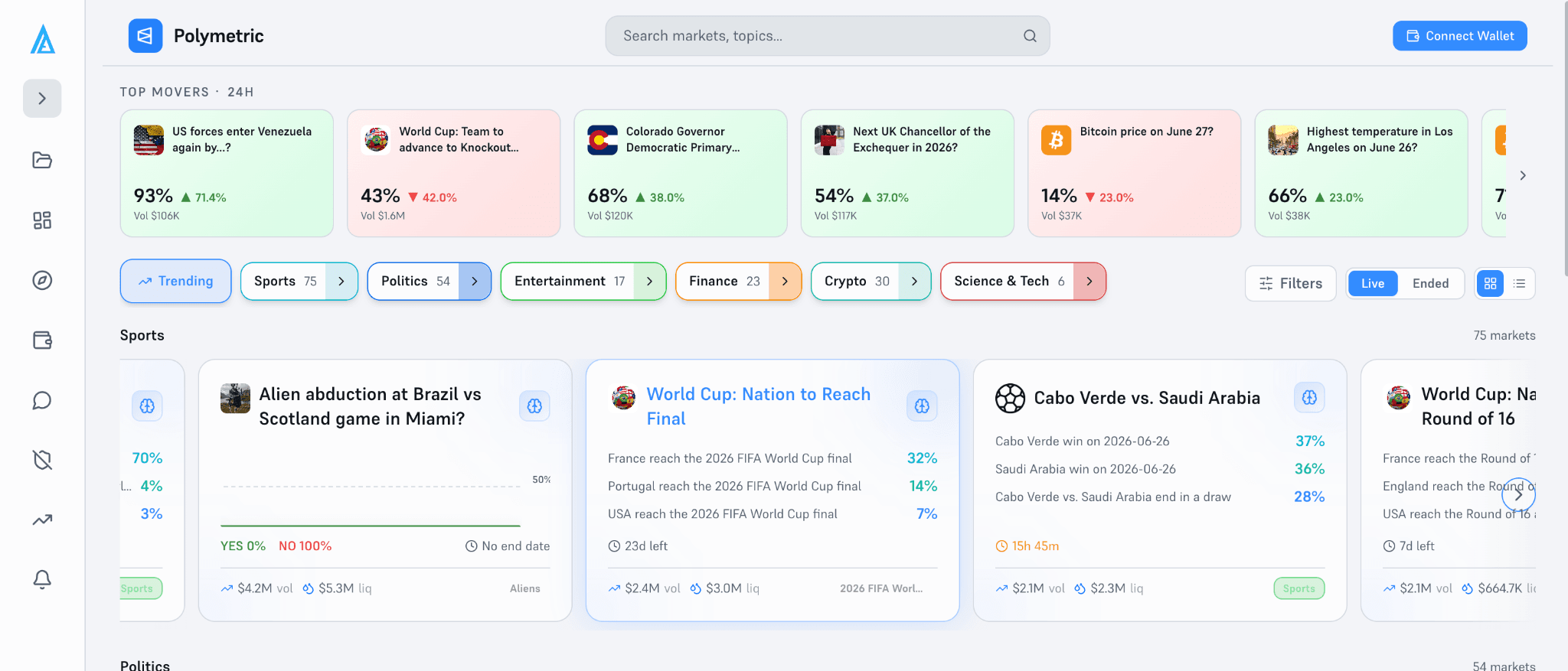
Track how government shutdown probabilities move in real time across every active Polymarket contract with Polymetric by Laika AI. Live market intelligence for traders who need to see legislative developments reflected in prices before the broader market catches up.