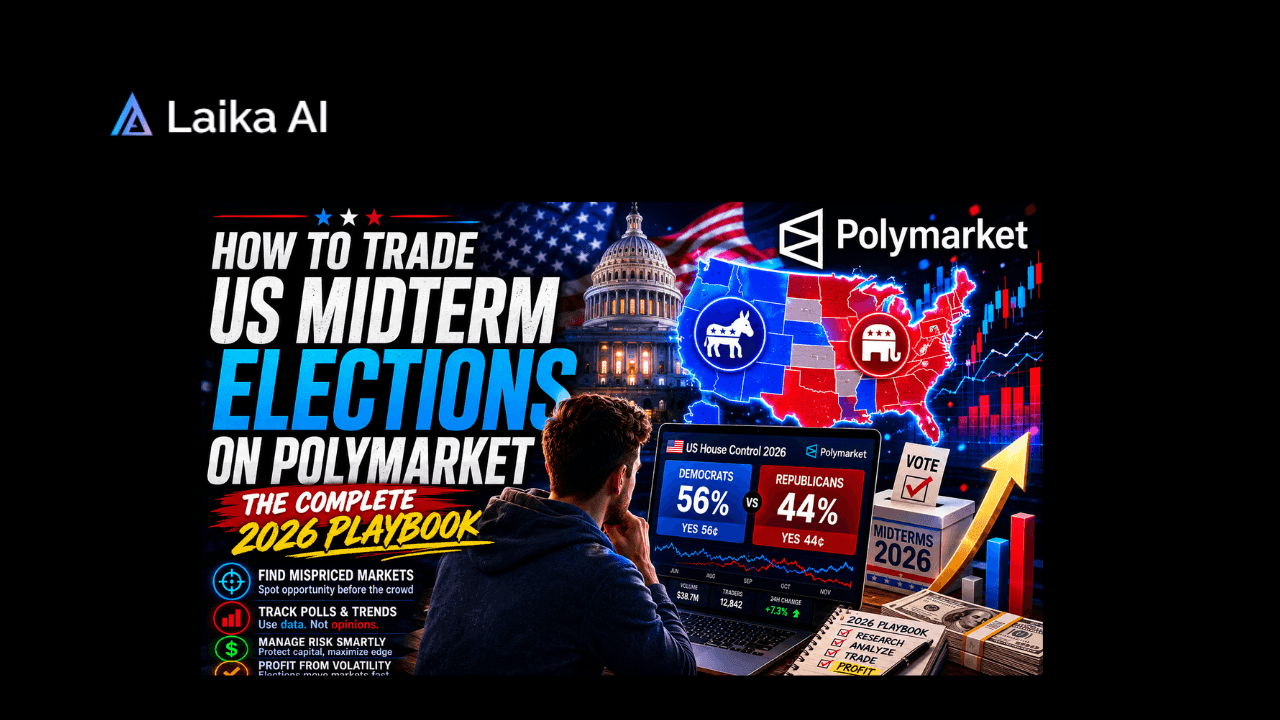
The polymarket midterm elections 2026 markets are structurally different from the presidential cycle markets that drove $3.7 billion in trading volume in 2024, and understanding those structural differences is the prerequisite for trading them profitably. Presidential markets concentrate enormous liquidity into a small number of high-profile contracts. Midterm markets distribute that liquidity across hundreds of individual congressional, Senate, and gubernatorial races, each with its own polling environment, candidate quality, and resolution timeline.
That distribution creates both the challenge and the opportunity. The challenge is that most individual midterm race markets have significantly lower volume than the flagship presidential contracts, which means wider spreads and less reliable price signals. The opportunity is that the crowd's analytical attention is similarly distributed, which means individual race markets are more likely to be mispriced than a $500 million presidential contract where sophisticated capital from around the world is concentrated on a single outcome.
The 2026 midterm cycle arrives in a specific political environment: a post-presidential election Congress where the House and Senate majorities are narrow enough that a small number of competitive races will determine control. That makes the chamber control markets, specifically which party controls the House and Senate after November 2026, the most liquid and most tradeable midterm contracts on Polymarket. For the foundational framework on how Polymarket prices political outcomes as probability estimates, Polymarket explained: how prediction markets work covers the complete mechanics before going into cycle-specific tactics.
How 2026 Midterm Markets Are Structured on Polymarket
Polymarket's 2026 midterm coverage runs across three distinct market categories, each requiring a different analytical approach and a different trading framework.
Chamber control markets
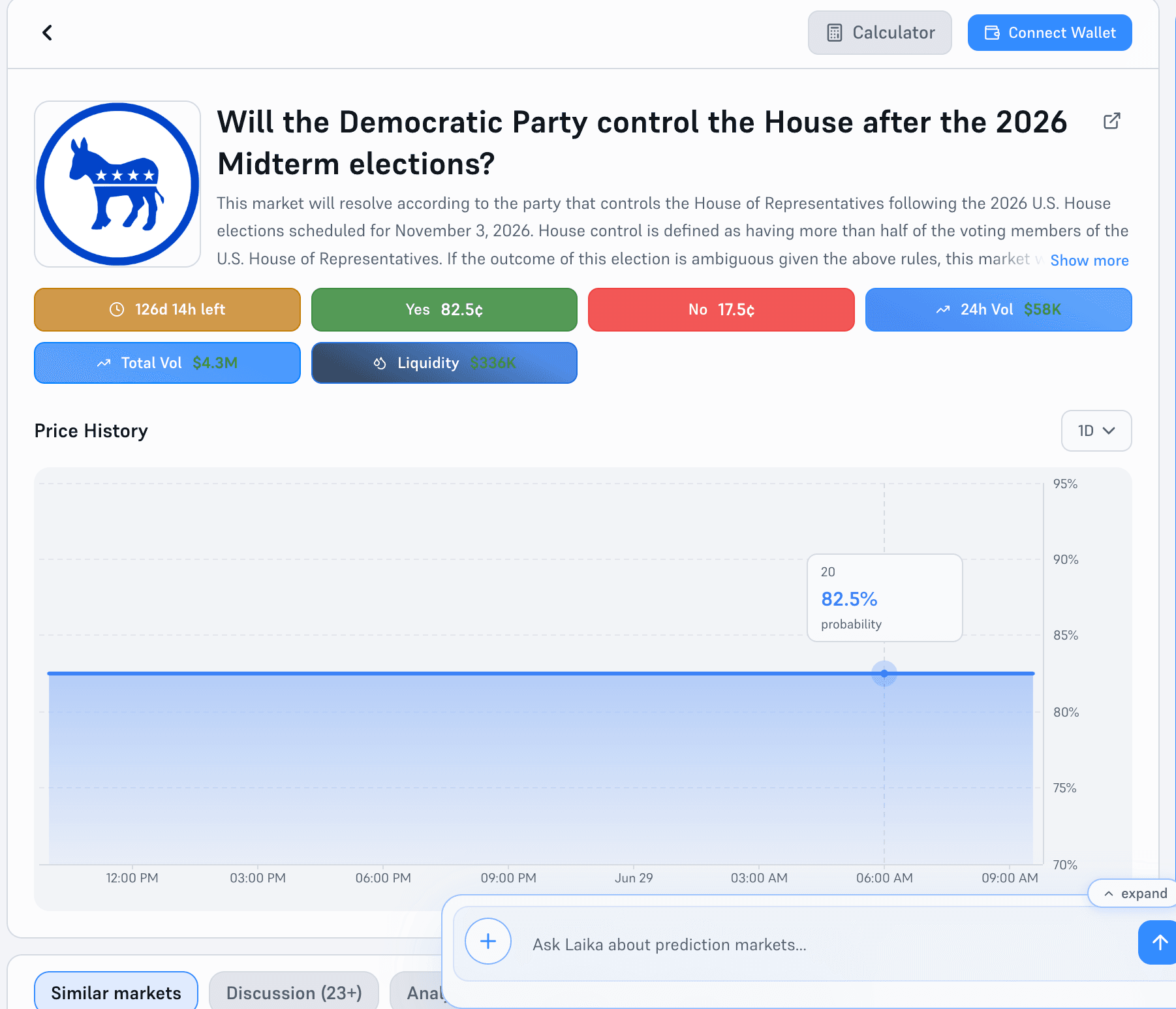
The House and Senate control markets are the flagship 2026 midterm contracts. They ask a single binary question: which party will control each chamber after the November election? These are the most liquid midterm contracts on Polymarket because they aggregate the outcome of all individual races into a single tradeable instrument.
The chamber control markets behave like a prediction market on the median competitive race rather than on any specific district or state. When the polling environment shifts in a way that affects a large number of competitive races simultaneously, the control probability decreases sharply. When individual race results deviate from the trend without changing the broader environment, the impact on control probability is smaller than retail traders typically expect.
Individual race markets
Polymarket runs individual race markets in competitive Senate, House, and gubernatorial elections. These contracts ask which candidate will win a specific race, priced as implied probability of the Democratic or Republican candidate winning.
Individual race markets are thinner than control markets and require more specific analytical work. The crowd pricing a Montana Senate race or a Pennsylvania congressional district is smaller and less informed than the crowd pricing House control probability. That information gap is where the edge in individual race trading lives, but it requires genuine knowledge of district-level demographics, candidate quality, and local political dynamics that most prediction market traders do not have.
Policy outcome markets
Polymarket also runs markets on specific legislative outcomes that are contingent on midterm results: will a specific bill pass in the next Congress, will a specific committee chairmanship change hands, will a specific policy be reversed. These markets have the thinnest liquidity of the three categories and the most complex resolution criteria, but they offer the most distinctive opportunities for traders with genuine policy expertise.
How Midterm Probabilities Are Priced and Where Historical Markets Have Been Wrong
Understanding the systematic errors that prediction markets have made in previous midterm cycles is the most reliable guide to finding exploitable gaps in the 2026 cycle.
The structural headwind that markets historically underprice
The president's party almost always loses seats in midterm elections. Since 1938, the president's party has lost House seats in 17 of 21 midterm elections. The average loss is 28 seats. This structural headwind is well-known and is incorporated into prediction market prices at the opening of the cycle.
What prediction markets have historically underpriced is the magnitude of that headwind in specific political environments. In cycles where presidential approval ratings are below 45%, the seat loss for the president's party has historically been significantly above the structural average. In cycles where economic conditions are deteriorating, the headwind amplifies further. Markets that price the structural headwind but underweight the environment-specific multiplier are systematically mispriced in a predictable direction.
The 2026 cycle opens with specific approval rating and economic conditions that should be compared against historical base rates before any position is taken in the chamber control markets. If the current environment is consistent with historical cycles that produced above-average seat losses for the president's party, the chamber control markets may be priced too favorably for the incumbent party.
The October surprise problem
Prediction markets in midterm cycles are particularly vulnerable to late-breaking information that moves prices sharply in the final six to eight weeks of the campaign. Unlike presidential markets where the candidate is fixed and the information environment is relatively stable, midterm markets can be affected by late candidate controversies, economic data releases, and external events that change the national environment in ways that ripple across dozens of competitive races simultaneously.
Historical examples include the 2006 cycle where the Foley scandal moved prediction market prices on Republican House control probability by 8 to 12 percentage points in a single week. The 2010 cycle saw Tea Party enthusiasm significantly underweighted by early-cycle prediction market prices because the models used were anchored to historical turnout patterns that did not account for motivated minority opposition.
The practical implication: midterm prediction markets should be sized with the recognition that low-probability tail events in the final weeks can produce outsized price movements. Full position sizing in October, four weeks before the election, carries a specific category of October surprise risk that is not present in positions entered in July or August.
Where polling-to-market gaps appear
The 2026 midterm prediction markets will price congressional races against a polling backdrop that has specific systematic errors based on recent election cycles. 2020 and 2022 showed consistent polling errors in the same direction in Senate and House races, with polls overestimating Democratic performance in specific states and districts.
Prediction markets historically anchor too closely to poll averages in individual race markets, which means that in cycles where polling error has been systematic and directional, the prediction markets inherit the same error. Traders who have a well-calibrated view of likely polling error based on the 2020 and 2022 patterns have an information advantage over the crowd that is directly trading the polling average.
For the parallel framework applied to how prediction markets price other binary political outcomes beyond elections, Iran war markets on Polymarket: what traders need to know covers the methodology for non-electoral political risk. For how prediction markets price legislative outcomes like government shutdowns that are directly affected by midterm results, US government shutdown markets: how to trade political gridlock covers the framework.
A Trading Playbook for the 2026 Midterm Cycle
Midterm election trading requires a different calendar framework from both sports markets, which reprice within hours, and presidential markets, which build toward a single known event date. The midterm cycle has multiple distinct windows where the information environment changes enough to warrant significant position adjustments.
Phase 1: Pre-cycle positioning (Now through April 2026)
The earliest entry window in the 2026 midterm cycle offers the widest potential return but the lowest information quality. Chamber control prices at this stage reflect structural factors, current approval ratings, and historical base rates rather than any race-specific polling or candidate quality assessment.
The correct approach in this phase is to identify whether the current political environment is above or below the historical average for the president's party's midterm performance, and position accordingly in the chamber control markets. If the environment suggests an above-average headwind for the president's party and the chamber control markets have not fully priced that headwind, buy the opposition party's control probability at the current price.
Position size should be small, 1 to 2 percent of your total political market budget, because the remaining uncertainty across nine months of campaigning is enormous. The early phase captures the highest potential return but carries the most uncertainty per dollar deployed.
Phase 2: Primary and candidate quality window (April through June 2026)
Primary elections in 2026 will determine the candidates in competitive Senate and House races, and candidate quality has a documented impact on race outcomes that is often underpriced in early prediction market contracts.
The 2022 cycle provided the clearest recent example: in several Senate races, Republican primaries produced candidates who significantly underperformed expectations against Democratic incumbents, and the individual race prediction markets did not fully adjust for candidate quality until well after the primaries concluded. Traders who assessed candidate quality immediately after primary results and compared it against the existing market prices had a consistent edge in those markets during the June to September window.
The candidate quality assessment framework: evaluate the winning primary candidate on three factors that have documented predictive value in competitive Senate and House races. Their fundraising capacity relative to the opponent, which is publicly available through FEC filings and is the single most reliable predictor of competitive race outcomes. Their general election favorability rating in the specific district or state, which requires access to quality district-level polling. And their prior electoral experience, with first-time candidates in competitive races consistently underperforming prediction market prices relative to experienced candidates.
Phase 3: The debate and polling window (July through October 2026)
The summer and fall debate cycle is the highest-information window of the entire midterm campaign. State and congressional debates provide direct candidate comparison in a way that polls and fundraising data cannot replicate, and prediction markets historically underprice significant debate performances in individual race contracts.
The specific pattern to watch: when an underdog candidate significantly outperforms expectations in a debate and the incumbent visibly struggles, the individual race market price adjusts within hours. But the chamber control market is slower to reflect the same information because it requires traders to assess how the single debate outcome affects the aggregate of all competitive races, which is a more complex analytical step that the crowd takes longer to complete.
The arbitrage opportunity within the Polymarket midterm market structure: buy the underdog's individual race probability immediately after a strong debate performance, and if your read on the candidate quality suggests the debate represents a genuine improvement in their race position rather than a one-night anomaly, add to the position in the chamber control market where the adjustment has not yet fully propagated.
Phase 4: Election day volatility (November 2026)
Election day creates the most concentrated price volatility in any prediction market cycle. Early results in key competitive races move chamber control probability in real time as traders interpret partial results against the expected voting pattern.
The systematic error that retail traders make on election day is treating early returns as representative of the final outcome. Early precinct reporting in many competitive states is geographically concentrated in ways that make the early results directionally biased before the full picture is available. Rural precincts, which tend to report earlier in many states, have historically skewed results toward Republican candidates before urban precincts report and rebalance the count.
Traders who understand the reporting sequence in key competitive states, Pennsylvania, Wisconsin, Arizona, Georgia, Nevada, and Michigan in Senate cycles, can assess whether early results are consistent with the expected reporting pattern rather than treating early numbers as the final trend. The price movement on chamber control markets during the two-hour window when early returns are coming in but before the full picture is clear is almost always an overreaction to the directional bias of early reporting.
For the broader framework on systematic political market strategies across multiple event types, Kalshi prediction market: 7 strategies that work in 2026 covers approaches that apply across the full political market category.
Risk Management for Political Markets
Political prediction markets carry specific risk categories that are different from sports markets and that most retail traders underweight when sizing positions.
Binary outcome risk compounds with position size
Every individual midterm race market resolves to either $1 or $0. A 65% favorite still loses 35% of the time. A portfolio of ten individual race positions where each position has 65% implied probability of winning will produce at least two to three losing positions on average, and those losses can offset gains from the winning positions if position sizes are not calibrated correctly.
The correct framework is portfolio-level expected value rather than contract-level expected value. Your total midterm market allocation should be sized to produce a positive return even if 35% of your individual race positions lose. That means smaller individual position sizes than most retail traders use, and more diversification across the market categories described above.
Liquidity windows narrow sharply around election day
Individual race markets on Polymarket can develop wide spreads in the final 24 to 48 hours before election day as the trader pool concentrating on any specific market becomes thinner relative to the volatility of the market. The liquidity that was sufficient to enter and exit positions smoothly three weeks before the election may not be available at the same quality in the final two days.
Plan your exit strategy for any individual race position before election day, not during it. If you want to realize a gain on a position that has moved in your favor, execute the exit in the final week before the election when liquidity is still sufficient rather than on election day when the spread may have widened significantly.
Resolution timelines are longer than sports markets
Midterm election results in competitive races may not be certified for days or weeks after election day. Mail ballot counting in states like Arizona and Nevada has historically extended the period between election day and final certified results. Prediction market contracts on those races cannot resolve until the official result is confirmed, which means capital can be locked in unresolved positions for a week or more after the election.
Model your expected capital return timeline based on the specific states your positions are concentrated in. Positions in states with slower certification processes require longer capital commitment than positions in states that typically certify results within 24 to 48 hours of election day.
For the complete framework on sizing across binary political markets including correlation risk across multiple race positions, the prediction market bankroll management guide covers the methodology in full.
Frequently Asked Questions
Does Polymarket have 2026 midterm election markets?
Yes. Polymarket runs markets on the 2026 US midterm elections including chamber control markets for both the House and Senate, individual race markets for competitive Senate and House seats, and gubernatorial race markets in key states. The chamber control markets are the most liquid and the most actively traded. Individual race markets open as primary results confirm candidates and polling begins to focus on specific competitive races. Check the live elections section at polymarket.com for the current active 2026 midterm contracts.
How does Polymarket price congressional race probabilities?
Congressional race probabilities on Polymarket are set by the aggregate of all capital-backed trader positions on the platform's central order book. No algorithm or house sets the price. Traders price races based on available polling, historical base rates, candidate fundraising data, and their own assessment of the political environment. The resulting price reflects the crowd's aggregate probability estimate. Historical analysis shows that prediction markets anchor closely to public polling averages in individual race markets, which means they inherit systematic polling errors when polls are directionally biased.
What is the best strategy for trading midterm elections on Polymarket?
The most consistently profitable approach combines early-cycle positioning in chamber control markets when the structural political environment diverges from current market prices, candidate quality assessment in the post-primary window when the market has not yet adjusted for primary results, and election day exit discipline that avoids the overreaction to early reporting bias in key competitive states. On polymarket midterms reddit, the prediction markets subreddit carries active community discussion of specific race-level analysis and polling interpretation throughout the cycle.
Can US users trade political markets on Polymarket?
Yes. Polymarket US launched in December 2025 under CFTC oversight and political markets including the 2026 midterm elections are accessible to residents in eligible states. Nine states have active restrictions on sports-adjacent markets but political markets have a different regulatory status under the CFTC's framework. Verify current access for your specific state at Polymarket's help center before depositing. For the deepest liquidity on individual race markets and lower-volume political contracts, the global Polymarket platform accessed through USDC on Polygon typically has better order book depth than the US-only platform.
The Bottom Line
The 2026 polymarket midterm elections cycle offers a different set of opportunities from the 2024 presidential market that drove the platform's record volume. The liquidity is more distributed, the analytical work is more granular, and the edge lives in specific windows rather than in a single concentrated event.
The chamber control markets are the most liquid and the best entry point for traders who want straightforward exposure to the midterm environment without race-specific analytical work. The individual race markets offer higher potential edges for traders with genuine district-level knowledge but require careful attention to liquidity and resolution timelines. The October surprise window is the highest-risk, highest-potential-reward period of the cycle and requires conservative position sizing that allows for late-breaking information to move markets significantly in either direction.
Track how 2026 midterm election probabilities move in real time across every active Polymarket contract with Polymetric by Laika AI. Live market intelligence for political traders who want to see polling shifts and market repricing before the crowd acts on them.