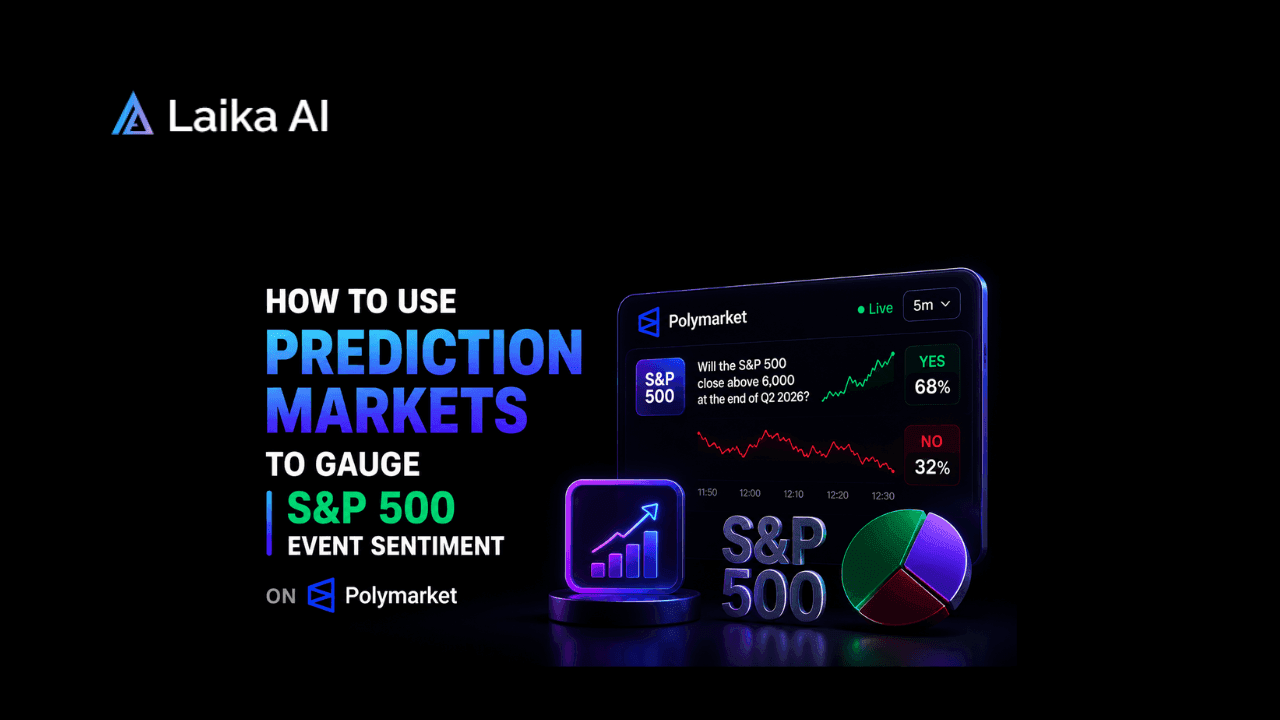
Prediction market S&P 500 sentiment tracking works because the events that move equity markets most sharply, Federal Reserve decisions, elections, major earnings, and geopolitical shocks, are also the events that Polymarket and Kalshi price explicitly as binary probability contracts. A Fed rate decision market showing 85% probability of a hold is not just a curiosity for prediction market traders. It is a real-time, continuously updating read on how a large pool of capital-backed participants assesses the exact event that will move the S&P 500 within hours of resolution. Reading that signal correctly, and understanding precisely where it stops being useful, is what separates a genuinely additive input to your equity trading process from a distraction that adds noise instead of edge.
This guide covers how prediction markets price the macro events that drive S&P 500 movement, how to read those prices as a leading indicator rather than a lagging one, a practical framework for incorporating this data into actual equity trade decisions, and the specific limitations, liquidity, sample size, and reflexivity, that determine when this signal is trustworthy and when it is not. For the foundational mechanics of how any Polymarket contract prices probability, Polymarket explained: how prediction markets work covers the structure underlying every signal referenced in this guide.
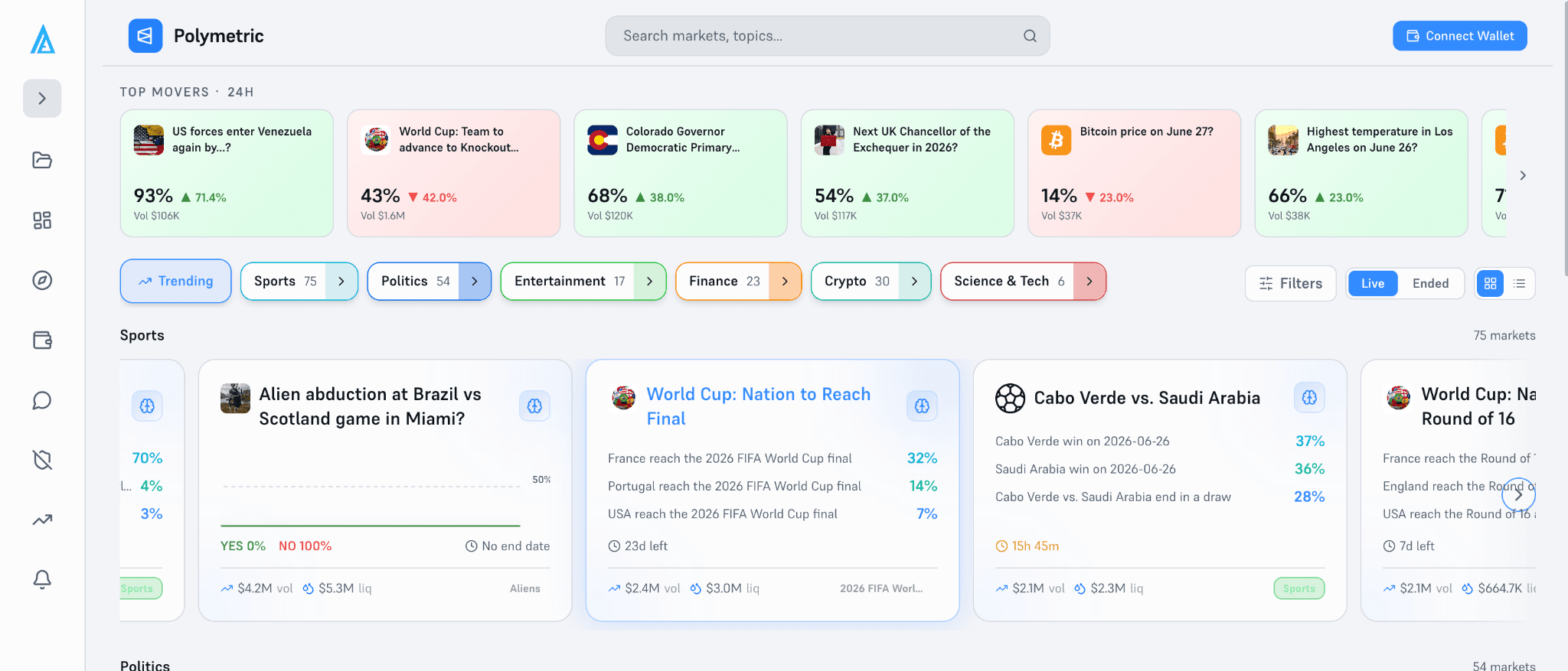
Discover where the market is moving before the headlines. Browse live prediction markets, track real-time odds, and trade on sports, crypto, politics, and breaking global events all in one place.
Explore Live Prediction Markets
How Prediction Markets Price the Events That Move the S&P 500
The S&P 500 does not move randomly. It reacts predictably, if not always precisely, to a defined set of macro and corporate events, and prediction markets price the probability of those specific events explicitly before they occur.
The Federal Reserve's FOMC meeting calendar is the single most important reference point for this entire framework, since Fed decisions produce the most consistent and best-documented relationship between prediction market pricing and subsequent S&P 500 movement of any event category. Every scheduled FOMC meeting has a corresponding Polymarket or Kalshi contract pricing the rate decision probability well in advance, updating continuously as economic data arrives between meetings.
The mechanism connecting the prediction market price to the equity move is straightforward: when a Fed decision market shifts meaningfully, informed traders are updating their probability assessment of monetary policy, which is one of the primary drivers of equity valuation through the discount rate applied to future earnings. A polymarket stock market connection exists not because Polymarket trades equities directly, it does not, but because the events Polymarket prices are the same events equity markets are pricing simultaneously, often with prediction markets moving first given their continuous, low-friction trading structure.
Reading Prediction Market Signals as a Leading Indicator
The value of prediction market data for equity sentiment comes from a specific structural advantage: continuous, capital-backed repricing without the friction of options market maker inventory management or the batch-processing nature of survey-based sentiment indicators.
Why prediction markets can lead equity pricing
A Fed rate decision market can reprice sharply on a Sunday evening following a surprise economic data leak or a significant geopolitical development, while equity index futures remain in a comparatively illiquid overnight session. Traders monitoring the prediction market price directly capture that repricing before Monday's cash equity session opens and processes the same information in a less continuous, more constrained trading environment.
Reading the signal correctly
The practical skill is distinguishing a meaningful probability shift from routine noise. A Fed decision market moving from 82% to 85% probability of a hold over several days reflects gradual data absorption and carries limited standalone signal value. The same market moving from 82% to 45% within a single session, following an unexpected inflation print or a surprise Fed communication, represents a genuine repricing event that equity markets have likely not fully absorbed yet, particularly if the move occurs outside standard trading hours.
This same framework applies directly to other macro-sensitive asset classes beyond equities. Crypto correlation trading with prediction markets covers how the identical logic, using event-driven contract repricing as a leading indicator, applies to crypto assets that are similarly sensitive to Fed policy and macro data surprises. Commodity prediction markets 2026 extends the same principle to oil and gold, both of which respond to overlapping macro drivers that predict market price continuously.
A Practical Framework for Incorporating This Data
Turning prediction market signals into an actual input for equity trade decisions requires a defined process rather than casual observation of prices moving around.
Step 1: Build a watchlist of the highest-relevance contracts
Not every Polymarket or Kalshi contract carries equal weight for S&P 500 sentiment. Prioritize the events with the most established, documented relationship to the equity movement.
Step 2: Establish a baseline and monitor for deviation
Check your Tier 1 contracts daily and note the current probability alongside the equity market's apparent pricing of the same risk, visible through options-implied volatility or futures positioning if you have access to that data. A meaningful divergence, where the prediction market has moved but equity pricing has not yet reflected the same shift, is the specific signal worth acting on.
Step 3: Weight the signal by timing and magnitude
A prediction market move that occurs during standard equity trading hours has likely already been partially absorbed by the time you observe it. A move occurring overnight, over a weekend, or during a period of low equity market attention carries substantially more standalone value, since it represents information equity markets have not yet had the opportunity to fully price.
Step 4: Use the signal to inform position timing, not replace fundamental analysis
Prediction market sentiment data works best as a timing and confirmation layer on top of your existing equity analysis, not as a standalone trading signal. If your fundamental view already favors a specific sector or direction, a sharp, unexplained prediction market shift in a related event contract is a reason to act with more urgency or reconsider timing, not a reason to abandon your underlying thesis and chase the prediction market price alone.
For the broader application of event-driven prediction market signals as portfolio protection rather than purely directional signals, geopolitical hedging with prediction markets covers how the same monitoring framework extends into a formal hedging structure for equity and broader portfolio exposure.
The Limits of Prediction Market Signals for Equity Trading
Liquidity constraints
A prediction market contract with thin trading volume can show price swings driven by a single large order rather than genuine shifts in aggregate probability assessment. Treating a low-liquidity contract's price movement as a meaningful equity sentiment signal risks reacting to noise rather than information. Restrict signal reliance to contracts with substantial, consistent trading volume, particularly the major Fed and election markets where deep participant bases produce more reliable pricing.
Small sample size
The relationship between prediction market pricing shifts and subsequent equity movement is documented but not backed by the decades of data that traditional technical or fundamental indicators draw on. Prediction markets at meaningful scale are a relatively recent phenomenon, and the specific correlation patterns observed over the past several years may not hold with the same reliability going forward. Treat correlation strength as a directional guide rather than a precisely calibrated statistical relationship.
Reflexivity risk
As more traders incorporate prediction market data into equity decisions, the signal itself can become partially self-fulfilling or distorted by the attention it receives. A widely-watched Fed decision market may begin reflecting not just genuine probability assessment but also anticipatory positioning from traders who know other market participants are watching the same contract. This does not eliminate the signal's usefulness but means it should never be the sole input driving a trade decision.
For the complete framework on sizing positions and managing risk when incorporating any external signal, including prediction market data, into a broader trading process, the prediction market bankroll management guide covers position sizing discipline that applies equally to equity trades informed by these signals.
Frequently Asked Questions
Can prediction markets predict S&P 500 movements?
Not directly or with certainty, but they provide a genuine leading signal for the specific macro events, Fed decisions, elections, inflation data, that historically drive S&P 500 movement. Prediction markets price these events continuously and with less friction than equity markets, which means meaningful probability shifts can precede the equity market's own repricing, particularly when the shift occurs outside standard trading hours.
Which Polymarket events are most correlated with S&P 500 performance?
Federal Reserve rate decision markets and inflation data release markets show the strongest and most consistently documented relationship with S&P 500 movement, given the direct link between monetary policy expectations and equity valuation. Presidential and congressional election markets, government shutdown deadline markets, and major geopolitical conflict markets also carry meaningful but generally less immediate correlation.
How do you use prediction market data as a trading signal?
Build a watchlist of the highest-relevance contracts, primarily Fed decisions and inflation data, monitor for meaningful deviations from baseline rather than routine drift, weight signals more heavily when they occur outside standard equity trading hours since equity markets have not yet had the chance to react, and use the resulting signal to inform position timing and urgency rather than as a standalone replacement for fundamental analysis.
Are prediction markets a reliable leading indicator for equity markets?
They are a genuinely useful supplementary input with specific, well-documented limitations rather than a fully reliable standalone indicator. Liquidity constraints on thinner contracts, a relatively small historical sample size for the underlying correlation, and reflexivity risk as more traders watch the same signals all mean prediction market data works best as one input among several in an equity trading process, not as the sole basis for a trade decision. For ongoing community discussion of specific prediction market signals and their equity market implications, polymarket S&P 500 reddit threads in prediction market and trading communities tend to be most active around major scheduled Fed and economic data events.
The Bottom Line
Prediction market S&P 500 sentiment tracking works because the underlying events, Fed policy, elections, inflation data, geopolitical shocks, are priced explicitly and continuously on Polymarket and Kalshi before equity markets have the opportunity to fully absorb the same information. The structural advantages, 24/7 trading, no market maker inventory constraints, direct binary event isolation, create a genuine leading indicator in specific, identifiable circumstances, particularly overnight and weekend repricing events that equity markets have not yet processed.
The limitations are real and should shape how heavily this signal factors into any trading decision. Liquidity constraints on thinner contracts, a limited historical sample for calibrating correlation strength, and reflexivity risk as the signal becomes more widely watched all argue for treating prediction market data as a confirmation and timing layer rather than a standalone trading system.
Track how Fed decision, inflation, and election probabilities move in real time across every active Polymarket contract with Polymetric by Laika AI. Live market intelligence for equity traders who need to see the macro repricing before the broader market catches up.