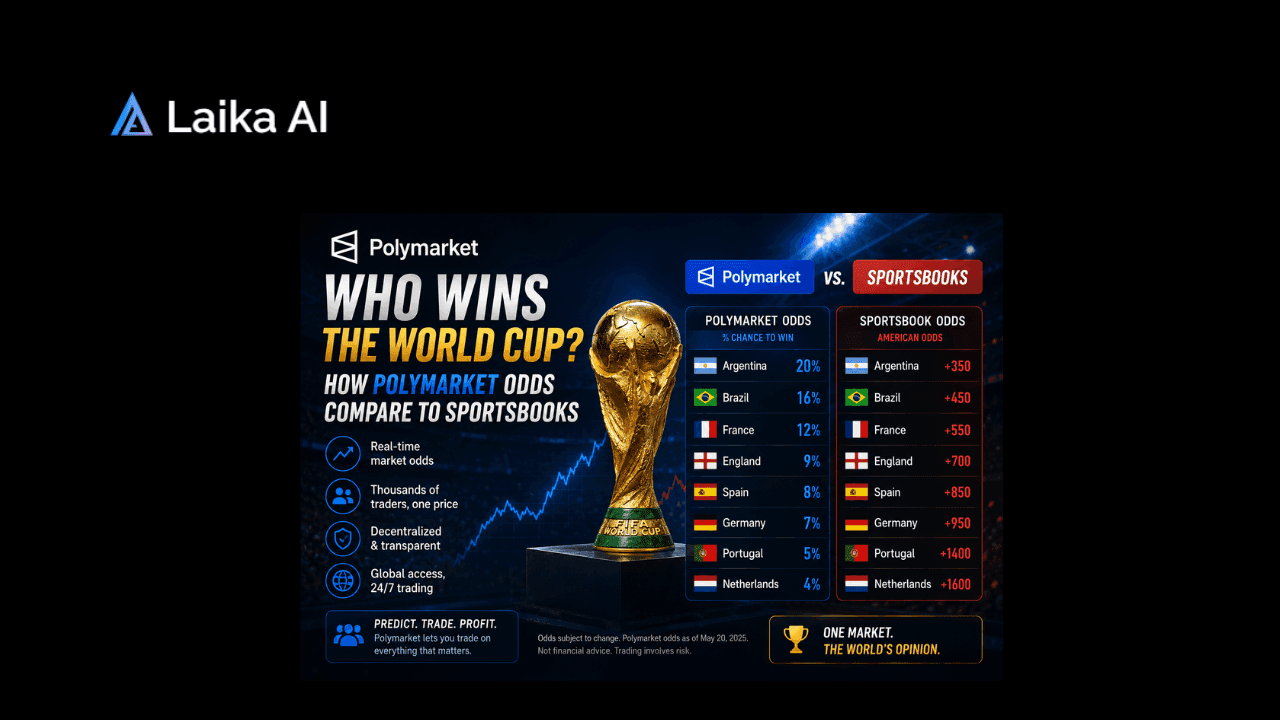
With few days until the 2026 FIFA World Cup kicks off in Mexico City, the two most sophisticated pricing systems for sports outcomes are telling meaningfully different stories about who wins. Polymarket has Spain and France as co-favourites at 17% each. FanDuel has Spain ahead at +450 with France back at +550. DraftKings has France and Spain tied at +500. The divergences across platforms on this polymarket world cup market are not random noise, they are information. Within the broader polymarket sports markets guide ecosystem, the World Cup winner market at $394.9 million in pre-tournament volume is the largest world cup prediction market ever run on any platform.
This article covers the full head-to-head comparison table, what the gaps mean, the Yamal injury case study as live evidence of how Polymarket replicates faster, which platform has historically been more accurate, and what to do with all of it before June 11.
The Full Comparison Table: Polymarket vs Sportsbooks Right Now
Verify all Polymarket figures at the live Polymarket World Cup winner market and all sportsbook figures at respective platforms before making any trading decisions.
The tightest alignment between Polymarket and sportsbooks is in Spain, both pricing them at approximately 17 to 18% which suggests this is the most efficiently priced position in the entire tournament. The widest gap is in France: Polymarket has them at 17% while FanDuel has them at +550, implying roughly 15.4%. That 1.6 percentage point difference on the co-favourite is meaningful at scale and is not explained by big alone.
The full context of how polymarket world cup 2026 pricing is constructed and where the structural inefficiencies tend to sit is covered in how to read polymarket sports odds.
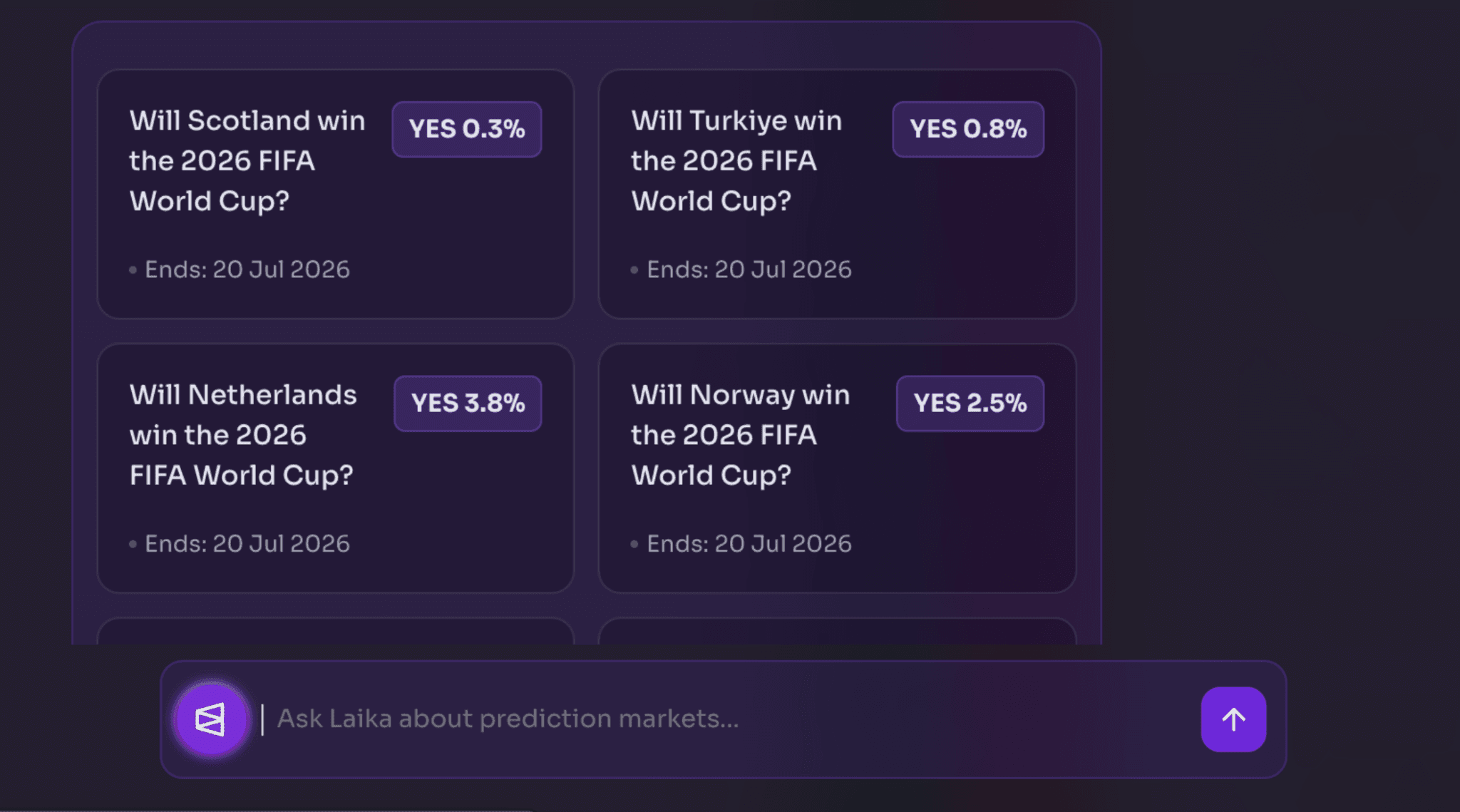
Not every profitable trade comes from favorites. Some of the biggest prediction market opportunities come from mispriced long shots before public sentiment catches up. Ask Laika AI who has hidden value in the 2026 FIFA World Cup markets and compare odds across platforms instantly.
Where the Gaps Are and What They Mean?
Four specific divergences from the comparison table, each with a concrete explanation.
Gap 1: France: Polymarket higher than FanDuel by 1.6 points
Polymarket prices France at 17% equivalent to approximately +471. FanDuel has France at +550, implying 15.4%. Two possible explanations for this world cup 2026 odds gap. First, FanDuel is embedding more vig into France's line while Polymarket's fee-free structure reflects a cleaner probability. Second, Polymarket's global trader base includes a significant French sports audience that is systematically more bullish on France than FanDuel's US-centric customer base. Historically when these two diverged on a European team, Polymarket's global audience tends to be better calibrated on European international form. France at 17% on Polymarket versus 15.4% on FanDuel is either more accurate pricing or an audience bias and the evidence leans toward the former.
Gap 2: England: sportsbooks higher than Polymarket by 1 to 2 points
FanDuel has England at +650 implying 13.3%. Polymarket has England at approximately 11%. A 2.3 percentage point gap on a top-five contender. Sportsbooks are pricing England more generously than Polymarket's crowd. The most likely explanation: American sportsbook customers are more familiar with the Premier League than with the nuances of England's actual international tournament record consecutive exits at Euro 2020 and Euro 2024, both on penalties, both from winnable positions. Polymarket's global audience is pricing England's tournament history. Sportsbooks may be pricing the Premier League halo.
Gap 3: Argentina: Polymarket lower than sportsbooks
Polymarket prices Argentina at approximately 8%. FanDuel and DraftKings have them at +800 to +900 implying 10 to 11.1%. The defending champions are priced more generously on sportsbooks than on Polymarket. Polymarket traders, many of whom closely follow South American football, may be pricing in Argentina's difficult qualifying campaign and the genuine uncertainty around Messi's playing time more accurately than the US sportsbook audience that primarily remembers the 2022 title.
Gap 4: Morocco: broadly consistent
Morocco sits at 2 to 3% on Polymarket and approximately +5000 on DraftKings. The two are close enough to suggest efficient cross-platform pricing on an emerging contender. No obvious edge here when Polymarket and sportsbooks agree on a team, the consensus is likely fair.
For the full winner market analysis grounded in tournament structure and historical probability, 2026 world cup winner odds analysis covers the complete breakdown.
The Yamal Injury A Live Case Study in How Polymarket Reprices Faster
This is not a theory. It happened during this tournament cycle and the data is clean.
After Spain's 18-year-old phenom Lamine Yamal suffered a hamstring injury in a Barcelona match, Spain's World Cup winner probability dropped immediately on Polymarket within hours of the injury being reported. Before the injury Yamal was considered Spain’s most dangerous attacking threat the player who had lit up Euro 2024. and become the fulcrum of Spain's offensive system. The market priced his absence risk through Spain's winning contract within the same news cycle.
Sportsbooks adjusted their lines over the following 12 to 24 hours.
The repricing gap between platforms is the most consistently documented edge in World Cup pre-tournament trading, and the Yamal injury is the clearest polymarket world cup 2026 example of it in action. Polymarket prices update in real time based on supply and demand from thousands of traders reacting simultaneously. Sportsbooks have a line adjustment process, a human or algorithm that reviews the news, assesses the risk, and updates the number. That process takes time. The gap between Polymarket's real-time update and the sportsbook's adjusted line is the window.
Yamal is now expected to be available for the tournament. Spain's price has recovered to 17%. Traders who bought Spain during the injury scare when the price dipped on the uncertainty and held through the recovery captured a real return on information about his likely availability. That trade was available on Polymarket within hours of the injury report. On sportsbooks, the line had not yet moved far enough to make the same entry compelling.
The world cup prediction market repricing speed advantage is not limited to the pre-tournament window. It repeats throughout the group stage, through every upset elimination, and through every injury update across the tournament's 48 days. The pattern is structural, not coincidental.
Why Polymarket and Sportsbooks Price the World Cup Differently
Three Structural Reasons, Not One.
The big difference
Polymarket is a peer-to-peer exchange, not a sportsbook. There is no house taking the other side of your trade. Sportsbooks like FanDuel and DraftKings build 4 to 8% overround into their lines. This overround compresses the implied probabilities a team priced at 17% on Polymarket might appear at +550 on FanDuel partly because the sportsbook has taken margin from both sides of the market. When comparing Polymarket probability to sportsbook implied probability, strip approximately 3 to 4 percentage points of sportsbook vig before treating any gap as genuine information. Some of what looks like a divergence is big. Not all of it is.
The audience difference
Polymarket's global user base includes traders from Europe, South America, Africa, and Asia where soccer is the dominant sport and local knowledge runs deep. US sportsbook audiences are more familiar with the Premier League and less so with CONMEBOL qualifying form, African Cup results, and the nuances of European qualifiers. This difference in audience composition is what creates the France gap, the Argentina gap, and the Morocco alignment simultaneously each reflecting the contrast between a globally informed market and a US-centric one.
The exit mechanic
A sportsbook futures bet is locked until the tournament ends. A Polymarket position can be sold at any time at the current market price. This means Polymarket prices reflect what traders are willing to pay with the knowledge that they can exit mid-tournament which produces more efficient long-run pricing than a locked futures market where every bettor is committed to resolution. For the full structural comparison of how polymarket sports betting mechanics differ from sportsbooks, prediction markets vs sports betting covers the framework in detail.
Has Polymarket Been More Accurate Than Sportsbooks at Past World Cups?
The 2022 Qatar World Cup was Polymarket's first major tournament with significant volume. The 2026 tournament with $394.9 million in aggregated volume before a single game has been played is the largest World Cup prediction market ever run.
The theoretical case for prediction market accuracy is well established. Prediction markets aggregate the financial conviction of thousands of participants in real time without a house view distorting the output. The price is purely the aggregate of all capital-backed positions. No oddsmaker's bias, no risk management protecting the book's position, no vig compressing the probability distribution.
The practical limitation is shared by both platforms. A 17% favourite has an 83% chance of not winning the World Cup. The question is not which platform picks the winner neither does reliably but which platform produces prices that better reflect true probability distributions across many events and many years.
On that measure, the evidence supports prediction markets on two specific counts. They are faster to incorporate the Yamal injury case study in the 2026 demonstration. And they are less subject to public bias toward familiar teams; England's overpricing at +650 on sportsbooks versus 11% on Polymarket is the clearest current example.
The polymarket world cup winner market at $394.9 million in volume is not just the largest ever run. It is the most information-dense sports forecasting instrument currently in existence. Whether it is right about France at 17% will be known on July 19. Whether it was more right than FanDuel at +550 will be a useful data point either way. For the methodology on identifying where these gaps represent genuine mispricing versus noise, how to find mispriced markets on Polymarket covers the framework. Common biases in prediction markets explains why the crowd makes predictable errors that create systematic opportunities.
Golden Boot Odds: Polymarket vs Sportsbooks
The Golden Boot comparison adds a second market dimension and shows where the platform divergence is most dramatic at the player level.
DraftKings currently prices Kylian Mbappe as the Golden Boot favourite at +600, Harry Kane at +700, Lionel Messi at +1200, Erling Haaland at +1400, Lamine Yamal at +1800, Mikel Oyarzabal at +1800, Cristiano Ronaldo at +2000, and Vinicius Junior at +2200.
Polymarket's Golden Boot market has the same top tier as its market leaders. The specific figures need verification before publishing as the dedicated market is expected imminently.
The structural point that matters most for the polymarket world cup comparison at the player level: the Golden Boot market on Polymarket has one concrete advantage over a sportsbook Golden Boot bet that has nothing to do with price accuracy. You can sell your position after the group stage when the leading scorer emerges, rather than waiting until the final game of the tournament. A player who scores four goals in the group stage and sees his Golden Boot probability jump from 8% to 35% on Polymarket can be sold at that peak. A sportsbook bet at 8% cannot be cashed out until the final whistle of the final on July 19. That exit mechanic is worth real money on a seven-week market.
Frequently Asked Questions
Who is the favorite to win the 2026 World Cup according to Polymarket?
Spain and France sit nearly tied atop the 2026 FIFA World Cup winner market on Polymarket at 17% each as of late May 2026. England follows at approximately 11%, with Brazil at 10% and Argentina at 8%. These odds update in real time, check polymarket.com before making any trading decisions.
How do Polymarket World Cup odds differ from sportsbook odds?
Polymarket prices are pure crowd-sourced probabilities with no vig. Sportsbooks embed 4 to 8% overround into every line, compressing implied probabilities. Spain at 17% on Polymarket converts to approximately +471 American odds. FanDuel has Spain at +450, a narrower gap than exists in France and England where the divergence is more pronounced and more likely to reflect genuine information rather than big alone.
Are Polymarket World Cup odds more accurate than sportsbooks?
Evidence supports prediction markets repricing faster after news events; the Yamal injury is the clearest 2026 example and being less subject to public bias toward familiar teams. Neither platform reliably picks tournament winners, but Polymarket's fee-free peer-to-peer structure produces prices that reflect aggregate information without a house margin distorting the output.
Why are Spain's odds different on Polymarket vs DraftKings?
Polymarket has Spain at 17% and DraftKings has Spain at +475 implying 17.4%. The gap is under half a percentage point the tightest alignment in the entire comparison table. After stripping DraftKings' embedded vig, the two platforms are effectively saying the same thing about Spain. This is what efficient cross-platform pricing looks like on a well-covered team.
Can you use Polymarket to trade during the World Cup if you are in the US?
Polymarket US launched in December 2025 with sports markets and is available in most US states. Nine states have restrictions. The global Polymarket platform where the deepest World Cup liquidity sits requires USDC on the Polygon blockchain. US traders in restricted states can use Kalshi for World Cup winner contracts with similar market structure. For the full platform comparison, polymarket vs kalshi for sports covers every relevant dimension.
How do World Cup odds change during the tournament on Polymarket?
Prices reflect real-time crowd-sourced probabilities and shift continuously as traders react to results and new information. Group stage results cause the largest single repricing events; a major upset elimination can redistribute 10 to 15 percentage points of championship probability within hours of the final whistle. The fastest moves happen in the 2 to 4 hours immediately after a result is confirmed, before the broader crowd has fully processed the implications.
What to Do With This Information Before June 11?
The comparison table tells a clear story across four teams.
Spain is efficiently priced across all platforms, with no obvious edge in either direction.
France is priced more generously on Polymarket than on FanDuel. The gap may reflect Polymarket’s global audience pricing France more accurately, or FanDuel’s vigour creating the illusion of divergence.
England is priced more generously on sportsbooks than on Polymarket. Sportsbooks appear to be pricing in the Premier League halo rather than England’s actual knockout-stage tournament record.
Argentina is priced more generously on sportsbooks than on Polymarket’s South America literate trader base, which may be pricing the difficulty of CONMEBOL qualifying and uncertainty surrounding Messi more accurately.
None of these gaps are certainties. They are signals. The Yamal injury case study is the clearest demonstration of what Polymarket does better: it processes information faster because there is no line adjustment delay and no house margin to protect. The window to act on these gaps closes June 11.
For everything running across the full World Cup and broader sports prediction market ecosystem, the polymarket sports markets guide is the complete picture.
Tracking how World Cup winner odds shift across Polymarket in real time from the Yamal injury to group stage results to knockout upsets is exactly what Polymetric is built for. Live market intelligence for every game of the tournament. → Start at laikalabs.ai