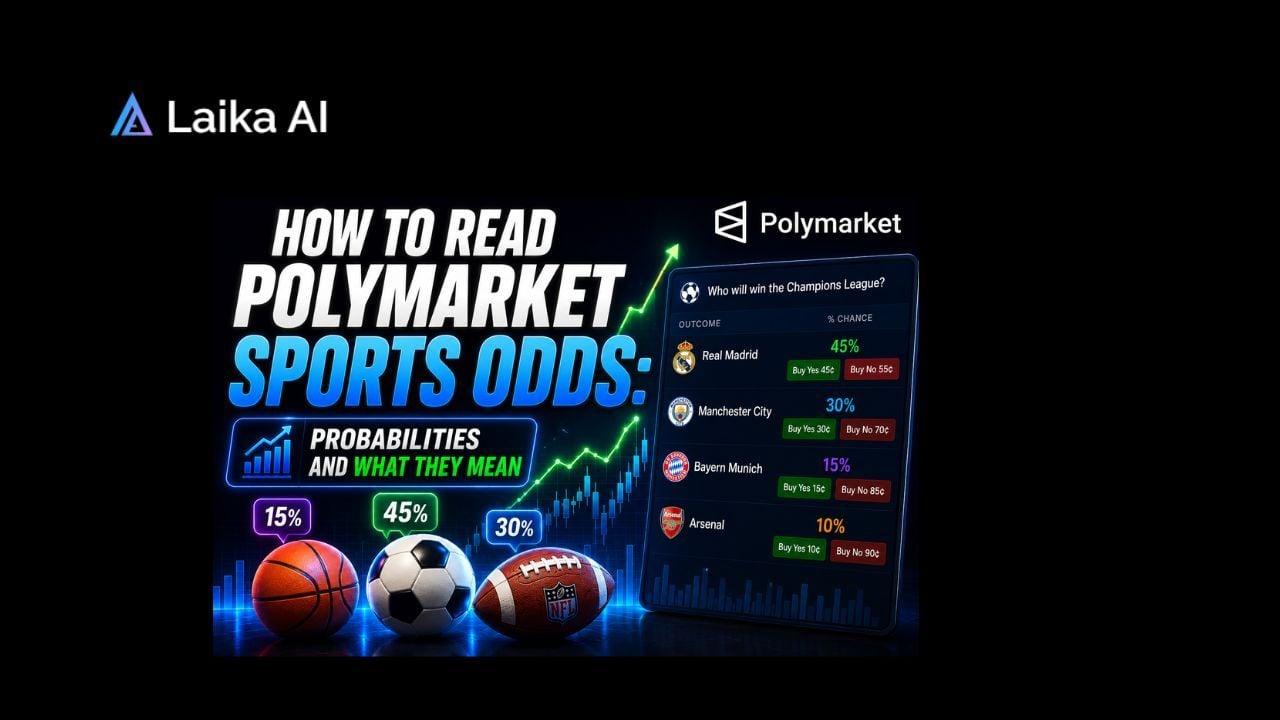
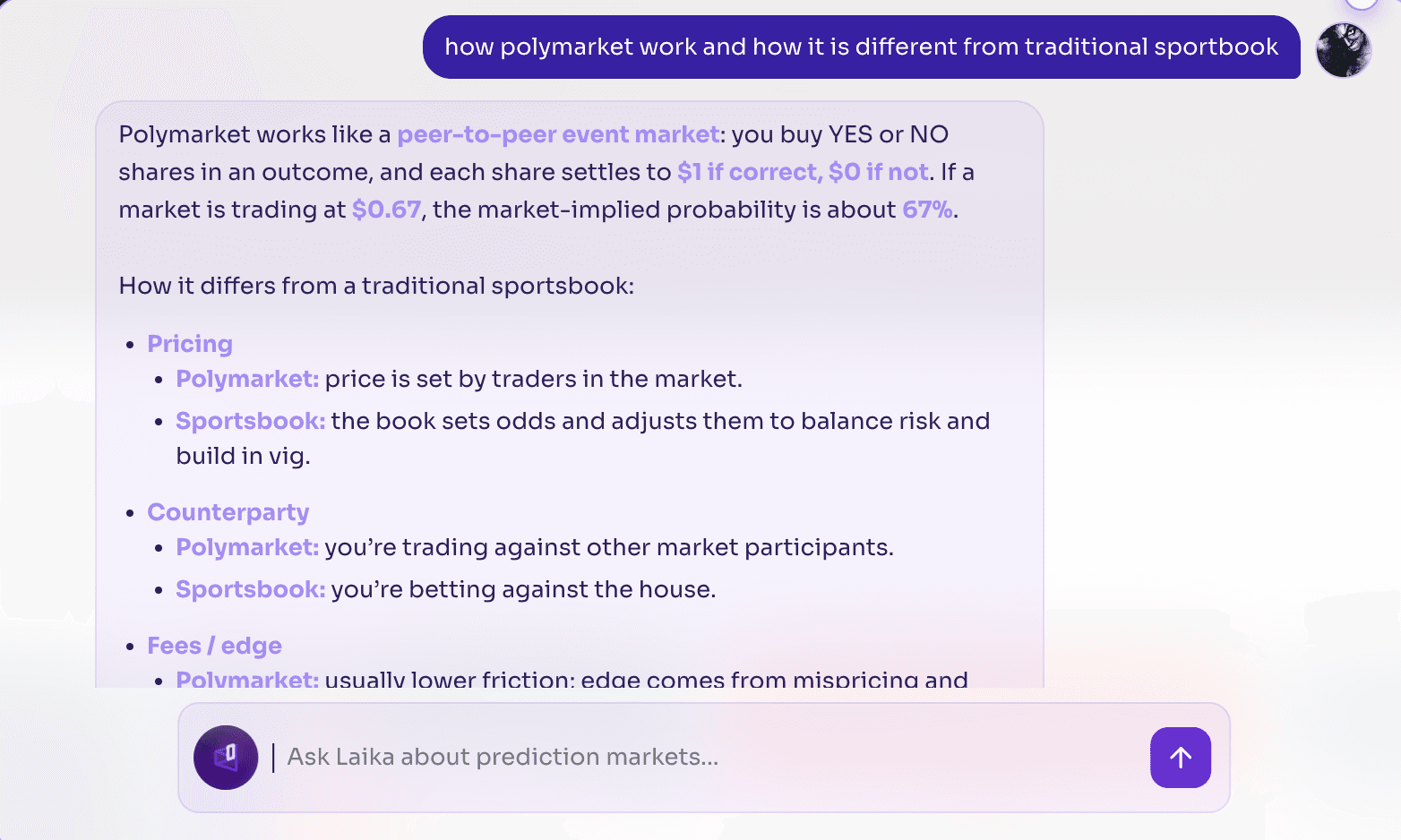
On Polymarket, the price is the probability. A contract priced at 47 cents means the market assigns a 47% chance to that outcome. There are no plus signs, no minus signs, no juice. Just a number between 0 and 1 that tells you exactly what the collective market believes. Understanding polymarket sports odds requires one foundational concept and nothing else: the price you see is the probability being quoted. Within the broader polymarket sports markets guide ecosystem, this is the one skill that unlocks everything else.
This article covers the mechanics of probability pricing, how YES and NO shares work, the four odds formats Polymarket supports, how to convert to sportsbook odds, how to spot value when prices diverge, and how odds move in real time. Written for anyone who understands traditional sportsbook odds but has never seen probability-based pricing before.
The Core Mechanic: Price Equals Probability
Every Polymarket market has outcomes priced between 0 cents and 100 cents. That price is the implied probability of the outcome occurring. The formula has no complexity.
Implied probability = share price x 100
A share priced at $0.47 equals 47% implied probability. A share priced at $0.17 equals 17% implied probability. A share priced at $0.88 equals 88% implied probability.
Three live examples from current markets.
Spain is priced at 17 cents in the 2026 FIFA World Cup Winner market. Traders collectively believe there is roughly a 17% chance Spain wins the tournament. France sits at the same 17 cents. Co-favourites, priced identically, reflecting genuine uncertainty at the top of the market.
The Oklahoma City Thunder are priced at approximately 47 cents in the 2026 NBA Champion market. The market assigns OKC a 47% chance of winning the championship. A sportsbook equivalent would be approximately -89, just under even money.
If Brazil is priced at 22 cents in the World Cup winner market, each YES share you buy at $0.22 pays out $1.00 if Brazil wins. That is a 355% return on your stake. The polymarket implied probability of 22% is exactly what it says: the crowd gives Brazil roughly a 1 in 4.5 chance.
This is the entire pricing system. There is no additional formula, no conversion required to read the base number, no hidden margin changing the probability the price represents. The price you see is the probability the market is quoting.
For a complete beginner's introduction to trading sports markets on the platform using these mechanics, the polymarket beginner trading guide covers the step-by-step process.
YES vs NO Shares: How Both Sides Work
Most beginner guides explain YES shares and stop there. NO shares are one of the most practically useful and most misunderstood mechanics on the platform.
To take a position on any outcome, select what you believe is most likely, choose YES to trade in favour of it or NO to trade against it, enter your amount, and submit. If your chosen outcome occurs when the market resolves, your YES shares pay out $1 each. If it does not occur, they pay out $0. You can sell shares at any time before resolution if you want to lock in a profit or cut a loss before the event ends.
YES shares: You buy YES at the current price. If the outcome occurs, you receive $1 per share. Your profit is $1 minus your purchase price. Example: buy YES in Spain at 17 cents. Spain wins the World Cup. You receive $1. Profit: 83 cents per share. Spain does not win. You lose the 17 cents you paid.
NO shares: You buy NO at approximately 1 minus the YES price. If Spain is at 17 cents YES, the NO share is priced at approximately 83 cents. If Spain does NOT win the World Cup, your NO share pays $1. Your profit is 17 cents per share. You risked 83 cents to make 17 cents because you were betting on the high-probability side.
YES and NO prices always sum to approximately $1.00 minus fees, creating an internal consistency check. If YES is at 47 cents and NO is at 53 cents, they sum to $1.00 and the market is internally consistent. If the two sides sum to more than $1.02 or less than $0.98 on a liquid market, that gap can represent a potential arbitrage opportunity.
The practical insight for sports bettors: buying NO on a heavily favoured team at 90 cents YES is structurally identical to taking the underdog. You are paying 10 cents to win 90 cents if the favourite loses. Polymarket yes no explained simply is this: YES pays if it happens, NO pays if it does not, and both sides always price to one dollar combined.
The Four Odds Formats on Polymarket
Most articles on this subject do not mention this. Polymarket supports four display formats and readers from different betting backgrounds will find different ones intuitive.
Polymarket's default format is Price, which shows each outcome as a dollar value between $0.01 and $1.00. This is the native format where the price directly represents the implied probability. Once you select a format, your choice persists across all sports markets and future sessions.
How to switch: tap the settings icon on any sports market page and select your preferred format. The underlying contract, fees, and payout are identical regardless of which display format you choose. The number changes. The reality it represents does not.
For a reader arriving from DraftKings or FanDuel, switching to American odds display makes the transition frictionless. You are reading the same implied probabilities you already understand, presented in a familiar format. For a reader coming from Betfair or a European sportsbook, decimal odds will be the natural choice.
Converting Polymarket Odds to Sportsbook Lines
The conversion formula in both directions.
Polymarket to American odds: Favourite (price above $0.50): American odds = minus (price divided by (1 minus price)) multiplied by 100 Underdog (price below $0.50): American odds = ((1 minus price) divided by price) multiplied by 100
The full conversion table using live market reference points
Live translation examples from current markets.
OKC Thunder NBA Champion at $0.47 equals approximately -89 in American odds, just under even money. A sportsbook would price this at approximately -90 to -110 depending on the vig embedded in their line.
Spain World Cup Winner at $0.17 equals approximately +488 in American odds. France trades at the same 17 cents, equivalent to approximately +471, reflecting 17.5% implied probability. The two are effectively co-favourites at near-identical pricing.
A $0.40 Polymarket contract equals +150 American odds and 2.50 decimal odds, all representing 40% probability. A $0.67 contract equals -200 American odds and 1.50 decimal odds, all representing 66.7% probability.
For the full probability and arbitrage methodology including how to identify and act on price gaps, the polymarket probability and arbitrage guide covers the complete framework. An independent odds conversion reference is available at lines.com/guides/how-to-read-prediction-market-price-probability
Polymarket Odds vs Sportsbook Lines: Reading the Gap
Reading the price is only half the skill. The other half is understanding what the gap between Polymarket and sportsbook implied probability actually means.
If your sportsbook shows -250 odds, implying 71.4% probability, but Polymarket trades at $0.58, implying 58% probability, that 13-point discrepancy is significant and requires explanation before you act on it.
Three types of gap and what they mean
Sportsbook higher than Polymarket.
The sportsbook prices the outcome as more likely than Polymarket does. This can mean the sportsbook is embedding extra margin into the favourite's line, which is the most common explanation on large favourites. Or it can mean Polymarket traders have received and priced information the sportsbook has not yet incorporated. In liquid markets the vig explains 2 to 5 percentage points of the gap. A gap larger than 5 points on a major market after stripping the sportsbook vig is worth investigating.
Polymarket higher than sportsbook.
Polymarket traders are more bullish on this outcome than the sportsbook. This can mean the Polymarket crowd is overreacting to recent news, a strong performance or media narrative, and has pushed the price above fair value. Or it means Polymarket's global, skin-in-the-game crowd has priced something the sportsbook has not caught up to yet. Distinguishing between these two explanations is the work of the trade.
The vig-adjusted comparison.
Sportsbooks build 4 to 8% into their lines invisibly. To compare fairly, strip the sportsbook vig first. A -110/-110 market at DraftKings implies 52.4% on each side, but the true probability on a coin-flip event is 50% each. The 2.4-point difference is the vig made visible. Polymarket has no vig on most sports markets, so its prices reflect actual market consensus more cleanly than any sportsbook line on the same event.
The full structural comparison of what makes polymarket sports and sportsbook lines different at a fundamental level is covered in prediction markets vs sports betting.
How Polymarket Sports Odds Move in Real Time
Prices are not static. They update continuously as traders buy and sell. Understanding what moves them is as important as knowing how to read them.
Polymarket odds update continuously as traders incorporate new information across injuries, weather conditions, sportsbook line movement, and in-play developments. Four specific price drivers on sports markets.
Injury news is the fastest single mover. A confirmed starter ruled out moves the contract price within minutes. The Thunder vs Spurs WCF series showed this directly. When Jalen Williams was ruled out for Game 3, OKC's game contract price moved sharply before most sportsbooks had adjusted their lines. The window between Polymarket's reprice and the sportsbook adjustment is measured in minutes to hours.
Sportsbook line movement is a secondary signal worth monitoring. When a major sportsbook moves its line significantly, informed Polymarket traders often front-run the equivalent move on the prediction market. Watching for unusual sportsbook line movement and checking whether Polymarket has already priced it is a standard workflow for advanced traders.
Volume concentration reflects real money flowing into a market and can signal where consensus is forming before a price has moved. A sudden volume spike without obvious news often precedes a price move. Someone with information is buying. This is not a reliable standalone signal but it is worth monitoring on major markets alongside the price itself.
Game results are the fastest and largest single repeating events in the entire sports calendar. A playoff upset redistributes championship probability within minutes of the final whistle. The market does not wait for morning coverage or sportsbook line updates. It adjusts immediately as traders act on the confirmed result.
How to Spot Value in Polymarket Sports Odds
Three concrete patterns worth knowing before entering any major sports market.
Pattern 1: The recency overreaction
A team wins two games impressively and their championship probability spikes 8 to 10 cents on Polymarket within 48 hours. The underlying statistical case has not changed. Two games are a small sample. The price spike is a narrative reaction, not an informational one. This is the most consistent fade opportunity across all sports markets on the platform. The crowd buys the story. The edge is in the gap between the story and the full-season reality.
Pattern 2: The base rate underpricing
Some outcomes have well-documented historical base rates that the market systematically ignores. The home team in NFL playoff games wins approximately 57% of matchups. Polymarket frequently prices home teams at 50 to 53% on game markets before informed traders adjust the price. When the historical base rate for an outcome is meaningfully higher than the current Polymarket price and no news explains the discrepancy, that gap is worth examining before the broader market catches up.
Pattern 3: The platform divergence signal
If a sportsbook shows -250 odds at 71.4% implied probability but Polymarket trades at $0.58 at 58% probability, that 13-point discrepancy signals potential value or a significant vig differential. The same logic applies between Kalshi and Polymarket. When two platforms with different user bases price the same outcome 5 or more cents apart after accounting for vig, one of them is wrong. Identifying which is the analytical work of the trade, not the reading of the odds.
For the systematic methodology on identifying market mispricings across all sports categories, how to find mispriced markets on Polymarket covers the complete framework. The crowd errors that produce these patterns reliably, recency bias, narrative anchoring, and base rate neglect, are documented with specific examples in common biases in prediction markets.
Worked Examples: Reading Live Polymarket Sports Odds Right Now
Example 1: Multi-outcome futures market (World Cup winner)
The 2026 FIFA World Cup Winner market has 50 plus outcomes. Spain is at 17 cents. France is at 17 cents. Brazil at approximately 10 to 12 cents. England at approximately 10 cents. All 50 plus outcomes sum to approximately $1.00 across the entire field.
Reading this correctly: France at 17 cents means the market gives France a 1 in 6 chance of winning the tournament. The sportsbook equivalent is approximately +471. A trader who believes France's true probability is 22%, not 17%, has a 5-cent edge per share if they are right. That 5 cents is the value the trader is capturing relative to what the market is currently pricing. For the full breakdown of current polymarket world cup odds across every active contract, polymarket world cup 2026 markets covers the complete picture.
Example 2: Binary game market (Thunder vs Spurs Game 5)
OKC is priced at 61.5 cents. Spurs at 38.5 cents. The two sum to $1.00, which confirms internal consistency. Reading this: the market gives OKC a 61.5% chance of winning at home. American odds equivalent: approximately -160.
A sportsbook with OKC at -175, implying 63.6%, would represent a gap of 2.1 percentage points. Within normal vig range. A sportsbook with OKC at -200, implying 66.7%, would represent a 5.2-point gap after stripping vig. That gap is worth examining as either a Polymarket underpricing or a sportsbook overpricing of OKC.
For the full NFL market context and how to apply this odds-reading framework to specific game markets and futures, the polymarket nfl trading guide covers the complete structure.
Frequently Asked Questions
What does the price on Polymarket sports odds mean?
The price is the implied probability. A contract priced at $0.47 means the market assigns a 47% chance to that outcome. If you buy YES shares at $0.47 and the outcome occurs, each share pays out $1.00, a profit of $0.53 per share. If the outcome does not occur, each share pays $0.
What is the difference between YES and NO shares on Polymarket?
YES shares pay $1 if the outcome occurs and $0 if it does not. NO shares pay $1 if the outcome does not occur. If Spain is at 17 cents YES, the NO share is approximately 83 cents. Buying NO on Spain pays $1 per share if any team other than Spain wins the tournament.
How do you convert Polymarket odds to American sportsbook odds?
For favourites above $0.50: American odds = minus (price divided by (1 minus price)) multiplied by 100. For underdogs below $0.50: American odds = ((1 minus price) divided by price) multiplied by 100. Example: $0.47 converts to approximately -89. $0.17 converts to approximately +488.
What does it mean when Polymarket odds and sportsbook odds are different?
A gap between Polymarket probability and sportsbook implied probability can mean the sportsbook has embedded extra vig, or that one platform has priced new information faster than the other. Gaps above 5 percentage points on liquid markets after stripping sportsbook vig are worth examining as potential value signals. For the structural explanation of why the two platforms diverge, prediction markets vs sports betting covers the full comparison.
Can Polymarket sports odds be wrong?
Yes. Mispriced markets occur when the crowd overreacts to news or ignores base-rate evidence. Polymarket prices reflect collective trader opinion, not objective truth. Recency bias, narrative overreaction, and thin market liquidity all create situations where prices diverge from true probability. These mispricings are the source of edge for informed traders.
How do Polymarket sports odds update in real time?
Prices update continuously as traders buy and sell shares. Every transaction changes the market price instantly. Major price movers include injury announcements, game results, sportsbook line movements, and volume spikes from informed traders entering a position. There is no scheduled update. The market replicates the moment new capital enters.
The One-Sentence Summary
On Polymarket, the price is the probability, YES and NO sides always sum to $1.00, and every gap between Polymarket and a sportsbook line is either big, an information difference, or a mispricing.
Reading those three things correctly is the entire skill of interpreting polymarket sports odds. The conversion table in this article covers every price you will encounter. The four display formats cover every odds format you are accustomed to from other platforms. The three patterns in the value section cover the most consistent ways the crowd gets sports market pricing wrong.
What you do with a correct odds reading is a different question. That is strategy, and it varies by sport, market depth, and timing. But none of it is accessible without first understanding what the price means. The price is the probability. Everything follows from there.
For everything running across the full prediction market ecosystem, the polymarket sports markets guide is the complete picture.
If you want to watch how Polymarket sports odds move in real time across every active market, NFL, NBA, World Cup, and beyond, Polymetric surfaces live price movements as they happen.
Start at laikalabs.ai