FanDuel vs Kalshi used to be an odd comparison. Two different worlds, basically a fantasy-sports giant and a CFTC-regulated exchange founded by ex-Goldman traders. Not anymore. Both now sell you the exact same thing: a Yes/No contract on whether the Chiefs cover, whether the Lakers win it all, whether some rookie takes home MVP. And the overlap keeps growing every month.
This piece is a real fanduel predicted vs kalshi breakdown, not a puff comparison. We'll get into sports coverage, fees, where each one is actually legal to trade sports on right now, and which app just feels better to use on a Sunday afternoon. For a deeper look at FanDuel's side of this on its own, FanDuel Predicts Review 2026: Prediction Markets via CME Group covers the full platform beyond just the sports angle.
How FanDuel Predicts Handles Sports
FanDuel Predicts sports coverage runs through NFL, NBA, NHL, MLB, college football, and college basketball. Plus World Cup 2026 markets, which just launched with props attached. The contracts themselves look familiar if you've ever used a sportsbook: game winners, spreads, totals, conference champs, the works.
Here's the catch, though. FanDuel only offers sports contracts in 18 states as of this writing. The other 32 states get finance, economics, and commodities markets, the Fed rate, GDP prints, that sort of thing but no sports at all. Why? Because FanDuel already runs a licensed sportsbook in most of those 32 states, and offering both at once creates a regulatory headache nobody wants to deal with. Idaho, notably, has neither.
Pricing is dollar-amount based, not contract-count based like Kalshi. You type in $4.80, not "3 contracts at $1.60." Small things. Matters more than you'd think once you're moving fast during a live game.
Kalshi's Sports Trading Setup
Kalshi sports trading covers 17 sports total football, basketball, baseball, tennis, soccer, hockey, golf, MMA, esports, motorsport, cricket, boxing, rugby, darts, and, oddly, chess. Yes, chess. Someone at Kalshi apparently decided chess deserved a seat at the table alongside the NFL, and that's the kind of detail that tells you this isn't a sportsbook pretending to be something else.
Kalshi is a CFTC Designated Contract Market. That status is what lets it operate in states where FanDuel's sportsbook side can't touch sports betting at all, California and Texas being the two biggest examples. Trading happens through an order book, bids and asks, buyers matched against sellers. It's closer to a stock exchange than a betting counter, honestly. For readers still fuzzy on whether any of this counts as gambling under the law, Kalshi Sports Betting: Is It Legal, Is It Gambling, and How It Works untangles that question properly.
FanDuel Predicts vs Kalshi: Head-to-Head
A fanduel forecast vs Kalshi table like this flattens things a bit. Numbers change. Kalshi adds sports monthly, and FanDuel's state count has moved before and will move again.
FanDuel vs Kalshi: Which One's Actually Bigger?
Numbers help here more than vibes do. Kalshi's monthly trading volume has been reported around $33 billion as of mid-2026, spread across sports, politics, and economic contracts combined. FanDuel Predicts is younger; it only went fully nationwide in January 2026 and Flutter's own CEO said publicly he expects volume to really ramp in the second half of the year. Translation: Kalshi has the lead right now, and probably will for a while.
That gap shows up in liquidity, not just headline volume. Bigger books mean tighter spreads on marquee games, think Sunday Night Football, not a Tuesday G-League matchup. FanDuel's sports book is thinner outside the biggest events, which can mean slippage if you're trying to move size. Not a dealbreaker for someone tossing $20 on a Chiefs game. Matters a lot more if you're trading five figures.
One more wrinkle worth mentioning: Robinhood currently routes its own prediction-market sports contracts through Kalshi's infrastructure. That's set to change once Robinhood's own exchange goes live, but for now it's another data point on how much of the market's plumbing already runs through Kalshi rather than around it.
Live and In-Play Trading
Both platforms let you trade while the game's still happening, which is honestly the more interesting product than pre-game markets anyway. Prices tick in real time as players develop a pick-six, a blown coverage, a buzzer-beater and you can enter or exit mid-action rather than locking in your view before kickoff.
Kalshi's live markets tend to update faster and cover more games simultaneously, a side effect of just having more sports listed and more traders active in each one. FanDuel's live experience feels more polished, honestly, if you're coming from its sportsbook app already with the same visual language, same familiar checkout flow. Different strengths. Neither one is objectively "better" here, and I'd resist anyone who tells you otherwise with total confidence.
How Does Kalshi Sports Trading Work?
You pick a market. You pick Yes or No. You set a limit price, or you take whatever's on offer right now market order, basically instant. Then you wait, or you don't; you can sell out of the position before the game even ends if the price moves your way.
That's the mechanical answer. But the real answer to how kalshi sports trading works is that it's peer-to-peer the whole way through. Kalshi isn't taking the other side of your bet. Some other trader is. The exchange just matches you up and clips a small fee for facilitating it.
Fees Compared
FanDuel charges a flat 2% fee on your payout, not your stake. Buy a contract at 60 cents, it wins, you get 98 cents instead of a full dollar. Lose, and you pay nothing extra you just lose the 60 cents you put in. Simple. Predictable. Almost boringly so, which some traders actually prefer.
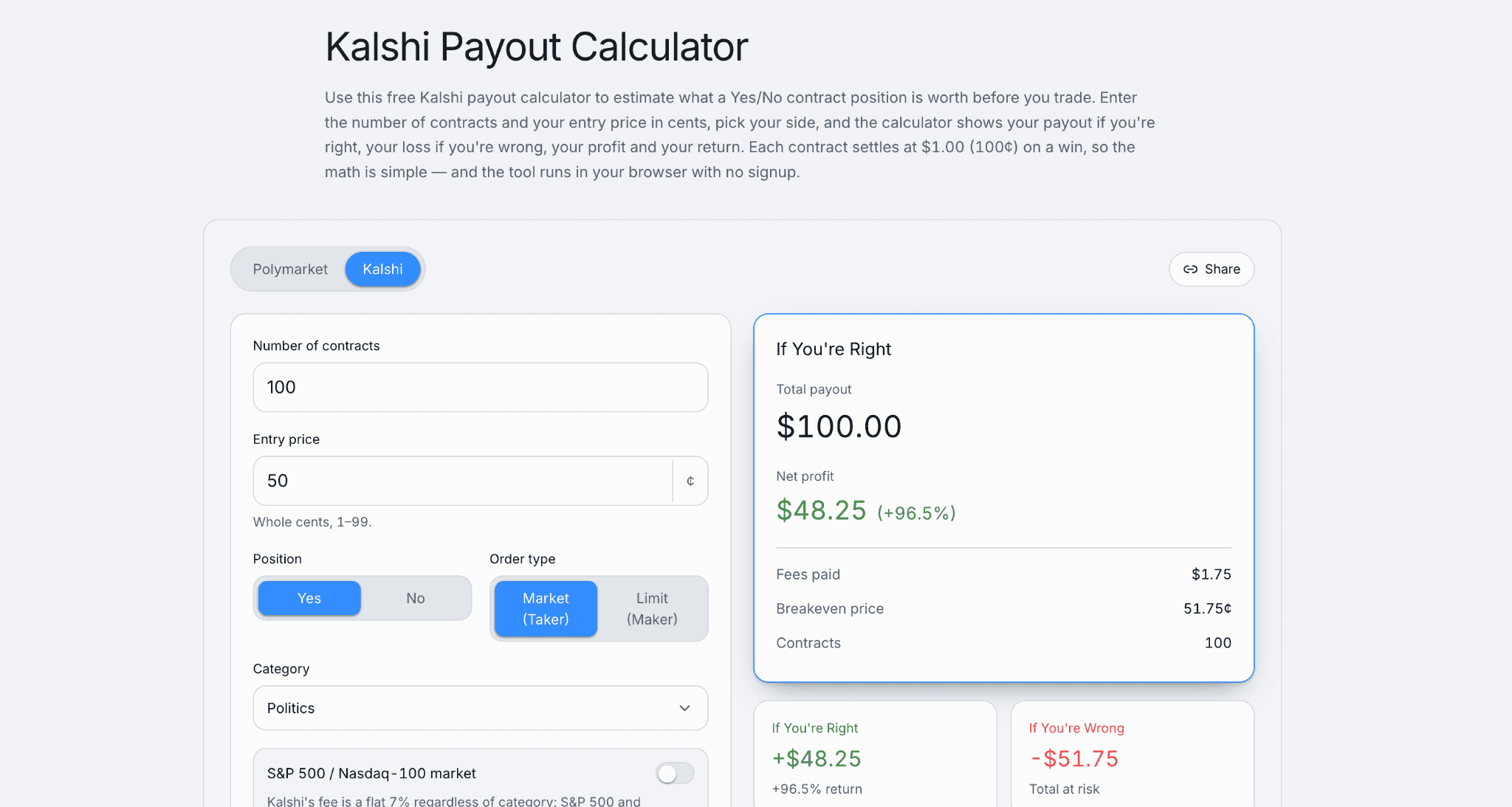
Kalshi's fee structure is a formula, not a flat percentage, and it scales with how close a contract sits to 50-50 odds the messier the market, the more the fee bites. Typical per-contract costs land somewhere around a penny or two, though that number moves depending on price and size. For the full math on both sides, plus how Polymarket stacks up too, Prediction Market Fees in 2026: Kalshi vs Polymarket breaks the formulas down properly.
Big picture: FanDuel is easier to predict before you trade. Kalshi can be cheaper at scale but not always, and the answer really depends on which markets you're trading.
State Availability, the Real Dividing Line
This is where the comparison gets genuinely uneven, and I'd lean hard toward Kalshi here. FanDuel Predicts covers sports contracts in only 18 states right now, pulled back everywhere else because of its existing sportsbook licenses. Kalshi, riding federal CFTC status instead of a patchwork of state gambling licenses, is legally available almost everywhere sports contracts are offered at all California, Texas, Florida, states where a traditional sportsbook can't legally operate.
If you live in one of the 32 FanDuel-restricted states, this whole comparison is moot. You're using Kalshi. Full stop.
DraftKings has entered this same lane too, running its own CME-backed product alongside FanDuel's. DraftKings DKeX Prediction Market Review 2026 covers how that third option stacks up if you're weighing more than just these two.
Beyond the US Majors
Sports trading isn't only a Kalshi-versus-FanDuel story. Polymarket has quietly built out a sports catalog of its own, leaning into international soccer leagues and tournament-scale markets that neither Kalshi nor FanDuel matches yet. Polymarket Sports Markets 2026 Complete Guide to NFL NBA MLB Soccer covers that side of the market if broader international coverage matters more to you than depth on mainstream US leagues.
And if you're brand new to any of this order books, Yes/No pricing, the whole concept How Does Kalshi Work? A Complete Beginner's Guide is a better starting point than jumping straight into a head-to-head comparison like this one.
Futures, Props, and Awards Markets
Game-by-game contracts are the easy comparison. Season-long markets are where the gap actually widens. Kalshi runs futures on NFL Champion, NBA Champion, individual team win totals, plus awards markets MVP, Rookie of the Year, Finals MVP that stay open from preseason all the way through the announcement. Months of positioning room, if that's your style.
FanDuel offers conference champions and Super Bowl winner markets too, alongside NBA Finals futures. Solid, but noticeably thinner once you get past the headline trophies. No dedicated MVP race contract as of this writing, at least not one I could find listed. That could change by the time you read this. This whole space moves fast, worth checking both apps directly before assuming either list is current.
A quick, specific example: Kalshi listed an NFL franchise relocation contract earlier this year. Not a game outcome. Not even a season outcome. A bet on whether a specific team moves cities. That's the kind of oddball market that tells you Kalshi's product team is building for depth, not just replicating a sportsbook menu with different branding.
Which Should You Actually Use?
Casual sports fan, trades occasionally, holds to the final whistle? FanDuel Predicts. The 2% fee is dead simple to calculate, the app feels like every other FanDuel product you've already used, and you don't need to think about limit orders or order-book depth.
Active trader who wants to move in and out of positions, chase live-game price swings, or trade a sport FanDuel doesn't even list? Kalshi. Deeper books, broader coverage, and it works in states where FanDuel's sports side simply isn't allowed to operate. If you're weighing the sports angle specifically against Polymarket rather than FanDuel, Polymarket vs Kalshi for Sports: Which Platform Is Better for Traders? is worth reading next.
Neither platform is wrong, exactly. FanDuel vs Kalshi isn't really a contest with one clean winner, it's two different products built for two different trading rhythms, and the right one depends entirely on which rhythm matches how you actually trade.
FAQs
Is FanDuel Predicts or Kalshi better for sports?
It depends on how often you trade and where you live. FanDuel Predicts suits casual traders who hold positions to settlement and want a simple, flat 2% fee. Kalshi suits active traders who want broader sports coverage, deeper order books, and nationwide legal access that doesn't depend on state-by-state sportsbook licensing.
How does FanDuel Predicts compare to Kalshi overall?
FanDuel vs Kalshi comes down to structure. FanDuel Predicts is a CME Group joint venture with a simpler, dollar-amount trading interface and a flat 2% payout fee, but sports contracts only in 18 states. Kalshi is a CFTC Designated Contract Market with a formula-based fee, contract-count trading, and sports availability across most of the country.
How does sports trading work on Kalshi?
Kalshi sports trading works through a peer-to-peer order book. You choose Yes or No on an outcome, set a price or take the current market price, and Kalshi matches your order against another trader rather than taking the other side itself. Positions can be held to resolution or sold early if the price moves favorably.
What sports can you trade on FanDuel Predicts?
Fanduel predicts sports currently cover the NFL, NBA, NHL, MLB, college football, and college basketball, plus newly added World Cup 2026 markets with props. Coverage is narrower than Kalshi's, which lists contracts across 17 different sports.
What are FanDuel Predicts' fees?
Fanduel predicts fees run a flat 2% charge on your payout at settlement or on early cash-out, with no deposit or withdrawal fees. If a contract loses, there's no fee at all since there's no payout to take a percentage of.