If you follow sports closely enough to have an opinion on who wins the NBA Finals, you already have the most important skill for trading on Polymarket. What is polymarket sports? It is a prediction market where your sports knowledge becomes a tradeable position rather than a conversation. The platform does not require financial expertise or crypto experience to get started. It requires being right about sports outcomes more often than the crowd on specific questions at specific prices. Within the broader polymarket sports markets guide ecosystem, the sports section is the most accessible entry point for anyone arriving from a sports betting background.
This guide covers what Polymarket sports markets are, how prices work, how to read the odds, how to place your first trade, and what the three most common beginner mistakes are. Written for someone who has never used a prediction market before, but who knows sports.
What Is Polymarket Sports?
Polymarket is a prediction market. A platform where you trade on the outcome of real-world events using money. The sports section works like this: take any sports outcome you have an opinion on. Will the Oklahoma City Thunder win the 2026 NBA Championship? You can buy a share in that outcome. If you are right, each share pays out $1. If you are wrong, each share pays out $0.
The price of the share tells you what the crowd thinks. Right now, OKC shares are trading at approximately 47 to 50 cents. That means the market collectively assigns roughly a 47 to 50% chance to OKC winning the championship. If you think the real probability is higher than 47%, if you believe OKC is being underpriced by the market, you buy. If you think 47% is too high, you can sell the contract instead.
This is fundamentally different from a sportsbook in one key way. You are not betting against the house. You are trading with and against other sports fans and traders who each have their own opinion on the outcome. The platform matches buyers and sellers. The house does not take the other side of your trade.
That structural difference is the answer to how the polymarket works at its most basic level. For a deeper explanation of the mechanism before going further, what prediction markets cover the foundation clearly.
How to Read Polymarket Sports Odds
Most beginners are confused by the price format because it looks nothing like traditional sportsbook odds. The translation is simpler than it appears.
Polymarket prices are probabilities, not traditional betting odds. Every share price sits between $0 and $1, representing the market's implied probability as a percentage. Here is the full translation:
Three live examples from current markets
OKC Thunder NBA Champion at $0.47. The market says OKC has a 47% chance of winning the title. A sportsbook equivalent would be approximately -89, just under even money. If you buy 100 shares at 47 cents and OKC wins, you receive $100 and profit $53. If OKC loses, you lose the $47 you paid.
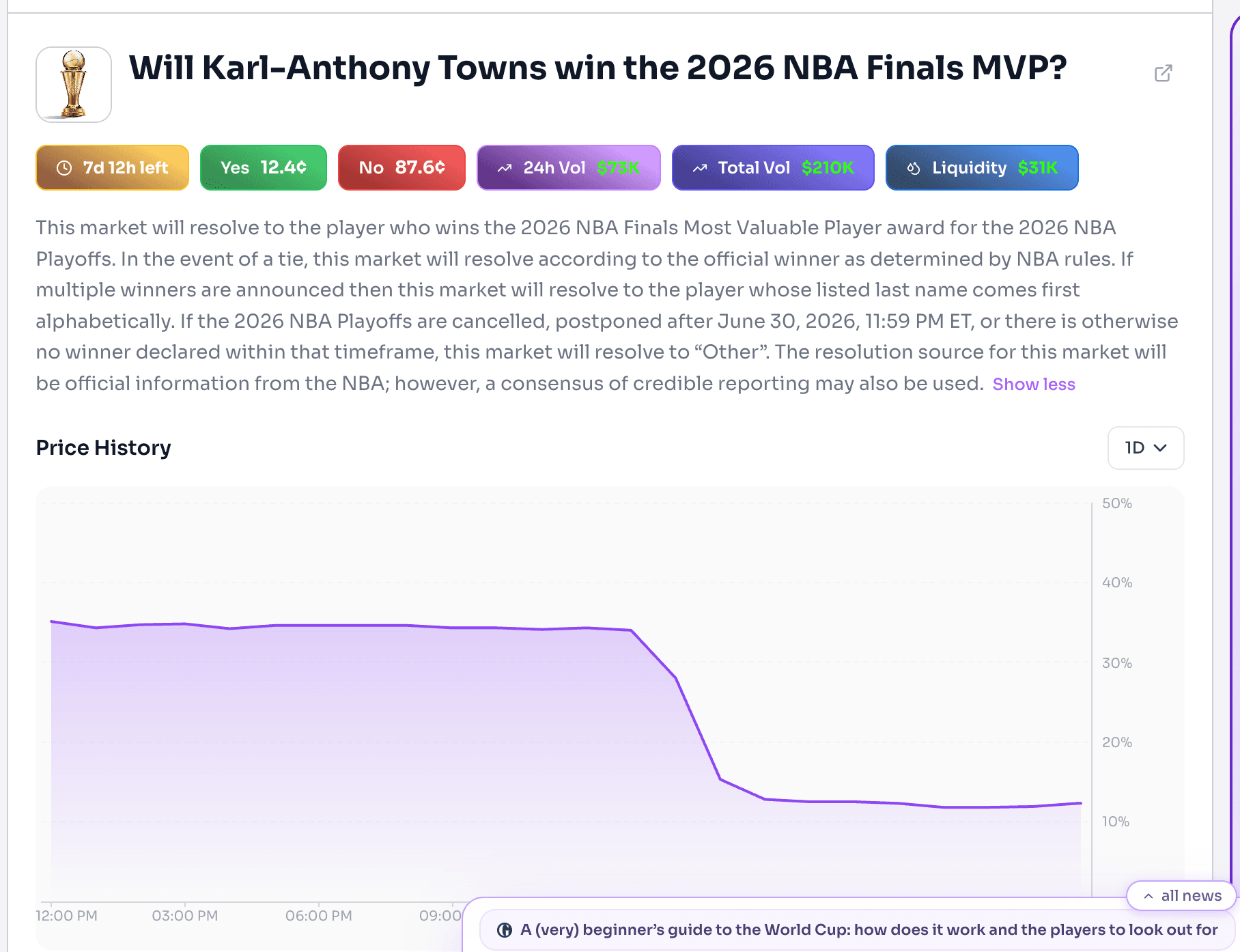
Knicks to advance to NBA Finals at $0.88. An 88% implied probability. High confidence, low upside. You are risking 88 cents to make 12 cents per share. The payout is small because the probability is high.
A tournament long-shot at $0.05. 5% implied probability. You risk 5 cents to make 95 cents if they win. High upside, low probability. The prediction market equivalent of a futures long-shot.
The critical insight for anyone coming from a sportsbook background: when you look at a polymarket sports odds price and think that is too low or that is too high based on your sports knowledge, that gap between your assessment and the market price is where your edge lives. You do not need to predict the outcome correctly every time. You need to identify when the crowd is systematically mispricing a specific outcome. For the full mechanics of how probability prices are formed and why they move, how prediction market prices work covers the framework.
What Sports Markets Are Available on Polymarket?
Polymarket covers 14 sports on the international platform. The most liquid categories with the most beginner-friendly entry points are as follows.
The NBA is the deepest sports category on the platform right now. The 2026 NBA Champion market alone has $533.7 million in volume, more liquid than most stock markets for individual companies. Game-by-game markets, championship futures, MVP awards, and conference champion markets are all active during the 2026 playoffs. This is the best entry point for a beginner who follows basketball.
The NFL is the second largest sports category by volume. The NFL Champion 2027 market already has $27.2 million in volume despite the season being three months away. Game markets, MVP, Super Bowl, and Draft markets run throughout the year, giving a consistent calendar of entry windows.
Other available sports include MLB, NHL, Champions League, EPL, La Liga, Serie A, golf majors, tennis Grand Slams, UFC, cricket, and esports. Liquidity varies significantly. Major events like the UEFA Champions League Final and Wimbledon attract significant volume. Niche league games have thinner markets with wider spreads that make small-position trading uneconomical.
What is not available: Horse racing is excluded entirely on both Polymarket platforms due to the Interstate Horseracing Act. Same-game parlays do not exist at sportsbook depth. Micro-betting on individual plays is not currently available.
For a beginner, the safest starting point is the NBA Championship or NFL Champion futures market. Deep liquidity, tight spreads, and a clear resolution date you can plan around. The full context of how polymarket sports betting works structurally and what the legal landscape looks like in 2026 is covered in the polymarket sports betting guide.
How to Place Your First Polymarket Sports Trade
Two things to have ready before you place a trade.
First, an account on either Polymarket US, which accepts debit cards and bank transfers with no crypto required, or Polymarket International, which requires USDC on the Polygon network. Second, a funded balance. The minimum trade is $1. Start small until you understand how the market moves. For the complete wallet setup process including how to fund a Polymarket account step by step, how to set up your Polymarket wallet covers every detail.
Step 1: Find a sports market
Go to polymarket.com/sports. Markets are grouped by sport and sorted by volume. The highest-volume markets appear first. These are your best starting points because tight spreads mean you lose less on entry and exit. The 2026 NBA Champion market and the OKC vs Spurs game markets are the highest-volume right now. Click any market to see the full odds table and order book.
Step 2: Read the market
Look at the current price for your chosen outcome. Check the order book depth, which shows how many shares are available at the current price. Thin markets with under $20,000 in total volume can have spreads exceeding 10%, meaning you lose 10 cents on the dollar before the market even moves. Stick to markets with at least $100,000 in volume for your first trades.
Step 3: Size your position
Market orders require a minimum of $1. Limit orders require a minimum of 5 shares. For your first trade, use a market order and keep the position under $50 until you understand how the platform behaves. Do not risk money you cannot afford to lose entirely on a single contract. Every position resolves to either $1 or $0, and nothing in between.
Step 4: Place the trade
Select YES or NO, enter the number of shares or dollar amount, and confirm the order. The platform matches you with another trader at the current market price. Your position appears in your portfolio immediately.
Step 5: Monitor and exit
You can sell your position at any time before resolution at the current market price. You do not have to hold until the event ends. If your position has moved in your favour, selling early locks in profit without waiting for the final result. If your position has moved against you, selling cuts the loss before it reaches zero. This exit mechanic is the most important practical difference between Polymarket and a traditional sportsbook bet.
How to Find Good Sports Markets to Trade
Most beginner guides skip this section and send new users directly into thin markets where they lose money on spreads before the event even starts. Three filters every beginner should apply before entering any sports market on Polymarket.
Filter 1: Volume above $100,000
Polymarket charges zero platform commissions on the global platform. The real cost on thin markets is the spread, the gap between the buy price and the sell price. On markets with under $100,000 in volume, that spread can be 5 to 10 cents per share. On major markets like the NBA Champion or NFL Championship futures, the spread is typically under 1 cent. Always check the volume figure on the market page before entering. A market that looks attractively priced may be costly to enter and exit if the order book is thin.
Filter 2: A clear resolution mechanism
Every Polymarket sports contract has a resolution source listed in its rules. Read it before you buy. The resolution source determines what counts as a win. For a championship market the criteria are straightforward, the official NBA or NFL result. For prop markets the resolution criteria can be ambiguous. Never enter a market where you are not certain how it resolves. The fine print is not boilerplate on prediction market contracts. It determines whether you get paid.
Filter 3: Trade what you know
Your edge on an NFL Championship market is your NFL knowledge applied to a probability question. Your edge on a Bundesliga market is zero if you do not follow Bundesliga. Stick to sports where you have genuine knowledge. The market is made up of people who are, on average, right. To beat the consensus you need to know something they do not, or weigh evidence more accurately than they are currently doing. Entering a market you do not follow because the price looks interesting is not an edge. It is noise.
For the systematic methodology on assessing market depth and identifying which markets have enough liquidity to enter and exit at scale, how to find liquid markets on Polymarket covers the complete framework.
Three Mistakes Every Beginner Makes on Polymarket Sports
Mistake 1: Entering at peak volume, not peak value
The most common beginner mistake is entering a market when it is most talked about, right before a big game or right after a surprising result. That is exactly when the market is most efficient and least valuable to trade. The OKC Thunder NBA Championship market at $533.7 million in volume right now is near-maximum efficiency. A beginner who enters OKC at 47 cents today is paying fair value for the current state of information. A trader who entered OKC in October at 15 cents captured the full inefficiency before the crowd arrived.
Volume tells you the market is popular. It does not tell you the market is mispriced. Those are different things.
Mistake 2: Ignoring the spread on thin markets
A beginner who sees an attractive 30-cent price on a niche market and buys without checking the order book may find the actual execution price is 33 cents due to the spread between buyers and sellers. On a 30-cent contract that is a 10% loss before the event has even started. Always check the order book depth before placing any trade larger than $20. The spread is invisible until you look for it. Once you have lost money on it once, you never forget to check again.
Mistake 3: Holding to zero when you should sell
Prediction market contracts resolve to either $1 or $0. There is no partial payout. A beginner who bought the Cavaliers at 3 cents thinking it was cheap has a position now heading toward zero with Cleveland down 3-0 to the Knicks. The exit mechanic exists for exactly this situation. If your position's probability has dropped to 1 or 2 cents, selling at that price recovers something. Holding to $0 recovers nothing. The discipline to sell a losing position before resolution is the most practically valuable skill in prediction market trading, and the one most beginners learn the expensive way.
What to Trade First: Three Starter Markets for Beginners
Starter market 1: NBA Champion 2026 (if you follow basketball)
The most liquid sports market on Polymarket right now. $533.7 million in volume. Four teams are still alive. OKC at 47 to 50%, Spurs at 24.9%, Knicks at 17 to 26%. Spreads are near zero on major teams. You can enter with $10 and understand exactly how the market works by following the NBA Finals over the next two weeks. This is the best live teaching market currently available. For the full NBA market context and how to read the deeper structure, the polymarket nba guide covers every active contract.
Starter market 2: NFL Champion 2027 (if you follow football)
Already live with $27.2 million in volume. The season starts in September, which gives you three months to learn the market before it becomes high-stakes. Lower volume than the NBA market right now means slightly wider spreads. Keep your first position under $25. The full strategy framework for NFL markets including how to trade through the season is covered in the polymarket nfl trading guide.
Starter market 3: A single playoff game moneyline
The Thunder vs Spurs Game 5 is the highest-volume single game contract on the platform right now at $1.8 million in daily volume. A game market resolves in hours, not months. It teaches you the full Polymarket cycle, buy, monitor, resolution, payout, in a single evening. Keep it small. $10 to $20 to understand the mechanics without material risk. The speed of resolution makes it the fastest way to learn how the platform actually works.
Frequently Asked Questions
What is Polymarket sports and how is it different from sports betting?
Polymarket sports is a section of the Polymarket prediction market where you trade yes/no contracts on sports outcomes including game winners, championship futures, awards, and player props. Unlike traditional sports betting, you are not wagering against the house. You are trading with other participants on a peer-to-peer exchange. Polymarket charges no vig on most major sports markets, and you can sell your position at any time before the event resolves at the current market price. For the foundational explanation of how prediction markets work, what are prediction markets covers the full structure.
How do you read Polymarket sports odds?
Polymarket prices are probabilities expressed in cents. A share priced at 47 cents means the market assigns a 47% chance to that outcome. A winning share pays $1.00. A losing share pays $0. To convert to traditional sportsbook odds: 50 cents equals even money at +100, 70 cents equals approximately -233, 30 cents equals approximately +233. If you think a team's actual probability is higher than what the polymarket sports odds imply, that gap is your edge.
How much money do you need to start trading sports on Polymarket?
The minimum market order is $1 on Polymarket. Starting with $10 to $20 is sufficient to learn the mechanics without material risk. A $100 entry position plus a $100 exit position costs approximately $0.04 in total gas fees at $0.02 per transaction on the global platform. On Polymarket US the debit card deposit is instant with no platform fees. There is no required minimum deposit beyond the trade minimum itself.
Can you lose all your money on Polymarket sports markets?
Yes. Every Polymarket sports contract resolves to either $1 or $0. If your team loses, your shares are worth $0 and you lose your full position. This is the same risk profile as a sportsbook futures bet. The difference is that you can sell your position at any time before resolution at the current market price, which means you can cut a loss before it reaches zero if the market moves against you and you make the active decision to exit.
How do Polymarket sports markets resolve?
Most sports markets resolve based on the official result from the relevant governing body, NBA, NFL, FIFA, or equivalent. The resolution source is listed in the rules of every market. Resolution typically happens within minutes to hours of the official result being confirmed. Winning shares automatically convert to $1 each in your account, usually within 2 to 5 minutes after resolution is confirmed.
What is the best Polymarket sports market to start with as a beginner?
Start with a high-volume futures market on a sport you follow closely. The 2026 NBA Champion market at $533.7 million in volume is the deepest and most liquid right now. Tight spreads, clear resolution, and live results to track daily. If you follow NFL more than NBA, the NFL Champion 2027 market already has $27.2 million in volume and the season starts in September, giving you time to learn before the stakes get high.
You Already Know More Than You Think
The crowd on Polymarket is made up of people who are, on average, right about sports outcomes. The market price reflects the collective view of thousands of traders at any given moment. To make money on what is polymarket sports trading, you do not need to be right more often than everyone. You need to find the specific situations where the crowd is systematically wrong.
Those situations exist. The OKC Thunder at 15 cents in October 2025 versus 47 cents today is one example. The crowd was anchored to preseason narratives rather than actual roster analysis. The gap between the October narrative price and the May reality was the edge. It was available to any trader who watched the roster construction and entered before the consensus caught up.
Your sports knowledge is the raw material. Polymarket is the mechanism for converting it into a position. Start small, trade markets you understand, read the resolution criteria before you buy, and never enter a thin market without checking the spread first.
For everything running across the full prediction market ecosystem, the polymarket sports markets guide is the complete picture.
If you want to track how Polymarket sports odds are moving in real time before you decide where to enter, Polymetric surfaces live market intelligence across all active sports markets. Start at laikalabs.ai