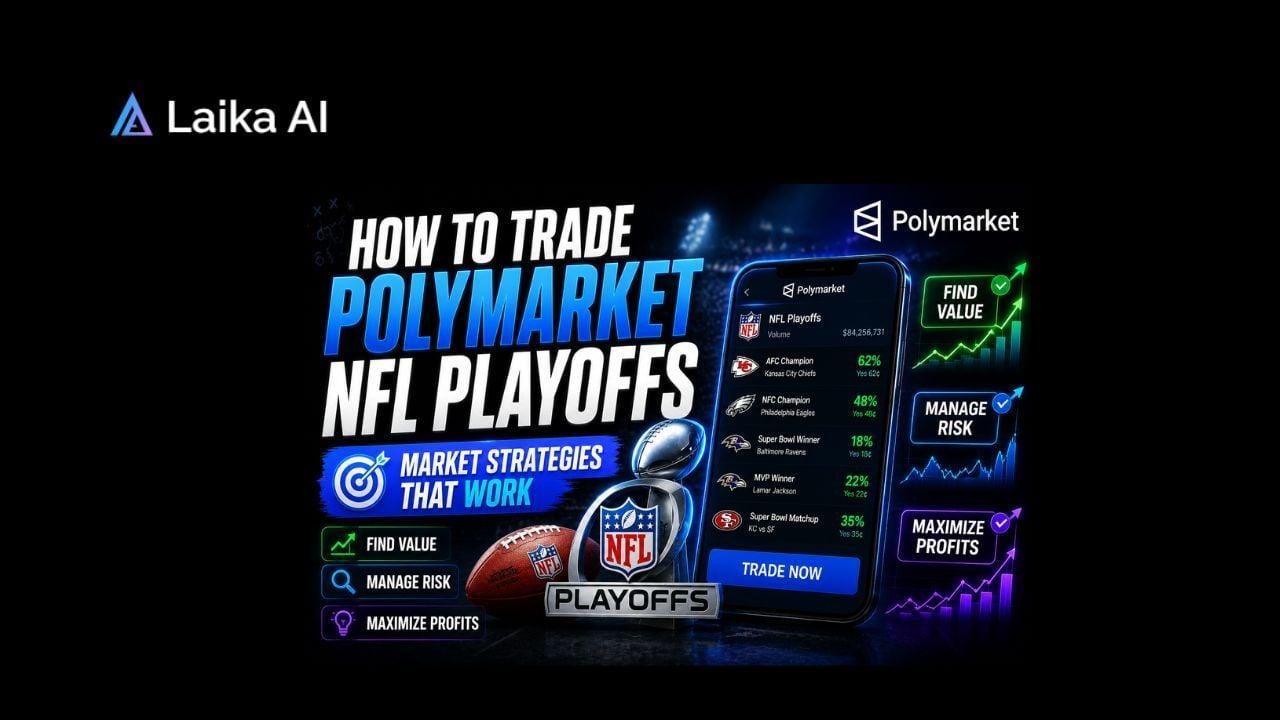
The polymarket nfl playoffs are not one market. They are four distinct market environments, each with different liquidity, different pricing efficiency, and different edges available to a prepared trader. A strategy that works on Wild Card weekend does not automatically translate to the Conference Championship. A position size that makes sense in the Divisional round is too large for the Super Bowl champion market. Understanding how each round behaves differently is what separates traders who extract consistent value from traders who apply regular season logic to January markets and lose money doing it. Within the broader polymarket sports markets guide ecosystem, the NFL playoffs represent the highest-volume, highest-stakes, and fastest-moving window of the entire NFL calendar.
The Super Bowl LX game market alone pulled $55.3 million in trading volume across market types. This article covers how each playoff round behaves differently, where prices move fastest, and the specific strategies that work in January.
What NFL Playoff Markets Are on the Polymarket?
Most readers arriving on this article know about the NFL Champion futures market. The full playoff market menu runs considerably deeper than that.
Game-by-game playoff markets
Individual moneyline, spread, and totals markets open for each playoff game. These behave like regular season game markets but with significantly higher volume and tighter spreads because more informed traders are active simultaneously. The Patriots vs Seahawks Super Bowl LX market generated $55.3 million in volume across all market types, more than most regular season games generate in an entire week. The nfl prediction market at its peak is a genuinely liquid instrument, not a novelty product.
Conference champion markets
Separate categorical markets for the NFC and AFC champion. Currently the NFC Champion market has the Los Angeles Rams at 16% and the Seattle Seahawks at 13% as frontrunners for 2027. These run all season and reprice dramatically after each playoff elimination. Unlike the game-by-game markets that resolve overnight, conference champion markets are long-duration positions that compound in value as each round narrows the field.
Parlay markets
Polymarket has offered multi-team parlay contracts, trading on two specific teams meeting in the Conference Championship, for example. Higher variance and lower liquidity than single-team positions, but useful for traders with strong directional views on how specific bracket matchups will develop.
The futures overlap
The NFL Champion 2027 market does not close during the playoffs. Each elimination replicates surviving teams in real time. A trader holding Seattle at 12% going into Wild Card weekend sees their position value shift immediately after each result. This overlap between the long-duration futures market and the short-duration game markets is where most of the playoff strategy actually lives. Managing both simultaneously requires understanding how they interact.
For the full NFL market landscape including regular season mechanics, moneylines, spreads, and player props, the polymarket nfl trading guide covers the complete picture.
How Polymarket Prices Move Round by Round
The playoffs compress a six-month market into four weekends. Each round behaves structurally differently and requires a different approach.
Wild Card (January, Week 1)
Six games over three days. Volume is high but spreads are still relatively wide compared to later rounds because 14 teams are still alive and the uncertainty is distributed across a wide field. Upsets here create the sharpest single-game repricing events of the entire season. A 5% underdog winning Wild Card sees its futures price jump three to four times overnight. The NFL Champion market redistributes eliminated teams' probability across survivors within hours of the final whistle, and that redistribution is fast, concentrated, and frequently irrational in the first two to four hours.
Divisional Round (January, Week 2)
Eight teams remain. This is the highest signal-to-noise round of the entire bracket. Teams that won Wild Card games have demonstrated real playoff performance, not just regular season results. Prices entering the Divisional round are the most informed they have been all season, but still carry 15 to 25% mispricing potential between Polymarket and Vegas on specific matchups. The Super Bowl LX analysis found this most clearly in the home field advantage gap: Denver was priced 2.6 percentage points below Vegas implied odds because Polymarket traders systematically underweighted home field advantage in the AFC playoffs.
Conference Championship (January, Week 3)
Four teams. The market narrows dramatically and uncertainty collapses. Edges are measurably smaller here than in earlier rounds. This is where overconfident position sizing damages traders. The correct approach is smaller positions with faster exit triggers, not larger positions simply because the field is narrower. The efficiency of the Conference Championship market is closer to the Super Bowl than to Wild Card. Treat it accordingly.
Super Bowl (February)
Two teams. Near-maximum efficiency on the champion market. The edge shifts almost entirely to props and specials, halftime performer markets, player props, broadcast mention contracts, where casual money creates inefficiencies that the champion market no longer offers. For the full breakdown of how prop markets work and where the resolution ambiguity risk sits, polymarket super bowl markets cover the complete strategy.
When to Enter Each Playoff Market
Three specific windows within each playoff week. Understanding which window you are in determines the quality of the entry available to you.
The pre-game window (Monday to Thursday before the game)
Lines open for each playoff game typically Monday or Tuesday. This is when the market is thinnest and spreads are widest. Value exists here, but execution is harder because you are trading against a less efficient order book where a single large position can move the price meaningfully. The correct use of this window is for traders who have done analysis before the line opened and want to enter before the crowd narrows the spread.
The injury report window (Wednesday to Friday)
Official injury reports are released Wednesday through Friday for playoff games. A significant injury to a starting quarterback or top defender moving from limited practice to did not practice between Wednesday and Thursday reports can move Polymarket prices five to ten percentage points before sportsbooks have adjusted their lines. The 24 hours after a key injury report is the single most consistent and repeatable repeating event in the entire NFL playoff calendar on Polymarket.
This is not about speed in the sense of milliseconds. It is about watching the right sources before ESPN alerts pick up the news. Official team injury reports, beat reporters covering that specific franchise, and practice observation accounts on social media consistently post material information 10 to 20 minutes before aggregators and mainstream sports media do.
The 48 hours before kickoff
Volume spikes as casual traders enter. Spreads tighten. The market approaches its most efficient state for that specific game. Entering here means paying near-fair value on a market that has already processed most of the available public information. This is when most retail traders buy in, and it is when most of the edge has already been competed away.
The core insight: the injury report window on Wednesday to Friday is the single most repeatable edge in playoff prediction market trading. It is not about predicting upsets. It is about being faster than the crowd after real information is released publicly. For the full entry timing framework, how to time your Polymarket entry covers the complete structure across every market type.
The MVP Race and Playoff Positioning
The NFL MVP market does not close when the playoffs start, and most traders do not realize the two markets are directly connected from a pricing perspective.
A quarterback's playoff performance in January directly affects his MVP probability on Polymarket even though the AP award is voted on regular season performance only. The crowd conflates playoff momentum with MVP likelihood and overprices quarterbacks who are playing well in January on the MVP market, regardless of whether the playoff games have any bearing on the award outcome.
This creates a specific trade. If your playoff market read says Team A's quarterback is likely to have a strong Conference Championship performance, his polymarket nfl mvp shares will likely reprice upward after that game regardless of whether the playoff performance materially changes his regular season award chances. Positioning in the MVP market ahead of a projected strong performance and selling into the post-game spike is a cross-market trade that most playoff traders are not running.
The reverse is also true. A quarterback who had a dominant regular season case but suffers a brutal playoff elimination sees his MVP probability drop on Polymarket in the immediate aftermath, even though the AP voters have already submitted their ballots. That drop is a buy signal if the underlying regular season case has not changed. For the full MVP market structure and where the edge sits across the full season, polymarket nfl mvp markets covers both the regular season and playoff dynamics.
Playoff Market Strategies That Actually Work
Four concrete, specific strategies grounded in how Polymarket NFL playoff markets have actually behaved.
The home field underpricing trade
The Super Bowl LX analysis found that Polymarket traders systematically undervalued home field advantage in the AFC playoffs by 2 to 6 percentage points compared to Vegas implied odds. Home field in the NFL playoffs is worth an estimated 3 to 5 percentage points in win probability, and it compounds across rounds for teams with top seeds who play every game at home through the Conference Championship.
The practical execution: check the gap between Polymarket probability and Vegas implied probability for home teams in each round. When Polymarket is pricing a home team three or more percentage points below the Vegas equivalent after stripping vig, that gap is historically a buy signal on the home team's futures position. The crowd is anchored on team quality and recent performance. The market is underweighting the structural advantage of playing at home in January in front of a full crowd.
The elimination cascade trade
When a high-probability team gets eliminated, their probability redistributes across survivors. It does not redistribute evenly. It follows the media narrative toward the next most talked-about surviving team, regardless of whether that team is the actual best remaining contender.
The 24 to 48 hours after a major upset elimination is when redistribution is most aggressive and least rational. The correct positioning is in the teams you believe are undervalued survivors before the upset resolves, not after. The market moves fastest in the hours immediately following a result. Being positioned before the cascade gives you the full benefit of the irrational redistribution. Entering after means you are buying into a price that has already partially corrected.
The injury report arbitrage
Official injury designations release on a known schedule across a known timeframe. Full practice, limited practice, did not practice, questionable, doubtful, out. When a key player moves from limited to did not practice between Wednesday and Thursday reports, Polymarket prices the news within hours. Traditional sportsbooks often take 12 to 24 hours to fully adjust their lines. The gap is narrow in absolute time but real in percentage points, especially in Wild Card and Divisional rounds where volume is building but not yet at the peak efficiency of Conference Championship week.
The edge here requires preparation before the injury report drops. Identify which players in each playoff game, if injured, would most dramatically shift the win probability. Monitor their practice status from the first available report on Wednesday. The traders who capture the injury arbitrage window are not reacting to the news. They are watching for it before it becomes news.
Fading the narrative favorite in the Divisional round
Media coverage during playoff week creates narrative favorites. Teams that won Wild Card games impressively, quarterbacks who looked unstoppable in the wild card round. Polymarket prices these narratives faster than the underlying performance data justifies because the crowd is anchored on two recent games rather than the full-season matchup analysis.
In the Divisional round specifically, the narrative favorite from Wild Card week is frequently overpriced by 4 to 7 percentage points on the moneyline relative to what the actual matchup data supports. Fading the biggest media darling in the Divisional round is one of the most documented systematic edges in playoff prediction market trading. The crowd is buying the story. The edge is in the gap between the story and the structural matchup reality.
How to find mispriced markets on Polymarket covers the systematic methodology for identifying these gaps before the crowd does. Common biases in prediction markets explains why recency bias, narrative anchoring, and media salience produce the same pricing errors in the same rounds every year.
Position Sizing for Playoff Markets
Most strategy articles skip this section entirely. Experienced traders know it is where most retail losses actually originate.
Resolution timelines are compressed
Every playoff position resolves within three to four weeks, not six months. That means your capital is either returned or gone quickly. Sizing appropriately for a binary resolution within 72 hours is structurally different from sizing for a market that runs through February. The faster the resolution timeline, the smaller the position should be as a percentage of total bankroll, because there is no time to recover from a single oversized loss before the round is over.
Playoff markets are more efficient
The extra scrutiny from higher volume and more sophisticated traders means there is less edge available per dollar risked than in September or October. Smaller position sizes relative to total bankroll preserve capital for the rounds where edge is actually present, primarily Wild Card and Divisional, rather than Conference Championship and Super Bowl where the market is most efficient and least mispriced.
Account for correlation across positions
If you are long Seattle in the NFL Champion market and you also go long Seattle on the Wild Card moneyline, your total Seattle exposure is the combined value of both positions. A loss compounds across both simultaneously. Most traders building playoff positions do not explicitly calculate their total correlated exposure before entering a game market in the same team they already hold in futures. That omission is the most common sizing error in polymarket nfl playoffs trading.
For the complete framework on bankroll management across Polymarket's market types including position sizing, correlation accounting, and round-by-round capital allocation, prediction market bankroll management covers the methodology in full.
Frequently Asked Questions
What NFL playoff markets are available on Polymarket?
Polymarket offers game-by-game moneyline, spread, and totals markets for every playoff game, conference champion categorical markets for the NFC and AFC, parlay contracts on specific matchup combinations, and the year-round NFL Champion futures market which continues repricing throughout the playoffs. Player props are also available for major playoff games. For the live current NFL market hub, visit the full NFL market hub on Polymarket
When do Polymarket NFL playoff markets open?
Game-by-game playoff markets typically open Monday or Tuesday of playoff week, around five to seven days before each game. Conference champion and futures markets are open year-round. Volume is thin early in the week and spikes sharply in the 48 hours before kickoff as casual traders enter. The injury report window on Wednesday to Friday is where the most actionable entry opportunities exist within each playoff week.
How does Polymarket reprice after each playoff round result?
Immediately and automatically. Once a game result is confirmed, eliminated teams resolve to $0 and surviving teams see their futures probability redistributed within hours. The NFL Champion market adjusts in real time as traders buy and sell based on the new bracket. The largest single repricing events happen within the first two to four hours after a major upset result, before the redistribution follows the next media narrative and compresses back toward rational pricing.
Can US residents trade NFL playoff markets on Polymarket?
The global Polymarket platform where full playoff market depth and volume exists is not available to all US residents. The US domestic Polymarket app offers limited single-game markets. US-based traders can access regulated NFL event contracts through Kalshi, though with a narrower market menu. Always check current platform access rules before depositing funds. The nfl prediction market depth available on the global platform is significantly greater than what is accessible through domestic US options.
What is the best NFL playoff market to trade on Polymarket?
Wild Card and Divisional round game markets offer the most edge because they are the least efficient relative to their volume. The market is most active but least rational in the injury report window on Wednesday to Friday of each playoff week. Conference Championship and Super Bowl champion markets are the most liquid but the least mispriced. Edge is harder to find the closer you get to the final, and position sizing should reflect that reality.
How are Polymarket NFL playoff odds different from sportsbook lines?
Sportsbooks build a vig into every line and adjust slowly after news events. Polymarket prices are pure crowd-sourced probabilities with no house edge, and they reprice in real time, particularly fast after injury reports and game results. The gap between Polymarket probability and Vegas implied odds on specific playoff matchups is where experienced traders look for value. The home field underpricing pattern documented in the Super Bowl LX AFC analysis is the clearest example of a systematic, repeatable gap between the two pricing systems.
The Bottom Line on Trading NFL Playoffs on Polymarket
NFL playoff trading on polymarket nfl playoffs is not one strategy applied across four rounds. It is four different market environments compressed into four weekends, each requiring a different approach to entry timing, position sizing, and exit discipline.
Wild Card and Divisional rounds reward traders who move on injury news, fade narrative overreactions, and position in undervalued home teams before the crowd catches up. Conference Championship rewards smaller positions and faster exits because the market has caught up to most of the available information. The Super Bowl champion market is efficient enough by game week that the real edge has shifted into props and specials where casual money creates the last remaining pricing inefficiencies.
The traders who lose money in the playoffs are almost always the ones applying regular season logic to January markets. Sizing too large because the field has narrowed. Entering too late because volume is high. Following media narratives rather than the gap between Polymarket prices and Vegas lines. None of those are prediction failures. They are process failures.
For everything running across NFL markets and the broader prediction market ecosystem, the polymarket sports markets guide is the complete picture.
Tracking how playoff probabilities move in real time across every round, every game, and every injury report is what Polymetric is built for. Live market intelligence so you are never the last one to know. Start at laikalabs.ai