The NFL MVP market is one of the highest-volume sports award markets on Polymarket, with search interest peaking at 3,600 per month in December and January when the race reaches its decisive stretch. The polymarket nfl mvp market for the 2026 season is already live, with Josh Allen leading early sportsbook lines at +550 on DraftKings while Polymarket has Jahmyr Gibbs as the current front runner at 20.6% in its low-liquidity early market. Those two facts together tell you exactly where the opportunity is. The broader polymarket sports markets guide covers every market type on the platform, but the NFL MVP is one of the few that rewards a prepared trader across a full six-month window.
This article covers how the market works, where the current odds stand, how to time your entry, and what separates traders who extract value from traders who follow the crowd in December when the edge is already gone. Even if you use sportsbooks, the NFL prediction market prices on Polymarket are worth watching because they reprice faster and carry no house margin.
What Is the Polymarket NFL MVP Market?
The Polymarket NFL MVP market is a categorical prediction market. Traders buy shares in individual players to win the AP NFL MVP award. Each player has their own yes/no contract, and each contract is priced in cents representing the implied probability of that player winning the award.
The mechanics are straightforward. A share priced at 17 cents means the market assigns a 17% probability to that player winning. If that player wins, each share pays out $1. If they do not, the share pays $0. You can buy or sell your position at any time before resolution at the current market price.
The market opens during the preseason and resolves the day after the AP NFL MVP award is officially announced, typically in early February at NFL Honors. The 2026 season market resolves on or around February 15, 2027. That is a trading window of approximately six months from September through February.
Multiple player contracts trade simultaneously. The 2026 market currently has contracts open on every realistic candidate: Josh Allen, Lamar Jackson, Drake Maye, Joe Burrow, Patrick Mahomes, Jalen Hurts, and a long list of others. The total implied probabilities across all players sum to approximately 100%.
The key framing difference from a sportsbook: Polymarket prices are probabilities, not odds. A player at 17 cents is not the same as a player at +600 on DraftKings even though both imply roughly 14% to 17% probability. Understanding that distinction is the foundation of the nfl prediction market approach. For the full mechanics of how these prices are constructed and why they move the way they do, how prediction market prices work is the right starting point. For everything else running on the platform for the NFL beyond the MVP market, the polymarket nfl trading guide covers the full picture.
Current Polymarket NFL MVP Odds for the 2026 Season
Figures pulled directly from Polymarket. Total market volume is currently low at this early offseason stage. Verify all figures at the live Polymarket NFL MVP market before making any trading decisions.
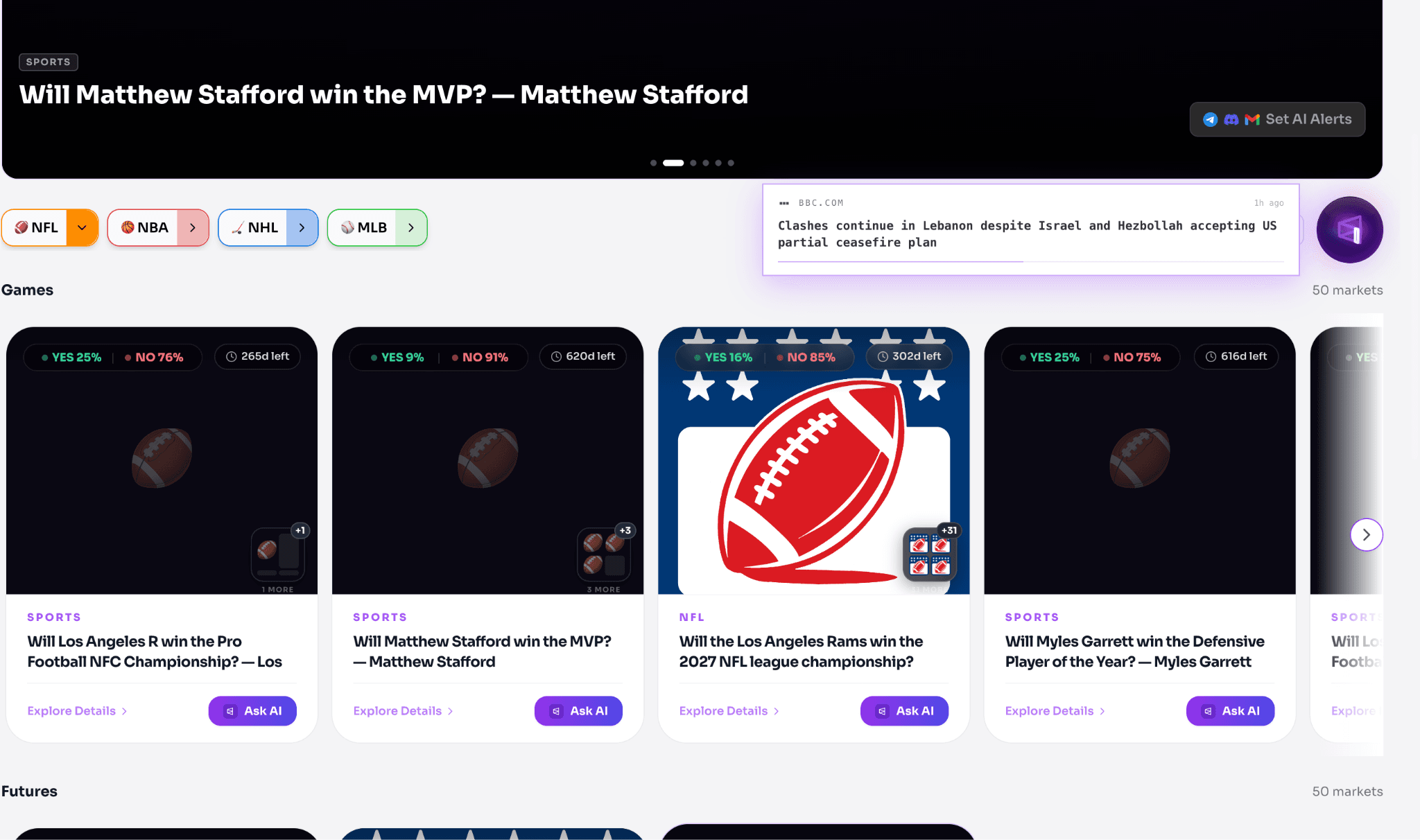
Two things stand out from this early market. First, running backs are unusually overrepresented at the top of the Polymarket market relative to sportsbook lines, where quarterbacks dominate. Gibbs at 20.6% on Polymarket versus Allen at +550 on DraftKings represents a stark divergence that either reflects genuine crowd intelligence or early market thinness being moved by a small number of traders. The total volume on this market is currently $4,021 as of early June. That is extremely thin. Second, the market is a new one and has not yet had enough volume to reflect informed consensus. This is the definition of the early entry window.
Polymarket NFL MVP Odds vs Sportsbook Lines
Sportsbook figures sourced from DraftKings and FanDuel opening lines.
The most important signal in this table is the Gibbs situation. Polymarket has a running back leading a market where sportsbooks have not even listed him in their top five. Two explanations are possible. Either a small number of early traders have moved a thin market to a position that does not reflect genuine crowd consensus, or the Polymarket crowd is pricing something about Detroit's 2026 offensive structure that sportsbook lines have not yet incorporated. At $4,021 in total volume, the former is far more likely. This is a known risk in early markets that the prediction market prices work framework addresses directly.
The Allen gap is more informative. Sportsbooks have Allen at 14 to 15% implied probability. Polymarket has him at 13%. A 1 to 2 percentage point gap on a thin market is not actionable, but it establishes that once the market builds volume toward September, Allen is the reference point around which both platforms will price.
The historical pattern is clear from the 2025 season: Matthew Stafford won the MVP at age 37 in what was widely considered a surprise result. Sportsbooks had him at +1400 in December, reflecting their anchoring on youth and familiarity. Polymarket had already begun redistributing probability toward Stafford earlier in December as his late-season stats strengthened. That repricing window, from +1400 to near-certainty in six weeks, is the clearest recent demonstration of what this market offers a prepared trader.If you want to track how NFL MVP odds are moving in real time without watching Polymarket manually, Polymetric gives you live market intelligence for active traders. → Start at laikalabs.ai
How to Trade the Polymarket NFL MVP Market
Step 1: Understand what you are actually buying
You are buying shares in a probability, not a fixed-return bet. That distinction changes how you think about position sizing. A player at 10 cents who you believe should be priced at 20 cents is a 2x return if you are right and a near-total loss if you are wrong. The correct position size for a 10% contract is smaller than the correct position size for a 40% contract, because the variance is higher at lower probabilities.
Start by deciding how much of your total prediction market budget you are comfortable allocating to a single NFL MVP position across the full season. The market runs for six months. You will have information in November that you do not have in August, which means you should leave room to add to a position as conviction builds, rather than deploying your full allocation in the first week of September.
Step 2: Read price movement, not just price
The absolute probability matters less than the direction it is moving. A player at 18% who was at 12% three weeks ago is a different trade from a player at 18% who was at 24% three weeks ago. The direction of movement tells you where informed money is going, while the absolute price tells you where the crowd consensus sits today.
Monitoring polymarket nfl trades on the platform shows you when a large position moves the market and whether that movement is sustained or reversed within 48 hours. A price spike that reverses within two days is typically a temporary move driven by one large position. A price increase that holds and builds over two weeks reflects genuine information aggregation. Learn to distinguish between the two before treating any price movement as a signal.
Step 3: Know when to exit
Most traders hold too long. By Week 16 or Week 17, the MVP race has usually narrowed to one or two players and the leader is priced between 60 and 80 cents. At that price, you are risking 60 to 80 cents to make 20 to 40 cents on a position that is already near-consensus. The risk-reward has inverted from what it was in September when you entered at 10 to 15 cents.
The exit triggers are specific. Exit when your player suffers a significant injury and the market has not yet fully repriced. Exit when a competitor has a statistically dominant three-week run and your player's probability compresses below a level where you believe the current price fairly reflects their season trajectory. And exit after the conference championship games when the polymarket nfl superbowl dynamic takes over and MVP conversation shifts entirely to playoff narrative. The MVP award is voted on by journalists who covered the regular season, but late-season performance and playoff success influence the final narrative even after voting closes.
When to Enter the Polymarket NFL MVP Market?
The insight the data makes clear is that the best edge exists in August and early September before the crowd arrives and before public money pushes consensus picks toward fair value. By December when volume peaks at 3,600 monthly searches, the market reflects a broad consensus that has already incorporated most of the available information. You are not paying for insight at that stage. You are paying for confirmation.
One specific dynamic worth understanding: the polymarket nfl playoffs convergence that happens in Weeks 14 through 18. When MVP frontrunners are on playoff-bound teams, their probability tends to hold steady or increase as media coverage intensifies. When an MVP candidate's team falls out of playoff contention in December, their probability drops sharply even if their individual statistics are strong, because voters historically discount players on non-playoff teams. Managing your position around this dynamic in November and December is a specific edge that most traders who enter in October have not thought through.
For the full entry timing framework across Polymarket's market lifecycle, how to time your entry on Polymarket covers the complete structure. For the methodology on identifying where the market is mispriced relative to true probability, mispriced markets on Polymarket is the right framework.
The Edge Most Traders Miss on the NFL MVP Market
Three specific angles grounded in how this market actually behaves.
Recency bias creates reliable sell signals
The crowd overweights the last two weeks of performance consistently. A quarterback who throws four touchdowns in Week 14 sees his Polymarket price spike beyond what the full-season statistics justify. This is a sell signal, not a buy signal. The market is relying on a two-game sample while the AP voters who determine the award are weighing a seventeen-game season.
The correct response to a recency-driven price spike is to assess whether the underlying full-season case has changed, not whether last week's game was impressive. If the answer is that the full-season case has not materially changed and the price has moved 8 to 12 cents on two games, that is a fading opportunity. Common biases in prediction markets covers why this pattern repeats reliably across award markets.
Liquidity asymmetry in August and September
The current Polymarket NFL MVP market has $4,021 in total volume. At that level, a single trader with $500 to $1,000 can move prices meaningfully. The Gibbs situation at the top of the current market is almost certainly a reflection of this dynamic rather than a genuine crowd consensus that a running back will win the 2026 NFL MVP.
The risk is that a new trader sees Gibbs at 20.6% and treats that as an informed signal. It is not. It is a thin market with low volume that has been moved by one or two early positions. The way to protect against this is to check total market volume before treating any Polymarket price as a consensus signal. Under $50,000 in volume, the price reflects early movers, not the crowd. Over $500,000 in volume, the price reflects genuine informed consensus. For the full framework on how to assess market depth before entering, how to find liquid markets on Polymarket covers the practical methodology.
The injury repricing window
When a top MVP contender gets injured, the Polymarket market replies within two to four hours of the official injury announcement. Sportsbooks typically take 12 to 24 hours to fully adjust their lines. The window between the Polymarket reprice and the full sportsbook adjustment is where most of the remaining edge in the late-season MVP market lives.
This window is narrow and requires being positioned in advance. The traders who capture it are not the ones reacting to injury news in real time. They are the ones who have already identified the second and third-tier candidates who would benefit from a frontrunner injury and are holding small positions in those players through November and December. When the injury breaks, those positions spike immediately. The crowd catches up within hours. By the time the sportsbook has adjusted, the window is already closing.
Frequently Asked Questions
1. What is the Polymarket NFL MVP market and how does it work?
The Polymarket NFL MVP market lets traders buy shares in a player winning the AP NFL MVP award. Each share price represents the market's implied probability of that outcome. The market resolves the day after the AP award announcement in February each year. Positions pay out at $1 per share for the winning player and $0 for all others. You can sell your position at any time before resolution at the current market price. If you are new to how these mechanisms work, what are the prediction markets that cover the foundation?
2. When does the Polymarket NFL MVP market resolve?
It resolves the day after the AP NFL MVP award is officially announced, typically in early February at NFL Honors. For the 2026 season, the resolution date is on or around February 15, 2027. Positions pay out at $1 per share for the winning outcome and $0 for all others.
3. How accurate are Polymarket NFL MVP odds compared to Vegas lines?
Historically, prediction markets and sportsbooks track closely but diverge around major news events such as injuries or sustained hot streaks. Polymarket tends to reprice faster than traditional sportsbooks because there is no line adjustment delay and no house margin to protect. The 2025 season showed Stafford moving from an afterthought to near-certainty on Polymarket before sportsbooks had fully adjusted their lines in the final weeks of December.
4. Can US residents trade NFL markets on Polymarket?
Polymarket's global platform has historically restricted US residents due to regulatory constraints. Following the December 2025 relaunch under CFTC oversight, US residents in eligible states can access Polymarket sports markets. A small number of states retain active restrictions. US traders in restricted states can use Kalshi, which offers regulated sports event contracts with comparable market structure.
5. What happens to my position if the MVP favourite gets injured?
The market prices immediately. Your shares drop in value as probability redistributes to other contenders. You can sell your position at the new lower price or hold if you believe the injury is minor and the market has overreacted. The two to four hours after an injury announcement are when the repricing is fastest and least rational. If you have strong information about the severity of the injury, that window is where the edge lives.
6. When is the best time to enter the Polymarket NFL MVP market?
August and early September offer the most value. Volume is low, spreads are wider, and the crowd has not yet pushed consensus picks to fair value. By December when monthly search volume peaks at 3,600, most of the edge has already been priced in. The best entry is a player you believe is underpriced relative to their true season trajectory, entered before the rest of the market reaches the same conclusion.
Should You Trade the Polymarket NFL MVP Market?
The NFL MVP market on Polymarket is one of the most consistently tradeable long-duration sports award markets available. It runs for six months, has a clear price evolution pattern that repeats across seasons, and rewards traders who enter early with a thesis rather than following consensus in December when the market is already efficient.
The 2025 season illustrated this as clearly as any recent cycle. Stafford at +1400 in December while Polymarket began redistributing toward him in late November. Traders who identified the full-season case in September or October were holding a position that the market spent two months catching up to.
The edge is not in picking the MVP correctly. It is in understanding when the polymarket nfl mvp market is mispricing a player relative to their actual season trajectory, and entering before the crowd reaches the same conclusion. That window opens every August. It closes every December.
For everything running across NFL markets and the broader prediction market ecosystem, the Polymarket sports markets guide is the complete picture.
If you want to track how NFL MVP odds are moving in real time without watching Polymarket manually, Polymetric gives you live market intelligence for active traders. → Start at Laika AI