The Super Bowl is the single largest prediction market event on Polymarket. The polymarket nfl superbowl champion market for Super Bowl LX crossed $688 million in trading volume by January 2026, making it the most liquid sports market the platform has ever run. No other sports event comes close. Within the broader polymarket sports markets guide ecosystem, the Super Bowl market is in a category of its own, not just by volume but by market depth, prop variety, and the length of the trading window available to prepared traders.
This article covers every market type currently available, current 2027 odds, how props and specials work, entry timing across the full season, and where the edge actually sits. One thing to understand before going further: this market is not just the biggest. It opens the moment the previous Super Bowl ends and rewards traders who position months before the crowd arrives in January.
What Super Bowl Markets Are Live on Polymarket Right Now?
Most traders who find Polymarket through Super Bowl coverage know about the champion market. Very few know how deep the full menu runs. There are four distinct market types currently live, each with a different liquidity profile and edge window.
NFL Champion 2027 (the main market)
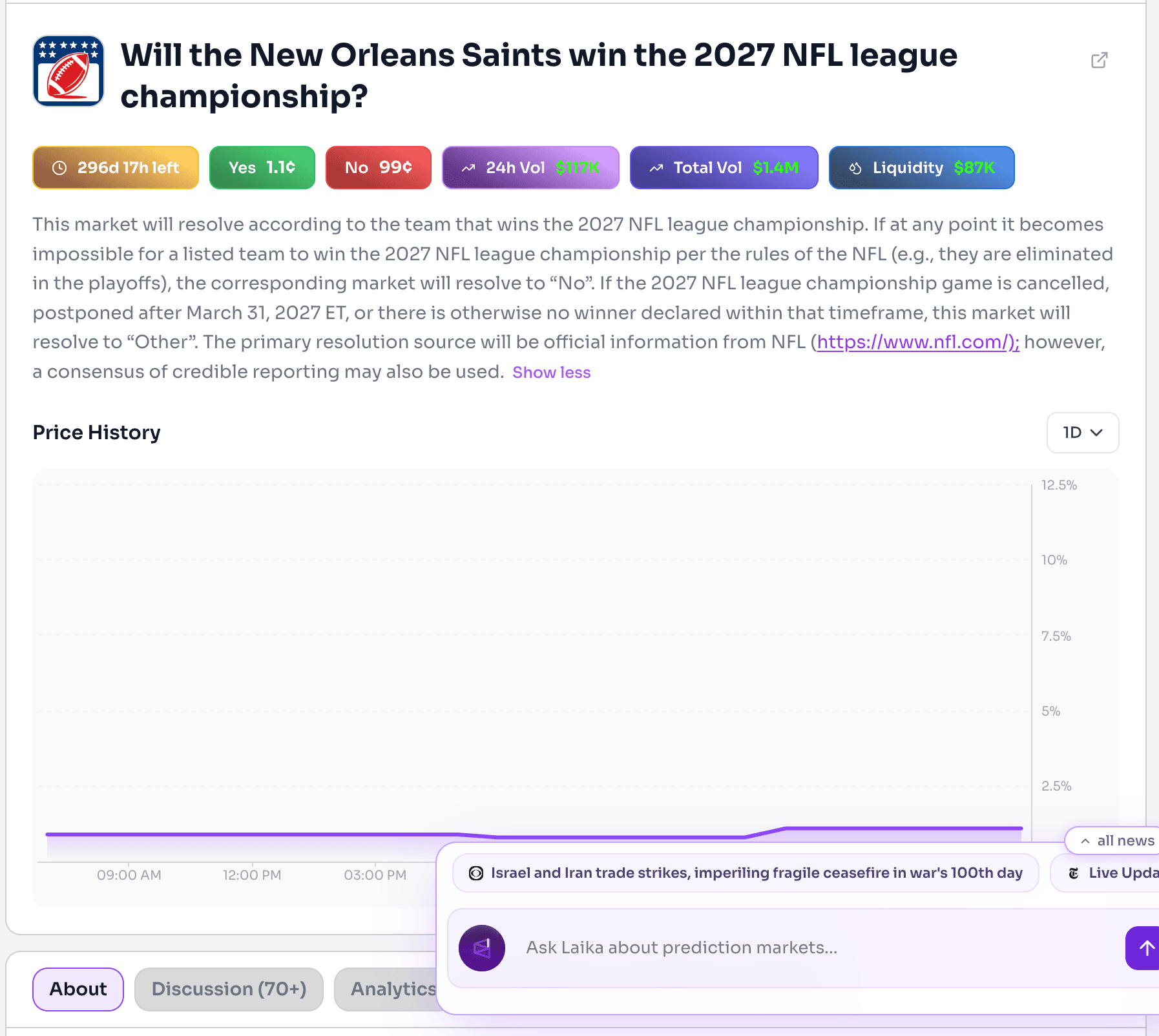
The flagship. A categorical market with one share per team, each priced as the implied probability of that team winning the Super Bowl. Currently $27.2 million in volume with the Seattle Seahawks and Los Angeles Rams both sitting at 10% as joint frontrunners. This is where the serious capital is concentrated and where the most informed trading happens across the full season.
Conference champion markets
Separate categorical markets for the 2027 NFC Champion and AFC Champion. The NFC Champion market currently has the Los Angeles Rams at 16% and the Seattle Seahawks at 13%. These run independently from the main champion market and are worth treating that way. Lower liquidity than the main market but more granular positioning for traders who have a strong conference-level view without a specific Super Bowl finalist thesis.
Division winner markets
Individual markets for each of the eight NFL divisions. Open early in the season with thin liquidity. The primary use case is hedging an existing Super Bowl position rather than standalone entry.
Prop and specials markets
This is where Polymarket separates itself from every sportsbook and from Kalshi. Over 293 active markets in the Super Bowl category covering halftime performer, winning state, broadcast mention markets, and player props. Polymarket has previously run markets on specific celebrities appearing in ads during the broadcast. These are genuinely exotic and covered in full detail in the props section below.
All four market types resolve at distinct points. The champion market resolves after the Super Bowl final whistle. Conference markets resolve after their respective championship games. Props and specials resolve on game night based on the specific resolution criteria stated in each contract. The resolution criteria matter more on props than on any other market Polymarket runs, which is why the props section covers them in detail.
For the full NFL market landscape beyond the Super Bowl, the polymarket nfl trading guide covers every active contract category and how they interact.
Current Polymarket NFL Champion 2027 Odds
Verify all figures at the live NFL Champion 2027 market before making any trading decisions.
The 2026 Super Bowl LX was won by Seattle, who beat the New England Patriots. Both Seattle and the Rams have carried their NFC West dominance into the early 2027 market pricing, which is why the NFC West currently holds a disproportionate share of total championship probability. That concentration is worth examining critically before following it.
At $27.2 million in volume on a polymarket nfl superbowl market that will run until February 2027, the current pricing still reflects preseason narratives more than actual performance data. The season has not started. This is the early entry window where the most mispricing exists relative to what the market will look like in November. The NFL prediction market at this stage is pricing storylines, not statistics.
For the full context on how these probability prices are constructed and where inefficiency tends to accumulate in early-season markets, how prediction market prices work covers the mechanics in detail.
Not every profitable trade comes from favorites. Some of the biggest prediction market opportunities come from mispriced long shots before public sentiment catches up. Ask Laika AI who has hidden value in the 2026 FIFA World Cup markets and compare odds across platforms instantly.
Polymarket Super Bowl Props and Specials: The Markets Most Traders Miss
The prop menu on Polymarket is where the platform's structural depth becomes most visible. Sportsbooks offer Super Bowl props. Polymarket offers a different kind of prop market, structurally different in ways that create both opportunity and risk.
Halftime show markets
One of the most traded prop markets on the platform. Traders bet $47.3 million on Kalshi's halftime market for Super Bowl LX, with a comparable Polymarket market pulling over $10 million in volume. A Polymarket user who opened an account the day before Super Bowl LX walked away with nearly $17,000 in profit after winning nearly all their Super Bowl halftime wagers, earning an ROI above 24%.
The critical thing readers need to understand about halftime markets: they resolve based on the platform's interpretation of what constitutes a performance. The 2026 Super Bowl created a genuine controversy when Cardi B made a brief cameo during Bad Bunny's set. Polymarket resolved it as a YES performance. Kalshi gave partial payouts. Two platforms, same event, different outcomes for the same traders.
Before entering any halftime market, read the resolution criteria in full before placing a position. This is the one market category on Polymarket where the fine print directly determines whether you get paid.
Winning state markets
Polymarket offers a market on which US state the winning team is based in. California currently leads at 48% given the Rams and other California franchises. Low research friction, reasonable liquidity, and a natural hedge against an existing champion position. If you are long a California team in the champion market, a YES position on California in the winning state market reduces your binary risk without requiring a second directional view.
Mention markets
Contracts on specific words or phrases the broadcast team will say during the game. Safety and MVP are typically the highest-priced terms given their base rate frequency in Super Bowl broadcasts. These markets are genuinely entertaining to trade, but liquidity is thin. Size positions accordingly. The risk of resolution ambiguity is higher on mention markets than on any other prop category because the platform must make judgment calls on audio clips.
The prop market depth on Polymarket is what makes polymarket sports betting structurally different from any sportsbook equivalent. DraftKings and FanDuel offer Super Bowl props. They do not offer halftime performer markets with $10 million in volume, winning state markets, or broadcast mention contracts. These market types do not exist on traditional platforms at any depth.
Polymarket Super Bowl Odds vs Sportsbooks
Three things to understand about how the two pricing systems compare on the Super Bowl.
The structural vig difference
Polymarket takes 0 to 2% on resolution only. Sportsbooks build 4 to 6% into every line. On a market that crossed $688 million in volume during Super Bowl LX, the dollar value of that fee difference is not abstract. Traders who positioned in September and held through January avoided the house edge on every position they held. That structural advantage compounds across the full six-month trading window.
The live comparison table
Figures for illustration. Verify current figures before trading.
When Polymarket probability and sportsbook implied probability diverge by more than 3 percentage points on the same team after stripping sportsbook vig, that gap is a signal worth investigating. The global polymarket NFL audience tends to price team quality more accurately than US sportsbook lines on NFC and NFC West outcomes specifically.
The US access distinction
The global Polymarket platform is where all the Super Bowl volume and prop depth sits. The US domestic Polymarket app had no Super Bowl markets at all until the Thursday before Super Bowl LX, when a single game-winner contract appeared with no props or futures. US traders need to understand this distinction before planning to trade the Super Bowl on Polymarket. US traders in restricted states can use Kalshi for regulated NFL event contracts, though the prop depth is significantly narrower.
When to Enter Polymarket Super Bowl Markets
The market lifecycle runs six months. Each window has different characteristics and different risk-reward profiles.
September (season opens)
The NFL Champion market has been live since the previous Super Bowl ended. When the regular season begins, volume picks up sharply. Early season pricing reflects preseason expectations more than actual performance data. Teams that dominated the preseason narrative but started 2 and 3 are oversold. Teams that go 4 and 0 against a soft schedule are overbought. This is where the most mispricing exists relative to actual team quality, and where the earliest informed entries are available.
October to November
The market becomes genuinely informative. Injury updates, divisional standings, and quarterback performance data start separating real contenders from narrative picks. The signal-to-noise ratio is higher in this window than at any other point in the season. Traders who built positions in September are watching for confirmation or contra-evidence of their thesis.
December (playoff picture forming)
Volume spikes aggressively. The market replicates around playoff seeding implications. Week 17 and 18 games where teams rest starters create short-term mispricing opportunities that resolve within 48 hours. The polymarket nfl playoffs convergence becomes the dominant price driver. Teams clinching first-round byes see probability move upward. Teams that fall to wild card spots see probability compress even if their actual championship case has not changed.
January (playoffs)
Each playoff result eliminates half the remaining contenders and redistributes their probability across survivors. The market after a Conference Championship result, with just two teams remaining, is the most liquid single window of the entire cycle and the least edgy. By this point the market reflects genuine consensus and most of the available edge has been competed away.
Super Bowl week
Volume peaks. Halftime and prop markets open in the week leading up to the game. This is when the exotic markets attract the most casual traders, which creates pricing inefficiencies in the less-followed props for traders who have read the resolution criteria that casual participants have not.
For the full entry timing framework across Polymarket's market lifecycle, how to time your Polymarket entry builds the complete structure. For the specific dynamics of playoff market repricing, polymarket nfl playoffs covers how probability redistributes across elimination rounds.
Super Bowl Market Strategy: Where the Edge Actually Is
Three specific and concrete angles grounded in how the market has actually behaved.
The narrative overreaction trade
Early in the season, Polymarket prices track media narratives closely. A team that wins its first three games by large margins and is featured heavily across sports media will see its championship probability priced above what the underlying data supports. The 2026 Super Bowl LX illustrated this precisely: both Seattle and New England were considered secondary contenders in preseason, yet one of them won the championship. The teams that dominated the October narrative were not the teams that played in February.
Fading the media narrative darlings in October, before they either prove the narrative correct or falter under real playoff-caliber opponents, is where a consistent edge has been found historically across Super Bowl markets. The crowd is anchoring on recent games and highlight reels. The edge is in the full-season structural case.
The elimination cascade
Each playoff game eliminates teams and redistributes their probability across survivors. When a 20% favorite gets knocked out, approximately 20 percentage points of total market probability redistribute across remaining teams. That redistribution does not follow team quality. It follows the next media narrative. The 24 to 48 hours after a major upset elimination is the fastest and least rational repricing window in the entire Super Bowl market cycle.
Traders who are already positioned in surviving teams benefit from this redistribution automatically. Traders who are watching for underexposed survivors, teams that advanced but are not receiving proportional media attention, have a narrow window to enter before the redistribution catches up to reality.
The halftime market trap
The Super Bowl LX halftime controversy is the clearest available warning about this specific market category. The same event produced $17,000 in profit for one trader and losses for others who bet on the same outcomes but encountered resolution ambiguity. The edge in halftime markets is not in predicting the performer. It is in reading the resolution criteria before entering and understanding exactly what the platform will and will not count as a performance, a cameo, or a guest appearance.
The trap is entering a halftime market based on the odds alone without reading the resolution rules. Resolution ambiguity on prop markets is not rare on Polymarket. It is a documented pattern across entertainment and specials contracts. How to find mispriced markets on Polymarket covers how to assess resolution risk as part of entry analysis. Common biases in prediction markets explains why most traders underweight resolution ambiguity as a risk factor.
Frequently Asked Questions
What Super Bowl markets are available on Polymarket?
Polymarket offers four main categories: the NFL Champion market, which is the flagship currently with $27.2 million in volume for 2027; conference champion markets for the NFC and AFC; division winner markets for all eight NFL divisions; and an extensive prop and specials menu covering halftime performers, winning state, broadcast mention markets, and player props. The prop menu has over 293 active markets during Super Bowl season. If you are new to how these mechanisms work, what prediction markets cover the foundation before trading any of them.
How much trading volume does the Polymarket Super Bowl market get?
The Super Bowl is the largest sports prediction market on Polymarket by volume. The NFL Champion market for Super Bowl LX crossed $688 million in total trading volume by January 2026. For comparison, the NBA Championship market sees around $234 million in peak volume. The halftime show alone attracted over $10 million in volume on Polymarket for Super Bowl LX. The 2027 champion market has $27.2 million in volume with the season not yet started, which indicates how quickly this market builds once regular season games begin.
When is the best time to enter Polymarket Super Bowl markets?
September through November offers the best entry window. After the season starts and real performance data is available, but before December when volume spikes and the crowd compresses prices toward fair value. Early season pricing still reflects preseason narratives rather than actual standings, injury patterns, and defensive matchup data. Traders who position in September and October on undervalued contenders capture the majority of the available price movement before the broader market catches up.
Can US residents trade Super Bowl markets on Polymarket?
The global Polymarket platform, where all Super Bowl volume and prop depth sits, is not available to all US residents. The US domestic Polymarket app offered only a single game-winner contract during Super Bowl XL week with no props or futures available. US-based traders can use Kalshi for regulated NFL event contracts, though the prop depth and champion market liquidity are significantly narrower than Polymarket's global platform.
How do Polymarket Super Bowl odds compare to sportsbooks?
Polymarket prices are pure crowd-sourced probabilities with no vig built in. Sportsbooks like DraftKings and FanDuel build a house edge of 4 to 6% into every line. On a liquid market like the Super Bowl champion, prices tend to track closely across platforms, but Polymarket consistently repricees faster after major news because there is no line adjustment delay and trading runs 24/7. The most consistent gap between the two appears in the weeks following unexpected playoff results, when Polymarket's crowd has already absorbed and priced the new information before sportsbooks have fully adjusted their futures lines.
What happens to my Polymarket position if my team gets eliminated in the playoffs?
Your shares resolve to $0 immediately once the team is officially eliminated. You can sell your position at any time before elimination at the current market price, which will already be falling to reflect the increased elimination risk as the game unfolds. Do not wait until the final whistle if your team is losing a must-win playoff game. Exit before resolution if you want to recover any remaining value. A position worth 8 cents with five minutes left in a loss is worth $0 five minutes later. The exit mechanic exists precisely for this scenario.
Is the Polymarket Super Bowl Worth Trading?
The Super Bowl market on Polymarket is the most liquid and most diverse sports prediction market on the platform. With $688 million in Super Bowl LX volume, it rivals participation levels in many financial derivatives markets. The champion market rewards traders who position early and think independently from media narratives. The prop market rewards traders who read resolution criteria carefully and size positions to match the liquidity of each specific contract.
The risk is real in both directions. The champion market is illiquid on specific longshot team outcomes, and the prop markets carry resolution ambiguity that the platform itself has been inconsistent about resolving. The halftime controversy during Super Bowl LX is the clearest documented example of that risk materializing for real traders with real positions.
The traders who extract consistent value from the polymarket nfl superbowl market are not the ones who enter in January when everyone is watching. They are the ones who were positioned in September when the market was still pricing preseason narratives and the September picks had not yet proven or disproved themselves.
For everything running across NFL markets and the broader prediction market ecosystem, the polymarket sports markets guide is the complete picture.
Tracking how Super Bowl probabilities shift across the full season, from September narratives to January playoff results, is exactly the kind of live market intelligence Polymetric is built for.