The 2027 NFL Draft is 11 months away and Arch Manning is already the market favorite on both sportsbooks and Polymarket. That is the nature of polymarket nfl draft markets. They run year-round, not just in April when the rest of the world pays attention. The broader polymarket sports markets guide covers every market type on the platform, but NFL Draft markets behave differently from every other sports prediction market on Polymarket because they resolve on a single night rather than across a six-month season. That single-night resolution changes the risk profile, the timing strategy, and the sizing discipline required.
This article covers which markets exist on Polymarket right now, how they are structured, where the current odds sit, and how to find edge before the April crowd arrives and competes it away.
What NFL Draft Markets Are Live on Polymarket?
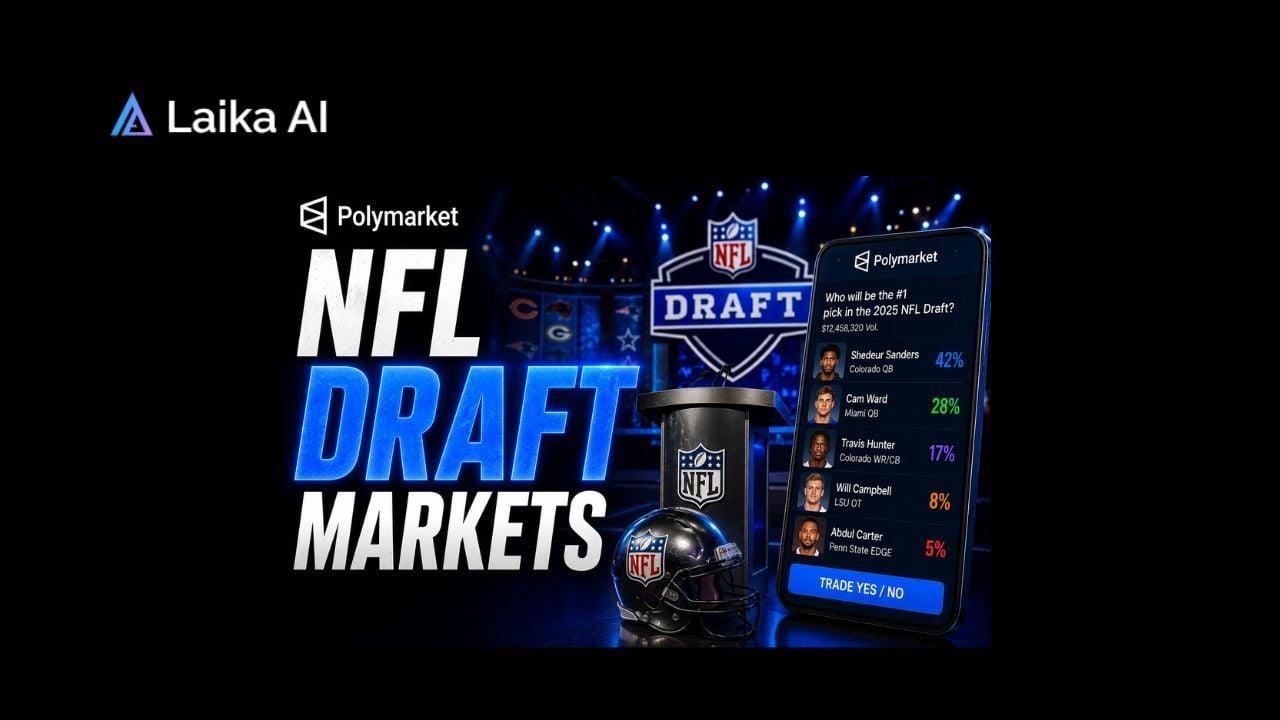
Most readers who land on this article know that Polymarket runs a first overall pick market. Very few know the full range of what is available. Polymarket currently hosts 45 active NFL markets with over $29.8 million in total trading volume, and the draft section runs four distinct market types.
First overall pick market. The most liquid NFL Draft market on Polymarket, open year-round. This is where Arch Manning sits as the current favorite. The market has a single resolution event on draft night and builds liquidity steadily through the college football season. This is the anchor market around which everything else in the draft section is priced.
Top pick position markets. Individual yes/no markets for specific players going in the top 3 or top 5. Each resolves independently on draft night based on the official selection. These run at lower volume than the first overall pick market but offer specific entry angles when a player's probability in a narrower range diverges from their first overall probability.
Position-based markets. Will a quarterback go first overall? Will an edge rusher go in the top 5? These markets run at lower liquidity than player-specific contracts, but they offer a more consistent edge because the crowd follows player names and narratives rather than positional base rates. The historical data is clean: 21 of the last 28 first overall picks have been quarterbacks, and that rate is rarely reflected efficiently in early-season pricing.
Team-specific markets. Which team drafts which player. These open closer to the draft when team needs and roster construction are clearer. Higher variance, thinner markets, and resolution that depends on both player performance and team decision-making simultaneously.
All markets resolve on draft night within hours of each official pick being announced. There is no ambiguity in resolution. The pick is made, the contract resolves, positions pay out. The polymarket nfl market structure for drafts is one of the cleanest resolution setups on the platform.
For the full NFL market landscape beyond draft markets, the polymarket nfl trading guide covers every active contract category. For how prediction market prices are constructed and why they move the way they do, how prediction market prices work is the right foundation.
Current Polymarket NFL Draft Odds: First Overall Pick 2027
Last updated June 2, 2026. Verify all figures at the live Polymarket NFL Draft market page before making any trading decisions.
The nfl draft odds 2027 as of early June 2026
Two things stand out in this table. First, all five current leaders are quarterbacks, which reflects the historical base rate accurately. Over the last 28 years, 21 first overall picks have been quarterbacks. The market is not being irrational by concentrating probability at the top on signal-callers. It is being historically informed.
Second, the Manning gap is worth noting. Sportsbooks have Manning at +225, implying approximately 30.8% probability. Polymarket has him at approximately 27%. That 4 percentage point gap is either DraftKings embedding vig into a tighter line or a genuine divergence in crowd assessment. After stripping sportsbook overround, the two are likely closer than the raw numbers suggest. Manning's late 2025 college season surge, going 7-1 in his final eight games at Texas, is what is driving his current market position on both platforms.
For historical draft pick data and official selection records, the NFL.com official draft history is the primary reference source.
Polymarket NFL Draft Odds vs Sportsbook Lines
Three things to understand about how the two platforms price draft markets differently.
What the gap actually means. When Polymarket has Manning at 27% and DraftKings has him at roughly 31%, the two are close enough that after stripping sportsbook vig the difference narrows to under 2 percentage points. That is not a signal. When two platforms diverge by 5 percentage points or more on the same outcome after adjusting for vig, that divergence is information worth investigating.
The 2026 draft cycle as a concrete example. Manning was originally the heavy favorite to enter the 2026 draft. When his grandfather confirmed Arch would not enter the 2026 class, odds collapsed from +200 to +850 across all platforms within hours. Traders who were positioned ahead of that announcement, watching family statements and team signals rather than waiting for a media report, had a 2 to 4 hour window before the market fully repriced. That window existed on Polymarket before the sportsbooks had adjusted their lines. That is the draft market edge in its clearest form.
Why prediction markets reprice faster. When nfl draft pick predictions from credible insiders break, Polymarket reprices immediately because there is no line adjustment process, no trading hours restriction, and no vig to recalibrate before the new price is offered. A sportsbook needs a human or algorithm to review the information, assess the risk to the book, and update the number. That process takes time. On a market where critical information can break at any hour, that speed differential is meaningful.
How to Trade Polymarket NFL Draft Markets
What you are actually buying
Each share is a probability stake with a binary resolution. If you buy Arch Manning at 27 cents per share and he goes first overall, your share pays out $1. If he does not, it pays $0. The structure is identical to every other Polymarket contract, but the single-night resolution changes how you should think about position sizing.
In a season-long MVP market you can exit over weeks as your conviction builds or fades. In a draft market you are building toward one night. Position sizing should be smaller than you would use in a season-long market unless you have strong conviction backed by sourced information. Keep positions proportional to your certainty level and leave room to add as the college football season provides real performance data through the fall.
Thin markets in the early months mean wider spreads between the buy and sell price. Entering in May or June means accepting those wider spreads in exchange for prices that have not yet been moved by the November and December crowd.
How mock draft noise moves prices
Mock drafts from major outlets including ESPN, The Athletic, and NFL.com move Polymarket prices within hours of publication. The critical distinction that most traders miss is that mock drafts are speculative narratives, not information sourced from actual team conversations. A mock draft from a media reporter is an educated guess built on publicly available information and the reporter's read of team tendencies. The actual pick depends on private workouts, front office dynamics, and draft-day trade scenarios that reporters do not have access to until the week of the draft.
When a high-profile mock comes out projecting a surprise pick at number one, the market replicates sharply on what is essentially someone's opinion. That repricing is usually an overreaction. The trader who understands that NFL draft pick predictions from media outlets are narratives and that Polymarket prices are capital-backed probabilities is already ahead of most market participants. Fading sharp mock-driven moves, particularly in the October to January window, is one of the clearest systematic edges in this market category.
Position management going into draft night
Draft markets compress rapidly in the 48 to 72 hours before the draft. Liquidity spikes, spreads tighten, and the market approaches its most efficient price of the entire cycle. Three specific decisions arise in this window.
When to lock in profit: if your position has moved significantly from entry and the remaining upside is 15 to 20 cents per share, the question is whether you are holding 70 cents of risk to make 20 cents. At that stage, a partial exit preserves most of the return while removing the binary downside of a single announcement going the wrong way.
Injury news in the pre-draft window: a prospect who suffers an injury at a pre-draft workout sees their probability drop sharply and often irrationally. If you believe the injury is minor and the market has overreacted, that drop is a buy signal. If you believe the injury is significant, the market may not have dropped far enough yet.
Holding to resolution: the only time holding a draft position to resolution is clearly correct is when the market is already pricing your pick above 75 to 80 cents and the remaining upside justifies the continued binary risk. Below that level, the risk-reward of partial exits is almost always more favorable than full holds.
When to Enter Polymarket NFL Draft Markets
The calendar tells you more than any volume statistic does. Each phase of the draft cycle creates a different type of opportunity.
Right now (May to June). The 2027 NFL Draft market is already live. Arch Manning leads the board. This is the thinnest liquidity window of the entire cycle, which means spreads are wider than they will be in January. That is a disadvantage for execution quality but an advantage for finding mispriced positions. There are fewer sophisticated traders active at this stage, which means prices are more likely to reflect early narratives than accurate probability assessments.
August to November (college football season). Volume builds steadily as the season reveals which prospects are performing to draft expectations and which are declining. Manning's performance across his full 2026 college season will be the single largest price driver for the entire first overall pick market. Every significant win or loss replicates his probability. Savvy traders who are watching the games rather than the mock drafts are active in this window and are building positions ahead of the December consensus.
December to January. The market becomes genuinely liquid. Senior Bowl preparations, injury updates, and team need analysis filter in. This is when the first overall pick market locks in its consensus. Early traders who positioned in June are either taking profit or adding to positions at this stage.
February (NFL Combine). Measurable data arrives: 40-yard dash times, bench press results, positional drills in front of scouts. Prospects who exceed physical expectations see probability jumps. Those who disappoint on measurables drop. This is the last major recruiting event before the draft, and it creates short windows where NFL draft first overall pick odds move faster than the broader market catches up.
March to April. The crowd arrives. Search volume for nfl draft odds peaks at over 1,000 monthly searches and nfl draft pick predictions hits 1,900 in April. By this point the market reflects a broad consensus that has already incorporated most of the available information. Entering here means competing for edges that earlier traders have already extracted.
The conclusion is direct: the best entry window is now through November, not when everyone is paying attention in April. For the full entry timing framework, how to time your Polymarket entry covers the complete structure. For identifying where the market is mispriced relative to true probability in early windows, how to find mispriced markets on Polymarket is the right methodology.
Where the Real Edge Is in NFL Draft Markets
Three specific and concrete angles. No generic advice.
The mock draft overreaction trade
When a major outlet publishes a mock with a surprise pick at number one, Polymarket replies within hours. The market treats the mock as a signal. It is usually noise. A mock draft from a media reporter is an educated guess built on public information. The actual pick depends on team strategy, private player workouts, and front office dynamics that reporters simply do not have access to.
Fading sharp mock-driven moves is one of the clearest edges in this market. The nfl draft first overall pick odds that emerge from a single ESPN mock are not the same quality of information as odds built from months of capital-backed trading across thousands of participants. When the mock creates a sharp move, the correct question is whether the mock reporter has access to information the market did not previously have. In most cases, the answer is no.
The news arbitrage window
The 2026 draft cycle gave the cleanest possible example. When Archie Manning confirmed Arch would not enter the 2026 draft, odds across all platforms moved within hours. Traders who were watching family statements and team signals ahead of that announcement had a 2 to 4 hour window before the market fully repriced. Following credible NFL insiders like Adam Schefter and Ian Rapoport in real time is the closest thing to a systematic edge in draft markets. The information is public when it breaks, but the speed at which you act on it determines whether you are positioned before or after the reprice.
The thin market problem
Draft markets outside the first overall pick are genuinely illiquid before December. A single large trader can move the price on a top-5 pick market by 5 to 10 percentage points during the summer. Do not mistake that price movement for crowd intelligence. It is capital, not signal. The way to protect against following a whale into a mispriced position is to always check total market volume alongside price whenever you see a sharp move in a less-traded draft contract.
Common biases in prediction markets explains why the crowd makes predictable errors in thin markets, including the tendency to treat any price movement as meaningful information regardless of volume context. For a framework on assessing whether a market has enough depth to trade without being adversely moved, how to find liquid markets on Polymarket covers the practical methodology.
Frequently Asked Questions
What NFL Draft markets are available on Polymarket right now?
Polymarket currently hosts NFL Draft markets including the first overall pick, individual top-pick position markets, position-based markets such as first quarterback selected, and team-specific draft markets. The first overall pick is the most liquid. For the 2027 Draft, Arch Manning leads the current market at approximately 27% implied probability. All markets resolve on draft night based on official pick announcements. If you are new to how these contracts work, what prediction markets cover the foundation.
When does the Polymarket NFL Draft market resolve?
NFL Draft markets on Polymarket resolve on the night of the draft, within hours of each pick being officially announced by the team. Resolution is based on the actual selection made, not pre-draft reports or media speculation. There is no ambiguity in the resolution criteria.
Who is the current favorite to go first overall on Polymarket?
As of May 2026, Arch Manning of Texas leads both Polymarket and sportsbook odds to go first overall in the 2027 NFL Draft, with approximately 27% implied probability on Polymarket. Behind him are Oregon QB Dante Moore at 20%, Notre Dame QB CJ Carr at 12%, South Carolina QB LaNorris Sellers at 7%, and Miami QB Darian Mensah at 6%. These odds will shift significantly through the 2026 college football season based on actual game performance.
Can US residents trade NFL Draft markets on Polymarket?
Polymarket's global platform has historically restricted US residents due to regulatory constraints. Following the December 2025 relaunch under CFTC oversight, US residents in eligible states can access Polymarket sports markets. A small number of states retain active restrictions. US traders in restricted states can use Kalshi, which offers regulated sports event contracts on some NFL markets.
When is the best time to enter NFL Draft markets on Polymarket?
The early entry window from May through November offers the best value. Liquidity is thinner but the crowd has not yet arrived, meaning prices are less efficient and more tradeable. By March and April when search interest peaks, consensus picks are already fully priced in and available edge is minimal. The best positions are built before the college football season reveals consensus, not after it does.
How is trading the NFL Draft on Polymarket different from sportsbook betting?
Sportsbooks offer traditional odds with a vig built into every line. Polymarket prices are pure crowd-sourced probabilities with no house edge baked in. You can also exit your position at any time before resolution by selling your shares at the current market price, which traditional sportsbook futures bets do not allow. The nfl prediction market structure on Polymarket also means the platform earns on fees regardless of who wins, so there is no structural incentive to limit profitable accounts.
Is the Polymarket NFL Draft Worth Trading?
The polymarket NFL draft market is genuinely tradeable year-round, not just in April when the broader public pays attention. The edge is concentrated in three windows: early positioning before the college season begins in August, news arbitrage during announcement cycles when critical information breaks before the market fully prices, and combine repricing in February when measurable data creates short-window opportunities.
The crowd that arrives in March and April brings liquidity to the market but takes away most of the available edge at the same time. If you are going to trade the draft, you need to be earlier than the consensus, not in it.
For everything running across NFL markets and the broader prediction market ecosystem, the polymarket sports markets guide is the complete picture.
Tracking how NFL Draft probabilities are shifting in real time across Polymarket is exactly what Polymetric is built for. Live market intelligence for traders who want to move before the crowd does. → Start at laikalabs.ai