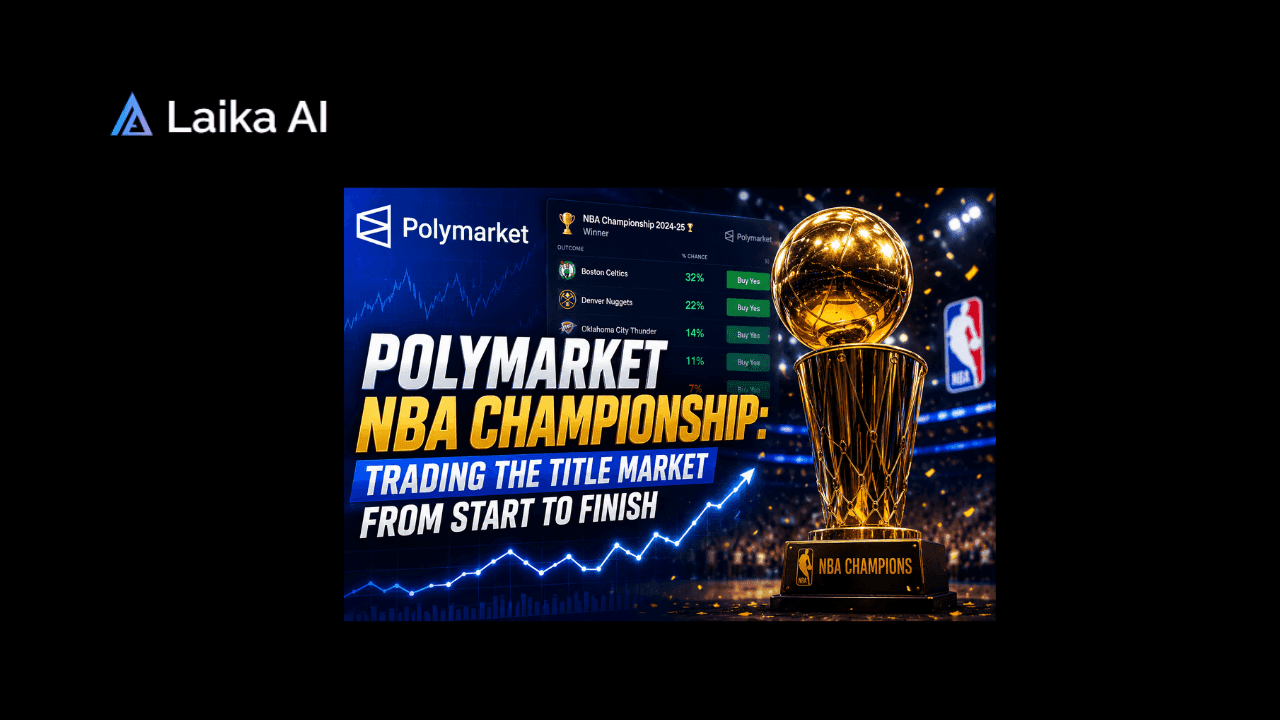
The 2026 polymarket nba championship market has crossed $533.7 million in total trading volume and the Finals matchup is still being decided tonight. Game 5 of Thunder vs Spurs is the highest-volume single sporting contract on the entire platform right now at $1.8 million in 24-hour volume, OKC at 61.5%, Spurs at 38.5% for the game. Meanwhile the Knicks sit at 88% to advance from the East. This is the biggest prediction market in sports and it has been running since October. Within the broader polymarket sports markets guide ecosystem, nothing else comes close in volume or strategic depth.
This article covers how the championship market works from opening day in October through to Finals resolution, where the price dislocation windows are, what the 2025-26 season teaches as a complete case study, and how to position for the 2026-27 market that opens in October.
Tracking how NBA Championship probabilities shift from October opens through Conference Finals is exactly what Polymetric is built for. Live market intelligence so you see the dislocation windows before the crowd does. → Start your journey with Laika's Polymetric Intelligence today at laikalabs.ai
How the Polymarket NBA Championship Market Works
For traders coming from a sportsbook background, the structure here is different enough to matter before you enter anything.
The NBA Championship market on Polymarket is categorical 30 individual yes/no contracts, one per team. Each contract is priced in cents representing implied probability. OKC at 47 cents means the market assigns a 47% chance to OKC winning the championship. A correct share pays out $1. An incorrect share pays $0. You can buy or sell your position at any time before resolution at the current market price.
The exit mechanic is the single most important structural difference between this and a traditional futures bet. Unlike a sportsbook position that locks you in until the season ends, Polymarket contracts are live throughout the entire season. A trader who bought OKC in October at 15 cents can sell in May at 47 cents and realize the profit without waiting for the Finals to resolve. That flexibility changes how you size, when you enter, and how you manage risk across a nine-month window.
The market resolves on July 1, 2026, based on the official NBA Finals result. All 30 team contracts trade simultaneously; you can buy multiple teams at once to spread risk or hedge an existing position. This is what makes it a genuine nba championship prediction market rather than a simple futures bet. The full mechanics of how probability prices are constructed are covered in how prediction market prices work. For everything else running on Polymarket for the NBA beyond the championship market, the polymarket nba guide covers the complete picture.
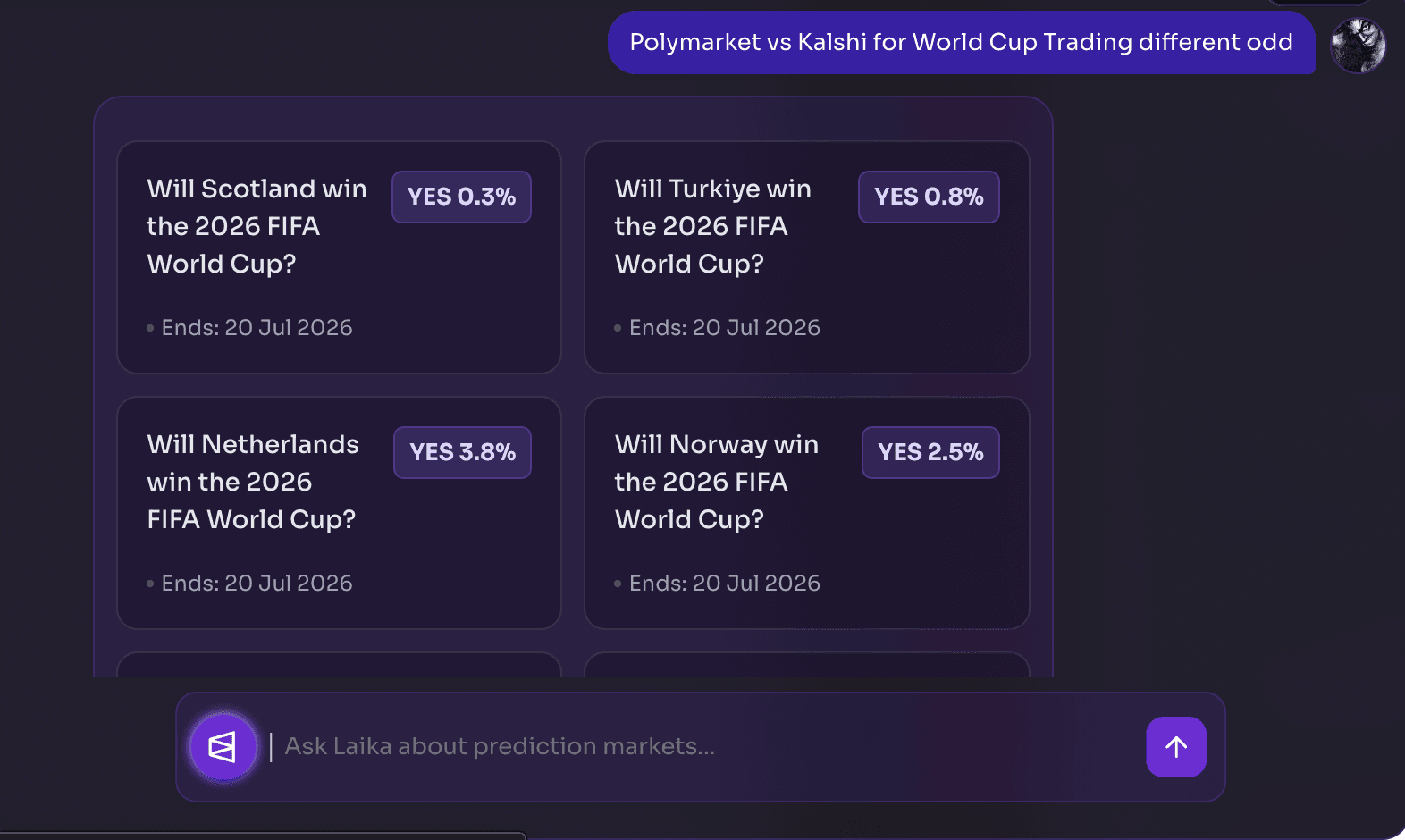
Current Polymarket NBA Championship Odds May 27, 2026
Last updated May 27, 2026. Verify all figures at the live 2026 NBA Champion market before making any trading decisions.
The polymarket nba championship market is reflecting one of the more compelling WCF structures in recent playoff history. The series has followed a perfect home court pattern every game across the first four won by the home team. Game 5 tonight at OKC's Paycom Center has the Thunder priced at 61.5% for the individual game, which is where the platform's highest single-contract volume is concentrated right now.
OKC's depth argument is not theoretical at this point. When Jalen Williams was ruled out for Game 3 with a hamstring injury, the Thunder's reserves outscored San Antonio's bench 76-23 in a road win, with Jared McCain posting a playoff career-high 24 points. That is what a 45 to 50% championship price is reflecting not just SGA, but the system behind him.
The Knicks at 88% to advance with a 3-0 ECF lead are effectively through. At under 3 cents, the Cavaliers are the tournament's most extreme price compression, a team technically alive but priced as if elimination is a formality.
The Full 2025-26 Season A Case Study in How the Market Moves
No other article can walk through this arc with live data. Here is the full season chronologically use it as the playbook for every championship market that follows.
October 2025: market opens
OKC opened as a mid-tier contender in October. The Boston Celtics and Denver Nuggets with Jokic anchored the early market, the previous season's narrative favourites. OKC sat at roughly 12 to 15 cents, representing genuine value for anyone who had watched the Thunder's offseason roster construction. The crowd was pricing last season's story. The market had not yet priced what the 2025-26 Thunder actually were.
This is the October pattern. Preseason prices are built on narratives, not performance data. Teams that quietly add depth additions, coaching adjustments, and player development are systematically underpriced because there is no recent media storyline driving their contract price upward.
February: trade deadline dislocation
The trade deadline creates the most predictable single repricing event of the entire season. Teams that make significant acquisitions see championship probability jump 5 to 15 percentage points within hours of a trade being announced. Teams that lose key pieces drop just as fast.
The traders who benefit most from this are not the ones reacting fastest to the announcement. They are the ones who were positioned in the acquiring team in November or December when trade rumours were circulating but not yet confirmed. Following credible NBA insiders in the weeks before the deadline is the closest thing to a systematic pre-deadline positioning strategy available.
April: playoffs begin
The first round creates the second major dislocation window. First-round upsets a top seed losing to a 5 or 8 seed redistribute probability sharply and irrationally. The surviving upset team absorbs less probability than its actual Finals chances justify because the crowd is still processing the narrative shock of the result rather than the basketball reality.
This is where polymarket nba markets are most readable for a prepared trader. The crowd is reactive. The edge is in the gap between narrative and reality.
May: Conference Finals
The market has narrowed to four teams. At this stage the championship market is more efficient, spreads are tighter, and the exit mechanic becomes more valuable than new entries. A trader long OKC from October at 15 cents is sitting on a position at 47 cents. The polymarket nba finals question at this point is not whether to enter it is whether to hold through the Finals or take the profit now.
The OKC case is the 2025-26 illustration in its clearest form. A trader who bought at 15 cents in October is sitting on a potential 3x return if OKC wins the championship. That return exists entirely because OKC was correctly undervalued in October relative to their actual probability and the market spent the next seven months catching up.
The Three Price Dislocation Windows Where Edge Lives
Three specific, documented windows when the championship market is reliably mispriced. Not principles. Mechanics.
October: narrative vs reality
The market opens anchored in preseason storylines: last year's Finals teams, the biggest offseason acquisitions, the most talked-about rosters. All of this is priced into contracts before a single regular season game has been played.
Teams that built quietly are systematically underpriced in October for one simple reason — there is no recent narrative driving their price. OKC in October 2025 is the clearest example from this cycle. The entry window is October. The return is realized in January through May. The crowd will eventually catch up to what the roster actually is. Your job is to be there before they do.
February: trade deadline
Every year on the trade deadline, the championship market processes significant news in a compressed window. The pattern is consistent enough to be treated as a systematic opportunity rather than a reactive one.
Position in the acquiring team in November or December when trade rumours are circulating and credible, but not yet confirmed. The trade announcement moves the price. You want to be holding before it happens, not buying into a 10-point jump after the news breaks. The rumour window is the edge. The announcement is when that edge closes.
Playoff bracket mispricing
When playoff seeding locks in after the regular season, teams with demonstrably easier first-round matchups should see championship probability adjust upward. In practice the market adjusts slowly. Casual traders focus on team quality, not matchup difficulty.
Checking the bracket against current championship prices for teams with favourable first-round draws is a systematic entry signal at the start of each playoff round. The adjustment happens — it just happens slower than it should, and that lag is where the value sits.
For the full methodology on identifying these windows systematically, how to find mispriced markets on Polymarket covers the structural approach. Common biases in prediction markets explains why the crowd is predictably slow at each of these three points and why the pattern repeats.
When to Enter and Exit the Championship Market
The decision timeline is more useful than a general principle. Here is exactly when to act and why.
Best entry: October
Lowest liquidity, widest spreads, highest potential return. Narrative-driven prices diverge most from actual probability in the first two weeks of the season. Accept wider spreads in exchange for maximum upside. The OKC 15-cent October entry now sitting at 47 cents is the 2025-26 illustration. This is the window that generates 3x returns. It opens once per season.
Second entry: post-trade deadline rumour window
The day after a major trade closes is not the entry point. The rumour window is — the weeks before the deadline when credible chatter is circulating but not yet a confirmed move. Position in the acquiring team before the announcement. Once the trade breaks, the price has already moved.
Exit decision: Conference Finals
By the time four teams remain, championship prices have compressed significantly. A trader long since October at 15 cents now at 47 cents faces a specific decision.
The remaining upside if the team wins is 53 cents per share. The risk of a single series loss is a near-total loss on the position. Partial exits selling half the position to lock profit while holding the remainder for Finals upside is how experienced traders manage compressed positions at this stage. It is not about prediction. It is about position management.
Do not enter at the Finals
Volume peaks during the NBA Playoffs and Finals. By the time two teams remain and the market is at its highest activity, the championship market is at near-maximum efficiency. OKC at 47 cents with two teams remaining is paying 53 cents of upside for what is essentially a coin-flip series. That risk-reward does not justify a new entry. The crowd has arrived. The edge has been completed.
For the full entry and exit timing framework across Polymarket's market lifecycle, how to time your Polymarket entry builds the complete structure.
The Finals MVP Market What Opens When the Matchup Is Set
Most readers will not know this market exists separately from the championship contract. It is worth understanding before the matchup is confirmed.
Finals MVP markets open once the NBA Finals matchup is set usually after the Conference Finals in late May or early June. Once OKC and the Knicks are confirmed as the Finals teams, which the current market strongly implies, a Finals MVP market opens featuring the key players from both squads.
The structural differences from the regular season MVP market matter here.
The Finals MVP market runs 3 to 4 weeks maximum. It is tied to one series, not an 82-game season. It replicates after every game. It requires active monitoring rather than patient positioning. Do not size it like a season-long trade; the duration, liquidity profile, and edge windows are completely different instruments.
The base rate insight that most traders ignore: the best player on the winning team wins Finals MVP approximately 70 to 75% of the time. SGA, if OKC wins, is the obvious market leader. But Finals MVP has been awarded to defensive anchors and role players in longer series creating genuine value on secondary players priced at 10 to 15% if you have a strong read on how the series plays out. For the full breakdown of how polymarket nba mvp markets are structured and where the edge sits, the polymarket nba mvp markets guide covers both the regular season and Finals variants.
Tracking the Whales Who Is Holding the Biggest Championship Positions
At $533.7 million in volume, the polymarket nba championship market has a small number of very large position holders. On Polymarket, all wallet activity is publicly visible on the blockchain. Tracking the largest OKC, Spurs, and Knicks position holders when they bought, at what price, and whether they have been adding or reducing is a legitimate signal layer on top of price movement alone.
A wallet that bought OKC in October at 15 cents and has been consistently adding through the Conference Finals is a more meaningful signal than a wallet that entered at 47 cents last week. The former represents conviction built over months of observed data. The latter represents recency bias, a trader reacting to a price that has already moved.
Whale wallets adding to a position during a price dip are a different signal from whale wallets that entered at the top and have not moved. The entry point tells you as much as the position size. For the full methodology on reading wallet data as a signal layer, how to track Polymarket wallets covers the practical approach.
Frequently Asked Questions
What is the Polymarket NBA Championship market and how does it work?
The Polymarket NBA Championship market is a categorical prediction market with 30 individual yes/no contracts, one per NBA team. Each contract is priced in cents representing the implied probability of that team winning the championship. Contracts pay $1 per share if the team wins and $0 if they do not. You can buy or sell your position at any time before the market resolves on July 1, 2026.
How much volume does the Polymarket NBA Championship market generate?
The 2026 NBA Champion market has generated $533.7 million in total trading volume as of late May 2026, making it one of the largest sports prediction markets ever recorded on the platform. The single highest-volume game contract right now is Thunder vs Spurs Game 5, with over $1.8 million in 24-hour trading volume. Individual conference finalist game markets routinely exceed $1 million in daily volume during the playoffs.
Who is the current favorite to win the 2026 NBA Championship on Polymarket?
As of May 27, 2026, the Oklahoma City Thunder lead at approximately 45 to 50%, followed by the San Antonio Spurs at 24.9% and the New York Knicks at 17 to 26%. The WCF is tied 2-2 with Game 5 tonight at OKC's Paycom Center. The Knicks lead the ECF 3-0 over Cleveland and are effectively through to the Finals at 88% probability to advance. These odds update in real time to check for current live figure
When does the Polymarket NBA Championship market open each season?
The championship market opens in October at or shortly before the start of the NBA regular season. It runs continuously through the regular season, trade deadline, and playoffs before resolving after the NBA Finals a trading window of approximately 8 to 9 months. Finals MVP markets open later, once the Finals matchup is confirmed after the Conference Finals in late May or early June.
Can US residents trade the NBA Championship market on Polymarket?
Polymarket relaunched for US users in December 2025 after acquiring CFTC-licensed exchange QCEX. US residents can now access Polymarket sports markets including the NBA Championship market in most states. A small number of states have active restrictions. Check your state's current status at Polymarket's availability page before depositing. Kalshi is the alternative for US traders in restricted states.
When is the best time to enter the Polymarket NBA Championship market?
October offers the highest-value entry window. Championship prices are anchored in preseason narratives rather than real performance data, creating the widest gap between market price and actual probability. The OKC Thunder's move from approximately 12 to 15 cents in October 2025 to 47 cents by late May 2026 illustrates the full range of value available to early entrants. By the time the Conference Finals begin and the market has $500 million in volume, most of that value has been competed away.
The Bottom Line on Trading the Polymarket NBA Championship
The NBA Championship market on Polymarket is the largest and most liquid sports prediction market on the platform. Nine months, three documented price dislocation windows October open, trade deadline rumour period, bracket release and a structure that rewards traders who enter early with a thesis over those who follow the crowd in May when the market is already efficient.
The 2025-26 season made this as clear as any cycle in recent memory.
OKC at 12 to 15 cents in October. The same position at 47 to 50 cents in May. A 3x return available to anyone who watched the roster construction in the offseason and entered before the narrative caught up. That move did not require prediction. It required positioning ahead of the crowd and letting the market do its job over nine months.
The Finals matchup is being decided tonight. If you are watching, the polymarket nba championship market is moving in real time.
For the full NBA championship markets hub and every live contract currently running, visit polymarket
For everything running across sports prediction markets beyond the NBA, the polymarket sports markets guide is the complete picture.
Tracking how NBA Championship probabilities shift from October opens through Conference Finals is exactly what Polymetric is built for. Live market intelligence so you see the dislocation windows before the crowd does. → Start your journey with Laika's Polymetric Intelligence today at laikalabs.ai